When you click on links to various merchants on this site and make a purchase, this can result in this site earning a commission. Affiliate programs and affiliations include, but are not limited to, the eBay Partner Network.
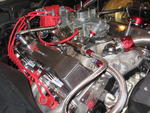
L82 Pushrod issue. I just had my short block back from my enfgine builder. The block and pistons checked out ok so I was able to use all of the original rotating assembly. The new cam is a comp 442X446 265X 269. I installed the E street Edelbrock Heads and am now trying to install the push rods and 1.5 roller rockers. The push rods are Comp 5/16 Magnum 7.750"
I have checked and verified TDC several times but when I get the push rod adjusted to zero up and down play that is where I have a problem. After a 1/4 " turn I screw down the set screw and it only goes in a couple of threads. I sustututed an original push rod that was maybe 1/16 or so longer but I still have a lot of threads showing from the set screws. From all indications it looks like I need longer push rods. I have read about the push rod checkers but I just get terribly confused . I did buy one but it is a 6.8- 7.8 before I started this insstall. It's a piece of crap threads are very loose so waste of time using it. I have photos and will try to download what I have.
You do not put longer pushrods in to clear things...you put the correct pushrod that is the right length to give you a proper "roll" along the tip of the valve.
Looks like your E-Street heads have the +.100 valve length, but I cannot be positive of this.....if it is, you will be into at least a 7.900 pushrod.....and the valve geometry checkers that are available that set on top will not work.
The only way to correctly check your pushrod length is with an adjustable pushrod......and light tension springs.....on a small block you only have to do one as they are an inline valve setup.
This is a flat tappet setup....you need to double check the specs on those springs and possibly the valves too.....flat tappet stuff not only doesn't need +.100 springs, the springs you have on it look way to aggressive, they appear to be hydraulic roller springs. The studs look too long too....
You need to take a step back and double check everything as I fear you have some mismatch going on.....
I have limited valve train time, just my own stuff. To my untrained eye the rocker body looks real close to the top of the spring. You can use a sharpie and mark the top of the valve and then cycle the engine and observe if the wear mark on the valve is centered. I would get a good checker and use it, the geometry has to be right. Not sure about the polly locks....
The one thing I do notice is the lack of assembly lube, even though you will prime it before starting, assembly lube is recommended...
Thanks Jebby,
I took my new heads to my engine builder before I installed them and he replaced them with 100 PSI springs just as you have suggested. So I guess I will have to learn how to set up the adjustable push rod and go from there. It's always a journey to get these old vettes back on the road. I just don't want to screw up this engine.
Thanks Again!!
Thanks Jebby,
I took my new heads to my engine builder before I installed them and he replaced them with 100 PSI springs just as you have suggested. So I guess I will have to learn how to set up the adjustable push rod and go from there. It's always a journey to get these old vettes back on the road. I just don't want to screw up this engine.
Thanks Again!!
If you have not fired up the engine....then you should be able to remove the head to install the light springs.....you can't check for rocker tip roll on the valve with hydraulic as they will plunge some when not under oil pressure.....
Though this is a lot of busy work to check it...the procedure is super easy.....just need the adjustable checker.....
I used the rod checker and it took a length of 7 13/16 (7.812") long to get the roller to ink out in the middle of the valve tip.After I close the lash on the push rod I have very little resistence on the nut. I do have more threaded area for the hex lock but that means it is the only thing that is keeping the rocker from letting loose. I am used to the standard stamped rockers with the lock nuts that are very tight. Am I over reacting or is there someting else that is wrong with this set up. I have built several small block chevys as a shade tree mechanic and never had any rocker issues but that was a long long time ago. Yes they did run and quite well at that..
Stock pushrods are 7.8 inches. You have 7.812?
Something seems amiss. Most aluminum heads require a longer pushrod to keep the geometry in specs without retainer interference.
Often on aluminum heads, the rocker stud machined pad is higher. That moves both ends of the rocker arm higher. You have to make up for the higher distance by DOUBLE / TRIPLE checking and ordering longer rods. Figure $120 for one piece style, moly set of 16 for guide plates.
Something doesn't look right down inside the rocker in one photo. Why is the rocker ball offset? If the rocker nuts refuse to tighten then they are most likely shot.
I see what is wrong.....those are short poly locks with a long set screw.......get a set of correctly made poly locs.....
If you didn't set the valve tip roller with light tension springs, the pushrod length is wrong......
Generally....and this is generally...you will be into a pushrod that is 7.850 on aftermarket heads......
Honestly, it would be terribly difficult for individuals here, on a forum, to accurately establish whether your "set-up" is proper or not. All anyone here would be able to do is to provide you subject for consideration, and in response to your specific observations and conclusions supplying possible confirmation or rejection of such. And in the end, the sum of input required by you (as your the guy there, hands on) would lead you yourself to the conclusion of proper or not before you posted the inquiry.
But in light of the "something to consider", first study up a little (lots of info on Google; just that some of it is bad!) on "proper" valve-train geometry. There are few different perspectives on the subject, and you seem to be aware of the intent for a centralized rocker arm roller to valve stem tip relationship, but this isn't the only consideration for a "proper" set-up, as in nearly anything there will be compromises. As a suggestion, look into the rocker-arm sweep radius value, which also presents a travel function in the relationship of the roller to valve stem end. I would suggest starting with the understanding of these two subjects and then just where does your set-up present itself in relation to them.
After you've optimized this perspective, then observe the related hardware that you have and its' ability to provide the proper mechanical fitment and function; if not, then one must ask if it would be appropriate to compromise the preferred geometry, in order to use what might be the improper parts?
An adjustable pushrod might be handy, but first I would just start with what I had, if only as this would only seem as perhaps an appropriate starting point; though the hydraulic lifter is a problem here, as the collapsing lifter plunger needs to be removed from the effort. If you happen to have an old mechanical lifter laying about, perfect, if you might have a hydraulic example, then pop the clip, remove the plunger, spring, valving, etc., and then shim the void until when you replace the plunger you've achieved the effect of a solid lifter, at the correct installed height (the clip will pop back in holding the plunger without excessive movement permitted); but do check that the two lifter heights agree (face of lifter to pushrod cup). Now apply your researched analysis process, and if then questioning the pushrod length you currently have, then maybe go ahead and purchase the adjustable checking pushrod.
B.T.W.: If following this process, and then if you selected some handy little washers/precision spacers (well maybe not so precision?) in the lifter body of your test lifter, then you could just start adding a subtracting washers, changing the lifter height (leave the clip out) as this would in effect be the same as having the adjustable pushrod (though not quite as easy to change distance of), and just measure the sum of the (precision) spacers/washers, and add or subtract from the existing pushrod length (saves buying something you might not ever use again?) And remember, that once deviating from the O.E.M.'s measurement the aftermarket generally addresses pushrod lengths in .050" distance changes (not mention what you'll receive vs. what was ordered), so this isn't truly so "precision" a measurement task.
C3 Fixer,
In your first post you mentioned you bought a pushrod length checker, but its maximum is 7.8 inches. You will need the next size longer. Something like 7.0 - 8.5
Looks like O' Reiley's web site has one, as does Amazon. They are only about $24. When you install it, put the adjustment nuts towards the lifter.
After doing your valve stem ink test. Back off the rocker nut and remove the checker w/o disturbing the length. You really need a measurement caliper for accuracy and not use a common tape measure.
Try to find prefabbed one-piece rods at Summit. They have common sizes for aluminum heads. (Custom lengths are expensive)
In the photos it appears you have the three-piece ball-end rods. Those ball-ends are a press fit. Will work fine for stock but any spirited driving will test those cheaper rods. The ball-ends will come out and destroy either the rocker arm and / or lifter. Not pretty.
Your rocker arm appears to be dangerously close to the valve retainer. Offhand I don't remember the minimum clearance, maybe 0.060 ???? but you could shove a feeler gauge between the two for reference. Longer pushrods will increase that distance, safely.
And remember, that once deviating from the O.E.M.'s measurement the aftermarket generally addresses pushrod lengths in .050" distance changes (not mention what you'll receive vs. what was ordered), so this isn't truly so "precision" a measurement task.
Scott.
Most aftermarket one piece pushrods are made by Trend in Detroit.....they are part of Diamond pistons too. They come in .025 increments and to me, it is important to get even the last .025 out of the measurement because, well, if somethings worth doing, it's worth doing right.....this is one of those "good practice" things that seasoned builders and mechanics do just for the hell of it.....it is oddly gratifying. I have used head gaskets on the wall and every once in a while someone will ask why I have them......because that is my .040 that I use as a shim to get the head to the right height.
When building an engine....I spend a lot of time on the valvetrain getting the guide plate shift correct and the pushrod length spot on.......I am as **** about it as bearing clearance......when you get it right, your valve train will live a LONG time......
To the OP...you need to remove the head and do this right.....with light tension springs.
Hopefully, and as it seems in most cases here, participating posters on this forum understand that the purpose of this TECH/PERFORMANCE section is to aid others in 'THEIR' endeavor, and to provide documented comment on a subject that may prove useful to others both currently and perhaps as being referenced in the future. And hopefully solely "one-upmanship" efforts, that don't provide positively for the solution that the O.P. is in search of should be understood as not productive and frowned upon.
Let's not have this turn into a forum of the level of so many other "KIDDIE" forums.







 '77 L82 Push Rod Issue