When you click on links to various merchants on this site and make a purchase, this can result in this site earning a commission. Affiliate programs and affiliations include, but are not limited to, the eBay Partner Network.
What is “too tight” for turning over a 383 stroker with no heads? 6” rods, 3.75 stroke, forged flat-top pistons.
When I installed my pistons I only sampled the ring gaps (as opposed to verifying every ring in every cylinder). When I turn the engine it takes a little over 40 ft-lbs or torque and its not consistent. At 42 ft-lbs the wrench will click for about 3/4 of the turn only, the other 1/4 clicks at about 35. This is with WD-40 on the walls. Molly rings, diamond bore. I read somewhere that it shouldn’t take more than about 30 to turn over a 350.
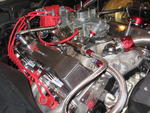
Is this normal? here’s a pic of where it was when I took these measurements. Also a pic of #6, I notice that it’s the only one that has this mark from the gap. Assembly is further along now but I thought I should ask now before I get too far, in case someone raises a warning flag. Any concerns?
I'm not certain how many engines I have assembled in my life. Certainly would have lost track back in my teens. I'm mid 60's now.
Never have I assembled an engine without checking every ring for correct gap. Never installed a piston in a bore without verifying proper clearance.
And NEVER in my life have I put a torque wrench on a crank to measure turning resistance.
It's smooth and right. Or it isn't. Period.
did you check your main and rod bearing clearances?
Is everything oiled up properly?
If you have any doubts at all. Take it back apart. Mic your pistons and bores. Check EVERY ring gap. Use plastigage on every rod and main bearing. Make certain everything is correct. Reassemble making certain to lube everything as you go.
then turn it over. Does it feel smooth?
There comes a point in engine building that you just accept what is in front of you and re-do it........back home in Detroit, there is a counterculture of beer drinkers that screw up something like this and want to ask 20 people about it until they get one "expert" that will tell them something so they do not have to take it back apart......well, you are taking it back apart.....40 ft/lbs. is too much to spin a completed assembly......this is slightly under what you torque the rod bolt to......that's a lot.
Who built it? Did they give you a sheet of measurements?
Anyway.....take the rods/pistons out and spin the crank with the cam and timing chain attached......how freely does it spin....? Pull a ring pack or two out and stick in a bore, square it up and measure the gap......make sure the oil expanders are inserted in the piston properly.
My take on engine assembly is to check and record everything and don't go too fast or get distracted.......turn your goddamn phone off LOL......distraction is the #1 cause of mistakes next to misinformation when it comes to assembly......I build engines in a 2.5 car garage like anyone else has......the trick is paying attention....and attention to detail....if you think it is wrong, measure it and find out if your gut is right....the numbers DO NOT lie......and they never will......but if you miss grinding one ring, the numbers didn't matter, did they? I have taught exactly two people in 30 years how to build an engine because 95% of society cannot pay that close attention to something like what I am showing them for hours on end.....and there are NO shortcuts.....
A lot of people have mentioned that I am pretty excitable when it comes to people screwing up engines or giving bad information and my reply is that how would you like it if you spent $6000 on a paint job to have it all come out in orange peel because someone told you to use the wrong reducer? You would scream right? But there sure are a LOT more engine "experts" than painting experts.....LOL....what's a person to do.....?
Most common causes of a tight assembly:
Main/Rod clearance too tight
Rod backward on the piston as installed...rod chamfer incorrectly installed backwards
Ring Gap not checked, rings butting together/oil ring expander incorrectly installed....
Thanks @Jebbysan and @4-vettes . Exactly what I needed to hear. I had a sneaking suspicion that I shouldn’t have skipped those steps. This is only the fourth engine I’ve built. first was a 4 banger in a Datsun 200SX at 17, second a 351W in my 71 Cougar when I was about 35, then 25 years later the 88 C4 I rebuilt last year. All were simply rebuilds, with somewhat stock replacements.
The past year has been filled with YouTube, books, and poring over the Internet trying to sort through opinion, experience, and best practices. And even my journey here has been learning to differentiate between those that actually pay attention and have real experience, and those that simply want to help me spend my money. (Have to give props… I’ve seen much less of the latter on C3… maybe it’s the average age of the members? LOL!)
And even some of the rigor recommended in places, it’s hard to tell what’s actually required and what’s superstition (“Always wear your lucky socks when you install pistons.”). So just saying I welcome your guidance. Thanks, I needed that.
Before you pull it apart...please post some pics looking down at all pistons where we can see valve reliefs on all 4 holes at once. Those pistons appear to have one large and one small valve relief and if so...you really have to pay attention to the middle 4 cylinders because the order of the valves is different with the two exhausts being side by side. Many an engine has been destroyed by mixing them up. If they are the same...it makes it easier.
The heavier assembly lube like ARP/Clevite will be pretty "sticky" and definitely make it harder to turn during assembly...but it's great stuff. Plain engine oil will be the slickest. I'm assuming you have standard tension rings in it....but as mentioned it's definitely worth checking end gaps and ring clearance in the grooves. I've seen some pistons where they grooves were shallower for specific rings and the rings didn't have any back clearance when installed. When you push the ring down into the groove, it should not protrude from the groove once it's bottomed out in the back of the groove.
Jebby mentioned several other easy to make mistakes...so just go slow and ck everything. As you insert each piston you can feel the rotational force increase.
Verify main/rod clearances so you know exactly what you have. I recently rebuilt an engine done by a high end mega $$$ shop they did for a buddy...and I was absolutely shocked with what they passed as good even when it was taken back to them after spinning 4 rods.
Jim brings a good point on the center 4 pistons........****, even I have to visualize it before I slip them in......high end JE/Wiseco/Diamond are this way too.......one big and one small valve relief......
Main bearing clearance is something I am freaking **** about......I want on a small block .003 on mains 1-4....#5 I like .0035.....which it usually works out that way on most cranks anyhoo.....I want .0025 on the rods too.....
When you control the clearances.....you know how much oil pressure it will have......unless you have incorrectly made parts.......these clearances with a Std. M55 pump give 25psi idle and 60psi at 5000rpm hot......with a nice easy rising and falling sweep of the gauge.....
If you have an Eagle crank......you almost always have to use 1X bearings for extra clearance.....on the mains, rods are a crap shoot......the last three Scat cranks I did (408 Fords).....they were on the money.....Scat has come a LONG way since circa 2005.....
Top ring should be .0020...second should be .0022....oil rings are what they are but check to make sure they are not misboxed, stick em in a bore.....even "pre-gapped" ring sets are way too small......I use a Proform Electric ring grinder.....the handheld ones work ok but take a while.......patience is key here......after grinding go inside out toward the edge lightly with a points file......just to kiss off any burrs......takes me 2.5 hours to grind a whole set with the electric grinder......but admittedly....I pause a lot....don't push it, that is how mistakes are made.......
I get $1000 to assemble an engine now......and for good reason.......I don't build one in a day.....short block one day, heads, intake valvetrain the next......after you build the short block, let your brain rest.....there is a lot going on.....start fresh with heads and valve train....
I see you prefer "looser" clearances on these things too.
Things move around and the old adage about " A little loose...you'll know it...a little tight...everyone will know it when it comes apart" is very true.
I'm very picky about measuring clearances also and once done, I never have to wonder as I assemble it.
I need to get one of those electric ring filers some day, I still pull up a chair and sit down with my ancient old "points file" my Daddy had!
I see you prefer "looser" clearances on these things too.
Things move around and the old adage about " A little loose...you'll know it...a little tight...everyone will know it when it comes apart" is very true.
I'm very picky about measuring clearances also and once done, I never have to wonder as I assemble it.
I need to get one of those electric ring filers some day, I still pull up a chair and sit down with my ancient old "points file" my Daddy had!
JIM
Loose clearances do a few things.....one, it keeps **** cool, lots of flow wisking away heat.....two, it won't trap a .001 particle and dig it into the babbit.....three, if you have a crank with a small amount of runout....it allows for that (you yourself mentioned that not long ago in a thread Jim....)............of course, the downside is more windage, but we are talking about 5800 rpm street engines.......and for a flat tappet cam, it loves it......four, thta wonderfull oil gauge sweep....goes right up and down with the tach.....a nicely balanced rise and fall, my target clearances are a nice controlled leak. Musi, Reher-Morrison and others shoot for these numbers too when they can......
BUT....there are some instances where I have to punt.......like the 406 Poncho I built in January....the crank had been cut 20/20....so there are no "21" bearing and I had .002 on the mains with a 3" main journal.....not optimal....but they started it last week and all is well......
Shunyun,
Maybe it's just me, but that bore looks drier than a popcorn fart.
WD 40 is ok for household door hinges. But really thin for what you are trying to accomplish.
I used to pretty much drown the pistons / rings in a 20w before installing.
Looks like that WD40 was removed on the very first pass of the rings. I see a crosshatch pattern but appears to be some scratches or scuff marks too.
Jim brings a good point on the center 4 pistons........****, even I have to visualize it before I slip them in......high end JE/Wiseco/Diamond are this way too.......one big and one small valve relief......
Main bearing clearance is something I am freaking **** about......I want on a small block .003 (GOOD) on mains 1-4....#5 I like .0035 (GOOD).....which it usually works out that way on most cranks anyhoo.....I want .0025 (GOOD) on the rods too.....
When you control the clearances.....you know how much oil pressure it will have......unless you have incorrectly made parts.......these clearances with a Std. M55 pump give 25psi idle and 60psi at 5000rpm hot......with a nice easy rising and falling sweep of the gauge.....
If you have an Eagle crank......you almost always have to use 1X bearings for extra clearance.....on the mains, rods are a crap shoot......the last three Scat cranks I did (408 Fords).....they were on the money.....Scat has come a LONG way since circa 2005.....
Top ring should be .0020...second should be .0022....oil rings are what they are but check to make sure they are not misboxed, stick em in a bore.....even "pre-gapped" ring sets are way too small......I use a Proform Electric ring grinder.....the handheld ones work ok but take a while.......patience is key here......after grinding go inside out toward the edge lightly with a points file......just to kiss off any burrs......takes me 2.5 hours to grind a whole set with the electric grinder......but admittedly....I pause a lot....don't push it, that is how mistakes are made.......
I get $1000 to assemble an engine now......and for good reason.......I don't build one in a day.....short block one day, heads, intake valvetrain the next......after you build the short block, let your brain rest.....there is a lot going on.....start fresh with heads and valve train....
Jebby
.0200 & .0220 did you type your numbers wrong above ? what you have is 2 thousands & 2 thousands 2 tenths which is less than the thickness of a typical human hair.
maybe I've been away from the machines to long = NOT
.0200 & .0220 did you type your numbers wrong above ? what you have is 2 thousands & 2 thousands 2 tenths which is less than the thickness of a typical human hair.
maybe I've been away from the machines to long = NOT
Jebby,
I’ve always heard and followed grinding rings inside to out. Why is that?
With a hand bench filer.....it is too easy to chip the moly coating on the outer edge as you are going in on a leading edge.....
My electric filer files up to down.....
So I took it down to the point of removing caps and testing with green plastigauge. Now a caveat: the balancer is installed so I didn’t remove the crank… there is StaLube assembly lube under the main journals here but I cleaned the top. Torqued to 70 ft-lbs.
I read:
1: .003
2: .0015
3: .0015
4: .0015
5: .003
2020 Corvette of the Year Finalist (performance mods)
2019 C3 of Year Winner (performance mods)
2016 C3 of Year Finalist
I found the green to be a bit on the tight side. I use a red and a green so I can compare those with actual measuring tools If you can i would get a cylinder bore gauge and a good micrometer, or just borrow a reliable one from a friend. Its more accurate and you dont want to be guessing with a spread like you think you have on your mains. Ive been trying to get my bearings right for over a month now. finally zeroing in on sets that work for my motor.
And I would use engine oil in your cylinders, WD is good to keep it from flash rusting but it isnt a lubricant








 Torque for turning a 383