When you click on links to various merchants on this site and make a purchase, this can result in this site earning a commission. Affiliate programs and affiliations include, but are not limited to, the eBay Partner Network.
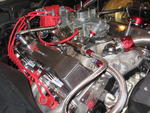
I'm helping a friend, with a small 355 engine "rebuild"
His heads cracked (883 heads, yes over heating)
When he took the heads of, he could see, that a lifter was toast, and we could the same for the camshaft, when it came out.
I have a few questions, that I hope you can help us with.
I've found a nice set of 71 heads (487) for a nice price here localy in Denmark.
My questions for the heads are, how much lift can they take?
I assume max. 0.500, if so, and he want a bit more, will a set of Z28 0.550 give a bit more, or can the valves not handle that?
Next is regardig DCR.
The below is his engine, since it steel heads, we would like 10:1, and DCR at 8, and Quench at 0.035
But as you can see here, DCR is 8.34, it that too much?
If so, I will find a camshaft, that closes later, to bleed of some compression.
If any have a cam suggestion, then please tell me, it a street car, not race, TH350, and 3.55 rear.
2020 Corvette of the Year Finalist (performance mods)
2019 C3 of Year Winner (performance mods)
2016 C3 of Year Finalist
ITs not the heads per se, its the spring, the spring pocket and the valve seal guide. If you get those machined for the proper spring and clearances you will be fine. You also need to run a motor oil with High ZDDP (zinc and phosphorous) to protect a flat tappet cam from going flat.
you will have to do some investigating for local oil but over here mobil1 15w50 is high in ZDDP as well as diesel engine oils
Are you using 4cc domed pistons or 4 are they flat tops with 4 cc reliefs? i only ask because you have it entered as -4cc dome. some calculators with calculate this as the opposite.
im running the retro roller version of that comp 218 -224 cam in my 355 now with like 5- 7cc flat tops and smaller chamber 64cc heads and .015 shim gaskets.. I can run 89 octane with a .039 quench
Last edited by augiedoggy; Jun 10, 2024 at 03:11 PM.
ITs not the heads per se, its the spring, the spring pocket and the valve seal guide. If you get those machined for the proper spring and clearances you will be fine. You also need to run a motor oil with High ZDDP (zinc and phosphorous) to protect a flat tappet cam from going flat.
you will have to do some investigating for local oil but over here mobil1 15w50 is high in ZDDP as well as diesel engine oils
BTW we do have Castrol classic oil here, and some other brands, for the same.
Yes, I noticed the negative number on the piston tops also.
Sometimes the piston manufacturer will list the volume of a dome.
Your Dynamic C. R. is spot on. The ideal range is 8.0 - 8.5. The closer to the high side, the more power. But more than likely premium gas will be in order.
(my 355 was in the 7.9 range, then I decided on 64 chamber heads)
I also noticed a 0.15 on deck ht. On avg, most pistons are 20 if not 25 in the hole. But no big deal.
Congratulations on doing all the math to come up with a decent D.C.R.
Static comp ratio is just a number thrown around at cars shows and really does not mean as much as Dynamic.
Yes, I noticed the negative number on the piston tops also.
Sometimes the piston manufacturer will list the volume of a dome.
Your Dynamic C. R. is spot on. The ideal range is 8.0 - 8.5. The closer to the high side, the more power. But more than likely premium gas will be in order.
(my 355 was in the 7.9 range, then I decided on 64 chamber heads)
I also noticed a 0.15 on deck ht. On avg, most pistons are 20 if not 25 in the hole. But no big deal.
Congratulations on doing all the math to come up with a decent D.C.R.
Static comp ratio is just a number thrown around at cars shows and really does not mean as much as Dynamic.
Thanks for the reply : )
Ok, so DCR is fine, but maybe will need better gas, that is no problem.
Anyone can tell me aboout the 487 heads, what can they lift?
And can Z28 springs help a bit here, if that is needed?
Not a big fan of 1.6 rockers.
Those rockers sell like crazy, to people that want more lift out of the cam they have chosen previously. And I get that.
But to me, it makes more sense to order the lift you desire right from the get-go. You are starting from scratch on a cam selection.
And 1.6 adds a little more unusual stress to the valve guides.
And if 1.6 rockers were the greatest ratio, why didn't all the SBC come with them in the first place?
Perhaps a better option and much safer on the valvetrain are the Comps 1.52 rockers.
Then order your lobe lift accordingly.
I am running 1.6 rockers with mine myself... They came with used heads I bought 12 years ago so ive been running them since. I do now also have a nice set of 1.5 RRs so I guess I should throw those in my dyno software as well and consider running them or maybe a combo of both myself with the new engine I'm building.
That first cam is pretty mild to me...not sure exactly what you want to do. I'm not a fan of any of the 'Xtreme" series of lobes in flat tappets. Pushing them to the edge with aggressiveness just speeds up issues. I prefer "old school" flat tappets.
I'll give you another reference point. my '32 Ford has a 383 in it. It cam with a Comp 270H flat tappet. Relatively mild single pattern flat tappet. It has twisted wedge aluminum heads on it. It will idle in gear with a solid lope with a stock converter...has great off idle response and pulls 6K+ RPM easily. It's not a super smooth cam as far as idle roughness...but drives fantastic. Probably not what I'd have picked for it....but now that I have it, I see no reason to change it. Now the car is light...but it only has 3.42 gears, 31" tall rear tires and a 4L60 O/D. Cruises along just fine on the highway.
The old 268H is a mild one similar to the 262 you picked...just a lazier lobe....but proven long life.
There's some great ones at Isky too. And Engle still sells good ones....I've used several solid rollers from them over the years with great results.
.............. it makes more sense to order the lift you desire right from the get-go.
..............1.6 adds a little more unusual stress to the valve guides.
Just out of curiosity, if one has the poppet valve transition in the same fashion, what difference does it make whether the effect is garnered from the camshaft lobe or via the rocker arm ratio, that as to having the effect of "more stress to the valve guides"?
Its my understanding that when changing the fulcrum geometry the longer ratio arm puts more stress on the inner portion of the guide.
Stands to reason, otherwise someone could use a 1.7, 1.8 with no end in sight. (or until the valve hits the piston)
GM engineers spent years perfecting the perfect rocker-arm for longevity. Its the aftermarket engineers that begged to differ.
So, in summary. If someone wants more lift at the valve, why not just buy more lift at the lobe using the original geometry?
Its my understanding that when changing the fulcrum geometry the longer ratio arm puts more stress on the inner portion of the guide.
The engineering from the fixed fulcrum point of the rocker arm to the pivot juncture of the valve stem tip doesn't change; so said valve movement value being equal, in a comparison of how it was accomplished (cam-lobe vs. rocker-ratio) as to guide wear doesn't matter.
Well it does. And one should really think about what changing the original ratio to a 1.6 can do. You have to double check, triple check more than normal about the geometry.
Here is a list of possible issues with 1.6 rockers and was found on another web site.
1. Rocker to retainer contact.
2. Piston to valve interference.
3. Damage to cam lobes.
4. Bent pushrods.
5. And last but not least,excessive valve guide wear.
It is imperative that the cylinder heads have elongated pushrods slots designed for 1.6 rocker ratio. (not all cyl heads do)
If std pushrod holes are present in the head, constant rubbing will take place resulting in #4 above and sometimes # 3.
While all that is interesting.
I'll add my 2 cents from real world experience in a street driven, sometimes pounded on the track, (road track, not drag) car.
Many years ago I thought it would be a good idea to put in 1.6-1 rockers to get a touch more out of my basically stock engine. Factory heads, factory L82 cam. Did it make a difference? Ehhh, maybe a tad.
It ran fine for years and years however.
About 7 years ago or so it was time to rebuild my now fairly high mileage and old engine. On went new Aluminium heads, etc.
I didn't save those original 1.5-1 rockers. And my 1.6-1 rockers were in excellent condition. So I chose a cam and valve spring combination based on my 1.6 rockers. I personally don't see a problem with that.
Well, in the last 7 years I've pounded on her pretty hard at times! (It is a toy after all), and gone on some fairly long trips, etc.
Running fine. No issues whatsoever.
Is there more side loading on the valve guides? Yes, perhaps. How much more than stock? I really don't know. If I wear out guides in 80 thousand miles instead of 100 thousand miles is this really a great concern for me? No, not really.
Did my pushrods rub with the factory heads? No.
Do my pushrods rub with my aluminium heads? Yes, they have guide plates and are designed to rub on them. Have I ever bent a pushrod? No.
All up I've been running these 1.6-1 rockers for about 25 years without issue. Go figure, I must be one lucky guy!
I think you missed it........................ "so said valve movement value being equal".
So in reality, it doesn't, as far as valve guide wear goes anyway (original subject of concern); but this statement also would cancel any change in the relationships in the items listed #1 through #5). Just think about it.
You just think about it. The valve movement will not be equal. Obviously a 1.6 will open the valve farther.
If you change the ratio, of course it's going to affect the side loads on the valve-stem & guide.
I don't make this chit up. I do research. Try it sometime.






 Camshaft, DCR to high?