When you click on links to various merchants on this site and make a purchase, this can result in this site earning a commission. Affiliate programs and affiliations include, but are not limited to, the eBay Partner Network.
Replaced long tube headers (they were in terrible shape) and installed patriot “tight tuck” headers that arrived with Corvette central system. All good looking pieces in this kit by the way, hopefully the rest of the fit will go well. As seen in the photo, the starter and flange of header touch by the slightest of margins. My question is if anyone has crossed this bridge already and what did you? Leave it? Grind a little material off the header and exhaust pipe flange for clearance? Or is a mini starter going to make more sense?
was the clearance this close with original stock manifold?
I’m leaning toward grinding a little clearance on the exhaust components and moving on but wanted to see if someone had a bit of wisdom for me.
The starter that you have is part of the 10MT family of starters and is also the "High Torque" version which is about an inch longer than the standard 10MT starter. The starter that Speedreed8 is referring to is a PG260. While the PG260 is a decent piece it uses a plastic ring gear that's prone to failure. I like the Powermaster 9100 starter.
I am using high compression in my 427 and it was very difficult to spin it over quickly enough with the factory starter. I switched to a gear-drive starter that was designed for engine with up to 18-1 compression and that device spins the engine up perfectly.
With modern MSD 6AL boxes you can "pull the timing" from the engine while it is cranking. I used an older MSD box that was designed with similar software allowing you to pull the timing while cranking. This feature is awesome when you use a higher compression. It allows the starter to turn over even faster while cranking the engine. Once the engine starts then the timing returns to the original settings. Using this system the engine starts very quickly and runs great, even when hot. I was so glad when I saw that Holley uses this system to pull timing while cranking in the software for the Holley EFI system I am using.
The long tube headers on my 427 do not heat up the mini-starter or cause it any ill effects. The "Tight Tuck" exhaust manifolds might not clear the starter as easily and this will require you to switch to a mini-starter. With the tight tuck exhaust manifolds you might want to wrap the mini-starter to protect it from the heat.
You mentioned "Grinding a little material off the header and exhaust pipe flange for clearance?". If you need to dimple the exhaust pipes that is one thing, I never grind on the tubes used in the exhaust manifold as they are generally fairly thin tubing. The Flange is a whole different matter.
I would recommend that you buy a gear drive type Mini-starter with as much clearance between the starter and the exhaust manifold and then if needed you wrap it in some sort of heat protection.
According to fly skids up the pg260 has plastic gears, this is incorrect, I have been running this setup for over 14 years and have never had any issues.
According to fly skids up the pg260 has plastic gears, this is incorrect, I have been running this setup for over 14 years and have never had any issues.
Have you ever taken one apart?? I guess not. I've worked in a auto electric shop rebuilding starter and alternators so don't tell me what the internal components are made of.
Thanks, for all the helpful responses! Much appreciated. I'll likely go the way of replacing the starter. I'll research some of the suggestions here. Thanks. When I get a new starter installed, I'll update with a picture.
First of all not a guru or a bubba. Secondly I am the type that looks for solutions to a problem. If this set up were on my ride I don't see the harm in some minor clearance on the flange(s). Seems to make more sense than changing the starter. You can also spray some silver paint into the cap and brush a little touch up to the flanges.
One more thing I like to point out. From looking at the OP picture the starter rear support bracket is missing. That bracket helps with flex when cranking thus keeping the armature coming in contact with the field magnets. That alone can cause slow cranking when hot.
The bracket is also another GRD source, right to the block itself.
And to the O.P.
AJT84,
Quick question. I assume both shorties are "twins"?
Does the drivers side header have the flange welded exactly like the one in the photo?
Or is the flange in a different orientation?
Last edited by HeadsU.P.; Feb 20, 2025 at 06:46 PM.
The bracket is also another GRD source, right to the block itself.
And to the O.P.
AJT84,
Quick question. I assume both shorties are "twins"?
Does the drivers side header have the flange welded exactly like the one in the photo?
Or is the flange in a different orientation?
They appeared to be twins, but I’ll take a close look at the flanges tomorrow and see if there is a difference in orientation.
You might get lucky, and the other header flange is turned ever so slightly before welded.
I see this happening more often on full length header collector flange.
Grind it off enough for clearance. If starter lays down sometime. Make sure you get a shorter body on the next one. Get that brace on there. There are different braces also. Also as said previously, flanges do vary some. May not be 100% to some, but it's cheaper, and the project moves along.
The starter that you have is part of the 10MT family of starters and is also the "High Torque" version which is about an inch longer than the standard 10MT starter. The starter that Speedreed8 is referring to is a PG260. While the PG260 is a decent piece it uses a plastic ring gear that's prone to failure. I like the Powermaster 9100 starter.
Well, I thought the Powermaster 9100 looked like an good option. But of course, the plot thickens. Pulled out the old starter and looking at the replacement I'm not discovering that my starter has an S and R terminal. The new starter does not have a provision for the R terminal. This car runs the points ignition, so it seems that R terminal may be important. Does anyone have advice on where to go from here?
There seems to be a diode kit from Powermaster available to put inline with the R terminal wire? Is this the way to go? Should I return the starter for something with the correct terminal setup, if available? Anyone have any advice. I'm also sending an inquiry to Powermaster tech support.
Some where along the way you should have been asked what yr Vette.
I believe '75 and earlier had the points IGN system? That came with different starter wiring.
Another option would be to swap out the solenoid only. I know its brand new, but may not be the Heavy Duty unit.
The H.D. have a brown end cap indicating its ceramic, which handles the heat better.
I installed the mini starter with the diode kit for the R terminal wire, and now I’ve got plenty of room. Gave it a quick test and it seemed fine. Moving on to exhaust..








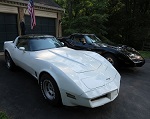





 70’ starter and header, gurus wanted.