



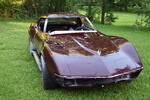



Resurrecting my 68 Corvette

Thread Starter
Advanced


Joined: Jul 2017
Posts: 84
Likes: 71
From: Texas City Texas
 Resurrecting my 68 Corvette
I haven’t posted in a good while- nothing really to post!
Just to refresh, I modified my 68 Corvette into basically a track car (1/4 mile and standing mile) in 2018 and raced in many events until late 2022. The car has all ride tech suspension with coil overs, Willwood 4 wheel disks, built rear end and we were racing it with a 632 and built 4L80 trans with brake. We ran a Holley super sniper set up and E85 fuel. I had a 185 Nitrous shot, but only used it once. The car ran consistent 9.50’s in the quarter and we retired the car when we ran 203 mph in the Texas mile in October of 2022. Since the car was only teched for 199.9, no more mile races without major modifications. Due to this and Raceway Park in Baytown, TX being closed we retired the car, sold the race drivetrain and started building a chassis car for standing mile and drag & drive events.
It hurt my heart to see the vette covered in dust in our shop, but didn’t have time to dedicate to the 68.
I pretty much completed the race car late last year ( as much as you can) and committed to getting the sweet vette back on the street. The goal is a nice driver.
I bought a BPE 540 and Hayes 4L80 transmission. We are using the 8 injector sniper, with a Holley Terminator X ecu to control motor and transmission. The motor and transmission are currently in the car. We had to modify one header tube (the 632 was a tall deck with raised exhaust ports). We are hoping to be back on the streets in mid April.
Life is not complete without a C3 cruiser!!!
Just to refresh, I modified my 68 Corvette into basically a track car (1/4 mile and standing mile) in 2018 and raced in many events until late 2022. The car has all ride tech suspension with coil overs, Willwood 4 wheel disks, built rear end and we were racing it with a 632 and built 4L80 trans with brake. We ran a Holley super sniper set up and E85 fuel. I had a 185 Nitrous shot, but only used it once. The car ran consistent 9.50’s in the quarter and we retired the car when we ran 203 mph in the Texas mile in October of 2022. Since the car was only teched for 199.9, no more mile races without major modifications. Due to this and Raceway Park in Baytown, TX being closed we retired the car, sold the race drivetrain and started building a chassis car for standing mile and drag & drive events.
It hurt my heart to see the vette covered in dust in our shop, but didn’t have time to dedicate to the 68.
I pretty much completed the race car late last year ( as much as you can) and committed to getting the sweet vette back on the street. The goal is a nice driver.
I bought a BPE 540 and Hayes 4L80 transmission. We are using the 8 injector sniper, with a Holley Terminator X ecu to control motor and transmission. The motor and transmission are currently in the car. We had to modify one header tube (the 632 was a tall deck with raised exhaust ports). We are hoping to be back on the streets in mid April.
Life is not complete without a C3 cruiser!!!

Safety Car


Joined: May 2001
Posts: 4,759
Likes: 1,647
From: Fairfax Virginia
We the few, the lucky ones, the ones who own one of the greatest Corvettes of all times, the 1968 Corvette, salute you for being brave enough to take a C3 up to 200 mph. That takes some huevos to go that fast in a car not designed to do that! Congratulations!!
The BIG question I have is How did you hold the front end down while going that fast? The extra engine size/weight would help a bit but what else did you have to do to get past the lifting force? It scares me when the wheels are not solidly on the ground. I purposely stay below 130 mph because of that lifting sensation.
200 miles per hour is blazing fast and with the lifting shape of the nose of the C3, I would really like to know how you managed to to keep the directional control above 130 mph or so.
Did you run with the 1968 Differential or was it replaced to be able to achieve the speeds you were trying for? After reading some of Gary's posts it seems that the 1968 differential is not a great thing for high horsepower applications.
The BIG question I have is How did you hold the front end down while going that fast? The extra engine size/weight would help a bit but what else did you have to do to get past the lifting force? It scares me when the wheels are not solidly on the ground. I purposely stay below 130 mph because of that lifting sensation.
200 miles per hour is blazing fast and with the lifting shape of the nose of the C3, I would really like to know how you managed to to keep the directional control above 130 mph or so.
Did you run with the 1968 Differential or was it replaced to be able to achieve the speeds you were trying for? After reading some of Gary's posts it seems that the 1968 differential is not a great thing for high horsepower applications.

Pro


Joined: Mar 2022
Posts: 564
Likes: 185
We the few, the lucky ones, the ones who own one of the greatest Corvettes of all times, the 1968 Corvette, salute you for being brave enough to take a C3 up to 200 mph. That takes some huevos to go that fast in a car not designed to do that! Congratulations!!
The BIG question I have is How did you hold the front end down while going that fast? The extra engine size/weight would help a bit but what else did you have to do to get past the lifting force? It scares me when the wheels are not solidly on the ground. I purposely stay below 130 mph because of that lifting sensation.
200 miles per hour is blazing fast and with the lifting shape of the nose of the C3, I would really like to know how you managed to to keep the directional control above 130 mph or so.
Did you run with the 1968 Differential or was it replaced to be able to achieve the speeds you were trying for? After reading some of Gary's posts it seems that the 1968 differential is not a great thing for high horsepower applications.
The BIG question I have is How did you hold the front end down while going that fast? The extra engine size/weight would help a bit but what else did you have to do to get past the lifting force? It scares me when the wheels are not solidly on the ground. I purposely stay below 130 mph because of that lifting sensation.
200 miles per hour is blazing fast and with the lifting shape of the nose of the C3, I would really like to know how you managed to to keep the directional control above 130 mph or so.
Did you run with the 1968 Differential or was it replaced to be able to achieve the speeds you were trying for? After reading some of Gary's posts it seems that the 1968 differential is not a great thing for high horsepower applications.
I don’t doubt you did it but dam !!!
My ‘68 has the L68 thats got a bit more hp with the rebuild but I’m sure its no where close to what it takes to run 9.5’s in the quarter. Still when I punch it the front raises up and stays up till I let off. When it had the 3.08 gears I had it up to 125 with the nose up and it hadn’t stopped pulling hard. I ran out of nerve before it ran out of power. It was kinda terrifying as the front felt very light at that speed . To think that guys buried the speedo back in the day on bias ply tires is nuts. Hitting over 200 even on the best of tires is equally nuts.
I have a ‘73 Rallye Charger I’ve modded and lowered with more than twice the original spring rate. I’ve had that up to 135 and it sat like a rock compared to the vet. It’s only about 400lbs heavier too. I’m sure the Vette is a lot faster but at speed the Charger is more confidence inspiring.
Drifting


Joined: Oct 2005
Posts: 1,528
Likes: 148
From: East London/SW Essex UK
That feeling of 'disconnection' with the front-end of my '68 is not a pleasant 'experience', certainly on OEM sized wheels and tyres - surprising using 18's with same height but low profile rubber seems to help that 'feeling' significantly. As for 200 mph with a 3.08 rear end and Muncie 'box......no way without some form of overdrive transmission unless you can use seriously tall rear tyres I'm guessing.
Old Pro Solo Guy


Joined: Dec 2017
Posts: 8,095
Likes: 4,449
From: Marlton NJ
5 degrees positive caster would help stability quite a lot dropping the front in at least an inch or inch and a half is what Chevy recommended to raise these things back in the day that helps with stability as well on the nose
Corvette Stories
The Best of Corvette for Corvette Enthusiasts

Top 10 Most Expensive Corvettes Ever Sold on Bring A Trailer
Brett Foote
10 Things Every Corvette Owner Needs (2026 Edition)
Michael S. Palmer
8 Most "Only Corvette Owners Understand" Quirks and Problems
Pouria Savadkouei
10 Reasons the C6 Z06 is Still A Performance Benchmark After 20 Years
Joe Kucinski
How Much Horsepower Every Corvette Engine "LOST" in 1972
Joe Kucinski
Top 10 DOs and DON'Ts for Protecting Your Convertible Top!
Michael S. Palmer
Top 10 Most Explosive Corvettes Ever Made: Power-to-Weight Ratio Ranked!
Joe Kucinski
150 hp to 1,250 hp: Every Corvette Generation Compared by the Specs That Matter
Joe Kucinski