When you click on links to various merchants on this site and make a purchase, this can result in this site earning a commission. Affiliate programs and affiliations include, but are not limited to, the eBay Partner Network.
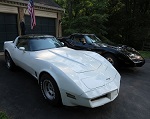
My car is a 1980 4-speed with the L-48 engine. She's mostly stock, somewhat neglected, has 100K+ miles, and a few Bubba mods here and there. No dreams of being a show queen, just wanting a fun reliable cruiser.
Late last year my ignition failed. Got it fixed but realized the harmonic balancer had spun. Decided it was time to address multiple engine leaks and neglected maintenance issues while at it. Slow but steady progress with no major issues so far (I'll list details below for anyone interested). My efforts have led me understand the original plug routing and management system (which Bubba had abandoned) raising questions.
I already planned to make custom plug wires (inspired by other posts here).Need to decide if I restore the factory routing (with shields), or go with my own plug routes.
Questions:
1. Do you use factory plug wire routing or have you rerouted your wires?
2. What are your perceived benefits for your routing choice?
3. For those who have made custom plug wires, what brands of wire and and which specifications are good for stock HEI ignition systems?
Clearly the factory routing is an added hassle during installation and makes future inspections difficult. Aside from NCRS points (no value to me), is there any benefit such as a reduction in radio frequency interference? Substantially longer plug wires seems counterintuitive, but reliable clearance from heat and moving parts has value.
Planned Replacements: Water pump, timing chain, motor mounts, spark plugs, plug wires, cap, rotor, coil, control module, valve covers, and all related seals. Considering new fuel pump and oil pump.
Appreciate any serious thoughts, feedback, and experience the forum has.
Thank you in advance.
.
Edit: Meant to mention I'm running stock manifolds now, but do want to eventually run headers (when the budget allows it).
Last edited by MMK; Jun 14, 2025 at 11:44 PM.
Reason: Added Info
For my 80 L48 4-speed, I used wire loams that attached to the valve covers. With headers and insulating socks, I could route the wires from above. Dunno if that is an option with the stock manifolds.
The factory routed the ignition wires with the engine on a stand, then installed it onto a bare chassis, then dropped the body from above. Folks have made the stock routing work with the engine in place (through the engine mount!), but it's more work than it needs to be. The ignition shielding acts mostly to keep static from your AM radio.
1. Factory routing is silly.
2. The loams keep the wires separated, and headers make it easier to reach the plugs.
3. Probably Accel? I forget. Be sure to get a crimper that works for your wire choice.
If your running headers. Yes factory routing is silly.
if your running manifolds. The factory routing is the best way. Keeps everything out of harms way. And prevents burnt wires. Not to mention how tidy it looks.
Can you even see any plug wires? Can't get a cleaner look. And no burnt wires!
The shielding is for AM radio Only. How often do you listen to AM?
There's a radio in my 1971 Corvette Convertible? I thought all the music came from under the hood.
Yes, you'll find all sorts of techniques GM (and others) used back in the day to keep static and noise out of the radio and it's not just AM. Ignition shielding on a fiberglass Corvette keeps this noise from getting through the fiberglass "firewall". You'll notice capacitors on many components all over. One in particular is the tune signal flasher. It keeps the annoying clicking noise out of the radio when the turn signal is flashing
Even with headers, the plug wires can be routed below the primary tubes.
It all depends of the route of the primary tubes, spark plug angles in the heads and how determined you are to make it all work.
performance takes preference over optics
wires with a metal, spiral core (but Not solid-core)
not married to any OE shielding
from dist, drape the wires down at rear, R&L sides of motor
then come up, from beneath, to plugs.
*go in-person look at how a half-dozen local roundy-round sbc guys route their wires; surviving 30-50 very hot laps per session.
Hello there 4-vettes, You are right, you can't see the spark plugs. On my 1968 C3 427 I can reach all 8 from above and can change them in 20 minutes. None of my wires has been burnt yet on my long tube headers. I like to consider myself to be a "practical" man but I see no reason to spend double the amount of time (or more) for a benefit that we no longer need.
When I bought my Corvette it had the OE Shielding and that was quickly removed and traded for something useful. I really hated the original shielding and was glad to be rid of the mess. Since I removed the parts I have had NO issue with any background noise, static or buzzing. Even with my EFI system there has been no noise or static on any of the power lines.
I often wondered why people are so anxious to keep that bunch of parts of shielding. It is supposed to look cool but I am not sure what it does to justify it's existence. Just keep wires from getting burned? I am so glad to not have to deal with removing the shielding just to check the timing or change the rotor. If it is there only for AM radio usage then it will no problem yanking it out....
Putting covers on engines that require hours of disassembly work just to be able to access the engine, is dumb. I hate the covers on today's engines as they cover more and more every year. One car took almost an hour to see the basic engine just to be able to work on it. I like seeing the engine laid out on display right in front of you, preferably "clean" (without Grease).
I've never had a set of ignition wires that fit like the originals so I make my own. I recently used Taylor Spiro-Pro spark plug wire set.
And I used this tool to strip and crimp (hey I'm a poet and didn't even know it, lol) :
I don't run the factory ign. shielding covers because I listen to AM radio. I run them because they look great. And 2 wingbolts do not take long to remove. And yes a couple more wingbolts down by the plugs. But those aren't the heat shields. And I do run manifolds. So the factory routing seems the very best way. I'm on my third set of wires. The car is almost 50 years old. I'm thinking it's not that often I need to change them. Least I can do is do a good job. And then look, they last!
I run headers and use a modified under exhaust instalation. If you want to run headers later, you might as well look for a ceramic plug boot wire set now. I used a cut to length set from Jeg's house brand because the terminals snap on better than some other sets out there. I did not use the boomerangs because I went to a different year block that was not compatible. They were not really important to me. The factory wire clips down by the oil pan were handy. I did not run the wires thru the motor mounts in every case because of header interfearance in a few places. The metal loom brackets with rubber separators at the rear of the engine block were retained. They work well.
Designer Imagines A Corvette That Looks More Like a Corvette Than the Corvette
Slideshow: A Jaguar designer's personal project imagines what a modern front-engined Corvette might look like if Chevrolet revisited the golden age of the Stingray.







 Plug Wire Advice