When you click on links to various merchants on this site and make a purchase, this can result in this site earning a commission. Affiliate programs and affiliations include, but are not limited to, the eBay Partner Network.
Yes, Motobecane is a French brand, best known for its mopeds (like the one in my avatar, an AV88 that I restored for my wedding), but it also made bicycles.
The repair sleeve is indeed the best option, but I need to find a workshop that can fit it at a reasonable price!
Don't drop your cast iron cam either, they're brittle and can break as well. T shirt. Hopefully, you'll choose a different cam anyway.
The Only way to ensure your New ring doesn't touch or sweep that hole is to make Many measurements AND to obtain either drawings or dimensions from piston manufacturer(s). Then, Verify same via mocking up an assembly. From drawings, At Minimum, you'll need to learn exact distance from wristpin bore to bottom of lower oil ring rail groove.
On the off chance you have a very good local friend in hi-tech manufacturing. An experienced metrologist can take His company's CMM (Coordinate Measuring Machine) and Your "clean" block and "clean" parts. He can use his CMM's touch or laser probe to accurately determine if they'll fit and how much clearance may remain. Again, you can do likewise with accurate gaging and lots of measurement.
*Please show us a pic of the Top of a piston; to Verify what type Crown it has; that can help in estimating a baseline compression ratio.
I looked very closely at piston #2 and all sides of it (except the Crown I'd also like to see). On Both Non-thrust sides I see what I think is damage, immediately below bottom oil ring rail. it's a thin part and appears to be bent/pushed up and may actually contact rail.. On the upper pic showing wrist pin, the damage seems more gentle and broad and in one area. In the lower pic showing wrist pin, there seems to be damage in Two separate areas and damage is narrow but each bend is more sharply formed.
It's only a two-dimensional photo, I cannot be certain of many things and I cannot be certain the damage impinged upon rail OR IF it is preventing rail to rotate.
I cannot answer your questions about balancing. I have ALWAYS had access to a shop with dynamic balancing capabilities; I've had dynamic done many times. From small Toyota performance motors, to Harley drag motors to SBC circle track motors/milder street rods. I've personally weight-matched rods and piston sets; then had the shop dynamic balance complete rotating assemblies. The shop makes weight changes to crank's counterweights, by either adding or removing material. Your crank was balanced by GM to a specific bobweight; that closely matched the weight of rods, pistons, rings, bearings oil and per a calculation. It is Unlikely your New combo of parts will closely match existing bobweight; possible but Unlikely. Dynamic balancing will guide the shop to exactly where and exactly how much any weight should be changed. Consider this: the rotating assembly weighs about 65 to 75 pounds and it is rotating Many times faster than any balanced tire and wheel you have.
The pistons pictured above Are Cast Aluminum, A telltale sign of cast piston is the Raised crosshatch weave pattern seen on either side of wristpin hole. There's probably a similar Raised pattern on underhead, underneath the crown (we don't see that in photo). Regardless, those Are Cast (as is expected in 1981 L81 motor). Still want to see a pic of piston Crown..
*** I also knew of motobecane brand, And, your wedding day pic is superb !
Last edited by Rebelyell; Sep 26, 2025 at 06:34 PM.
Rebelyell Please find attached a photo of the piston crown.
Regarding the marks you mention, I can't see the ones you're talking about, so I've included a photo with other small marks. These marks are present on all the other cylinders, and they don't seem to affect the rotation of the oil ring rag; they all turn by hand with the same resistance.
I've made a note about the dynamic balancing; it does seem essential, so I'll have to find an engine builder who can do that.
Unfortunately, I don't have any knowledge of modeling measurements...
Last edited by Motobecane; Sep 26, 2025 at 07:39 PM.
In regards to closing the hole in the cylinder..... if the bore size is where you need it then you can have the hole brazed up. There are LOTS of old Harley-Davidson motorcycles with holes in the cylinder right at the bottom like this and they came from the factory that way. They used it for draining oil from the heads back to the cases. If you stroked the engine these holes need to be relocated lower in the bore so the original holes get brazed up in the process. Common practice and held up to drag racing extremes.
Pete79L82, thank you for the measurement; please find attached the measurement on my piston.
I'm at 23.47 mm, or 0.9240“, so the difference with yours is 0.2535”, which is significant. The solution is indeed there to avoid the hole.
But we still need to subtract the difference in compression height between the two, normally 1.56" on the original pistons.
70s, thanks for the tip, which is also very interesting for a repair! Do you know what type of solder it is? In the photos, it looks like copper-phosphorus solder, like the kind used for plumbing. And after soldering, isn't reaming still necessary?
No, they don’t. If they did, they would wear out the ring lands.
Given enough time/cycles, they DO wear ring grooves; that wear is both expected and predictable. Rebuild specs include those dimensions.
The better grades of aluminum pistons have hard-anodized ring grooves (to help minimize that groove wear).
I suggest you do some research of credible pro sources; e.g. SAE white papers.
Pete79L82, thank you for the measurement; please find attached the measurement on my piston.
I'm at 23.47 mm, or 0.9240“, so the difference with yours is 0.2535”, which is significant. The solution is indeed there to avoid the hole.
But we still need to subtract the difference in compression height between the two, normally 1.56" on the original pistons.
70s, thanks for the tip, which is also very interesting for a repair! Do you know what type of solder it is? In the photos, it looks like copper-phosphorus solder, like the kind used for plumbing. And after soldering, isn't reaming still necessary?
The procedure described to fill cylinder hole is called brazing, and it's typically done with a gas torch and a Brass-alloy rod/wire. FWIW, many Older bicycle and some Older motorcycle frames made of steel tubing and ferrous unions were/are brazed together. Today, they're welded without any Brass.
No, they don’t. If they did, they would wear out the ring lands.
I'm not here to argue about the need for rings to rotate on a Intenal Combustion Engine piston. Plenty of white papers out there that explain the need. I am just trying to assist a fellow forum member on his build. If he feels my recommendations aren't accurate, he is more than free to ignore it.
Pete79L82, thank you for the measurement; please find attached the measurement on my piston
I'm at 23.47 mm, or 0.9240“, so the difference with yours is 0.2535”, which is significant. The solution is indeed there to avoid the hole.
But we still need to subtract the difference in compression height between the two, normally 1.56" on the original pistons.
Ring stacks and compression heights are two independent measurements. Both are measured from the piston crown down. One does not depend on the other until they intersect.
That particular piston is for a 3.5" stroke crank, and 6" rod and a 9" deck height. The math is 9.0" - 6" rod - 1/2 of stroke (3.5÷2)
9-6-(3.5÷2)= 1.250 compression height
If you use a 5.7 rod the math is:
9-5.7-(3.5÷2)= 1.55 compression height
Neither scenario affects the ring stack. So the ring position stays the say regardless of the connecting rod used. You select the piston with the correct compression height for the rod you are using to achieve a 9.0 deck height (sbc).
I'm not here to argue about the need for rings to rotate on a Intenal Combustion Engine piston. Plenty of white papers out there that explain the need. I am just trying to assist a fellow forum member on his build. If he feels my recommendations aren't accurate, he is more than free to ignore it.
Be the way, this was last week's work.
And this is next week's work How many engines have you assembled this month?
Nice gaggle of motors ! I'm about 200mi SW of AD's shops.
The cam has a nice duration for the street, 218/227*
However, it is a Billet cam core.
That is a good thing, but it means you need to use a melonized distributor gear.
I would also suggest a Howards polymer fuel pump pushrod, not the bronze tipped ones, and definately not a stock steel one.
You showed us an 8:1 CR piston, And said you are going to 10:1, that would mean flat-tops.
I suggest you show us the piston top, brand and number you plan to buy before you waste any money.
There are several experienced engine builders on this site.
I guess I am not surprised that bore spot has not caused you any trouble, as it just barely touches the rings, and there is no load on them at the bottom of the cylinder.
But in good conscience, I would not be able to put that motor together, just knowing it was there.
You have several good suggestions to deal with it.
The pistons may be the least expensive way for you.
On balancing, weigh one of your existing pistons on a small scale, and find out the weights of the new ones. Many times new ones are much lighter. If that is the case, you basically must get the rotating assembly balanced. Your machine shop should know a place.
I also would not recommend the 6" rod. That will raise the pin height, and make the piston lighter, but will basically have no effect at your power level. The thinner ring pack should clear your spot with either rods. These days, it is almost as cheap, or cheaper, to buy new rods, than to recondition old ones. And with lack of that expertise in France, new may be the better option. Boring the block should be standard for any machine shop.
Last edited by leigh1322; Sep 28, 2025 at 12:24 AM.
If you're building a 10:1 sbc, I also like that SUM-1222 retrofit hyd roller cam, but suggest do not buy the kit at over $915. Summit lifters are too expensive.
Instead, buy the cam alone at about $270, But then, buy the hydraulic retrofit Roller lifters from RockAuto at about $206 for 8 PAIRS; all for a bit less than $500.
EngineTech P/N RFC35016 https://www.rockauto.com/en/moreinfo...choice=0-0-0-1
Yes, that cam (billet 5150 steel core) requires a melonized dist gear. But does not require Any special fuel pump rod. Chevrolet markets several Gen I hydraulic roller cam crate motors with 5150 cores and fuel pump eccentric; although they all require a melonized dist gear, they all also use a common stock steel fp rod GM P/N 3704817. GMPP/CPP uses that same fp rod in crates that use EITHER cast iron flat tappet cams and in those with 5150 billet steel roller cams; fact check it by reviewing install guides for those motors. For years, I've been around Lots of crates going into regional CT cars; both flat tappet & roller; same old fp rod for all. As per install guide instructions. Every now and then, life's simpler than it may seem.
If there's some need for a New fp rod, 3704817 is about $15 at summit
Peter, your workshop is amazing! And there's no doubt about your experience! Thanks for your clear explanations about the pistons.
As for the upper engine, I had already bought everything months ago, when I thought I was only going to rebuild the upper engine, so I missed out on a nice saving on the hydraulic tappets...
I had bought the necessary accessories for this camshaft: the melonized timing gear, the cam button for adjusting the clearance, and the fuel pushrod with bronze tip. But I understand that this isn't necessarily the best option, or even necessary.
For my problem, I'm planning to go with the simplest solution proposed, which is to replace the connecting rod and piston with new ones, so that I'm above the hole.
I note that dynamic balancing is essential, so I will have this done once the parts have been ordered and weighed.
To summarize the information from my various messages about my configuration:
I want a street configuration with low and mid-range torque (with a 2-bolt block, I'm not looking for rpm); the Corvette is equipped with a TH 350 transmission and the original torque converter. I already have in stock:
I am therefore open to your advice and suggestions for parts!
To summarize the information from my various messages about my configuration:
I want a street configuration with low and mid-range torque (with a 2-bolt block, I'm not looking for rpm); the Corvette is equipped with a TH 350 transmission and the original torque converter. I already have in stock:
64cc/180cc Flotek cylinder heads (102-505), with Arp bolts and Felpro 1003 gaskets
a SUM K1222 retrofit roller camshaft, with all the peripherals related to the retrofit and double roller timing set
Edelbrock 2701 intake manifold
AVS2 650cfm carburetor (with calibration kit and a AFR Gauge to optimise setting)
HEI 8362 ignition
Magnum roller tip 1.52 rocker arm
Long 4-in-1 exhaust with side pipe
I run on 98 octane gasoline. I was thinking of going for a compression ratio of 10:1, but I'm open to your suggestions.
The easiest option for me is to order from Summit or Rock Auto, but I see that JEGS and Speedway Motors also offer international shipping.
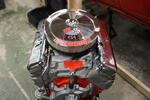
Motobecane, the engine in this picture is very close to your build. By the rules it is built for, it has to use a particular Dart iron cylinder head (not as good as your choice) and a flat tappet camshaft (a little more duration than your choice) and must use a 2 barrel carburetor. Everything else is the same as yours. Same intake, 10.5 compression, flat top pistons. That motor just dynoed at 408 HP.
Your next step will be getting the block prepped. Checking the exact bores dimension, checking for any taper, top to bottom, in the cylinder, and getting a good hone finish. Once that is done, we can choose a piston and rod combination to order.
One side note to remember. The firing order of the cam you selected is different from standard small block. You will have to remember that when setting up your ignition. Standard firing order is 18436572. Your cam is 18726543.
Last edited by Pete79L82; Sep 28, 2025 at 08:26 AM.
Designer Imagines A Corvette That Looks More Like a Corvette Than the Corvette
Slideshow: A Jaguar designer's personal project imagines what a modern front-engined Corvette might look like if Chevrolet revisited the golden age of the Stingray.