





78' Big Problems with Hestition and Bogg
Thread Starter
Advanced

Joined: Jun 2004
Posts: 64
Likes: 0
 78' Big Problems with Hestition and Bogg
OK im new to Vette's. I purchased a 78' early this summer and have been doing body work all summer basicly ( low funds ) but now I have money to fix it up. So i put new plugs, wires, roter, and cap into it. But here is my problem. I wanted this car so I could have some fun and smoke off these old tires on it, but i cant! When i floor the pedal my car just boggs down and hesitates to the point that it almost dies out. if i ease off the gas it will pick up and go. so i have NO problem what so ever just slowly or even quickly accelerating. but when i really stomp on it, either from a stop, OR on the roll, the car hesitates. what is causeing this?? im completely stumped. please help me so i can have some fun before winter sets in!! 
PS i also have no dash board lights, i put all new bulbs in and i get electricity to the fuse box but nothing happens. no interior lights unless i turn them on manually. i think its the stupid headlight switch, any opinions? thanks!

PS i also have no dash board lights, i put all new bulbs in and i get electricity to the fuse box but nothing happens. no interior lights unless i turn them on manually. i think its the stupid headlight switch, any opinions? thanks!
Last edited by Classic78Vette; Sep 27, 2004 at 09:54 PM.
Advanced
Joined: Jul 2004
Posts: 66
Likes: 0
From: OH
I'd guess the carb needs rebuilt. This is especially true if the car has spent significant time without being driven. Someone once told me that today's gasoline doesn't treat yesterday's carb gaskets very well. So, a rebuild can be a good idea for that reason, alone (if it's true).
I plan to rebuild my carb this winter because I have very similar symptoms.
As for the dash lights... lots of people have reported the same thing and have indicated that replacing the headlamp switch fixes the problem. Again, I have the same problem and this is on my wintertime list of projects.
I plan to rebuild my carb this winter because I have very similar symptoms.
As for the dash lights... lots of people have reported the same thing and have indicated that replacing the headlamp switch fixes the problem. Again, I have the same problem and this is on my wintertime list of projects.
Burning Brakes


Joined: Aug 2004
Posts: 971
Likes: 7
From: roanoke va
sound like the accelator pump in the carb. you may have to rebuild the carb. or repair the pump. pull the air cleaner off and look down the carb. when you work the accelator you should see gas squirting in the carb. on both ft. sides if it does not squirt or is real poor streams you need to repair the pump.

Melting Slicks

Joined: Dec 2000
Posts: 3,407
Likes: 2
From: Carmichael CA
Sounds like it's running fine...carb is working fine because it delivers the correct air/fuel mixture at all speeds. A bad accelerator pump will cause your engine to run lean when you first stomp on it, causing it to bog for just 1/2 a second, but then the full power of the engine will kick on...so that doesn't sound like your problem either if you aren't getting the full power after the initial hessitation.
It sounds more like timing. My guess is that your timing is off and your vacuum advance isn't working like it should. I would first do a timing ritual. Disconnect and plug the vacuum line leading to the distributor so that only mechanical advance is working, then run the engine at a very low RPM like 550 or 600 so that there should be no mechanical advance and then check your timing...you should be seeing in the neighborhood of 10º Before Top Dead Center (BTDC). Once that is set then rev the engine slightly to around 1500...you should see the timing advance and move about twice as far as the 10º (like 20º BTDC). Next, plug the vacuum advance into the ported carb fitting that is correct for your hose routing. Now when you rev the engine the vacuum advance should kick the timing up further to like 40º just for the first 1/2 second as you open the throttle, then settle back to just the 20º of the mechanical...this is what you want...a little more advance when you first open the throttle. If you have the vacuum line plugged into manifold vacuum then you will see this huge 40º of vacuum at just the idle (in fact the car may die if you plug it into the wrong port) and when the pedal is depressed the vacuum will drop to the 10º for the first 1/2 a second then rise back up...this is how most engines get bogged...someone plugs the vacuum line into the manifold vacuum, then adjusts the timing...so when you open the throttle the engine bogs. You would not believe the number of people that pull into a shop claiming that their engine is losing power and probably has a blown head gasket or something just to find out that they replaced some vacuum hoses and routed them wrong.
This is the general procedure...many custom variaties exists...find one that works for you.
Hope this helps.
It sounds more like timing. My guess is that your timing is off and your vacuum advance isn't working like it should. I would first do a timing ritual. Disconnect and plug the vacuum line leading to the distributor so that only mechanical advance is working, then run the engine at a very low RPM like 550 or 600 so that there should be no mechanical advance and then check your timing...you should be seeing in the neighborhood of 10º Before Top Dead Center (BTDC). Once that is set then rev the engine slightly to around 1500...you should see the timing advance and move about twice as far as the 10º (like 20º BTDC). Next, plug the vacuum advance into the ported carb fitting that is correct for your hose routing. Now when you rev the engine the vacuum advance should kick the timing up further to like 40º just for the first 1/2 second as you open the throttle, then settle back to just the 20º of the mechanical...this is what you want...a little more advance when you first open the throttle. If you have the vacuum line plugged into manifold vacuum then you will see this huge 40º of vacuum at just the idle (in fact the car may die if you plug it into the wrong port) and when the pedal is depressed the vacuum will drop to the 10º for the first 1/2 a second then rise back up...this is how most engines get bogged...someone plugs the vacuum line into the manifold vacuum, then adjusts the timing...so when you open the throttle the engine bogs. You would not believe the number of people that pull into a shop claiming that their engine is losing power and probably has a blown head gasket or something just to find out that they replaced some vacuum hoses and routed them wrong.
This is the general procedure...many custom variaties exists...find one that works for you.
Hope this helps.

Advanced

Joined: Aug 2002
Posts: 84
Likes: 0
From: Riockwall Texas
You are sadly mistaken if you think Q-Jets can't be performance carbs. Set up properly, they are a match for any other comparable size carb.
Look up Lars' writeup on Q-Jet tuning and you will learn a great deal. They have been run very successfully on the Stock classes through the years. They are great on the street because of the low end punch, followed by huge secondaries metered by airflow.
Your problem could be one of several things. Vacuum advance has been mentioned, a bad accelerator pump also.
One not mentioned is a incorrect setting on the secondary air dam control spring. A spring set too weak can almost make the engine quit on a quick press of the go pedal. The cause is the secondary air dam flopping completly open at low air flow rates, and dumping full throttle fuel through the secondary jets into the manifold. The low runner velocity allows the fuel to fall out of suspension in the air stream and puddle in the manifold. Instant bad bog. Once the RPM's pick up, the runner velocity increases and the additional fuel makes it to the cylinders.
You can check the accelerator pump by looking into the primary barrels and opening the throttle. Should have a good, solid squirt into both primary bores.
I have seen more carb's "overhauled" because the owner didn't check all of the basics first and make sure that everything else on the motor is OK. It sounds that you have done that with the replacement of the parts you mentioned. Do the final check on the vacuum advance and timing before ripping into the carb.
By the way, what is the carb P/N?
Good Luck
Look up Lars' writeup on Q-Jet tuning and you will learn a great deal. They have been run very successfully on the Stock classes through the years. They are great on the street because of the low end punch, followed by huge secondaries metered by airflow.
Your problem could be one of several things. Vacuum advance has been mentioned, a bad accelerator pump also.
One not mentioned is a incorrect setting on the secondary air dam control spring. A spring set too weak can almost make the engine quit on a quick press of the go pedal. The cause is the secondary air dam flopping completly open at low air flow rates, and dumping full throttle fuel through the secondary jets into the manifold. The low runner velocity allows the fuel to fall out of suspension in the air stream and puddle in the manifold. Instant bad bog. Once the RPM's pick up, the runner velocity increases and the additional fuel makes it to the cylinders.
You can check the accelerator pump by looking into the primary barrels and opening the throttle. Should have a good, solid squirt into both primary bores.
I have seen more carb's "overhauled" because the owner didn't check all of the basics first and make sure that everything else on the motor is OK. It sounds that you have done that with the replacement of the parts you mentioned. Do the final check on the vacuum advance and timing before ripping into the carb.
By the way, what is the carb P/N?
Good Luck
Last edited by Bob in Dallas; Sep 28, 2004 at 12:17 AM.

Le Mans Master


Joined: Mar 2004
Posts: 7,502
Likes: 1,510
From: Little Rock AR
Originally Posted by Bob in Dallas
You are sadly mistaken if you think Q-Jets can't be performance carbs. Set up properly, they are a match for any other comparable size carb.
Look up Lars' writeup on Q-Jet tuning and you will learn a great deal. They have been run very successfully on the Stock classes through the years. They are great on the street because of the low end punch, followed by huge secondaries metered by airflow.
Your problem could be one of several things. Vacuum advance has been mentioned, a bad accelerator pump also.
One not mentioned is a incorrect setting on the secondary air dam control spring. A spring set too weak can almost make the engine quit on a quick press of the go pedal. The cause is the secondary air dam flopping completly open at low air flow rates, and dumping full throttle fuel through the secondary jets into the manifold. The low runner velocity allows the fuel to fall out of suspension in the air stream and puddle in the manifold. Instant bad bog. Once the RPM's pick up, the runner velocity increases and the additional fuel makes it to the cylinders.
You can check the accelerator pump by looking into the primary barrels and opening the throttle. Should have a good, solid squirt into both primary bores.
I have seen more carb's "overhauled" because the owner didn't check all of the basics first and make sure that everything else on the motor is OK. It sounds that you have done that with the replacement of the parts you mentioned. Do the final check on the vacuum advance and timing before ripping into the carb.
By the way, what is the carb P/N?
Good Luck
Look up Lars' writeup on Q-Jet tuning and you will learn a great deal. They have been run very successfully on the Stock classes through the years. They are great on the street because of the low end punch, followed by huge secondaries metered by airflow.
Your problem could be one of several things. Vacuum advance has been mentioned, a bad accelerator pump also.
One not mentioned is a incorrect setting on the secondary air dam control spring. A spring set too weak can almost make the engine quit on a quick press of the go pedal. The cause is the secondary air dam flopping completly open at low air flow rates, and dumping full throttle fuel through the secondary jets into the manifold. The low runner velocity allows the fuel to fall out of suspension in the air stream and puddle in the manifold. Instant bad bog. Once the RPM's pick up, the runner velocity increases and the additional fuel makes it to the cylinders.
You can check the accelerator pump by looking into the primary barrels and opening the throttle. Should have a good, solid squirt into both primary bores.
I have seen more carb's "overhauled" because the owner didn't check all of the basics first and make sure that everything else on the motor is OK. It sounds that you have done that with the replacement of the parts you mentioned. Do the final check on the vacuum advance and timing before ripping into the carb.
By the way, what is the carb P/N?
Good Luck
 What he said.
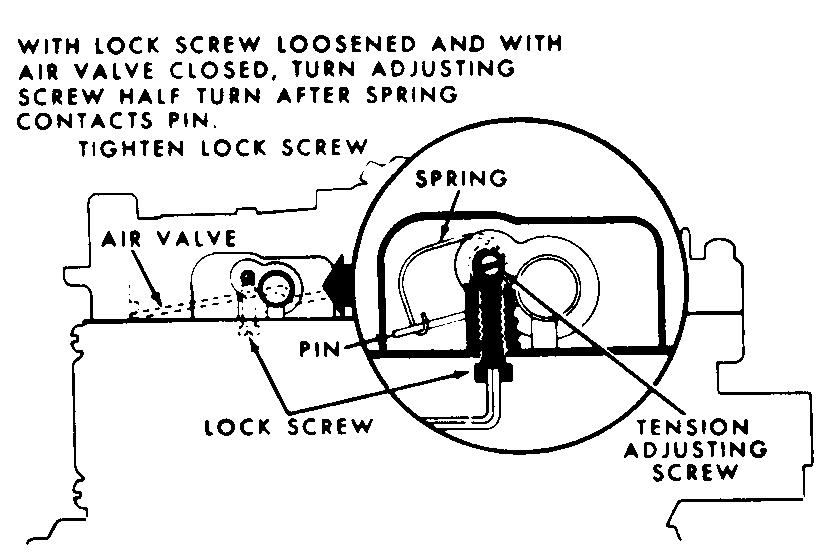
The secondary air flap adjustment sounds like a likely suspect. It is easy and free to check. If you do not have a spec for your exact model, you can use 7/8ths of a turn from closed. The vacuum pull-off might be shot as well but check the flap first.
-Mark.

Intermediate
Joined: Jan 2004
Posts: 42
Likes: 0
From: Roswell GA
Originally Posted by Classic78Vette
OK im new to Vette's. I purchased a 78' early this summer and have been doing body work all summer basicly ( low funds ) but now I have money to fix it up. So i put new plugs, wires, roter, and cap into it. But here is my problem. I wanted this car so I could have some fun and smoke off these old tires on it, but i cant! When i floor the pedal my car just boggs down and hesitates to the point that it almost dies out. if i ease off the gas it will pick up and go. so i have NO problem what so ever just slowly or even quickly accelerating. but when i really stomp on it, either from a stop, OR on the roll, the car hesitates. what is causeing this?? im completely stumped. please help me so i can have some fun before winter sets in!!
PS i also have no dash board lights, i put all new bulbs in and i get electricity to the fuse box but nothing happens. no interior lights unless i turn them on manually. i think its the stupid headlight switch, any opinions? thanks!
PS i also have no dash board lights, i put all new bulbs in and i get electricity to the fuse box but nothing happens. no interior lights unless i turn them on manually. i think its the stupid headlight switch, any opinions? thanks!
1...on the vacuum side check carb mounting nuts are torqued(properly?) and
2...on timing side poor/errant spark caused by bad coil. Coils display signs of impending failure in different ways and one of the many symptoms is sputter which is usu confused with fuel probs. Bad coils are hard to diagnose without some testing equipment - easier just to test with inexpensive spare(~$15).
Corvette Stories
The Best of Corvette for Corvette Enthusiasts

Top 10 Most Expensive Corvettes Ever Sold on Bring A Trailer
Brett Foote
10 Things Every Corvette Owner Needs (2026 Edition)
Michael S. Palmer
8 Most "Only Corvette Owners Understand" Quirks and Problems
Pouria Savadkouei
10 Reasons the C6 Z06 is Still A Performance Benchmark After 20 Years
Joe Kucinski
How Much Horsepower Every Corvette Engine "LOST" in 1972
Joe Kucinski
Top 10 DOs and DON'Ts for Protecting Your Convertible Top!
Michael S. Palmer
Top 10 Most Explosive Corvettes Ever Made: Power-to-Weight Ratio Ranked!
Joe Kucinski
150 hp to 1,250 hp: Every Corvette Generation Compared by the Specs That Matter
Joe Kucinski
8 Coolest Corvette Pace Cars (and Replicas) of All Time
Verdad Gallardo
Thread Starter
Advanced
Joined: Jun 2004
Posts: 64
Likes: 0
Thanks!!
Wow! Thanks a TON for all this info. Im a total amature at cars but i love tinkering. I can do all the basics but some of this stuff sounds slightly advanced ( ie tearing apart a carb. ) so ill try everything before that one. lol But thanks for all the replys and posts, infact Im going outside right now to see about those things!! 
Ohh and to the guy that has the same problems as me, good luck as well!! Winter is a great time to work on it agreed, but i would love to smoke those dry rotted POS's up before it sets in.
Ohh and to the guy that has the same problems as me, good luck as well!! Winter is a great time to work on it agreed, but i would love to smoke those dry rotted POS's up before it sets in.
Drifting


Joined: Jul 1999
Posts: 1,542
Likes: 43
From: Plano TX
Does the car run OK until the engine heats up?
The reason for this question is that in my early years of car onwer ship I chase a very similar issue to yours. Change the fuel pump, carb, plugs etc... and everytime I put my foot down it would bog. If you let it get up to speed slowly it was fine.
This was my first electronic ignition car and I finally figured out it was the HEI igniton module (damn $20 part). It seems that when the rotor begins to fail the high voltage of the HEI can arc through and hit the module cause it to fail this way. It you see waht looks like rust on the advance mechanism under the cap this is a sure sign of arcing.
The module is worth a look, its cheap and easy to change.
Hope you find the problem soon.
FYI - if your dashlights are out it could be the light switch which did the same on my 80.
Dave
The reason for this question is that in my early years of car onwer ship I chase a very similar issue to yours. Change the fuel pump, carb, plugs etc... and everytime I put my foot down it would bog. If you let it get up to speed slowly it was fine.
This was my first electronic ignition car and I finally figured out it was the HEI igniton module (damn $20 part). It seems that when the rotor begins to fail the high voltage of the HEI can arc through and hit the module cause it to fail this way. It you see waht looks like rust on the advance mechanism under the cap this is a sure sign of arcing.
The module is worth a look, its cheap and easy to change.
Hope you find the problem soon.
FYI - if your dashlights are out it could be the light switch which did the same on my 80.
Dave
Thread Starter
Advanced
Joined: Jun 2004
Posts: 64
Likes: 0
Originally Posted by Bob in Dallas
You are sadly mistaken if you think Q-Jets can't be performance carbs. Set up properly, they are a match for any other comparable size carb.
Look up Lars' writeup on Q-Jet tuning and you will learn a great deal. They have been run very successfully on the Stock classes through the years. They are great on the street because of the low end punch, followed by huge secondaries metered by airflow.
Your problem could be one of several things. Vacuum advance has been mentioned, a bad accelerator pump also.
One not mentioned is a incorrect setting on the secondary air dam control spring. A spring set too weak can almost make the engine quit on a quick press of the go pedal. The cause is the secondary air dam flopping completly open at low air flow rates, and dumping full throttle fuel through the secondary jets into the manifold. The low runner velocity allows the fuel to fall out of suspension in the air stream and puddle in the manifold. Instant bad bog. Once the RPM's pick up, the runner velocity increases and the additional fuel makes it to the cylinders.
You can check the accelerator pump by looking into the primary barrels and opening the throttle. Should have a good, solid squirt into both primary bores.
I have seen more carb's "overhauled" because the owner didn't check all of the basics first and make sure that everything else on the motor is OK. It sounds that you have done that with the replacement of the parts you mentioned. Do the final check on the vacuum advance and timing before ripping into the carb.
By the way, what is the carb P/N?
Good Luck
Look up Lars' writeup on Q-Jet tuning and you will learn a great deal. They have been run very successfully on the Stock classes through the years. They are great on the street because of the low end punch, followed by huge secondaries metered by airflow.
Your problem could be one of several things. Vacuum advance has been mentioned, a bad accelerator pump also.
One not mentioned is a incorrect setting on the secondary air dam control spring. A spring set too weak can almost make the engine quit on a quick press of the go pedal. The cause is the secondary air dam flopping completly open at low air flow rates, and dumping full throttle fuel through the secondary jets into the manifold. The low runner velocity allows the fuel to fall out of suspension in the air stream and puddle in the manifold. Instant bad bog. Once the RPM's pick up, the runner velocity increases and the additional fuel makes it to the cylinders.
You can check the accelerator pump by looking into the primary barrels and opening the throttle. Should have a good, solid squirt into both primary bores.
I have seen more carb's "overhauled" because the owner didn't check all of the basics first and make sure that everything else on the motor is OK. It sounds that you have done that with the replacement of the parts you mentioned. Do the final check on the vacuum advance and timing before ripping into the carb.
By the way, what is the carb P/N?
Good Luck
the carb is a roch if thats what you mean. but how do i adjust this flap you talk of? thanks

Heel & Toe

Joined: Sep 2004
Posts: 22
Likes: 0
From: Kirkland Wa
Just fixed the exact same problem on my 73. Turned out to be very simple. Was a small kink in the supply hose to the fuel pump. Only discovered when I'd gone through everything else and was getting ready to pull the fuel pump.
Drifting
Joined: Jul 1999
Posts: 1,542
Likes: 43
From: Plano TX
Since you've replaced the HEI module then I would look into fuel.
Accellerator pump is easy to check by open throttle and looking to see if fuel is squirted in the primaries.
I didn't see it mentioned but has the fuel filter been changed? I know this may sound stupid but a friend of mne refused to let me look at his old monty carlo and then spent $500 dollars at a rip off garage to still have the same problem. A few months later he said if you want the car come get it. Took it how and let it sit for a few months becuase of time. When I did look at it I found a bad 5 dollar fuel filter.
The car ran great for many years with only 60K miles on it when I got it. Used the motor later in an old blazer and not a IH Scout II.
Most problems are simple, it just takes time to pin point.
Also have you written this up in the section for your area to see if someone can come over and look at it?
Dave
Accellerator pump is easy to check by open throttle and looking to see if fuel is squirted in the primaries.
I didn't see it mentioned but has the fuel filter been changed? I know this may sound stupid but a friend of mne refused to let me look at his old monty carlo and then spent $500 dollars at a rip off garage to still have the same problem. A few months later he said if you want the car come get it. Took it how and let it sit for a few months becuase of time. When I did look at it I found a bad 5 dollar fuel filter.
The car ran great for many years with only 60K miles on it when I got it. Used the motor later in an old blazer and not a IH Scout II.
Most problems are simple, it just takes time to pin point.
Also have you written this up in the section for your area to see if someone can come over and look at it?
Dave
Racer
Joined: Jul 2004
Posts: 450
Likes: 0
From: Fredericksburg VA
I had the same problem in my 71 a while ago, wasn't till I tried to install a K&N top filter that I realized my problem had been that there wasn't enough clearance between my carb and my air cleaner lid. Very stupid problem and very easy to fix, thank god I hadn't had the car long before I figured it out. I ended up just getting some fuel line tubing and putting it between the two and this gave it enough clearance to fix the problem. You'd be able to tell, because your air cleaner lid would be dented around the area where the carb might hit it. I'd check this since its very simple and often because of that overlooked.
Le Mans Master
Joined: Mar 2004
Posts: 7,502
Likes: 1,510
From: Little Rock AR
Originally Posted by Classic78Vette
the carb is a roch if thats what you mean. but how do i adjust this flap you talk of? thanks
The allen set screw is backed off so you can adjust the spring screw. You then back off the spring screw enough so that the big air flap drops open. Then slowly adjust the air flap spring screw so that the air flap just barely closes against the top of the carb, then go 7/8ths of a turn tighter. Hold the spring screw in place while you tighten the set screw and that should be about right.
Now have a friend start the engine while you watch the operation of the vacuum dashpot that attaches to the flap you just adjusted. As the car starts, the dashpot should pull in. If not, it is probably trashed and need to be replaced.
The 7/8ths of a turn will get you very close if not perfect. Takes maybe 5 minutes if you get dirty and need to wash up.
-Mark.
Thread Starter
Advanced
Joined: Jun 2004
Posts: 64
Likes: 0
wow loads of info
well thanks for all the reply's! I am sure its not the filter as i replaced that, and the pump works because i see PLENTY of fuel shooting out the primary jets. but i want to go outside and adjust the secondary air dam now really bad because im hoping that that does it!! thanks again!! sorry i havent had time to post lately but thanks again!! 
Thread Starter
Advanced
Joined: Jun 2004
Posts: 64
Likes: 0
Help!
Ok so heres the deal. Im out in the rain working on the ar because Ohio weather changes every 10 min but I look EVERYWHERE for the tension screw and locking screw and I can NOT find it. No im not the best mechanic but Im smart enough to find this thing and I cant. Can someone please tell me where to find this damn thing at. Im at wit's end. Ohh and please dont just tell me, it would be more than excellent if you could take an actuall photograph of it so i dont have to work of these diagrams like this one. ---> (Loads Slow)
http://vetteworks.tripod.com/Graphics/Copy_of_roch6.gif

http://vetteworks.tripod.com/Graphics/Copy_of_roch6.gif
Last edited by Classic78Vette; Oct 15, 2004 at 03:36 PM.