


First time for brakes

Cruising

Joined: Oct 2010
Posts: 14
Likes: 0
From: PHiladelphia pa

Some pads on some cars have rivets that sit inside the piston well and you'll need to compress the piston before attempting to remove the pads. The spreader is useless in this case. (trust me, I've been there and done this) The pads designed like this don't allow for the caliper to be swung outward to drop pads and use the spreader.
The spreader only does the same job as a c-clamp if you don't have this problem with the rivets or raised metal, and the C-clamp can be used for other purposes where the spreader is only good for brake pads.
Melting Slicks


Joined: Apr 2007
Posts: 2,547
Likes: 46
From: NJ
Shouldnt take you more then 10 mins a side... Other then the 5 lugs on each wheel its only 4 bolts on each side 
Dont bleed the brakes. There is no need if the fluid was just flushed.
If you need a hand shoot me a PM!
Good luck!
Dont bleed the brakes. There is no need if the fluid was just flushed.
If you need a hand shoot me a PM!
Good luck!

Safety Car

Joined: Jan 2004
Posts: 3,759
Likes: 8
I changed the pads and rotors on my 89 a while back. Only thing I noticed was at the last second before I come to a complete stop, and as I take my foot off the brake. I get a brief sound/vibration and it sounds like the brakes groan. It will stay groaning if I'm inching forward. I never figured it out as it doesn't go away even with the brakes hot.
Safety Car
Joined: Jan 2004
Posts: 3,759
Likes: 8
Personally, I'd open the cap. Otherwise pressure builds in the master when you push fluid back in. It's easier to compress the pistons with the cap open.
It also makes it easier to keep an eye on the fluid level, as it may overflow when doing all the pads if it was ever topped off with worn pads.
It also makes it easier to keep an eye on the fluid level, as it may overflow when doing all the pads if it was ever topped off with worn pads.

Drifting


Joined: Sep 2007
Posts: 1,396
Likes: 379
From: Cincinnati Ohio
It is not a bad job at all. The fronts are the easiest. Take your time and do one side at a time. This way you can compare them to the other side if you run into problems. Have fun and make a winter project out of it....This is what I did...I am pretty **** so I removed the calibers and painted them....Looks great now!! just be sure that you get the e-clips installed correctly on the fronts..You do NOT want the pins backing out.
Rears before paint, I can't seem to find a pic of the fronts before

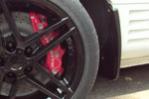
Fronts after paint, rotors also

Fronts with wheels installed.

It makes a world of difference on the car the brakes are seen but
not seen. I put on new wheels and I just had to paint the brakes and
rotors..remember 1 project almost always leads to ANOTHER!!!

Rears before paint, I can't seem to find a pic of the fronts before
Fronts after paint, rotors also
Fronts with wheels installed.
It makes a world of difference on the car the brakes are seen but
not seen. I put on new wheels and I just had to paint the brakes and
rotors..remember 1 project almost always leads to ANOTHER!!!
Last edited by seijack; Oct 25, 2010 at 09:57 AM.

Thread Starter
Melting Slicks
Joined: Apr 2007
Posts: 2,678
Likes: 1
From: Atlanta Georgia
I want to recommend against this for a couple reasons.
Some pads on some cars have rivets that sit inside the piston well and you'll need to compress the piston before attempting to remove the pads. The spreader is useless in this case. (trust me, I've been there and done this) The pads designed like this don't allow for the caliper to be swung outward to drop pads and use the spreader.
The spreader only does the same job as a c-clamp if you don't have this problem with the rivets or raised metal, and the C-clamp can be used for other purposes where the spreader is only good for brake pads.
Some pads on some cars have rivets that sit inside the piston well and you'll need to compress the piston before attempting to remove the pads. The spreader is useless in this case. (trust me, I've been there and done this) The pads designed like this don't allow for the caliper to be swung outward to drop pads and use the spreader.
The spreader only does the same job as a c-clamp if you don't have this problem with the rivets or raised metal, and the C-clamp can be used for other purposes where the spreader is only good for brake pads.
 4 month old thread revival...
Corvette Stories
The Best of Corvette for Corvette Enthusiasts

Every 2027 Corvette Engine Explained
Joe Kucinski
Designer Imagines A Corvette That Looks More Like a Corvette Than the Corvette
Verdad Gallardo
10 Ugly Corvettes That We Still Kinda Love
Joe Kucinski
Top 10 Most Expensive Corvettes Ever Sold on Bring A Trailer
Brett Foote
10 Things Every Corvette Owner Needs (2026 Edition)
Michael S. Palmer
8 Most "Only Corvette Owners Understand" Quirks and Problems
Pouria Savadkouei
10 Reasons the C6 Z06 is Still A Performance Benchmark After 20 Years
Joe Kucinski
How Much Horsepower Every Corvette Engine "LOST" in 1972
Joe Kucinski
Top 10 DOs and DON'Ts for Protecting Your Convertible Top!
Michael S. Palmer
Team Owner


Joined: Jan 2009
Posts: 73,568
Likes: 33
From: Somewhere in Mo
St. Jude Donor '09-'10, '14
But it saves me the search as I have to replace mine. I've done it many times but never on the vette so I was kinda wondering if I should do anything unusual or out of the ordinary.
some things are just meant to be!
One thing I always did was to open the bleeder valve to install the pads and then just rebleed the system. I always thought it best to always rebleed to make sure everything is set. I know it may be overkill but I have just always done it that way.
I've done it many times but never on the vette so I was kinda wondering if I should do anything unusual or out of the ordinary.some things are just meant to be!
One thing I always did was to open the bleeder valve to install the pads and then just rebleed the system. I always thought it best to always rebleed to make sure everything is set. I know it may be overkill but I have just always done it that way.
Last edited by RetiredSFC 97; Oct 25, 2010 at 11:09 AM.