


 ....WW

Required Octane

Racer

Joined: Jul 2004
Posts: 434
Likes: 0
From: Santa Barbara Minnesota
 What Planet are you from?
The 87 Vette is 9.5 to 1 Compression ratio.
Early L98 engines with cast iron heads were 9 to 1 ..
You can do whatever you wish .. Believe in Tooth Fairy.
Octane is related to compression ratio.
9.5 to 1, I would not run less than 91 octane.
Prove me wrong.
Yes newer cars run 11:1 compression, but are direct injection.

Race Director


Joined: Sep 2003
Posts: 16,839
Likes: 341
From: Database Error Indiana
The previous quotes are from GM.
The 87 Vette is 9.5 to 1 Compression ratio.
Early L98 engines with cast iron heads were 9 to 1 ..
You can do whatever you wish .. Believe in Tooth Fairy.
Octane is related to compression ratio.
9.5 to 1, I would not run less than 91 octane.
Prove me wrong.
Yes newer cars run 11:1 compression, but are direct injection.
The 87 Vette is 9.5 to 1 Compression ratio.
Early L98 engines with cast iron heads were 9 to 1 ..
You can do whatever you wish .. Believe in Tooth Fairy.
Octane is related to compression ratio.
9.5 to 1, I would not run less than 91 octane.
Prove me wrong.
Yes newer cars run 11:1 compression, but are direct injection.

Racer
Joined: Jul 2004
Posts: 434
Likes: 0
From: Santa Barbara Minnesota
Not a problem at all Jack. Some of these issues have been addressed in Tech & Performance. C4 Corvette was most incredible performance advance, in my opinion. Lacking HP. but lots of torque. But so much fun to drive. My areodynamasist, Jerry says C4's still fastest on Bonnyville. There were many changes between 85-86 new C4's .. I still beat Z06 with my C4 ..

Advanced
Joined: Apr 2012
Posts: 83
Likes: 0
 Meaning a 1988 car may see 89 oct as the fuel best suited for it. Here is the link if your interested:
http://forums.corvetteforum.com/c4-t...-mpg-test.html
Advanced
Joined: Apr 2012
Posts: 83
Likes: 0

The only thing I want to add is that this I feel is all weather dependent. Summer time I think u do better with a higher octane if ur driving in the heat of the day. Winter I do not feel its as big an issue. I mean when I did my test I could not get my car to go over 155 degrees on the hwy at 65. In the dead heat of the NE US summer at the high time for temps during the day I would be in the 180's for sure at 65 and in close to stand still traffic I would be in the low 200's and upward for dead stop traffic. So for me fall winter and early spring I think 89 is good for my car and apparently gets better MPG on it but in the summer I plan to redo the test and see and of course I do feel hot daily temps require better oct fuel.
Last edited by desperateaudio; Dec 11, 2012 at 02:17 PM.
Corvette Stories
The Best of Corvette for Corvette Enthusiasts

5 Best & 5 Worst Corvette Daily Drivers
Joe Kucinski
The Headlights of Every Corvette Generation Explained
Joe Kucinski
5 Best & 5 Most Overrated Corvette Track Packages of All Time!
Joe Kucinski
Every 2027 Corvette Engine Explained
Joe Kucinski
Designer Imagines A Corvette That Looks More Like a Corvette Than the Corvette
Verdad Gallardo
10 Ugly Corvettes That We Still Kinda Love
Joe Kucinski
Top 10 Most Expensive Corvettes Ever Sold on Bring A Trailer
Brett Foote
10 Things Every Corvette Owner Needs (2026 Edition)
Michael S. Palmer
8 Most "Only Corvette Owners Understand" Quirks and Problems
Pouria Savadkouei
Thread Starter
6th Gear
Joined: Oct 2012
Posts: 6
Likes: 0
There is no sticker on my gas cap indicating any octane preference. To date I have used 50% 91 octane and 50% 89 octane and everthing seem to be Ok. My vette is away for the winter so I will have to wait until spring to further test any other mixture. Thanks to all who passed on there knowledge.

Le Mans Master


Joined: Oct 2004
Posts: 6,314
Likes: 508
From: South-central Missouri
The previous quotes are from GM.
The 87 Vette is 9.5 to 1 Compression ratio.
Early L98 engines with cast iron heads were 9 to 1 ..
You can do whatever you wish .. Believe in Tooth Fairy.
Octane is related to compression ratio.
9.5 to 1, I would not run less than 91 octane.
Prove me wrong.
Yes newer cars run 11:1 compression, but are direct injection.
The 87 Vette is 9.5 to 1 Compression ratio.
Early L98 engines with cast iron heads were 9 to 1 ..
You can do whatever you wish .. Believe in Tooth Fairy.
Octane is related to compression ratio.
9.5 to 1, I would not run less than 91 octane.
Prove me wrong.
Yes newer cars run 11:1 compression, but are direct injection.
I might need some help on the exact date, but the EPA required all cars to be able to run on 87 octane at some point in the late 80s. Compression ratio plays a role in determining octane requirements, but it varies a lot with chamber design, as well as spark timing, and engine temperature (especially head temperature).
Case in point, the stock LT5 has 11.0:1 compression and will run on 87 octane, and utilizes SFI, but not direct injecton. However, spark timing is retared at the 87 octane level, especially at WOT, and so the motor's output will increase with higher (91-93) octane as reasult of much fewer knock counts signals the ECM it is OK to pull out some/all of the spark retard.
As for the L98, it appears the compression ratio increase over the years with roller lifters and cam changes, aluminum heads, etc, but never went over 9.5:1 in a Corvette (according to sources).
A compression ratio of 10.5:1 came with the Corvette in 1992 with the introduction of the LT1. The increase in compression was in part attributed to the reverse flow of coolant so that the heads received the water from the radiator before the block - the exact opposite up to that time. The LT1 will run on 87 octane as well, but when knocks counts reach a threashold level, the ECM will back out timing until the knocks subside (at the expense of performance and some mileage too).
In 1996 the compression ration of the LT4 was bumped to 10.8, but still the LT5 compression ratio was the highest factory spec at 11.0:1 primarily due to the very fast burn characteristics of the pent-roof chamber (LT5 pistons are dished, BTW).
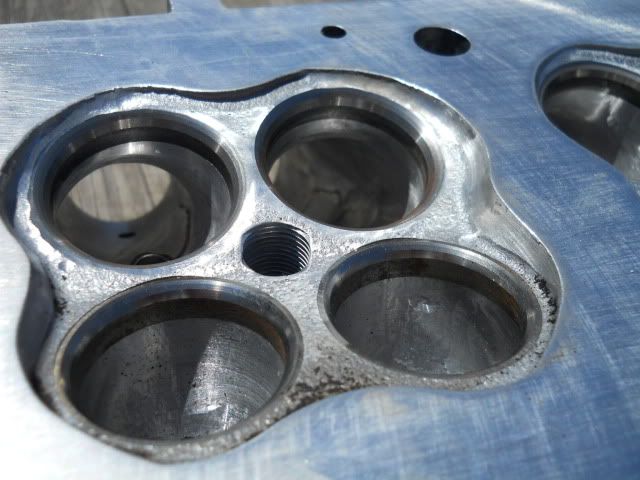
"Pent roof" differs slightly from the "hemi" in that the intake and exhaust valves each share their own flat plane. (This makes it easire to accomodate twin intakd and exhaust valves betther than the hemispherical design allows.) The two plane surfaces meet in the middle to form a shallow angle at the top of the chamber.
The pent angled roof is easy to see on this LT5 head that is undergoing porting.
P.