






Bose upgrade
Thread Starter
Advanced

Joined: Dec 2013
Posts: 75
Likes: 0
From: Murrieta CA
 Bose upgrade
I need some help please. I know this has been discussed a lot on the forum but I'm looking for info on double din head units and speakers you have installed. Mine is a 95 vert . I plan on doing the install myself without an additional amp or sub so I need good quality components that will sound great on their own.
I don't need nav. I want to connect my IPod from the back of the head unit so there are no visible cables in the front.
Which head unit and speakers did you use?
Did you need to trim material off the radio bezel to get the head unit to fit? If so, how do you do that?
Do you need special mounting chassis for these head units?
Is your head unit display still readable with the top down?
Can you control the brightness of the display with the instrument dimmer?
Sorry for all these dumb questions but this is my first shot on stereo upgrade so I need all the help I can get.
Thanks!!!
I don't need nav. I want to connect my IPod from the back of the head unit so there are no visible cables in the front.
Which head unit and speakers did you use?
Did you need to trim material off the radio bezel to get the head unit to fit? If so, how do you do that?
Do you need special mounting chassis for these head units?
Is your head unit display still readable with the top down?
Can you control the brightness of the display with the instrument dimmer?
Sorry for all these dumb questions but this is my first shot on stereo upgrade so I need all the help I can get.
Thanks!!!
Instructor


Joined: Dec 2013
Posts: 115
Likes: 16
From: By Oakland International Airport Michigan
I went with this:
Kenwood DDX370
I slightly altered the back end of the dash (you can't see) that the radio fit in, but IMHO, it looks perfect and I'm very happy with it. No special mounting bracket, no altering whatsoever of the dash bezel. This radio came with a dimming feature and it's very easy to see during the day/sunlight.
The speakers are a personal preference. I had to make new mounting boxes for the front speakers out of MDF board since I went with 5 1/2" rounds that wouldn't fit the Bose enclosures. You'll have to be careful about the depth and the stick out of whatever you choose if you go this route. You'll also have to be handy working with wood and designing them as well.
On the rears, I used a 6 3/4" round and they fit perfectly in the existing Bose enclosures. My Coupe has lots of room in the back and a considerable amount of room in the front of the enclosure.
I also used this:
Metra 70-1857 Bypass Harness
It allowed me to plug into the unit in the tub behind the passenger seat and directly into the new head unit in the dash. I think it gave me my hot/ground and power antenna connections. I ran new speaker wire to the new speakers and left the factory harness in place.
There is more information including pic's of DD units in C4's on this Forum located under General Corvette Topics in the sub forum Audio/Electronics section.
I pulled my passenger seat out to help with the installation...
Mine is a 1996 Coupe, they're much faster than the Verts
Hope this helps.
Kenwood DDX370
I slightly altered the back end of the dash (you can't see) that the radio fit in, but IMHO, it looks perfect and I'm very happy with it. No special mounting bracket, no altering whatsoever of the dash bezel. This radio came with a dimming feature and it's very easy to see during the day/sunlight.
The speakers are a personal preference. I had to make new mounting boxes for the front speakers out of MDF board since I went with 5 1/2" rounds that wouldn't fit the Bose enclosures. You'll have to be careful about the depth and the stick out of whatever you choose if you go this route. You'll also have to be handy working with wood and designing them as well.
On the rears, I used a 6 3/4" round and they fit perfectly in the existing Bose enclosures. My Coupe has lots of room in the back and a considerable amount of room in the front of the enclosure.
I also used this:
Metra 70-1857 Bypass Harness
It allowed me to plug into the unit in the tub behind the passenger seat and directly into the new head unit in the dash. I think it gave me my hot/ground and power antenna connections. I ran new speaker wire to the new speakers and left the factory harness in place.
There is more information including pic's of DD units in C4's on this Forum located under General Corvette Topics in the sub forum Audio/Electronics section.
I pulled my passenger seat out to help with the installation...
Mine is a 1996 Coupe, they're much faster than the Verts
Hope this helps.

Burning Brakes


Joined: Apr 2011
Posts: 917
Likes: 25
From: College Station Tx
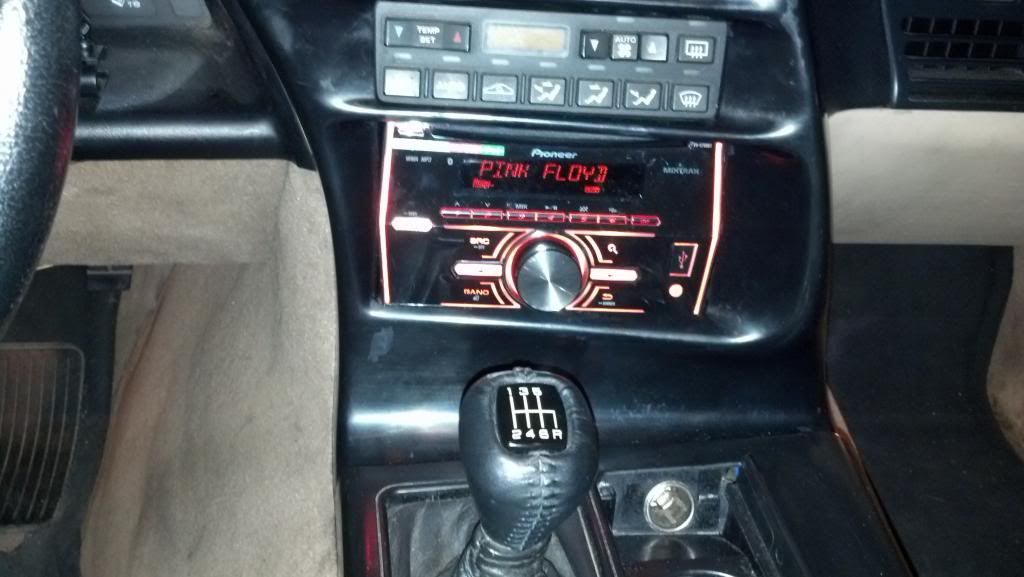
I went with the Pioneer FH-X700BT. You won't have to trim the bezel with most double DIN head units. As you can see in the pic, mine fits, but the angled sides of the head unit kinda screws the whole thing up. All-in-all, the stereo sounds great. It has Bluetooth and IPOD control capability.....no wires necessary. There are a lot of bluetooth and IPOD compatible units out there. Crutchfield is an excellent resource.


5th Gear
Joined: Dec 2013
Posts: 5
Likes: 0
bose
I went with the Pioneer FH-X700BT. You won't have to trim the bezel with most double DIN head units. As you can see in the pic, mine fits, but the angled sides of the head unit kinda screws the whole thing up. All-in-all, the stereo sounds great. It has Bluetooth and IPOD control capability.....no wires necessary. There are a lot of bluetooth and IPOD compatible units out there. Crutchfield is an excellent resource.
Burning Brakes
Joined: Apr 2011
Posts: 917
Likes: 25
From: College Station Tx
I used the wiring harness from Crutchfield. It is pretty easy to run the wiring to the compartment in the back (I have a '95). I also ran new speaker wire "just in case" I felt the need to replace the speakers.....which I did about a month after installing the head unit.

Racer

Joined: Oct 2012
Posts: 254
Likes: 34
From: Puyallup Washington
One Guy's Opinion
I've installed a number of stereos in C4's and F-body cars. There is a lot of misconception about installation and how to get good sound. The whole point of the Bose system to begin with was to model the best sound and deliver the system with fixed settings on the amplifiers, fixed speaker location, and a fixed controller unit (basically). Their thought was that it would produce the best overall sound by idiot-proofing the settings. Each brand, Nissan, Gm, etc. with factory Bose units are tuned for their specific listening environment. However, there are so many things prevalent in a car that can change the acoustics and how a stereo sounds. If you are a pro and understand acoustical theory, there’s a pretty good chance you can nail the right combination of equipment and placement to get the best sound. However, even they will admit that it’s often trial and error after the initial calculations are done.
Thus, I decided a long time ago that the more control a person has, the happier they'll be with the sound. The new double-din units are nice; loaded with options and often more capable than a person wants. Many have fixed equalization schemes that can hardly be adjusted. They might have five or so settings to choose from (IE. Rock, vocal, jazz, acoustic, etc.). More expensive units use software to modify the sound ahead of the amplifier. They typically give you a great deal more control but there are limits to what can be provided at the price automotive stereos commonly sell for. Consequently, little gems like cue filtering of the integrated EQ don’t exist. If you adjust one band of the equalizer, you disturb bands on either side of the one moved. That's why so often the overall sound is muddy or shrill. Speaking as an electrical engineer, I'll tell you that there is a major variance in electronic components and their effect on sound, even with the same specs. As much as I like the clean look of double-din decks, you'll get better control in the space you have available with a single-din deck and a component equalizer. Some EQ's also have internal amplifiers. That means you could use your low-level outputs (RCA) to the EQ and the output channels from the EQ to all the front speakers. Then use the amplified outputs direct off the deck to the rear speakers. I also recommend installing a pair of 1" tweeters in the car; somewhere directed to where your ears are when driving. The tweeters will give you the precision of sound you'll be looking for above all the mids and lows the other speakers produce.
Speakers need to be high quality, not big. You should buy the most expensive speakers you can afford. In the speaker world, dollars = quality. People who assert there isn't a difference likely lack the capacity to hear acoustic subtleties. Look into JL Audio speakers or similar and buy the best you can afford. Use stock mounting positions in the car because they are actually quite good. There are numerous choices. If you are willing to build your own mounts, your options quadruple. Anything larger than an 8" speaker will be useless inside the cab of a Corvette. You won't have the power to push anything bigger anyway. Large speakers aren't the key to good bass in a car. People put 12" and larger sub-woofers in cars. They truly can't be heard sitting inside the cab. In fact most of those systems sound better standing on the sidewalk than inside the car due to the length of the sound waves produced. Plus they shake Corvettes to pieces and are heavy. A great quality 6"x9" speaker in the right position will sound awesome. So just stick with whatever will go into the factory spots.
Don't get swindled into expensive speaker wire. You can find graphs with evidence of improved frequency response and so forth. It isn’t worth the money! You will never hear a difference. A dog won't hear any difference… Neither would a bat. For your system, regular speaker wire will be perfect.
Finally, consider installing insulation in the car. Acoustic abatement and enhancement is principal for good sound; not only to cut outside noise but to quiet assorted rattles and squeaks you're probably used to. While you have everything apart, take time to tighten fasteners. Make sure fasteners are in place and that the correct fasteners are being used. Look for broken plastic bits that will rub and squeak against each other. Buy sticky felt pads to use under fasteners between panels to help quiet those areas. Regrettably, doing this will also kill the sound of the engine. You might need louder exhaust then!
So to sum this up:
1. Buy a good head unit with high-level outputs. If you don't need all the navigation stuff and blue-tooth pairing, etc. Pioneer (and others) makes two or three models of double-din units that are in mid-$100 - $150 range. They are mostly blank-faced and won't compete with the styling of your Corvette interior. I can’t tell you specific models because there are so many good ones. A lot of it is based on what you think looks good in your dash. Or...
2. Buy a good quality single-din head unit with high and low-level outs. Your options here are nearly endless but stick with name brands. Pioneer, Alpine, Kenwood, Blaupunkt, JVC, Clarion, even Jensen have always impressed me. When I install the system in my C4, there are currently about ten different units I like to choose from.
3. If you use a single-din unit, look for a component equalizer; 7-band if possible with high-level outputs. You can find 1/2 and single-din equalizers on Amazon at really good prices. Clarion makes a nice unit. I can’t recall if it’s amplified or not, however. Some people mock the idea of using an equalizer and declare they can attain the same thing using crossovers and the right speakers. It’s true. But it takes money to get the right grouping. Even with adjustable crossovers and amps, most people never fiddle with them. The gear gets set up and never touched again. Using a graphic parametric equalizer in the dash gives you direct access to your sound. You can get it dialed in just the way you want on the fly. Going with a single-din head unit and a ½-din EQ will compel use of a Metra adapter. You may want to get a Metra harness connector but you should be running all new speaker wire so it will be predominantly useless. …Which brings us to the next point…
4. Just buy standard 16-AWG pure-oxygen-free stranded speaker cable. Solder the ends and use shrink tube everywhere. Take time to do a good job. Most systems would improve if the connections were remade.
5. Install speakers in the factory locations. Use the best quality speakers you can afford. The addition of tweeters high on the door panels or A-pillars will make the difference in sound and provide that elusive sizzle.
6. Insulate the doors, firewall, and floor. Several Corvette vendors sell nice under-carpet insulation. Also a good trick you might consider as well is to use a product called "Peel & Seal" from Lowe's instead of Dynamat. Dynamat is crazy expensive. Peel & Seal is a roll of foil-backed 5-layer asphalt-based gutter seal for roofs. It's about 6" wide x 25' I think. It costs around $16.50 per roll... Cheap! You can do everything in a Corvette for about $50. Another engineer and I compared a sheet of Dynamat against an equivalent sheet of Peel & Seal. Acoustically and chemically they were nearly identical. The Peel & Seal is stickier and forms really well to floor contours. It sticks well inside doors too. It’s slightly heavier and a little thicker than Dynamat. The biggest difference we found is the Peel & Seal is just silver foil-backed. Dynamat is black foil with really cool writing on it.
If you have any questions, please ask.
Thus, I decided a long time ago that the more control a person has, the happier they'll be with the sound. The new double-din units are nice; loaded with options and often more capable than a person wants. Many have fixed equalization schemes that can hardly be adjusted. They might have five or so settings to choose from (IE. Rock, vocal, jazz, acoustic, etc.). More expensive units use software to modify the sound ahead of the amplifier. They typically give you a great deal more control but there are limits to what can be provided at the price automotive stereos commonly sell for. Consequently, little gems like cue filtering of the integrated EQ don’t exist. If you adjust one band of the equalizer, you disturb bands on either side of the one moved. That's why so often the overall sound is muddy or shrill. Speaking as an electrical engineer, I'll tell you that there is a major variance in electronic components and their effect on sound, even with the same specs. As much as I like the clean look of double-din decks, you'll get better control in the space you have available with a single-din deck and a component equalizer. Some EQ's also have internal amplifiers. That means you could use your low-level outputs (RCA) to the EQ and the output channels from the EQ to all the front speakers. Then use the amplified outputs direct off the deck to the rear speakers. I also recommend installing a pair of 1" tweeters in the car; somewhere directed to where your ears are when driving. The tweeters will give you the precision of sound you'll be looking for above all the mids and lows the other speakers produce.
Speakers need to be high quality, not big. You should buy the most expensive speakers you can afford. In the speaker world, dollars = quality. People who assert there isn't a difference likely lack the capacity to hear acoustic subtleties. Look into JL Audio speakers or similar and buy the best you can afford. Use stock mounting positions in the car because they are actually quite good. There are numerous choices. If you are willing to build your own mounts, your options quadruple. Anything larger than an 8" speaker will be useless inside the cab of a Corvette. You won't have the power to push anything bigger anyway. Large speakers aren't the key to good bass in a car. People put 12" and larger sub-woofers in cars. They truly can't be heard sitting inside the cab. In fact most of those systems sound better standing on the sidewalk than inside the car due to the length of the sound waves produced. Plus they shake Corvettes to pieces and are heavy. A great quality 6"x9" speaker in the right position will sound awesome. So just stick with whatever will go into the factory spots.
Don't get swindled into expensive speaker wire. You can find graphs with evidence of improved frequency response and so forth. It isn’t worth the money! You will never hear a difference. A dog won't hear any difference… Neither would a bat. For your system, regular speaker wire will be perfect.
Finally, consider installing insulation in the car. Acoustic abatement and enhancement is principal for good sound; not only to cut outside noise but to quiet assorted rattles and squeaks you're probably used to. While you have everything apart, take time to tighten fasteners. Make sure fasteners are in place and that the correct fasteners are being used. Look for broken plastic bits that will rub and squeak against each other. Buy sticky felt pads to use under fasteners between panels to help quiet those areas. Regrettably, doing this will also kill the sound of the engine. You might need louder exhaust then!
So to sum this up:
1. Buy a good head unit with high-level outputs. If you don't need all the navigation stuff and blue-tooth pairing, etc. Pioneer (and others) makes two or three models of double-din units that are in mid-$100 - $150 range. They are mostly blank-faced and won't compete with the styling of your Corvette interior. I can’t tell you specific models because there are so many good ones. A lot of it is based on what you think looks good in your dash. Or...
2. Buy a good quality single-din head unit with high and low-level outs. Your options here are nearly endless but stick with name brands. Pioneer, Alpine, Kenwood, Blaupunkt, JVC, Clarion, even Jensen have always impressed me. When I install the system in my C4, there are currently about ten different units I like to choose from.
3. If you use a single-din unit, look for a component equalizer; 7-band if possible with high-level outputs. You can find 1/2 and single-din equalizers on Amazon at really good prices. Clarion makes a nice unit. I can’t recall if it’s amplified or not, however. Some people mock the idea of using an equalizer and declare they can attain the same thing using crossovers and the right speakers. It’s true. But it takes money to get the right grouping. Even with adjustable crossovers and amps, most people never fiddle with them. The gear gets set up and never touched again. Using a graphic parametric equalizer in the dash gives you direct access to your sound. You can get it dialed in just the way you want on the fly. Going with a single-din head unit and a ½-din EQ will compel use of a Metra adapter. You may want to get a Metra harness connector but you should be running all new speaker wire so it will be predominantly useless. …Which brings us to the next point…
4. Just buy standard 16-AWG pure-oxygen-free stranded speaker cable. Solder the ends and use shrink tube everywhere. Take time to do a good job. Most systems would improve if the connections were remade.
5. Install speakers in the factory locations. Use the best quality speakers you can afford. The addition of tweeters high on the door panels or A-pillars will make the difference in sound and provide that elusive sizzle.
6. Insulate the doors, firewall, and floor. Several Corvette vendors sell nice under-carpet insulation. Also a good trick you might consider as well is to use a product called "Peel & Seal" from Lowe's instead of Dynamat. Dynamat is crazy expensive. Peel & Seal is a roll of foil-backed 5-layer asphalt-based gutter seal for roofs. It's about 6" wide x 25' I think. It costs around $16.50 per roll... Cheap! You can do everything in a Corvette for about $50. Another engineer and I compared a sheet of Dynamat against an equivalent sheet of Peel & Seal. Acoustically and chemically they were nearly identical. The Peel & Seal is stickier and forms really well to floor contours. It sticks well inside doors too. It’s slightly heavier and a little thicker than Dynamat. The biggest difference we found is the Peel & Seal is just silver foil-backed. Dynamat is black foil with really cool writing on it.
If you have any questions, please ask.
Corvette Stories
The Best of Corvette for Corvette Enthusiasts

Top 10 Most Expensive Corvettes Ever Sold on Bring A Trailer
Brett Foote
10 Things Every Corvette Owner Needs (2026 Edition)
Michael S. Palmer
8 Most "Only Corvette Owners Understand" Quirks and Problems
Pouria Savadkouei
10 Reasons the C6 Z06 is Still A Performance Benchmark After 20 Years
Joe Kucinski
How Much Horsepower Every Corvette Engine "LOST" in 1972
Joe Kucinski
Top 10 DOs and DON'Ts for Protecting Your Convertible Top!
Michael S. Palmer
Top 10 Most Explosive Corvettes Ever Made: Power-to-Weight Ratio Ranked!
Joe Kucinski
150 hp to 1,250 hp: Every Corvette Generation Compared by the Specs That Matter
Joe Kucinski
8 Coolest Corvette Pace Cars (and Replicas) of All Time
Verdad Gallardo
Thread Starter
Advanced
Joined: Dec 2013
Posts: 75
Likes: 0
From: Murrieta CA
I've installed a number of stereos in C4's and F-body cars. There is a lot of misconception about installation and how to get good sound. The whole point of the Bose system to begin with was to model the best sound and deliver the system with fixed settings on the amplifiers, fixed speaker location, and a fixed controller unit (basically). Their thought was that it would produce the best overall sound by idiot-proofing the settings. Each brand, Nissan, Gm, etc. with factory Bose units are tuned for their specific listening environment. However, there are so many things prevalent in a car that can change the acoustics and how a stereo sounds. If you are a pro and understand acoustical theory, there’s a pretty good chance you can nail the right combination of equipment and placement to get the best sound. However, even they will admit that it’s often trial and error after the initial calculations are done.
Thus, I decided a long time ago that the more control a person has, the happier they'll be with the sound. The new double-din units are nice; loaded with options and often more capable than a person wants. Many have fixed equalization schemes that can hardly be adjusted. They might have five or so settings to choose from (IE. Rock, vocal, jazz, acoustic, etc.). More expensive units use software to modify the sound ahead of the amplifier. They typically give you a great deal more control but there are limits to what can be provided at the price automotive stereos commonly sell for. Consequently, little gems like cue filtering of the integrated EQ don’t exist. If you adjust one band of the equalizer, you disturb bands on either side of the one moved. That's why so often the overall sound is muddy or shrill. Speaking as an electrical engineer, I'll tell you that there is a major variance in electronic components and their effect on sound, even with the same specs. As much as I like the clean look of double-din decks, you'll get better control in the space you have available with a single-din deck and a component equalizer. Some EQ's also have internal amplifiers. That means you could use your low-level outputs (RCA) to the EQ and the output channels from the EQ to all the front speakers. Then use the amplified outputs direct off the deck to the rear speakers. I also recommend installing a pair of 1" tweeters in the car; somewhere directed to where your ears are when driving. The tweeters will give you the precision of sound you'll be looking for above all the mids and lows the other speakers produce.
Speakers need to be high quality, not big. You should buy the most expensive speakers you can afford. In the speaker world, dollars = quality. People who assert there isn't a difference likely lack the capacity to hear acoustic subtleties. Look into JL Audio speakers or similar and buy the best you can afford. Use stock mounting positions in the car because they are actually quite good. There are numerous choices. If you are willing to build your own mounts, your options quadruple. Anything larger than an 8" speaker will be useless inside the cab of a Corvette. You won't have the power to push anything bigger anyway. Large speakers aren't the key to good bass in a car. People put 12" and larger sub-woofers in cars. They truly can't be heard sitting inside the cab. In fact most of those systems sound better standing on the sidewalk than inside the car due to the length of the sound waves produced. Plus they shake Corvettes to pieces and are heavy. A great quality 6"x9" speaker in the right position will sound awesome. So just stick with whatever will go into the factory spots.
Don't get swindled into expensive speaker wire. You can find graphs with evidence of improved frequency response and so forth. It isn’t worth the money! You will never hear a difference. A dog won't hear any difference… Neither would a bat. For your system, regular speaker wire will be perfect.
Finally, consider installing insulation in the car. Acoustic abatement and enhancement is principal for good sound; not only to cut outside noise but to quiet assorted rattles and squeaks you're probably used to. While you have everything apart, take time to tighten fasteners. Make sure fasteners are in place and that the correct fasteners are being used. Look for broken plastic bits that will rub and squeak against each other. Buy sticky felt pads to use under fasteners between panels to help quiet those areas. Regrettably, doing this will also kill the sound of the engine. You might need louder exhaust then!
So to sum this up:
1. Buy a good head unit with high-level outputs. If you don't need all the navigation stuff and blue-tooth pairing, etc. Pioneer (and others) makes two or three models of double-din units that are in mid-$100 - $150 range. They are mostly blank-faced and won't compete with the styling of your Corvette interior. I can’t tell you specific models because there are so many good ones. A lot of it is based on what you think looks good in your dash. Or...
2. Buy a good quality single-din head unit with high and low-level outs. Your options here are nearly endless but stick with name brands. Pioneer, Alpine, Kenwood, Blaupunkt, JVC, Clarion, even Jensen have always impressed me. When I install the system in my C4, there are currently about ten different units I like to choose from.
3. If you use a single-din unit, look for a component equalizer; 7-band if possible with high-level outputs. You can find 1/2 and single-din equalizers on Amazon at really good prices. Clarion makes a nice unit. I can’t recall if it’s amplified or not, however. Some people mock the idea of using an equalizer and declare they can attain the same thing using crossovers and the right speakers. It’s true. But it takes money to get the right grouping. Even with adjustable crossovers and amps, most people never fiddle with them. The gear gets set up and never touched again. Using a graphic parametric equalizer in the dash gives you direct access to your sound. You can get it dialed in just the way you want on the fly. Going with a single-din head unit and a ½-din EQ will compel use of a Metra adapter. You may want to get a Metra harness connector but you should be running all new speaker wire so it will be predominantly useless. …Which brings us to the next point…
4. Just buy standard 16-AWG pure-oxygen-free stranded speaker cable. Solder the ends and use shrink tube everywhere. Take time to do a good job. Most systems would improve if the connections were remade.
5. Install speakers in the factory locations. Use the best quality speakers you can afford. The addition of tweeters high on the door panels or A-pillars will make the difference in sound and provide that elusive sizzle.
6. Insulate the doors, firewall, and floor. Several Corvette vendors sell nice under-carpet insulation. Also a good trick you might consider as well is to use a product called "Peel & Seal" from Lowe's instead of Dynamat. Dynamat is crazy expensive. Peel & Seal is a roll of foil-backed 5-layer asphalt-based gutter seal for roofs. It's about 6" wide x 25' I think. It costs around $16.50 per roll... Cheap! You can do everything in a Corvette for about $50. Another engineer and I compared a sheet of Dynamat against an equivalent sheet of Peel & Seal. Acoustically and chemically they were nearly identical. The Peel & Seal is stickier and forms really well to floor contours. It sticks well inside doors too. It’s slightly heavier and a little thicker than Dynamat. The biggest difference we found is the Peel & Seal is just silver foil-backed. Dynamat is black foil with really cool writing on it.
If you have any questions, please ask.
Thus, I decided a long time ago that the more control a person has, the happier they'll be with the sound. The new double-din units are nice; loaded with options and often more capable than a person wants. Many have fixed equalization schemes that can hardly be adjusted. They might have five or so settings to choose from (IE. Rock, vocal, jazz, acoustic, etc.). More expensive units use software to modify the sound ahead of the amplifier. They typically give you a great deal more control but there are limits to what can be provided at the price automotive stereos commonly sell for. Consequently, little gems like cue filtering of the integrated EQ don’t exist. If you adjust one band of the equalizer, you disturb bands on either side of the one moved. That's why so often the overall sound is muddy or shrill. Speaking as an electrical engineer, I'll tell you that there is a major variance in electronic components and their effect on sound, even with the same specs. As much as I like the clean look of double-din decks, you'll get better control in the space you have available with a single-din deck and a component equalizer. Some EQ's also have internal amplifiers. That means you could use your low-level outputs (RCA) to the EQ and the output channels from the EQ to all the front speakers. Then use the amplified outputs direct off the deck to the rear speakers. I also recommend installing a pair of 1" tweeters in the car; somewhere directed to where your ears are when driving. The tweeters will give you the precision of sound you'll be looking for above all the mids and lows the other speakers produce.
Speakers need to be high quality, not big. You should buy the most expensive speakers you can afford. In the speaker world, dollars = quality. People who assert there isn't a difference likely lack the capacity to hear acoustic subtleties. Look into JL Audio speakers or similar and buy the best you can afford. Use stock mounting positions in the car because they are actually quite good. There are numerous choices. If you are willing to build your own mounts, your options quadruple. Anything larger than an 8" speaker will be useless inside the cab of a Corvette. You won't have the power to push anything bigger anyway. Large speakers aren't the key to good bass in a car. People put 12" and larger sub-woofers in cars. They truly can't be heard sitting inside the cab. In fact most of those systems sound better standing on the sidewalk than inside the car due to the length of the sound waves produced. Plus they shake Corvettes to pieces and are heavy. A great quality 6"x9" speaker in the right position will sound awesome. So just stick with whatever will go into the factory spots.
Don't get swindled into expensive speaker wire. You can find graphs with evidence of improved frequency response and so forth. It isn’t worth the money! You will never hear a difference. A dog won't hear any difference… Neither would a bat. For your system, regular speaker wire will be perfect.
Finally, consider installing insulation in the car. Acoustic abatement and enhancement is principal for good sound; not only to cut outside noise but to quiet assorted rattles and squeaks you're probably used to. While you have everything apart, take time to tighten fasteners. Make sure fasteners are in place and that the correct fasteners are being used. Look for broken plastic bits that will rub and squeak against each other. Buy sticky felt pads to use under fasteners between panels to help quiet those areas. Regrettably, doing this will also kill the sound of the engine. You might need louder exhaust then!
So to sum this up:
1. Buy a good head unit with high-level outputs. If you don't need all the navigation stuff and blue-tooth pairing, etc. Pioneer (and others) makes two or three models of double-din units that are in mid-$100 - $150 range. They are mostly blank-faced and won't compete with the styling of your Corvette interior. I can’t tell you specific models because there are so many good ones. A lot of it is based on what you think looks good in your dash. Or...
2. Buy a good quality single-din head unit with high and low-level outs. Your options here are nearly endless but stick with name brands. Pioneer, Alpine, Kenwood, Blaupunkt, JVC, Clarion, even Jensen have always impressed me. When I install the system in my C4, there are currently about ten different units I like to choose from.
3. If you use a single-din unit, look for a component equalizer; 7-band if possible with high-level outputs. You can find 1/2 and single-din equalizers on Amazon at really good prices. Clarion makes a nice unit. I can’t recall if it’s amplified or not, however. Some people mock the idea of using an equalizer and declare they can attain the same thing using crossovers and the right speakers. It’s true. But it takes money to get the right grouping. Even with adjustable crossovers and amps, most people never fiddle with them. The gear gets set up and never touched again. Using a graphic parametric equalizer in the dash gives you direct access to your sound. You can get it dialed in just the way you want on the fly. Going with a single-din head unit and a ½-din EQ will compel use of a Metra adapter. You may want to get a Metra harness connector but you should be running all new speaker wire so it will be predominantly useless. …Which brings us to the next point…
4. Just buy standard 16-AWG pure-oxygen-free stranded speaker cable. Solder the ends and use shrink tube everywhere. Take time to do a good job. Most systems would improve if the connections were remade.
5. Install speakers in the factory locations. Use the best quality speakers you can afford. The addition of tweeters high on the door panels or A-pillars will make the difference in sound and provide that elusive sizzle.
6. Insulate the doors, firewall, and floor. Several Corvette vendors sell nice under-carpet insulation. Also a good trick you might consider as well is to use a product called "Peel & Seal" from Lowe's instead of Dynamat. Dynamat is crazy expensive. Peel & Seal is a roll of foil-backed 5-layer asphalt-based gutter seal for roofs. It's about 6" wide x 25' I think. It costs around $16.50 per roll... Cheap! You can do everything in a Corvette for about $50. Another engineer and I compared a sheet of Dynamat against an equivalent sheet of Peel & Seal. Acoustically and chemically they were nearly identical. The Peel & Seal is stickier and forms really well to floor contours. It sticks well inside doors too. It’s slightly heavier and a little thicker than Dynamat. The biggest difference we found is the Peel & Seal is just silver foil-backed. Dynamat is black foil with really cool writing on it.
If you have any questions, please ask.
Best Buy has a price match so price was a none issue. They have Labor Day specials running, so installation was taken care of as well for the head unit. They will install the head unit with the required Bose integration harness and IPod cable which mounts in the rear of the head unit and run thee cable to the console so The IPod will be hidden. I'll stay with the Bose speakers since they are still performing very well and $$ is a concern. Down the road if I ever need to replace the speakers, I can still do that. Install will be about the second week in Sept so I'll post some Pics when it is done. Thanks again for all your help!
T
Intermediate
Joined: Oct 2013
Posts: 33
Likes: 1
From: Sterling Heights Michigan
Or...
2. Buy a good quality single-din head unit with high and low-level outs. Your options here are nearly endless but stick with name brands. Pioneer, Alpine, Kenwood, Blaupunkt, JVC, Clarion, even Jensen have always impressed me. When I install the system in my C4, there are currently about ten different units I like to choose from.
3. If you use a single-din unit, look for a component equalizer; 7-band if possible with high-level outputs. You can find 1/2 and single-din equalizers on Amazon at really good prices. Clarion makes a nice unit. I can’t recall if it’s amplified or not, however. Some people mock the idea of using an equalizer and declare they can attain the same thing using crossovers and the right speakers...
2. Buy a good quality single-din head unit with high and low-level outs. Your options here are nearly endless but stick with name brands. Pioneer, Alpine, Kenwood, Blaupunkt, JVC, Clarion, even Jensen have always impressed me. When I install the system in my C4, there are currently about ten different units I like to choose from.
3. If you use a single-din unit, look for a component equalizer; 7-band if possible with high-level outputs. You can find 1/2 and single-din equalizers on Amazon at really good prices. Clarion makes a nice unit. I can’t recall if it’s amplified or not, however. Some people mock the idea of using an equalizer and declare they can attain the same thing using crossovers and the right speakers...
Racer
Joined: Oct 2012
Posts: 254
Likes: 34
From: Puyallup Washington
Hi, mfaria99. Yeah, the stacked components with the eq is a look I really like. In the Corvette, it makes the cockpit look even more like a fighter jet! lol But for getting better control right there at your fingertips, it really works great.
73green asked about the stock speakers. You can use stock speakers with a new head unit, but there are additional adapters and converters you have to install to make that work. Its a little awkward and doesn't end up sounding as good as it would if everything got changed out. And the previous statement is only if you have a factory Bose system. Some Corvettes had a standard system with regular speakers in the same locations. In that case you can just reuse the speakers that are existing. It's possible that a newer head unit will produce more output than stock and will eventually overdrive and blow the stock speakers, however.
73green asked about the stock speakers. You can use stock speakers with a new head unit, but there are additional adapters and converters you have to install to make that work. Its a little awkward and doesn't end up sounding as good as it would if everything got changed out. And the previous statement is only if you have a factory Bose system. Some Corvettes had a standard system with regular speakers in the same locations. In that case you can just reuse the speakers that are existing. It's possible that a newer head unit will produce more output than stock and will eventually overdrive and blow the stock speakers, however.

Team Owner


Joined: Aug 2004
Posts: 21,543
Likes: 3,216
From: Park City Utah
I've installed a number of stereos in C4's and F-body cars. There is a lot of misconception about installation and how to get good sound. The whole point of the Bose system to begin with was to model the best sound and deliver the system with fixed settings on the amplifiers, fixed speaker location, and a fixed controller unit (basically). Their thought was that it would produce the best overall sound by idiot-proofing the settings. Each brand, Nissan, Gm, etc. with factory Bose units are tuned for their specific listening environment. However, there are so many things prevalent in a car that can change the acoustics and how a stereo sounds. If you are a pro and understand acoustical theory, there’s a pretty good chance you can nail the right combination of equipment and placement to get the best sound. However, even they will admit that it’s often trial and error after the initial calculations are done.
Thus, I decided a long time ago that the more control a person has, the happier they'll be with the sound. The new double-din units are nice; loaded with options and often more capable than a person wants. Many have fixed equalization schemes that can hardly be adjusted. They might have five or so settings to choose from (IE. Rock, vocal, jazz, acoustic, etc.). More expensive units use software to modify the sound ahead of the amplifier. They typically give you a great deal more control but there are limits to what can be provided at the price automotive stereos commonly sell for. Consequently, little gems like cue filtering of the integrated EQ don’t exist. If you adjust one band of the equalizer, you disturb bands on either side of the one moved. That's why so often the overall sound is muddy or shrill. Speaking as an electrical engineer, I'll tell you that there is a major variance in electronic components and their effect on sound, even with the same specs. As much as I like the clean look of double-din decks, you'll get better control in the space you have available with a single-din deck and a component equalizer. Some EQ's also have internal amplifiers. That means you could use your low-level outputs (RCA) to the EQ and the output channels from the EQ to all the front speakers. Then use the amplified outputs direct off the deck to the rear speakers. I also recommend installing a pair of 1" tweeters in the car; somewhere directed to where your ears are when driving. The tweeters will give you the precision of sound you'll be looking for above all the mids and lows the other speakers produce.
Speakers need to be high quality, not big. You should buy the most expensive speakers you can afford. In the speaker world, dollars = quality. People who assert there isn't a difference likely lack the capacity to hear acoustic subtleties. Look into JL Audio speakers or similar and buy the best you can afford. Use stock mounting positions in the car because they are actually quite good. There are numerous choices. If you are willing to build your own mounts, your options quadruple. Anything larger than an 8" speaker will be useless inside the cab of a Corvette. You won't have the power to push anything bigger anyway. Large speakers aren't the key to good bass in a car. People put 12" and larger sub-woofers in cars. They truly can't be heard sitting inside the cab. In fact most of those systems sound better standing on the sidewalk than inside the car due to the length of the sound waves produced. Plus they shake Corvettes to pieces and are heavy. A great quality 6"x9" speaker in the right position will sound awesome. So just stick with whatever will go into the factory spots.
Don't get swindled into expensive speaker wire. You can find graphs with evidence of improved frequency response and so forth. It isn’t worth the money! You will never hear a difference. A dog won't hear any difference… Neither would a bat. For your system, regular speaker wire will be perfect.
Finally, consider installing insulation in the car. Acoustic abatement and enhancement is principal for good sound; not only to cut outside noise but to quiet assorted rattles and squeaks you're probably used to. While you have everything apart, take time to tighten fasteners. Make sure fasteners are in place and that the correct fasteners are being used. Look for broken plastic bits that will rub and squeak against each other. Buy sticky felt pads to use under fasteners between panels to help quiet those areas. Regrettably, doing this will also kill the sound of the engine. You might need louder exhaust then!
So to sum this up:
1. Buy a good head unit with high-level outputs. If you don't need all the navigation stuff and blue-tooth pairing, etc. Pioneer (and others) makes two or three models of double-din units that are in mid-$100 - $150 range. They are mostly blank-faced and won't compete with the styling of your Corvette interior. I can’t tell you specific models because there are so many good ones. A lot of it is based on what you think looks good in your dash. Or...
2. Buy a good quality single-din head unit with high and low-level outs. Your options here are nearly endless but stick with name brands. Pioneer, Alpine, Kenwood, Blaupunkt, JVC, Clarion, even Jensen have always impressed me. When I install the system in my C4, there are currently about ten different units I like to choose from.
3. If you use a single-din unit, look for a component equalizer; 7-band if possible with high-level outputs. You can find 1/2 and single-din equalizers on Amazon at really good prices. Clarion makes a nice unit. I can’t recall if it’s amplified or not, however. Some people mock the idea of using an equalizer and declare they can attain the same thing using crossovers and the right speakers. It’s true. But it takes money to get the right grouping. Even with adjustable crossovers and amps, most people never fiddle with them. The gear gets set up and never touched again. Using a graphic parametric equalizer in the dash gives you direct access to your sound. You can get it dialed in just the way you want on the fly. Going with a single-din head unit and a ½-din EQ will compel use of a Metra adapter. You may want to get a Metra harness connector but you should be running all new speaker wire so it will be predominantly useless. …Which brings us to the next point…
4. Just buy standard 16-AWG pure-oxygen-free stranded speaker cable. Solder the ends and use shrink tube everywhere. Take time to do a good job. Most systems would improve if the connections were remade.
5. Install speakers in the factory locations. Use the best quality speakers you can afford. The addition of tweeters high on the door panels or A-pillars will make the difference in sound and provide that elusive sizzle.
6. Insulate the doors, firewall, and floor. Several Corvette vendors sell nice under-carpet insulation. Also a good trick you might consider as well is to use a product called "Peel & Seal" from Lowe's instead of Dynamat. Dynamat is crazy expensive. Peel & Seal is a roll of foil-backed 5-layer asphalt-based gutter seal for roofs. It's about 6" wide x 25' I think. It costs around $16.50 per roll... Cheap! You can do everything in a Corvette for about $50. Another engineer and I compared a sheet of Dynamat against an equivalent sheet of Peel & Seal. Acoustically and chemically they were nearly identical. The Peel & Seal is stickier and forms really well to floor contours. It sticks well inside doors too. It’s slightly heavier and a little thicker than Dynamat. The biggest difference we found is the Peel & Seal is just silver foil-backed. Dynamat is black foil with really cool writing on it.
If you have any questions, please ask.
Thus, I decided a long time ago that the more control a person has, the happier they'll be with the sound. The new double-din units are nice; loaded with options and often more capable than a person wants. Many have fixed equalization schemes that can hardly be adjusted. They might have five or so settings to choose from (IE. Rock, vocal, jazz, acoustic, etc.). More expensive units use software to modify the sound ahead of the amplifier. They typically give you a great deal more control but there are limits to what can be provided at the price automotive stereos commonly sell for. Consequently, little gems like cue filtering of the integrated EQ don’t exist. If you adjust one band of the equalizer, you disturb bands on either side of the one moved. That's why so often the overall sound is muddy or shrill. Speaking as an electrical engineer, I'll tell you that there is a major variance in electronic components and their effect on sound, even with the same specs. As much as I like the clean look of double-din decks, you'll get better control in the space you have available with a single-din deck and a component equalizer. Some EQ's also have internal amplifiers. That means you could use your low-level outputs (RCA) to the EQ and the output channels from the EQ to all the front speakers. Then use the amplified outputs direct off the deck to the rear speakers. I also recommend installing a pair of 1" tweeters in the car; somewhere directed to where your ears are when driving. The tweeters will give you the precision of sound you'll be looking for above all the mids and lows the other speakers produce.
Speakers need to be high quality, not big. You should buy the most expensive speakers you can afford. In the speaker world, dollars = quality. People who assert there isn't a difference likely lack the capacity to hear acoustic subtleties. Look into JL Audio speakers or similar and buy the best you can afford. Use stock mounting positions in the car because they are actually quite good. There are numerous choices. If you are willing to build your own mounts, your options quadruple. Anything larger than an 8" speaker will be useless inside the cab of a Corvette. You won't have the power to push anything bigger anyway. Large speakers aren't the key to good bass in a car. People put 12" and larger sub-woofers in cars. They truly can't be heard sitting inside the cab. In fact most of those systems sound better standing on the sidewalk than inside the car due to the length of the sound waves produced. Plus they shake Corvettes to pieces and are heavy. A great quality 6"x9" speaker in the right position will sound awesome. So just stick with whatever will go into the factory spots.
Don't get swindled into expensive speaker wire. You can find graphs with evidence of improved frequency response and so forth. It isn’t worth the money! You will never hear a difference. A dog won't hear any difference… Neither would a bat. For your system, regular speaker wire will be perfect.
Finally, consider installing insulation in the car. Acoustic abatement and enhancement is principal for good sound; not only to cut outside noise but to quiet assorted rattles and squeaks you're probably used to. While you have everything apart, take time to tighten fasteners. Make sure fasteners are in place and that the correct fasteners are being used. Look for broken plastic bits that will rub and squeak against each other. Buy sticky felt pads to use under fasteners between panels to help quiet those areas. Regrettably, doing this will also kill the sound of the engine. You might need louder exhaust then!
So to sum this up:
1. Buy a good head unit with high-level outputs. If you don't need all the navigation stuff and blue-tooth pairing, etc. Pioneer (and others) makes two or three models of double-din units that are in mid-$100 - $150 range. They are mostly blank-faced and won't compete with the styling of your Corvette interior. I can’t tell you specific models because there are so many good ones. A lot of it is based on what you think looks good in your dash. Or...
2. Buy a good quality single-din head unit with high and low-level outs. Your options here are nearly endless but stick with name brands. Pioneer, Alpine, Kenwood, Blaupunkt, JVC, Clarion, even Jensen have always impressed me. When I install the system in my C4, there are currently about ten different units I like to choose from.
3. If you use a single-din unit, look for a component equalizer; 7-band if possible with high-level outputs. You can find 1/2 and single-din equalizers on Amazon at really good prices. Clarion makes a nice unit. I can’t recall if it’s amplified or not, however. Some people mock the idea of using an equalizer and declare they can attain the same thing using crossovers and the right speakers. It’s true. But it takes money to get the right grouping. Even with adjustable crossovers and amps, most people never fiddle with them. The gear gets set up and never touched again. Using a graphic parametric equalizer in the dash gives you direct access to your sound. You can get it dialed in just the way you want on the fly. Going with a single-din head unit and a ½-din EQ will compel use of a Metra adapter. You may want to get a Metra harness connector but you should be running all new speaker wire so it will be predominantly useless. …Which brings us to the next point…
4. Just buy standard 16-AWG pure-oxygen-free stranded speaker cable. Solder the ends and use shrink tube everywhere. Take time to do a good job. Most systems would improve if the connections were remade.
5. Install speakers in the factory locations. Use the best quality speakers you can afford. The addition of tweeters high on the door panels or A-pillars will make the difference in sound and provide that elusive sizzle.
6. Insulate the doors, firewall, and floor. Several Corvette vendors sell nice under-carpet insulation. Also a good trick you might consider as well is to use a product called "Peel & Seal" from Lowe's instead of Dynamat. Dynamat is crazy expensive. Peel & Seal is a roll of foil-backed 5-layer asphalt-based gutter seal for roofs. It's about 6" wide x 25' I think. It costs around $16.50 per roll... Cheap! You can do everything in a Corvette for about $50. Another engineer and I compared a sheet of Dynamat against an equivalent sheet of Peel & Seal. Acoustically and chemically they were nearly identical. The Peel & Seal is stickier and forms really well to floor contours. It sticks well inside doors too. It’s slightly heavier and a little thicker than Dynamat. The biggest difference we found is the Peel & Seal is just silver foil-backed. Dynamat is black foil with really cool writing on it.
If you have any questions, please ask.