


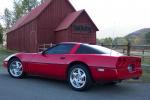




L98 engine overheating

Thread Starter
Advanced

Joined: Apr 2018
Posts: 61
Likes: 1
 L98 engine overheating
Hey guys,
I wanted too reach out too the people here and get some opinions as to what may be going on with my 1985 corvette that's overheating. So I built this car in the past year and a half and in the past month or so I've been able to drive it. I was coming home the other night when all the sudden I noticed the car was starting to overheat (I watch my coolant temp like a hawk).
There was some coolant in the radiator but I pulled over and the radiator fluid had almost completely boiled over into the overflow tank for some odd reason. I have a brand new radiator, I bought a brand new radiator cap yesterday and half of my coolant lines are brand new as well as my thermostat being a year old. I checked my oil for milky residue and there is no combination of oil/coolant which is really good.
I did notice that the main fan was turning on at 240F which seems a litttle late.
Does anybody here have any idea what this could be? I know these L98 engines are notorious for running hot but this one has me stumped
Thanks in advanced
I wanted too reach out too the people here and get some opinions as to what may be going on with my 1985 corvette that's overheating. So I built this car in the past year and a half and in the past month or so I've been able to drive it. I was coming home the other night when all the sudden I noticed the car was starting to overheat (I watch my coolant temp like a hawk).
There was some coolant in the radiator but I pulled over and the radiator fluid had almost completely boiled over into the overflow tank for some odd reason. I have a brand new radiator, I bought a brand new radiator cap yesterday and half of my coolant lines are brand new as well as my thermostat being a year old. I checked my oil for milky residue and there is no combination of oil/coolant which is really good.
I did notice that the main fan was turning on at 240F which seems a litttle late.
Does anybody here have any idea what this could be? I know these L98 engines are notorious for running hot but this one has me stumped
Thanks in advanced

Le Mans Master


Joined: Oct 2004
Posts: 6,314
Likes: 508
From: South-central Missouri
Hey guys,
I wanted too reach out too the people here and get some opinions as to what may be going on with my 1985 corvette that's overheating. So I built this car in the past year and a half and in the past month or so I've been able to drive it. I was coming home the other night when all the sudden I noticed the car was starting to overheat (I watch my coolant temp like a hawk).
There was some coolant in the radiator but I pulled over and the radiator fluid had almost completely boiled over into the overflow tank for some odd reason. I have a brand new radiator, I bought a brand new radiator cap yesterday and half of my coolant lines are brand new as well as my thermostat being a year old. I checked my oil for milky residue and there is no combination of oil/coolant which is really good.
I did notice that the main fan was turning on at 240F which seems a litttle late.
Does anybody here have any idea what this could be? I know these L98 engines are notorious for running hot but this one has me stumped
Thanks in advanced
I wanted too reach out too the people here and get some opinions as to what may be going on with my 1985 corvette that's overheating. So I built this car in the past year and a half and in the past month or so I've been able to drive it. I was coming home the other night when all the sudden I noticed the car was starting to overheat (I watch my coolant temp like a hawk).
There was some coolant in the radiator but I pulled over and the radiator fluid had almost completely boiled over into the overflow tank for some odd reason. I have a brand new radiator, I bought a brand new radiator cap yesterday and half of my coolant lines are brand new as well as my thermostat being a year old. I checked my oil for milky residue and there is no combination of oil/coolant which is really good.
I did notice that the main fan was turning on at 240F which seems a litttle late.
Does anybody here have any idea what this could be? I know these L98 engines are notorious for running hot but this one has me stumped
Thanks in advanced
A pin-hole leak or seeping gasket letting air into the system will expand and force coolant into the overflow. Same goes for a head gasket leaking.
Auto parts stores is where you can get the chemical you put in the coolant that changes color if there is evidence of exhaust gasses getting in the coolant. If no exhaust gasses in it (and too, no sign of water in the oil) then it is a tiny leak somewhere. (The ONE thing I don't like about the LT5s is the expense and effort to change a head gasket. I changed head gaskets on SBCs and even BBCs in my driveway on a Saturday and a six-pack of cold ones - no problem. LT5s...have to come out b/c the cams have to be rephased and doing so with the engine in place is impractical.)
Good luck!
You can rent a pressure kit from AutoZone and pressurize the cooling system and go hunting for leaks OR signs of leaks (i.e., coolant colored track where coolant evaporated).
edit: couldn't locate this earlier, but this turned out to be the latest problem causing the same symptoms you describe:
The overflow tank overflowing when engine was shut off (hot). But, due to a tiny leak (somewhere in the split in the tubing) air was being drawn into the system instead of retracting the coolant from the overflow. Next time out, the engine started running HOTer than normal. And, after shutting the engine off, the normal heat surge pushed more coolant into the overflow reservoir until it spilled out (about a quart) onto the garage floor.
As it happened, in spite of the size of the split seen in the (LT5) coolant elbow photo, the leak was so small that coolant would evaporate and leave no obvious puddles: only a trace of dry green (coolant) residue on the front of the motor, and that only seen with the car up on blocks and a strong light in use.
The split is obvious now, but as the motor cooled the coolant would contract and the system pressure would go negative (vacuum). Normally, this is when coolant would be pulled back out of the overflow back into the system. BUT! due to a tiny pin hole leak in that hose, instead of pulling coolant back into the block, AIR was drawn in instead. So, the clue was after the motor had completely cooled, the overflow bottle was still full of coolant. Ah, HA!!
In the 11 years I've owned the Z, this is the 3rd time this happened. The first two were due to cheap Chinese pressure cap seals. This last one due to OLD coolant hoses. (New ones on order).

Last edited by Paul Workman; Jul 3, 2018 at 10:04 AM.
Thread Starter
Advanced
Joined: Apr 2018
Posts: 61
Likes: 1
IF your radiator is free of debris AND the thermostat is OK, you have a leak in the system.
A pin-hole leak or seeping gasket letting air into the system will expand and force coolant into the overflow. Same goes for a head gasket leaking.
Auto parts stores is where you can get the chemical you put in the coolant that changes color if there is evidence of exhaust gasses getting in the coolant. If no exhaust gasses in it (and too, no sign of water in the oil) then it is a tiny leak somewhere. (The ONE thing I don't like about the LT5s is the expense and effort to change a head gasket. I changed head gaskets on SBCs and even BBCs in my driveway on a Saturday and a six-pack of cold ones - no problem. LT5s...have to come out b/c the cams have to be rephased and doing so with the engine in place is impractical.)
Good luck!
You can rent a pressure kit from AutoZone and pressurize the cooling system and go hunting for leaks OR signs of leaks (i.e., coolant colored track where coolant evaporated).
A pin-hole leak or seeping gasket letting air into the system will expand and force coolant into the overflow. Same goes for a head gasket leaking.
Auto parts stores is where you can get the chemical you put in the coolant that changes color if there is evidence of exhaust gasses getting in the coolant. If no exhaust gasses in it (and too, no sign of water in the oil) then it is a tiny leak somewhere. (The ONE thing I don't like about the LT5s is the expense and effort to change a head gasket. I changed head gaskets on SBCs and even BBCs in my driveway on a Saturday and a six-pack of cold ones - no problem. LT5s...have to come out b/c the cams have to be rephased and doing so with the engine in place is impractical.)
Good luck!
You can rent a pressure kit from AutoZone and pressurize the cooling system and go hunting for leaks OR signs of leaks (i.e., coolant colored track where coolant evaporated).
I am going to look into this further when I get home today. I replaced the head gasket on this car 4 months ago as well as literally every other gasket and I haven't overheated this engine once so I am praying its not my head gasket which is worse case scenario. I haven't looked at the thermostat in several months so I am going to start there as well as using a hose to flush out the entire system.
The water pump and the fan are the only things left that are original in regards to the cooling system. Do you think its in the realm of possibility that the water pump went bad?

Heel & Toe
Joined: May 2018
Posts: 17
Likes: 0
If its a small leak, it could be evaporating while the car is hot. Had a tiny leak on water pump in a different car do that, took months to find it lol Def pressure test the car when cold if you can, then maybe again while its hot for instance if its something that only leaks when it gets hot and parts expand...
Good luck.
Good luck.

Team Owner


Joined: Sep 2003
Posts: 20,172
Likes: 672
From: Freedom is never more than one generation away from extinction.
St. Jude '03 thru '24
Corvette Stories
The Best of Corvette for Corvette Enthusiasts

Corvette ZR1X Will Be Pacing the Indy 500, And Could Probably Race, Too!
Verdad Gallardo
Top 10 Corvettes Coming to Mecum Indy 2026!
Brett Foote
Top 10 C9 Corvette MUST-HAVES to Fix These C8 Generation Flaws!
Michael S. Palmer
10 Revolutionary 'Corvette Firsts' Most People Don't Know
Joe Kucinski
5 Reasons to Upgrade to an LS6-Powered Corvette; 5 Reasons to Stay LT2
Michael S. Palmer
2027 Corvette vs The World: Every C8 vs Its Closest Competitor
Joe Kucinski
10 Most Common Corvette Problems of the Last 20 Years!
Joe Kucinski
5 MOST and 5 LEAST Popular Corvette Model Years in History!
Joe Kucinski
2027 Corvette Buyer's Guide: Everything You Need to Know!
Joe Kucinski
Drifting

Joined: Jun 2013
Posts: 1,590
Likes: 60
From: ft myers FL/Munising MI
 should be a C4 axiom