



cylinder bore finish

Thread Starter
Melting Slicks


Joined: Oct 2000
Posts: 3,010
Likes: 1
From: Sweden/Stockholm

Originally Posted by redrose
i have a converted lt1 intake on my l98 and on two other sbc-1 engines--no leaks....i use the ''printo-seal'' gaskets
oil on top (inside cylinder head) of the intake valves is not acceptable and is either due to pcv valve (common), intake gaskets, or valve stem seals (worn or oversized guides can prevent seal function)
any new cylinder head (aluminum or iron) will experience some changes dimensionally during the first few heat cycles (50 cycles is usually considered sufficient to stabilize a new casting by ''experts'')....check for stem clearance with dial indicator and if ok,''hand lap'' valves lightly and look at lapping line on valve to ascertain that valve seating is correct... a good valve job on ''new'' heads that have been ''seasoned'' is highly recommended
oil on top (inside cylinder head) of the intake valves is not acceptable and is either due to pcv valve (common), intake gaskets, or valve stem seals (worn or oversized guides can prevent seal function)
any new cylinder head (aluminum or iron) will experience some changes dimensionally during the first few heat cycles (50 cycles is usually considered sufficient to stabilize a new casting by ''experts'')....check for stem clearance with dial indicator and if ok,''hand lap'' valves lightly and look at lapping line on valve to ascertain that valve seating is correct... a good valve job on ''new'' heads that have been ''seasoned'' is highly recommended
How can the PCV vavle cause oil on the vavles? Bad PCV vavle, or a faulty installed PCV system?
And could you explain more about the "..and if ok,''hand lap'' valves lightly and look at lapping line on valve to ascertain that valve seating is correct". Dont follow you there. What is "lapping" ? My english sucks

thanks..

Safety Car

Joined: May 1999
Posts: 3,651
Likes: 5
From: Atlantis
Cruise-In I Veteran
Because this post appears to be directed toward discrediting what I have gone out of my way to share, I am compelled to reply. I have seen with my own eyes just how important torque plating is on modern small block chevy. When not using one distorts a cylinder 3-4 thousands of an inch, as witnessed by me time and time again, I fail to see how it is only optional. But then again, what do I know.
That was NOT my intention at all.
I thought I said Torque Plates were a good thing.
I just said they were not an absolute necessity to achieving a good ring seal.
Surely you wouldn't argue that MILLIONS of good,reliable engines have been built without the use of them.
The factories (ALL of them) did it for years and years and engines ran fine.
I would EMPHATICALLY state that it may be a teeny bit presumptious to say the cause of oil consumption on this particular engine was caused by honing without a torque plate.
If that were the case there'd be millions of them with problems.
WIthout ALL the rest of the facts concerning THIS engine I don't think I could POSSIBLY make an accurate diagnosis. "But what do I know".
Maybe I could take a SWAG at it.... but what would that be worth????
About as much as anyone else's guess???
If I somehoe steped on your toes, I might point out there are a LOT of people that know more than you OR I about building engines.
We don't ALL know the same things or express the same points exactly the same wat.
You may surmise from what I wrote that I have built one or two engines personally and I've spent just a 'little' time learning from folks that knew certain 'fine points' of engine building.
That doesn't mean I know more than anybody else or more than you.
Did it bother you that I "SHARED" a bit of what I know???
Why???????????? I never intended to dispute anything you said but rather to just 'point out the obvious'.
ANy engine builder that said honing without torque plates was a 'better' method wouldn't be much of an engine builder. Didn't I make that clear??
Concerning torque plates..... I simply said...... they were not necessary to have an engine that runs good, has low or no oil consumption and will have a good service life. ISN'T that what we all want in a street engine? Again I'm NOT saying they are 'good for nothing'.
I wasn't trying to dispute anything you said. And I don't intend to have an argument over it here. THAT would be a TOTAL waste of MY time...and yours.
Pretty much what THIS post was.
No problem, I can find something else to do with my time. You can be the 'chief advisor' here if you like. It won't hurt my feelings.
Good luck with your engine devilfish.
BTW DevilFish, if you REALLY want to get down to the superfine points of building engines, concerning honing, the block SHOULD be filled with coolant and heated to the operating temperature expected during operation. That's after the torque plates are bolted on AND the main bearing caps are torqed to specs.
If you REALLY want to do it "right". Might as well bolt on the bell housing and torque it down because it WILL change the shape of the block also. How about bolting the engine mounts on and having the weight of the block supported by the engine mounts.
But is all THAT necessary for the normal production tolerance street driven engine???
Maybe someone else can expound on that a little. What do "I" know?
Pk, enough long posteses... I'm going work on something.

Le Mans Master


Joined: Oct 2004
Posts: 5,841
Likes: 19
From: CLT, North Carolina
Yes it is possible the intake manifold surface angle is not aligned with the head surface allowing a leak path. Look at the imprint in the old gaskets to check for uneven gasket compression. Look for the possibility of a leak path on the bottom edge. Concerning valve guides: It is very important that you do not have excessive stem to guide clearance. knurled guides and bronze wall liners have a very short lifespan and will wear out very quickly causing all kinds of grief, make sure you always install new guides. There are several good positive type oil seals on the market now but the tops of the guides may have to be machined to accept them. Getting back to the torque plate issue: it will be possible to confirm whether your block was honed with them but you will need a good dial bore gauge which reads in tenths (.0001") increments. Pull the rest of the engine out of the car and put it on a stand; remove the crankshaft, rods & pistons and torque the heads back on with your old head gaskets. Get the same person who put the heads on before to put em back on again using the same torque wrench. If the pistons are .030 over set the gauge to 4.030 with a micrometer that has been checked with a standard (good mikes come with them) and check for out of round with taper (tight at the top). If found to be within .001 do not lose anymore sleep over this (the best wouldn't be any better than .0005). The money spent to chase this one would probably be better off invested somewhere else. There is no substitute for knowing you have an honest knowledgeable engine builder/machinist who is genuinly interested in the quality of his work.
Regards, Greg
Regards, Greg

Melting Slicks

Joined: Feb 2006
Posts: 2,753
Likes: 15
From: backwoods upstate ny
Originally Posted by devilfish
Ok i see.
How can the PCV vavle cause oil on the vavles? Bad PCV vavle, or a faulty installed PCV system?
And could you explain more about the "..and if ok,''hand lap'' valves lightly and look at lapping line on valve to ascertain that valve seating is correct". Dont follow you there. What is "lapping" ? My english sucks
thanks..
How can the PCV vavle cause oil on the vavles? Bad PCV vavle, or a faulty installed PCV system?
And could you explain more about the "..and if ok,''hand lap'' valves lightly and look at lapping line on valve to ascertain that valve seating is correct". Dont follow you there. What is "lapping" ? My english sucks
thanks..
lapping uses a fine abrasive slurry applied between the valve and its seat (no valve spring, etc installed)...the valve is then rotated back and forth to ''grind'' a precise fit of the two together (this is very commonly done on motorcycle engines where limited number of cylinders makes each cylinder critical--visit any motorcycle repair shop)...there are machines to do this, but if you do it ''lightly'' by hand the valve face will only have a ''gray line'' part way around it if the casting has ''moved'' and the guide no longer ''guides'' the valve to the seat , or the valve head is warped (repeat with a known straight valve if you have no way of checking the first one)...lapping line on valve should not be wider than seat width...do not look at seat for evidence of fit,it is very difficult to see there.
your english is fine...much,much better than my swedish i am certain
Thread Starter
Melting Slicks
Joined: Oct 2000
Posts: 3,010
Likes: 1
From: Sweden/Stockholm
I noticed today I got pretty much oil in the intake as well. I dont know if thats "normal" and from the PCV system. Im going to change the vavle guides and seal just to be sure on the heads.
I also looked at the old intake gasket, the gasket I used for the lt1 intake whas a mr-gasget MRG-101B. Wrong gasket?
I also provide a picture of one of the intake vavles.

The black is from the burned oil I got there. This vavle i cleand as good as i could. But i cant get that last black off
This make me belive I got som probleme with the heads or intake more then a blow-by probleme. Is it even possible for oil to get ontop of the intake vavle if the oil is comming from blow-by?
Thanks m8s for helping out.
I also looked at the old intake gasket, the gasket I used for the lt1 intake whas a mr-gasget MRG-101B. Wrong gasket?
I also provide a picture of one of the intake vavles.
The black is from the burned oil I got there. This vavle i cleand as good as i could. But i cant get that last black off
This make me belive I got som probleme with the heads or intake more then a blow-by probleme. Is it even possible for oil to get ontop of the intake vavle if the oil is comming from blow-by?
Thanks m8s for helping out.

Drifting

Joined: Dec 2005
Posts: 1,360
Likes: 3
From: NORTHEAST
At our shop we have always used torque plates and we use a Sunnen 616 to do the finish honing and we build a lot circle track engines in the area and street performance engines as well and we spend a lot of detail to cylinder finish and have the cylinders a true 45 degrees from cam and crank center lines and a True 90 degrees to the crank.
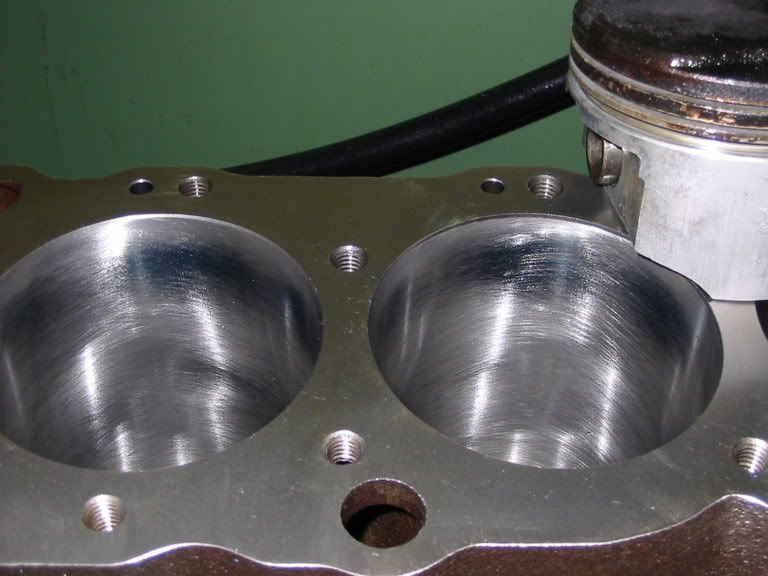
Here is a pic of a 454 that came in last summer using some oil and poor performance and when we got the pistons out and saw the blowby problemss under the top ring and so we blued the cylinders and put the plate on and hone it for a few strokes and notice the piston as there are signs of blowby down to the oil ring and this engine had less then 2500 miles on since it was rebuilt. We found no big probles with the head work and the local garage assembled the engine with the same cam and so far the engine is a whole different beast and athe custmer said it nite and day differance and the oil consumption has stopped.
Again this is what rings face with a block thats not plate honed properly how would thse rings even have a chance to seal.
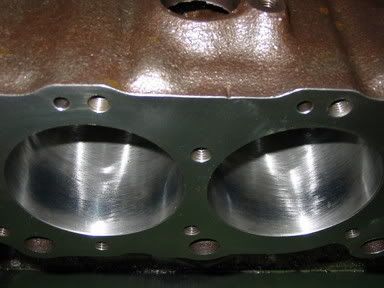
A pic of the other side of the cylinders
And here is alink I did on another forum on blue print machining a block.
http://www.chevelles.com/forums/showthread.php?t=93124
Here is a pic of a 454 that came in last summer using some oil and poor performance and when we got the pistons out and saw the blowby problemss under the top ring and so we blued the cylinders and put the plate on and hone it for a few strokes and notice the piston as there are signs of blowby down to the oil ring and this engine had less then 2500 miles on since it was rebuilt. We found no big probles with the head work and the local garage assembled the engine with the same cam and so far the engine is a whole different beast and athe custmer said it nite and day differance and the oil consumption has stopped.
Again this is what rings face with a block thats not plate honed properly how would thse rings even have a chance to seal.
A pic of the other side of the cylinders
And here is alink I did on another forum on blue print machining a block.
http://www.chevelles.com/forums/showthread.php?t=93124
Corvette Stories
The Best of Corvette for Corvette Enthusiasts

Top 10 Most Expensive Corvettes Ever Sold on Bring A Trailer
Brett Foote
10 Things Every Corvette Owner Needs (2026 Edition)
Michael S. Palmer
8 Most "Only Corvette Owners Understand" Quirks and Problems
Pouria Savadkouei
10 Reasons the C6 Z06 is Still A Performance Benchmark After 20 Years
Joe Kucinski
How Much Horsepower Every Corvette Engine "LOST" in 1972
Joe Kucinski
Top 10 DOs and DON'Ts for Protecting Your Convertible Top!
Michael S. Palmer
Top 10 Most Explosive Corvettes Ever Made: Power-to-Weight Ratio Ranked!
Joe Kucinski
150 hp to 1,250 hp: Every Corvette Generation Compared by the Specs That Matter
Joe Kucinski
8 Coolest Corvette Pace Cars (and Replicas) of All Time
Verdad Gallardo
Burning Brakes

Joined: Nov 2001
Posts: 1,189
Likes: 2
From: Austin TX
Originally Posted by devilfish
so even if the oil is coming from a bad ring seal it can lead to the burned oil on top of my intake vavles?
Thread Starter
Melting Slicks
Joined: Oct 2000
Posts: 3,010
Likes: 1
From: Sweden/Stockholm
Originally Posted by danno85
A bad ring seal results in blow-by. Blow-by results in two things. The oil gets dirty very quickly, and you get excessive crankcase pressure. The excessive crankcase pressure forces oil down the valve guides, no matter how good your valve seals are. So yes, bad ring seal can lead to oil deposit build-up on the top of the intake valve.
Im just guessing here...
thanks
Melting Slicks
Joined: Feb 2006
Posts: 2,753
Likes: 15
From: backwoods upstate ny
Originally Posted by devilfish
so even if the oil is coming from a bad ring seal it can lead to the burned oil on top of my intake vavles?
normal ''reversion'' pushes carbon deposits all the way back to the throttlebody...a ''retarded'' cam will increase carbon accumulation...soaking in lacquer thinner or brake cleaner combined with a little scrubbing should remove carbon from steel and polished aluminum surfaces, porous aluminum is much harder to clean-visit a local motorcycle shop for what they use
Thread Starter
Melting Slicks
Joined: Oct 2000
Posts: 3,010
Likes: 1
From: Sweden/Stockholm
Originally Posted by redrose
what i see in the pic looks more like carbon left from the combustion process...if this is wet and will soak into a piece of paper it is oil--if it is dry and very hard it is carbon.
normal ''reversion'' pushes carbon deposits all the way back to the throttlebody...a ''retarded'' cam will increase carbon accumulation...soaking in lacquer thinner or brake cleaner combined with a little scrubbing should remove carbon from steel and polished aluminum surfaces, porous aluminum is much harder to clean-visit a local motorcycle shop for what they use
normal ''reversion'' pushes carbon deposits all the way back to the throttlebody...a ''retarded'' cam will increase carbon accumulation...soaking in lacquer thinner or brake cleaner combined with a little scrubbing should remove carbon from steel and polished aluminum surfaces, porous aluminum is much harder to clean-visit a local motorcycle shop for what they use
I got that 7 of the intake vavles. My first thougt whas oil.
So is it "normal" to get carbon buildup like this? That must kill preformance?
Regards..
Burning Brakes
Joined: Nov 2001
Posts: 1,189
Likes: 2
From: Austin TX
Originally Posted by devilfish
I see. Wount that excessive crankcase pressure show it self as much smoke coming out from the vavle cover PCV "hole" ? Or that you can "feel" the pulses if you put your finger over the "hole" ?
Im just guessing here...
thanks
Im just guessing here...
thanks
Thread Starter
Melting Slicks
Joined: Oct 2000
Posts: 3,010
Likes: 1
From: Sweden/Stockholm
Originally Posted by danno85
You have to have something really seriously wrong, like broken rings, to see a bunch of smoke and / or feel pulses at a vented opening. The blow-by has to only be enough to overcome the capacity of the PCV system for crankcase pressure to build. It can build slowly, and will be more prevelant with the engine under load (i.e. accelerating) than idling, so your less likely to be able to detect it in the shop.
Thanks for the info m8.
Melting Slicks
Joined: Feb 2006
Posts: 2,753
Likes: 15
From: backwoods upstate ny
Originally Posted by devilfish
What you see on the intake vavle is what I couldent get off. But is whas not soft "goo" more hard and I could not remove it with my nail hade to use tools
I got that 7 of the intake vavles. My first thougt whas oil.
So is it "normal" to get carbon buildup like this? That must kill preformance?
Regards..
I got that 7 of the intake vavles. My first thougt whas oil.
So is it "normal" to get carbon buildup like this? That must kill preformance?
Regards..
a small amount of carbon build-up actually increases performance by very slightly raising compression in the cylinder...large deposits which become ''glow plugs''(causing preignition) and which make flake off and cause cylinder wall or valve seat damage are not desireable.
never scrape carbon from the piston tops while the piston is in the motor--small carbon chips which are diamond-hard will be left in the cylinder alongside the piston --careful use of brake cleaner and a cloth rag is acceptable as long as all contaminents are dissolved by the cleaner before removal
Drifting
Joined: Dec 2005
Posts: 1,360
Likes: 3
From: NORTHEAST
One other reason there might be some scuffing in the cylinders as first posted is there are a lot of shops out there that don't have the right measuring equipment or hone equipment to clearance the pin bores of the pistons as every set of pistons that has come through the shop we have had to nachine them for the proper fit.
Some times we have rods and pistons come in the shop and upon disassembly when have found gauling and wrist pin sdiscolored and piston and skirt and cylinder walls damaged do to the pin bores in the pistons being to tight.
And in some cases when the rods are resized no one spends the time to check them for bend and twist which will cause oil consumption as the ring will not set square in the bore.
Some times we have rods and pistons come in the shop and upon disassembly when have found gauling and wrist pin sdiscolored and piston and skirt and cylinder walls damaged do to the pin bores in the pistons being to tight.
And in some cases when the rods are resized no one spends the time to check them for bend and twist which will cause oil consumption as the ring will not set square in the bore.
Thread Starter
Melting Slicks
Joined: Oct 2000
Posts: 3,010
Likes: 1
From: Sweden/Stockholm
Just a update.
My engine builder is going to give me a new 4 bolt block. And hone it with torqueplate free of charge. I will reuse my piston and hole rotating assemby as they are almost brand new. He will also provide new bearings.
Thanks a lot for the help and feeback. if it whasent for you I still be driving a oil eating engine and be down on preformance.
The reason he will give it to me is so that I dont need to get new pistons that are oversize, and then rebalance the hole thing..
Best regards
Devil...
My engine builder is going to give me a new 4 bolt block. And hone it with torqueplate free of charge. I will reuse my piston and hole rotating assemby as they are almost brand new. He will also provide new bearings.
Thanks a lot for the help and feeback. if it whasent for you I still be driving a oil eating engine and be down on preformance.
The reason he will give it to me is so that I dont need to get new pistons that are oversize, and then rebalance the hole thing..
Best regards
Devil...


Race Director


Joined: Feb 2004
Posts: 12,518
Likes: 19
Originally Posted by redrose
sounds like he's honest and takes care of his customers..post his name details for the benefit of all
 The problem becomes unimportant when a good guy steps up to the plate to do the right thing.