


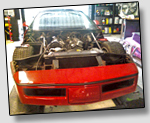


Help! Problem bleeding at master cylinder ('89)
Thread Starter
Advanced

Joined: Mar 2005
Posts: 60
Likes: 0
From: Northern Virginia
 Help! Problem bleeding at master cylinder ('89)
Following service manual instructions to bleed at master cylinder. Forward brake pipe did as manual described when loosened with brake pressed - all fluid, no air. Disconnected rear brake pipe completely and no fluid comes out at all! Both reservoirs are full.
The service manual says fluid should pour out. It doesn't.
Any ideas?
The service manual says fluid should pour out. It doesn't.
Any ideas?

Melting Slicks


Joined: Apr 2002
Posts: 2,118
Likes: 0
From: St. Charles, MO Route 66 Corvette Club
I just helped a friend install an new MC in his 88 Vette 2 weeks ago. We secured the new MC into a bench vise and used a set of bench bleeding tubes. There are two tubes and each tube attaches to a plastic fitting that goes the threaded hole in the front and rear sections of the MC. The reservoirs were filled with new fluid. The pumping process was started. Immediately, the front piston began to pump air and within a few minutes the fluid was clear. We were not able to detect any air bubbles in the rear section of the MC. After pumping for at least 10 more minutes, suddenly we had mucho air bubbles. Shortly, the bubbles were gone. We bled each wheel using a Mityvac and the breaks are very good. If you want a photo of the bench bleeding tubes and fittings, please advise. Red C6: I would bet you did not bleed the MC long enough to remove the air from the rear section of the MC 
Last edited by Sam Lam; Dec 26, 2006 at 06:47 PM. Reason: error
Thread Starter
Advanced
Joined: Mar 2005
Posts: 60
Likes: 0
From: Northern Virginia
It's not a new master cylinder
This is not a new master cylinder - I recently bought the car. Very possible the master cylinder has 115,000 miles on it. Brakes were mushy, so I decided to replace the dirty brake fluid as a start. Started with the master cylinder and that's where I hit this problem. Can't get any fluid to come out of the rear brake tube.
Where do I go from here? Take it out, bench bleed, and put it back in? New master cylinder?
Thanks.
Where do I go from here? Take it out, bench bleed, and put it back in? New master cylinder?
Thanks.
Le Mans Master


Joined: Mar 2004
Posts: 8,700
Likes: 298
From: Ft. Lauderdale Fl
This is not a new master cylinder - I recently bought the car. Very possible the master cylinder has 115,000 miles on it. Brakes were mushy, so I decided to replace the dirty brake fluid as a start. Started with the master cylinder and that's where I hit this problem. Can't get any fluid to come out of the rear brake tube.
Where do I go from here? Take it out, bench bleed, and put it back in? New master cylinder?
Thanks.
Where do I go from here? Take it out, bench bleed, and put it back in? New master cylinder?
Thanks.
Check you have a good master cylinder----disconnect both lines from the M/C to confirm fluid is comming out of both lines (have someone apply brake while seeing fluid flow).
Melting Slicks
Joined: Apr 2002
Posts: 2,118
Likes: 0
From: St. Charles, MO Route 66 Corvette Club
I assume you did not damage brake lines (like elefkow suggested) when you jacked up the car. Jack up the rear end just enough to get the wheels off. Remove one brake bleeder screw from a rear caliper. Note two things: does fluid slowly drip out the bleeded screw hole and is the hole in the bleeder screw itself stopped up? Try the other caliper. The hole in the bleeder screws tends to get crap in them and they will not bleed properly. Do this and let us know what you find.
Thread Starter
Advanced
Joined: Mar 2005
Posts: 60
Likes: 0
From: Northern Virginia
Thanks for the advice
I was concerned about pressing the brake pedal with the rear brake pipe disconnected from the master cylinder. When it's disconnected, nothing comes out. I'll try pressing the brake pedal with it disconnected to see if I get any fluid coming out. Was worried I would let more air in than out of the master cylinder and make the problem worse.
I was following the service manual which says to press the brake pedal, loosen the brake pipe at the master cylinder, let the air out, tighten the brake pipe and then release the brake pedal. Did this at least 30 times and still no fluid coming out of the rear fitting of the master cylinder. Took about an hour to do it (with pedal pusher help, of course).
I was following the service manual which says to press the brake pedal, loosen the brake pipe at the master cylinder, let the air out, tighten the brake pipe and then release the brake pedal. Did this at least 30 times and still no fluid coming out of the rear fitting of the master cylinder. Took about an hour to do it (with pedal pusher help, of course).
Melting Slicks
Joined: Apr 2002
Posts: 2,118
Likes: 0
From: St. Charles, MO Route 66 Corvette Club
Red: when you remove the bleeder screws, DO NOT PRESS THE BRAKE PEDAL! The fluid should slowly drip out the screw hole. As the fluid drips out, the reservoir in the MC will slowly drop. This practice will not introduce air into the system.......assuming you do not press the brake pedal! Air can be introduced into the system if you press AND release the pedal with the bleeder screw open. I hope this makes sense!
Last edited by Sam Lam; Dec 27, 2006 at 10:21 AM. Reason: add information
Corvette Stories
The Best of Corvette for Corvette Enthusiasts

Top 10 Most Explosive Corvettes Ever Made: Power-to-Weight Ratio Ranked!
Joe Kucinski
150 hp to 1,250 hp: Every Corvette Generation Compared by the Specs That Matter
Joe Kucinski
8 Coolest Corvette Pace Cars (and Replicas) of All Time
Verdad Gallardo
Top 10 Corvette Engines RANKED by Peak Torque (70+ Years of Muscle!)
Joe Kucinski
Corvette ZR1X Will Be Pacing the Indy 500, And Could Probably Race, Too!
Verdad Gallardo
Top 10 Corvettes Coming to Mecum Indy 2026!
Brett Foote
Top 10 C9 Corvette MUST-HAVES to Fix These C8 Generation Flaws!
Michael S. Palmer
10 Revolutionary 'Corvette Firsts' Most People Don't Know
Joe Kucinski
5 Reasons to Upgrade to an LS6-Powered Corvette; 5 Reasons to Stay LT2
Michael S. Palmer
Thread Starter
Advanced
Joined: Mar 2005
Posts: 60
Likes: 0
From: Northern Virginia
Thanks for the response
Red: when you remove the bleeder screws, DO NOT PRESS THE BRAKE PEDAL! The fluid should slowly drip out the screw hole. As the fluid drips out, the reservoir in the MC will slowly drop. This practice will not introduce air into the system.......assuming you do not press the brake pedal! Air can be introduced into the system if you press AND release the pedal with the bleeder screw open. I hope this makes sense!
Maybe you are saying that the suction from bleeding at the caliper will pull fluid into the master cylinder?
Melting Slicks
Joined: Apr 2002
Posts: 2,118
Likes: 0
From: St. Charles, MO Route 66 Corvette Club
Red: The best investment you can make on brake maintenance is to purchase a Mityvac tool. I bought model 04000 from Sears and it cost $75. There is a plastic version of this and it is about $35. Here is a photo for your reference:

This tool will work for most all auto brake systems. You simply attach the vac line to the caliper bleed screw, open the screw about 1 turn and start the sucking (by pumping the handle) process. As you suck fluid out of the caliper, the fluid level in the MC will drop. Do not let the MC run dry of fluid!!!! This will allow you to flush your brake system in less than an hour. This flush process also removes any trapped air in the brake system.
Just a note on the flushing process: use a turkey baster of a battery filler to suck all the old fluid out of the MC before you flush the system. Clean out the crap in the bottom of the MC with a clean rag and add new fluid to the MC before you start "sucking"
For the problem you state in your posts, this tool would be my recommendation.
This tool will work for most all auto brake systems. You simply attach the vac line to the caliper bleed screw, open the screw about 1 turn and start the sucking (by pumping the handle) process. As you suck fluid out of the caliper, the fluid level in the MC will drop. Do not let the MC run dry of fluid!!!! This will allow you to flush your brake system in less than an hour. This flush process also removes any trapped air in the brake system.
Just a note on the flushing process: use a turkey baster of a battery filler to suck all the old fluid out of the MC before you flush the system. Clean out the crap in the bottom of the MC with a clean rag and add new fluid to the MC before you start "sucking"
For the problem you state in your posts, this tool would be my recommendation.
Thread Starter
Advanced
Joined: Mar 2005
Posts: 60
Likes: 0
From: Northern Virginia
An update
I was able to get the Master Cylinder full by bleeding one of the rear calipers with a speed bleeder. After doing it for a while, I checked at the master cylinder and there was no air coming out of the rear brake tube. I then flushed all four calipers, in the correct order.
But I am still left with problem of a mushy brake, a right rear brake that seems to be barely used when brakes are applied, and a new left rear brake rotor that is binding with a new caliper. Was hoping flushing the entire system would fix all three. But that will be the topic of another thread.
Thanks for the help!
But I am still left with problem of a mushy brake, a right rear brake that seems to be barely used when brakes are applied, and a new left rear brake rotor that is binding with a new caliper. Was hoping flushing the entire system would fix all three. But that will be the topic of another thread.
Thanks for the help!
