


Red Tek for A/C recharge?

Thread Starter
Pro


Joined: Nov 2005
Posts: 602
Likes: 0
From: North Bay Ontario
 Red Tek for A/C recharge?
Has anyone used this product as as a direct replacement and retrofit refrigerant option for replacing R134a and R12 refrigerants? It has been recommended for my 85 which is, of course, set up for R12.

Le Mans Master


Joined: Sep 2006
Posts: 6,050
Likes: 147
From: Phoenix AZ
2021 C4 of the Year - Modified Finalist
freon
No experience with that product, but here's what I did
I have an 86, and when the air compressor seals went, so did the R12. I had the seals replaced, and the counter guy pushed 4 cans of 134 freon over with the compressor, and sold them to me for $4 a can. I didn't say anything, duh, I thought they put in 134 seals. I have a friend that works at u-haul fixing air conditioning in the trucks, and he said I could use that if I changed the dryer, and used pac-oil.
So I got some pac oil, put in about an ounce and a half in the dryer, put it all back together, got a 134 switchover kit, and filled it with 2 and a quarter cans of 134, and it works like it used to.
I was told by my friend that the 2 freons expand at different rates, and if I wanted even better cooling, I would need to change the orifice in a tube to make the expansion rate orifice compatible with the freon. I didn't do it, and it works like it used to so no problems so far.
The guy at the rebuild shop said usually the only place these newer systems leak is at the compressor seals. so that's why I did that. It doesn't leak any more either.
I would guess that's what you should do if you want the A/C back. It's cheaper, and you get about the same cooling.
I have an 86, and when the air compressor seals went, so did the R12. I had the seals replaced, and the counter guy pushed 4 cans of 134 freon over with the compressor, and sold them to me for $4 a can. I didn't say anything, duh, I thought they put in 134 seals. I have a friend that works at u-haul fixing air conditioning in the trucks, and he said I could use that if I changed the dryer, and used pac-oil.
So I got some pac oil, put in about an ounce and a half in the dryer, put it all back together, got a 134 switchover kit, and filled it with 2 and a quarter cans of 134, and it works like it used to.
I was told by my friend that the 2 freons expand at different rates, and if I wanted even better cooling, I would need to change the orifice in a tube to make the expansion rate orifice compatible with the freon. I didn't do it, and it works like it used to so no problems so far.
The guy at the rebuild shop said usually the only place these newer systems leak is at the compressor seals. so that's why I did that. It doesn't leak any more either.
I would guess that's what you should do if you want the A/C back. It's cheaper, and you get about the same cooling.
Last edited by coupeguy2001; Feb 24, 2007 at 10:00 AM.
Thread Starter
Pro
Joined: Nov 2005
Posts: 602
Likes: 0
From: North Bay Ontario
Coupeguy - Thanks for the sharing your experience with switching to r134. If I understood you correctly, you replaced your compressor? I was told that a proper conversion here would run me about $400 including labour, purging the system, parts. Figured I'd bump this thread to see if anyone has found the Red Tek idea to be a successful alternative?

Le Mans Master


Joined: Apr 2002
Posts: 5,727
Likes: 47
From: Waukesha WI
St. Jude Donor '15
I would stay away from any blends. You may make enemies at an A/C shop if you ever bring it in for service and the blends rarely work as well as sticking with R12 or R134a straight up.
Staying with R12 is the considered to be the easiest. However, to do the job correctly requires the same amount of work - just a different choice of materials. Either way, you still should find/repair the leak, replace the accumulator, o-rings, and do a flush to clean out any debris (mainly old oil and wear particles from the compressor). After that, it's just a choice of materials when you put it back together.
There is no magic to converting to 134a and, after all is said and done, it should be about the same price to do either correctly.
Staying with R12 is the considered to be the easiest. However, to do the job correctly requires the same amount of work - just a different choice of materials. Either way, you still should find/repair the leak, replace the accumulator, o-rings, and do a flush to clean out any debris (mainly old oil and wear particles from the compressor). After that, it's just a choice of materials when you put it back together.
There is no magic to converting to 134a and, after all is said and done, it should be about the same price to do either correctly.

Drifting

Joined: Oct 2006
Posts: 1,934
Likes: 3
From: Citrus Heights California
I had an air conditioning specialist convert my unit. He put in a new compresser and rebuilt the hoses. Out the door was about $700.00. The old unit leaked freon and would not cool. Now when it's 110 degrees I keep it at 70 degrees inside. Nice!

Le Mans Master
Joined: Jan 2002
Posts: 9,036
Likes: 13
From: Edmonton AB
I have Red Tek in an E34 5-Series BMW.
An independent shop recommended it and I agreed without any
research. Later I learned a little about the composition and the
question about possible flammability in an accident.
Here is a post of mine from five years ago which drew no responses
An independent shop recommended it and I agreed without any
research. Later I learned a little about the composition and the
question about possible flammability in an accident.
Here is a post of mine from five years ago which drew no responses
I'm looking for comments regarding the suitability of HC replacements for
automotive use.
I am interested in particular in whether anyone has any knowledge/experience with
Red Tek 12a (aka: Enviro-Safe).. If I have my facts straight, this is an
alkane (propane/butane mix) product.
What I understand so far is that the HC's give equivalent or superior
cooling compared to R12 and much better performance than 134a but
that there IS/IS NOT (depends who you listen to) a significant risk of fire
explosion due to their flammable components. (The naysayers claim the
auto-ignition point is so high as to not be a factor).
Cheers
Ken R.
Whew, a little knowledge is a dangerous thing! What your neighbor uses.
- http://www.hc-tech.com/forum/pages/forum.html
Envirosafe TechInfo
http://autorefrigerants.com/Envirotechnical.htm
-
EPA speaks up about Red Tek (search for 'Red Tek')
http://www.epa.gov/docs/ozone/title6/snap/612not14.pdf.
Red Tek sites
- http://sfrcolorado.com/tcbrr1.htm
- http://autorefrigerants.com/ (search for 'Red 'Tek')
- http://red-tek.com/
automotive use.
I am interested in particular in whether anyone has any knowledge/experience with
Red Tek 12a (aka: Enviro-Safe).. If I have my facts straight, this is an
alkane (propane/butane mix) product.
What I understand so far is that the HC's give equivalent or superior
cooling compared to R12 and much better performance than 134a but
that there IS/IS NOT (depends who you listen to) a significant risk of fire
explosion due to their flammable components. (The naysayers claim the
auto-ignition point is so high as to not be a factor).
Cheers
Ken R.
Whew, a little knowledge is a dangerous thing! What your neighbor uses.
- http://www.hc-tech.com/forum/pages/forum.html
Envirosafe TechInfo
http://autorefrigerants.com/Envirotechnical.htm
-
EPA speaks up about Red Tek (search for 'Red Tek')
http://www.epa.gov/docs/ozone/title6/snap/612not14.pdf.
Red Tek sites
- http://sfrcolorado.com/tcbrr1.htm
- http://autorefrigerants.com/ (search for 'Red 'Tek')
- http://red-tek.com/

Le Mans Master
Joined: Dec 2000
Posts: 7,839
Likes: 22
From: San Diego, Ca
Technically, it's illegal to dump in any HC based refrigerant in the US and possession is specifically outlawed in 20 or so States. Far more popular in Canada and Europe. Check flashpoint before using; don't assend anybody.
Corvette Stories
The Best of Corvette for Corvette Enthusiasts

5 Best & 5 Worst Corvette Daily Drivers
Joe Kucinski
The Headlights of Every Corvette Generation Explained
Joe Kucinski
5 Best & 5 Most Overrated Corvette Track Packages of All Time!
Joe Kucinski
Every 2027 Corvette Engine Explained
Joe Kucinski
Designer Imagines A Corvette That Looks More Like a Corvette Than the Corvette
Verdad Gallardo
10 Ugly Corvettes That We Still Kinda Love
Joe Kucinski
Top 10 Most Expensive Corvettes Ever Sold on Bring A Trailer
Brett Foote
10 Things Every Corvette Owner Needs (2026 Edition)
Michael S. Palmer
8 Most "Only Corvette Owners Understand" Quirks and Problems
Pouria Savadkouei
Team Owner

Joined: May 2002
Posts: 24,337
Likes: 25
From: San Diego , CA Double Yellow DirtBags 1985..Z51..6-speed
Nobody ever complained about driving around with 20 gallons of highly flammable gasoline pumping through their car.
I thought all those older refrigerants were flammable.
I thought all those older refrigerants were flammable.
Le Mans Master
Joined: Jan 2002
Posts: 9,036
Likes: 13
From: Edmonton AB
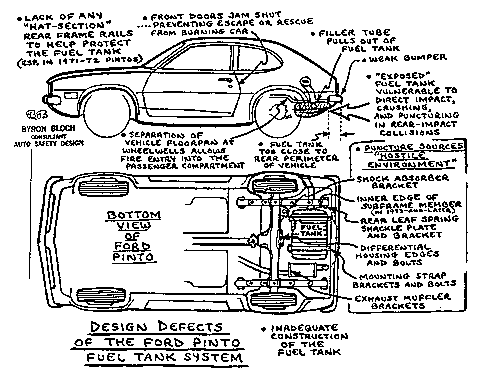
'The Historical Case Against the Placement of Gas Tanks Outside the
Frame Rails on the 1973-87 General Motors C & K Model Pickup Trucks'

.

Le Mans Master
Joined: May 2006
Posts: 9,226
Likes: 9
From: Irvine Ca
Just use 134a. Sure.....it doesn't work as well as R12. This doesn't mean your air won't blow cold. "Work as well" is a component of time. 134a will cool off and blow cold just not as quick as R12 hence the "Bad performance" reputation it has, However, in our cabin Mine blows a frigid 42° F I usually have to turn it down, even on a hot day. I'll post a pic later.
On My RX-7 it Blew 30°. On a 100°F Summer day I could get Chills inside a convertible with a Black top.

On My Celica, it would Blow Ice Crystals out the Center Vents.
Here is where the Disconnect is concerned.......Free Fluorine Molecules in the system. Fluorine in a confined system is not corrosive however if it is in free form or mixed with other gasses it can become highly corrosive. Once you introduce R134a into an R12 system you now have free fluorine molecules that will eat condensers, Evaporators and o-rings. Adding this gas to a already 20 year old system is just asking for trouble. Not to mention, why are people adding this cheap gas to their system in the first place? Could it be there is already a leak? I think so, that is why it stopped working in the first place.
Answer? Purge.
You can purge the system by vacuum or in the case of an old 20 year old leaky system....."perma-purge".... is what I call it. You fill the system and it purges itself over time through the existing leak...then you refill it. Most likely most of the fluorine will go out with the R134a and run directly to the Ozone layer.......that is another thread.
Understand the Oil in the system is completely contaminated with the R12 molecules and it may never be able to be removed via purge. So when you hear an Expert say that you need to replace numerous components He is correct.
Correct in the sense of how to repair the system to last another 20 years with out so much as a recharge.
Here is the difference. The OP is a person that owns one maybe two wrenches. He can refill the system in the amount of time it takes to Check the oil and add a quart. So if you don't mind just putting in a Can of $5 R134a now and again, just use said R134a and prepare to buy a new can every 6 months and along with your nifty little blue hose you can recharge the system in the parking lot of Kragen while you Show off your Ceramic coated Headers.
On My RX-7 it Blew 30°. On a 100°F Summer day I could get Chills inside a convertible with a Black top.
On My Celica, it would Blow Ice Crystals out the Center Vents.
Here is where the Disconnect is concerned.......Free Fluorine Molecules in the system. Fluorine in a confined system is not corrosive however if it is in free form or mixed with other gasses it can become highly corrosive. Once you introduce R134a into an R12 system you now have free fluorine molecules that will eat condensers, Evaporators and o-rings. Adding this gas to a already 20 year old system is just asking for trouble. Not to mention, why are people adding this cheap gas to their system in the first place? Could it be there is already a leak? I think so, that is why it stopped working in the first place.
Answer? Purge.
You can purge the system by vacuum or in the case of an old 20 year old leaky system....."perma-purge".... is what I call it. You fill the system and it purges itself over time through the existing leak...then you refill it. Most likely most of the fluorine will go out with the R134a and run directly to the Ozone layer.......that is another thread.
Understand the Oil in the system is completely contaminated with the R12 molecules and it may never be able to be removed via purge. So when you hear an Expert say that you need to replace numerous components He is correct.
Correct in the sense of how to repair the system to last another 20 years with out so much as a recharge.
Here is the difference. The OP is a person that owns one maybe two wrenches. He can refill the system in the amount of time it takes to Check the oil and add a quart. So if you don't mind just putting in a Can of $5 R134a now and again, just use said R134a and prepare to buy a new can every 6 months and along with your nifty little blue hose you can recharge the system in the parking lot of Kragen while you Show off your Ceramic coated Headers.
Le Mans Master
Joined: Dec 2000
Posts: 7,839
Likes: 22
From: San Diego, Ca
Gasoline doesn't have a direct path to the passenger compartment like a leaking Evaporator, nor is it flowing at 200 psi just behind the front bumper. Current fuel designs - well anything after the Pinto - centers the gas tank closer to the middle or creates some sort of buffer to protect the tank. Though you might get less of a show with an evaporator leak at 25 to 28 psi - as opposed to a holed Condensor at 200 psi - lighting up might not be a good idea with HC HVAC.
Supposedly, Domestic OEM's have experimented with the HC's but given up essentially admitting they couldn't make a leak proof system.
Europeans continue to tinker with it. Considering the source, doubt HC's will ever be an economical alternative.
Thread Starter
Pro
Joined: Nov 2005
Posts: 602
Likes: 0
From: North Bay Ontario
The OP is a person that owns one maybe two wrenches. -- hmmm...I'm not sure when jhammons01 was in my garage  but but I've spun a wrench or two in my day - A/C just isn't my specialty.
I do appreciate the varied opinions/experiences - thanks for the responses.
but but I've spun a wrench or two in my day - A/C just isn't my specialty.I do appreciate the varied opinions/experiences - thanks for the responses.
Le Mans Master
Joined: May 2006
Posts: 9,226
Likes: 9
From: Irvine Ca
My sentence meaning that I was SURE you had more than a wrench or two and more likely a Box full. I was being totally supportive but I guess I sounded a bit pompous. Sorry
Last edited by jhammons01; Feb 26, 2007 at 11:24 PM.
Le Mans Master
Joined: Jan 2002
Posts: 9,036
Likes: 13
From: Edmonton AB
so unexpectedly and hard.
.
Team Owner
Joined: May 2002
Posts: 24,337
Likes: 25
From: San Diego , CA Double Yellow DirtBags 1985..Z51..6-speed
That's a mortality rate of one thousandth of a percent, (aka 0.00001)
It's safety record was on par with other subcompacts of the era, better than some, worse than some. But I guess I had the luxury of looking at the whole thing in hindsight without biased influence.
Le Mans Master
Joined: Jan 2002
Posts: 9,036
Likes: 13
From: Edmonton AB
It was the remark about looking exactly like a C4 that caught me
unexpectedly. It's the first time I've come across a suggestion
that these two cars are siblings, separated at birth.
I certainly wasn't laughing about the people who were injured or
who perished as a result of accidents (and I do not feel you
implied that I was.)
For whatever reason, one sub-compact in particular was targeted
as being unnecessarily prone to catching fire and trapping occupants
during that era.
.
unexpectedly. It's the first time I've come across a suggestion
that these two cars are siblings, separated at birth.
I certainly wasn't laughing about the people who were injured or
who perished as a result of accidents (and I do not feel you
implied that I was.)
For whatever reason, one sub-compact in particular was targeted
as being unnecessarily prone to catching fire and trapping occupants
during that era.
.

Le Mans Master
Joined: May 2006
Posts: 9,226
Likes: 9
From: Irvine Ca

The A/C subject gets under my skin. You know there is every home improvement item known to man at Lowe's and Home Depot.........'cept for your a/c. A/C is black magic for DIY. You can't even find the fuses for the exterior box without first flashing your I.D.....well maybe that is a stretch but you get the picture.......We are forced to call a technician and pay somebody to do a job We all could easily do.
This is anger from Living in East Texas were it was really hot and before I learned about cryogenics.
Did you know that a regular a/c compressor with beefed up o-rings and charged with pure Helium is capable of temperatures as low as 20° Kelvin? In a matter of moments we could create a block of ice from just the moisture in the air. Pure helium is way more reactive than what we use today in....everything. Helium heats up more when compressed and cools off way more when it is allowed to expand. blah blah rant rant
Anyway, once everybody understands that we are just compressing a gas and releasing it in an enclosed system, the black magic goes away.
*This just in, jhammons01 banned for ranting, News at 11:00*