





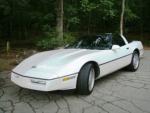


Regular gas Corvette conversion

Thread Starter
Racer

Joined: Dec 2006
Posts: 292
Likes: 0
 Regular gas Corvette conversion
Has anyone intentionally lowered the compression ratio to run regular octane gas? Besides saving money at the pump in the US it would be very useful while driving in Mexico where premium is either unavailable or much higher priced.
I was thinking about taking a stock 1990 L98 shortblock and putting on the 1985 iron heads. I believe this would be a change from 58cc to 76cc heads. I know there are calculators to determine the resulting compression ratio using different gaskets but roughly I think it would go from 9.5:1 to 8.5:1.
Besides retarding the timing are any computer tweaks required? This would probably go in a 1985 C4 with the stock computer setup but it could also go in a 1989.
The Corvette has power to spare and I think the power loss would be minimal for a casual driver.
I was thinking about taking a stock 1990 L98 shortblock and putting on the 1985 iron heads. I believe this would be a change from 58cc to 76cc heads. I know there are calculators to determine the resulting compression ratio using different gaskets but roughly I think it would go from 9.5:1 to 8.5:1.
Besides retarding the timing are any computer tweaks required? This would probably go in a 1985 C4 with the stock computer setup but it could also go in a 1989.
The Corvette has power to spare and I think the power loss would be minimal for a casual driver.
Burning Brakes


Joined: Sep 2006
Posts: 1,202
Likes: 3
From: MD
Have you tried just running regular gas in it? I used to run 87 octane gas in my 84 with no noticeable problems. Just set your baseline timing to 6 degrees and the knock sensor will take care of the rest.
Racer
Joined: May 2006
Posts: 293
Likes: 0
The head swap would do what you suggest it should, but probably to a greater extent than you think. You don't need a compression ratio calculator to figure out what the compression would be with the change. With the super low compression ratio, you will be able to advance the timing. A stock 1985 engine has a 9.00:1 compression ratio and will run on regular. Remember, octane ONLY serves to prevent knock. The lowest octane that doesn't allow knock is your best buy. More than the necessary octane does nothing for your car. It only helps to line the pockets of the oil companies.

Team Owner


Joined: Sep 2003
Posts: 20,179
Likes: 673
From: Freedom is never more than one generation away from extinction.
St. Jude '03 thru '24
My L98 runs just fine on regular. If I'm going to the track, a tank of the good stuff is added.
The ECM will compensate for the different grades of fuel...

The ECM will compensate for the different grades of fuel...
Racer
Joined: May 2006
Posts: 293
Likes: 0
If you are not getting knock counts at WOT, on the low octane gas, higher octane will NOT improve performance or 1/4 mile times. Some say it will hurt performance.
Corvette Stories
The Best of Corvette for Corvette Enthusiasts

5 Best & 5 Worst Corvette Daily Drivers
Joe Kucinski
The Headlights of Every Corvette Generation Explained
Joe Kucinski
5 Best & 5 Most Overrated Corvette Track Packages of All Time!
Joe Kucinski
Every 2027 Corvette Engine Explained
Joe Kucinski
Designer Imagines A Corvette That Looks More Like a Corvette Than the Corvette
Verdad Gallardo
10 Ugly Corvettes That We Still Kinda Love
Joe Kucinski
Top 10 Most Expensive Corvettes Ever Sold on Bring A Trailer
Brett Foote
10 Things Every Corvette Owner Needs (2026 Edition)
Michael S. Palmer
8 Most "Only Corvette Owners Understand" Quirks and Problems
Pouria Savadkouei
Team Owner
Joined: May 2002
Posts: 24,337
Likes: 25
From: San Diego , CA Double Yellow DirtBags 1985..Z51..6-speed
I'll trade you straight across for my 85 heads then. I'll even pay shipping both ways.
This babies have been run on 87 octane for the past 4 years without a single knock, including at the dragstrip.
This babies have been run on 87 octane for the past 4 years without a single knock, including at the dragstrip.
Elite Torch Red Member


Joined: Sep 1999
Posts: 57,805
Likes: 23
From: Exit 89 GSP,Lakewood,NJ The Land Of Mojo
Cental/South NJ Events Coordinator
CI 1-2-3-4-5-6-7-8-9-10-11-12 Vet
CI-II Burnout & Drag Champ
St. Jude Donor '03-'04-'05-'06-'07
All that work to save $5 a tankful? Even at a tank a week that's only a hair over $250 for the year.
All I know is that I was running on 93 and getting over 30 mpg om a road trip. Another member was on 87 and getting 22 mpg on the same trip, same year car, only difference was mine was a six speed. But even so I get close to 22 mpg on 93 octane in my automatic with 3.45 gears.
All I know is that I was running on 93 and getting over 30 mpg om a road trip. Another member was on 87 and getting 22 mpg on the same trip, same year car, only difference was mine was a six speed. But even so I get close to 22 mpg on 93 octane in my automatic with 3.45 gears.

Safety Car

Joined: Dec 2004
Posts: 4,088
Likes: 0
From: Poop land
If you wanna be cheap, I'd retard the base timing to 4 degrees instead of 6 and fill'er up with the cheap stuff. Then you won't a superficially amount of knock counts. The car will feel a tad slower but at least you know your motor won't ping.

Burning Brakes
Joined: May 2006
Posts: 1,097
Likes: 2
From: Richfield Utah
The "Cheap Stuff" is actually more volatile than the "Expensive Stuff". The lower the octane, the more meaner the gas. In fact it is so volatile. You get pre-ignition "ping". The "Expensive Stuff" is oiled down enough that it is harder to ignite, therefore less "pinging". If anything, High Octane should be cheaper. The oil company's have the people thinking that the high octane is rocket fuel.
My advice is just use the lowest octane that your car will run decent on. I'm not saying, go pinging down the road until you blow a hole through your pistons. Save your hard earned money. We give the Middle East to much as it is...
My advice is just use the lowest octane that your car will run decent on. I'm not saying, go pinging down the road until you blow a hole through your pistons. Save your hard earned money. We give the Middle East to much as it is...

Safety Car
Joined: May 1999
Posts: 3,651
Likes: 5
From: Atlantis
Cruise-In I Veteran
I want to line up second for trading my iron heads for your aluminum 58cc heads.
I'll pay shipping both ways also and give ya 50 bux to boot.
I have got some 72cc heads that will run with the cheapest gas out there with NO pinging
They would be JUST what you THINK need.
Oh, I was just advised my company has a bridge for sale up on the east side of New York... the price is right...
Interested?
I'll pay shipping both ways also and give ya 50 bux to boot.
I have got some 72cc heads that will run with the cheapest gas out there with NO pinging
They would be JUST what you THINK need.
Oh, I was just advised my company has a bridge for sale up on the east side of New York... the price is right...
Interested?


Safety Car
Joined: May 1999
Posts: 3,651
Likes: 5
From: Atlantis
Cruise-In I Veteran
That was NEVER the intention of having a knock sensor to provide another piece of data for the ECM.
The ECM code was also not written to provide a method of running the engine at the maximum timing depending on the octane (or any other specific parameter) of the fuel.
The factor that dictates the necessary fuel octane is 'hardcoded' into the engine by the combuston chamber and the amount the fuel charge is compressed before it is ignited.
The design of the intake and it's ability to 'mix' the fuel and air also have some affect on the engine's ability to resist knock. That's a topic for another discussion but it is a very important factor.
There is also an important detail in of the combustion chamber called 'quench' but that's also for another discussion.
The entire knock retard system was designed to protect the engine from the effects of bad fuel or the inadvertent load of low octane fuel.
I probably wouldn't say the ECM 'compensates' for different grades of fuel because that may be a slightly inaccurate way to describe the function of the knock control portion of the ECM.
I would say it 'tries' to protect the engine from the ill effects of lower than reccomended fuel octane.
Kind of like the bumper 'tries' to protect your vehicle from the damaging effects of a small collision the knock retard system 'tries' to protect the engine from detonation or preignition.
There is no sensor installed that reads the composition of the fuel.
The ONLY input the complete 'Knock Retard' system has is the Knock Sensor.
There is only ONE knock sensor..... If the system HAD been designed to allow the engine to run at maximum performance levels with lower than dictated fuel octane, there would be MORE than ONE knock sensor, possibility one for each cylinder. In addition there would be spark control for each cylinder that works in conjunction with the fuel management portion that could vary the timing for each individual cylinder.
The current system wasn't designed to 'PREVENT' knock. It is an 'after the fact' system that aggressively removes timing AFTER knock is detected. In this way, it attemps to eliminate additional knock after initial knock is detected...
The amount of timing retard and the rate the retard is applied is 'way too much, way too soon' because the intention is to protect the engine.
On the 'other end' of operation, the decay rate of the ignition timing retard is extremely slow.
IOW, the timing RETARD is very quickly added in LARGE amounts and that RETARD is then very slowly removed little by little.
The system was designed to protect the engine rather than as a method to allow operating the engine consistently with lower than reccomended fuel octane.
The ECM code was also not written to provide a method of running the engine at the maximum timing depending on the octane (or any other specific parameter) of the fuel.
The factor that dictates the necessary fuel octane is 'hardcoded' into the engine by the combuston chamber and the amount the fuel charge is compressed before it is ignited.
The design of the intake and it's ability to 'mix' the fuel and air also have some affect on the engine's ability to resist knock. That's a topic for another discussion but it is a very important factor.
There is also an important detail in of the combustion chamber called 'quench' but that's also for another discussion.
The entire knock retard system was designed to protect the engine from the effects of bad fuel or the inadvertent load of low octane fuel.
I probably wouldn't say the ECM 'compensates' for different grades of fuel because that may be a slightly inaccurate way to describe the function of the knock control portion of the ECM.
I would say it 'tries' to protect the engine from the ill effects of lower than reccomended fuel octane.
Kind of like the bumper 'tries' to protect your vehicle from the damaging effects of a small collision the knock retard system 'tries' to protect the engine from detonation or preignition.
There is no sensor installed that reads the composition of the fuel.
The ONLY input the complete 'Knock Retard' system has is the Knock Sensor.
There is only ONE knock sensor..... If the system HAD been designed to allow the engine to run at maximum performance levels with lower than dictated fuel octane, there would be MORE than ONE knock sensor, possibility one for each cylinder. In addition there would be spark control for each cylinder that works in conjunction with the fuel management portion that could vary the timing for each individual cylinder.
The current system wasn't designed to 'PREVENT' knock. It is an 'after the fact' system that aggressively removes timing AFTER knock is detected. In this way, it attemps to eliminate additional knock after initial knock is detected...
The amount of timing retard and the rate the retard is applied is 'way too much, way too soon' because the intention is to protect the engine.
On the 'other end' of operation, the decay rate of the ignition timing retard is extremely slow.
IOW, the timing RETARD is very quickly added in LARGE amounts and that RETARD is then very slowly removed little by little.
The system was designed to protect the engine rather than as a method to allow operating the engine consistently with lower than reccomended fuel octane.
Last edited by VetNutJim; Mar 18, 2007 at 04:49 PM.
Safety Car
Joined: May 1999
Posts: 3,651
Likes: 5
From: Atlantis
Cruise-In I Veteran
Here's a very simple way to think about 'octane'.......
LOW octane fuel ignites at a LOWER temperature than HIGH octane fuel.
HIGH octane fuel ingites at a HIGHER temperature than LOW octane fuel.
Why does it matter?
If the basic design of the engine calls for 91 octane fuel...
if you run it on lower octane fuel the exoplosion in the cylinders will happen before the 'correct' time because as the fuel charge is being compressed it get's hotter and hotter until the ignition sets the mixture alight.
If that explosion happens BEFORE the time the ignition fires, DETONATION (or pre-ignition) has ocurred.
The pressures inside the cylinder rise faster than the price of oil and on the next compression stroke the fuel charge is most likely to encounter even more latent heat inside the cylinder than the previous stroke.
A vicous cycle is initiated that can destroy the engine quickly.
The higher octane fuel can be heated (compressed) more before it is likely to 'self-ignite' or be ignited by some hot point in the cylinder.
LOW octane fuel ignites at a LOWER temperature than HIGH octane fuel.
HIGH octane fuel ingites at a HIGHER temperature than LOW octane fuel.
Why does it matter?
If the basic design of the engine calls for 91 octane fuel...
if you run it on lower octane fuel the exoplosion in the cylinders will happen before the 'correct' time because as the fuel charge is being compressed it get's hotter and hotter until the ignition sets the mixture alight.
If that explosion happens BEFORE the time the ignition fires, DETONATION (or pre-ignition) has ocurred.
The pressures inside the cylinder rise faster than the price of oil and on the next compression stroke the fuel charge is most likely to encounter even more latent heat inside the cylinder than the previous stroke.
A vicous cycle is initiated that can destroy the engine quickly.
The higher octane fuel can be heated (compressed) more before it is likely to 'self-ignite' or be ignited by some hot point in the cylinder.
Team Owner
Joined: May 2002
Posts: 24,337
Likes: 25
From: San Diego , CA Double Yellow DirtBags 1985..Z51..6-speed
High octane is like extra large pants. Any one can wear em, but it's really only necessary for fat people.
The skinny people can save money and buy small pants (low octane) that suit them better.
A fat person can fit into skinny pants, but might blow a hole in the inseam if any detonation occurs.
Then of course you still have all the skinny kids buying fat pants because they think they're better.
The skinny people can save money and buy small pants (low octane) that suit them better.
A fat person can fit into skinny pants, but might blow a hole in the inseam if any detonation occurs.
Then of course you still have all the skinny kids buying fat pants because they think they're better.
Team Owner
Joined: Sep 2003
Posts: 20,179
Likes: 673
From: Freedom is never more than one generation away from extinction.
St. Jude '03 thru '24
Thread Starter
Racer
Joined: Dec 2006
Posts: 292
Likes: 0
All that work to save $5 a tankful? Even at a tank a week that's only a hair over $250 for the year.
All I know is that I was running on 93 and getting over 30 mpg om a road trip. Another member was on 87 and getting 22 mpg on the same trip, same year car, only difference was mine was a six speed. But even so I get close to 22 mpg on 93 octane in my automatic with 3.45 gears.
All I know is that I was running on 93 and getting over 30 mpg om a road trip. Another member was on 87 and getting 22 mpg on the same trip, same year car, only difference was mine was a six speed. But even so I get close to 22 mpg on 93 octane in my automatic with 3.45 gears.
It is being done to serve as a Mexico car where premium is often not available or at a very high price if it is.