


HP vs Torque
Burning Brakes


Joined: Dec 2006
Posts: 936
Likes: 2
From: Tyrone PA

Yes I agree it has to be a REAR WHEEL number. That is where most people get lost, not realizing how much the engine's torque and horsepower figures are magnified by the gearing and driveline. I was thinking horsepower was the number to use for calculating the acceleration curve but like I said I wasn't sure. Ok then. You are comparing the same car's acceleration at low vs high rpm. You are saying that a TPI car will be accelerating harder at 3000rpm in 1st than at 5000rpm in first because the torque is falling off at 5000. I agree. But the point was compaing a TPI and say a LT1 because of it's higher powerband. When the TPI is shifted to 2nd gear, the RPM's fall back in the powerband, but the REAR WHEEL torque is significantly less than the LT1 car still in 1st gear, which is why the LT1 wins out. I understand it all in the physics and in the automotive respect, just not sure if the acceleration curve would follow the torque curve or the horsepower curve. You say you are sure it follows the torque curve and you might be right, but I'm not sure then why a motor that revs to 18,000 rpm's can pull so hard when it is only making about 150 or 200 torque but is making nearly 1000 hp. If the acceleration curve was following the torque at the rear wheel curve I would think it would be pulling harder when the torque was higher and the horsepower was lower. I know this is off the original TPI and LT1 subject but I think that one is covered!

Safety Car


Joined: Sep 2000
Posts: 3,524
Likes: 4
From: Hinckley Ohio
[QUOTE=dan0617;1563223395] but I'm not sure then why a motor that revs to 18,000 rpm's can pull so hard when it is only making about 150 or 200 torque but is making nearly 1000 hp.QUOTE]
...because if it is making 1000hp then rear wheel horsepower is also equal to 1000hp and even though the motor torque is low the rear wheel torque is high because of torque multiplication of the gear ratio...
In this example....horsepower is 1000 at both the wheels and the motor,.......at the motor it is high rpm times low torque while at the wheels it is high torque times low rpm...
Acceleration still follows the rear wheel torque curve..

...because if it is making 1000hp then rear wheel horsepower is also equal to 1000hp and even though the motor torque is low the rear wheel torque is high because of torque multiplication of the gear ratio...
In this example....horsepower is 1000 at both the wheels and the motor,.......at the motor it is high rpm times low torque while at the wheels it is high torque times low rpm...
Acceleration still follows the rear wheel torque curve..
Last edited by LT4BUD; Dec 19, 2007 at 05:43 AM.
Instructor


Joined: Mar 2006
Posts: 237
Likes: 1
From: Alpharetta GA
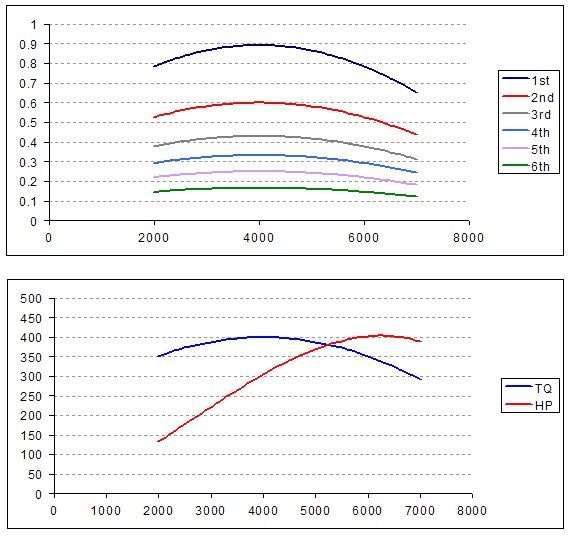
I don't know if this will help, but this is what the acceleration curves in each gear look like for a hypothetical engine in a c4 with a ZF6. Notice that the acceleration curve looks like the torque curve, not the hp curve.

Race Director


Joined: May 2005
Posts: 11,992
Likes: 1,331
From: Middletown, DE
Interesting -- but per your graph there is much better accelleration in 1st gear at the 6K RPM HP peak (.8G) than you get in 2nd gear at the torque peak of 4K RPM (.6G). The explanation should not be speed-related -- in an LT1 the car's MPH would be about identical given the gear ratios. This obseration holds true for each comparison, by the way. Wouldn't this argue for the contention that HP does matter? Or, are your curves illustrative and not to scale????
Safety Car
Joined: Sep 2000
Posts: 3,524
Likes: 4
From: Hinckley Ohio
Interesting -- but per your graph there is much better accelleration in 1st gear at the 6K RPM HP peak (.8G) than you get in 2nd gear at the torque peak of 4K RPM (.6G). The explanation should not be speed-related -- in an LT1 the car's MPH would be about identical given the gear ratios. This obseration holds true for each comparison, by the way. Wouldn't this argue for the contention that HP does matter? Or, are your curves illustrative and not to scale????
Rear wheel torque is what is most important.....as you have pointed out you get more acceleration at the higher horsepower gear--since this leads to higher rear wheel torque.....this is a good example of comparing performance at a fixed mph with different gears vs comparing performance at various mph with a fixed gear ratio...really confusing to sort out..
BTW his curves further demonstrate how to determine optimum shift points

Team Owner

Joined: May 2002
Posts: 24,337
Likes: 25
From: San Diego , CA Double Yellow DirtBags 1985..Z51..6-speed
Don't talk about HP and RWTQ as if they're two seperate concepts, because they're not. You'll see that RWTQ and HP go hand in hand, and that FWTQ is just a number and is meaningless by itself, see equation 8. (I'm ignoring all the conversion units, like 5252, feet/s to mph, etc.)
[1] F = Mass x Acceleration
...
[2] Acceleration = F / Mass
[3] Acceleration = (RWTQ / TireSize) / Mass
[4] Horsepower = FWTQ x RPM
[5] RPM = Gearing / TireSize x Speed
[6] Horsepower = FWTQ x Gearing / TireSize x Speed[7] RWTQ = FWTQ x Gearing
[8] Horsepower = RWTQ / TireSize x Speed ....ooh looky here!Combine #3 and #8 and you get...
[9] Acceleration = Horsepower / Mass / Speed
So, at 10 mph, how do you maximize acceleration? Maximimize HP. At 50 mph, how do you maximize acceleration? Maximize HP.
And you see here why HP/Weight ratio is so critical.
Last edited by CentralCoaster; Dec 19, 2007 at 11:33 AM.

Le Mans Master


Joined: Apr 2005
Posts: 6,413
Likes: 9
From: The Old Dominion
Well, I haven't had a chance to look at my datalog #'s. Though I'm prepared to be wrong and admit accleration curve mirrors the torque curve (with the magnitude scaled by the gearing).
However, I found this article that might be of interest from Jim Ingle: http://www.corvetteactioncenter.com/tech/hp_torque.html
Unfortunately he doesn't say too much that isn't already known. And he doesn't talk about why Corvette has the power bands it does. One thing I've noticed is that numerous GM motors have their torque peak at 4,400 rpm (or thereabouts) and their power peak at 5,600 rpm (or thereabouts). I wonder if there is some rational behind that? Now with these VVT motors and such it's not as true, but on a lot of GM motors it is.
However, I found this article that might be of interest from Jim Ingle: http://www.corvetteactioncenter.com/tech/hp_torque.html
Unfortunately he doesn't say too much that isn't already known. And he doesn't talk about why Corvette has the power bands it does. One thing I've noticed is that numerous GM motors have their torque peak at 4,400 rpm (or thereabouts) and their power peak at 5,600 rpm (or thereabouts). I wonder if there is some rational behind that? Now with these VVT motors and such it's not as true, but on a lot of GM motors it is.
Advanced
Joined: Dec 2007
Posts: 63
Likes: 0
From: Raleigh North Carolina
Hmmmm
For a motor, it always made more sense to me to talk about torque, rpm and horsepower in the same thought. It always seems to confuse people when you try to separate them as they are intimately related.
The relationship among torque, horsepower and RPM is:
Horsepower = (Torque x Engine speed) / 5250
Where:
torque is in lb-ft
and engine speed is in RPM
The relationship among torque, horsepower and RPM is:
Horsepower = (Torque x Engine speed) / 5250
Where:
torque is in lb-ft
and engine speed is in RPM
Corvette Stories
The Best of Corvette for Corvette Enthusiasts

Every 2027 Corvette Engine Explained
Joe Kucinski
Designer Imagines A Corvette That Looks More Like a Corvette Than the Corvette
Verdad Gallardo
10 Ugly Corvettes That We Still Kinda Love
Joe Kucinski
Top 10 Most Expensive Corvettes Ever Sold on Bring A Trailer
Brett Foote
10 Things Every Corvette Owner Needs (2026 Edition)
Michael S. Palmer
8 Most "Only Corvette Owners Understand" Quirks and Problems
Pouria Savadkouei
10 Reasons the C6 Z06 is Still A Performance Benchmark After 20 Years
Joe Kucinski
How Much Horsepower Every Corvette Engine "LOST" in 1972
Joe Kucinski
Top 10 DOs and DON'Ts for Protecting Your Convertible Top!
Michael S. Palmer
Instructor
Joined: Mar 2006
Posts: 237
Likes: 1
From: Alpharetta GA
Weights being equal, the car making the most HP at any given speed (and the most RWTQ) will ALWAYS accelerate quicker. Pick the gear that gives you the most HP at all times.
. . .
[9] Acceleration = Horsepower / Mass / Speed
So, at 10 mph, how do you maximize acceleration? Maximimize HP. At 50 mph, how do you maximize acceleration? Maximize HP.
And you see here why HP/Weight ratio is so critical.
. . .
[9] Acceleration = Horsepower / Mass / Speed
So, at 10 mph, how do you maximize acceleration? Maximimize HP. At 50 mph, how do you maximize acceleration? Maximize HP.
And you see here why HP/Weight ratio is so critical.
So what does this really mean in the real world? For this hypothetical car, it means that if you want to accelerate fastest, you don't shift at the power peak in 1st gear, you run that baby all the way up to 7000rpm in this case. Even though HP falls off, you are still accelerating faster than if you shift to 2nd at the power peak. If you shift to 2nd at the HP peak, you lose about 0.16g acceleration, as shown in the second graph (0.76g vs 0.60g). In this particular example, you can see that you should run every gear out to 7000RPM (past the HP peak and WAY past the TQ peak), otherwise you are not moving as quickly as you could be. And as a side note: per CC's equation above, a car with more HP (and more RWTQ, by association) at a given mph will accelerate faster.


Advanced
Joined: Dec 2007
Posts: 63
Likes: 0
From: Raleigh North Carolina
Actually, I'm pretty sure that the car making the most torque at any given speed will ALWAYS accelerate quicker.
Instructor
Joined: Mar 2006
Posts: 237
Likes: 1
From: Alpharetta GA
Originally Posted by CentralCoaster
Weights being equal, the car making the most HP at any given speed (and the most RWTQ) will ALWAYS accelerate quicker. Pick the gear that gives you the most HP at all times.
How is that different from what CC is saying? (since HP and TQ are directly proportional to each other)
Weights being equal, the car making the most HP at any given speed (and the most RWTQ) will ALWAYS accelerate quicker. Pick the gear that gives you the most HP at all times.
How is that different from what CC is saying? (since HP and TQ are directly proportional to each other)
Advanced
Joined: Dec 2007
Posts: 63
Likes: 0
From: Raleigh North Carolina
Originally Posted by CentralCoaster
Weights being equal, the car making the most HP at any given speed (and the most RWTQ) will ALWAYS accelerate quicker. Pick the gear that gives you the most HP at all times.
How is that different from what CC is saying? (since HP and TQ are directly proportional to each other)
Weights being equal, the car making the most HP at any given speed (and the most RWTQ) will ALWAYS accelerate quicker. Pick the gear that gives you the most HP at all times.
How is that different from what CC is saying? (since HP and TQ are directly proportional to each other)
Thread Starter
Race Director
Joined: Nov 2003
Posts: 12,221
Likes: 446
From: Overland Park Kansas
2020 Corvette of the Year Finalist (appearance mods)
C4 of Year Winner (appearance mods) 2019
Nice graph! I don't know how this relates to the gearing in a ZF car, but assuming it's close (ratio), your comments and the graph demonstrate clearly what you're saying.
If the shift points apply to our vehicles (and I assume they do), it's easy to see how the higher-winding LT motors outshine the L98s. It's easy to see how any motor that can stay in lower gears longer -- accelerates faster. Then there's 4:11 rear ends to make things more fun!
If you convert the L98 intake to the LT1 short-runner style, how durable is that motor in the upper rpms (i.e., 5K+). Would it then be similar to the LT cars? Are LT motors (heads) built to handle higher rpms better?
If the shift points apply to our vehicles (and I assume they do), it's easy to see how the higher-winding LT motors outshine the L98s. It's easy to see how any motor that can stay in lower gears longer -- accelerates faster. Then there's 4:11 rear ends to make things more fun!
If you convert the L98 intake to the LT1 short-runner style, how durable is that motor in the upper rpms (i.e., 5K+). Would it then be similar to the LT cars? Are LT motors (heads) built to handle higher rpms better?
Thread Starter
Race Director
Joined: Nov 2003
Posts: 12,221
Likes: 446
From: Overland Park Kansas
2020 Corvette of the Year Finalist (appearance mods)
C4 of Year Winner (appearance mods) 2019
Very different. At the same speed, if one car is making 500 HP and 320 lb-ft of torque, and the second car is making 400 HP and 380 lb-ft of torque, the second car will accelerate faster at that speed. Perhaps they are identical engines, but they have different rear axle ratios or are in a different gear so they will be at a different RPM. Or perhaps they are different engines completely, but at the same RPM. Doesn't matter. The one generating the most torque at that speed -- and not the most horsepower -- will accelerate faster.
 ). The 1st car is in the wrong gear!
I took CC to say you need to select the gear that maximizes your HP. If you do that, you will accelerate as quickly as you can. Hard to argue with that simple of a statement!
gp
Instructor
Joined: Mar 2006
Posts: 237
Likes: 1
From: Alpharetta GA
Very different. At the same speed, if one car is making 500 HP and 320 lb-ft of torque, and the second car is making 400 HP and 380 lb-ft of torque, the second car will accelerate faster at that speed. Perhaps they are identical engines, but they have different rear axle ratios or are in a different gear so they will be at a different RPM. Or perhaps they are different engines completely, but at the same RPM. Doesn't matter. The one generating the most torque at that speed -- and not the most horsepower -- will accelerate faster.
To have this debate, let's make two assumptions:
1) The cars are the same weight
2) We are talking about RWHP and RWTQ, at the contact patch
Now we can say that the car with the most RWTQ will accelerate faster, since A=F/M.
But, we can also say that the car with the most RWTQ is also making the most RWHP, since you stated that speed is constant. If the road is passing beneath the tires at the same speed, then RWHP=RWTQ*(a constant). If car 1 makes more RWTQ than car 2 at a given road speed, then car 1 also makes more RWHP than car 2.
At a constant road speed your example is inconsistent, because the second car should be making more RWHP than the first car.
Safety Car
Joined: Sep 2000
Posts: 3,524
Likes: 4
From: Hinckley Ohio
[QUOTE=TorchRedRob;1563244629]Pictures always help me understand things better.
FWIW I have these same curves, and similiar based on the actual dyno tests for my car. One I did that I found most interesting is rwtq(or hp)vs mph for the stock 3.45 rear end vs the 4.10. A picture is really helpful....I generated my curves/tables using Excel spreadsheet.
FWIW I have these same curves, and similiar based on the actual dyno tests for my car. One I did that I found most interesting is rwtq(or hp)vs mph for the stock 3.45 rear end vs the 4.10. A picture is really helpful....I generated my curves/tables using Excel spreadsheet.
Burning Brakes
Joined: Dec 2006
Posts: 936
Likes: 2
From: Tyrone PA
Yes, very nice graphs and representation. This thread turned out to be ok after all
I do see that the rate of acceleration is mirroring the torque curve. I learned something here. That is news to me. What some are not understanding now, however, is that at any given rpm, the higher the torque the higher the horsepower and the high rpm torque is what keeps you from shifting and keeps you accelerating. So you want to rev your car to the point that the torque of the motor has fallen off so bad that the gear ratio multiplication isn't making up for it (so to speak) and it will put as much or more torque to the ground by shifting to the next gear. You will then lose gear ratio multiplication but gain motor torque as you will be back in your engine's powerband. At that point your car is accelerating faster because you shifted, but if you are in a TPI car, the car that didn't have to shift is out accelerating you because he is still making plenty of motor torque and is still getting that excellent first gear gear ratio multiplication.
Also, torque at higher rpm's IS higher horsepower, and the higher the rpm's the horsepower really climbs because of the calculation that is horsepower. There is no hp vs torque, horsepower is torque. If you increase rear wheel torque through heads, cam, intake, tranny gears, rear gears, tire size, etc. you also increase rear wheel horsepower. The higher the rpm that you make the increase of torque, each lb-ft of torque you gain = proportionally more horsepower.
I do see that the rate of acceleration is mirroring the torque curve. I learned something here. That is news to me. What some are not understanding now, however, is that at any given rpm, the higher the torque the higher the horsepower and the high rpm torque is what keeps you from shifting and keeps you accelerating. So you want to rev your car to the point that the torque of the motor has fallen off so bad that the gear ratio multiplication isn't making up for it (so to speak) and it will put as much or more torque to the ground by shifting to the next gear. You will then lose gear ratio multiplication but gain motor torque as you will be back in your engine's powerband. At that point your car is accelerating faster because you shifted, but if you are in a TPI car, the car that didn't have to shift is out accelerating you because he is still making plenty of motor torque and is still getting that excellent first gear gear ratio multiplication.
Also, torque at higher rpm's IS higher horsepower, and the higher the rpm's the horsepower really climbs because of the calculation that is horsepower. There is no hp vs torque, horsepower is torque. If you increase rear wheel torque through heads, cam, intake, tranny gears, rear gears, tire size, etc. you also increase rear wheel horsepower. The higher the rpm that you make the increase of torque, each lb-ft of torque you gain = proportionally more horsepower.
Team Owner
Joined: May 2002
Posts: 24,337
Likes: 25
From: San Diego , CA Double Yellow DirtBags 1985..Z51..6-speed
Again, do the math at 10 mph. Do the math at 50 mph:
Acceleration = Horsepower / Mass / Speed
Acceleration = (RWTQ / TireSize) / Mass
(keep TireSize equal otherwise we can't compare RWTQ)
In your example, Car 1 is turning 8200 rpm, Car 2 is turning 5500 rpm. Since speed is equal, Car 1 must be geared 50% shorter than Car 2, and therefore is getting 50% more torque multiplication through gearing, and even with less FWTQ, is putting down about 25% more RWTQ than Car 1. So you see that Car 1 is accelerating quicker, is making the most HP and the most RWTQ.
The car making the most horsepower at any speed will always accelerate quicker.
Last edited by CentralCoaster; Dec 20, 2007 at 11:34 AM.