


Water In Gas Tank

Thread Starter
7th Gear

Joined: Apr 2005
Posts: 7
Likes: 0
 Water In Gas Tank
Is there anything that would block a tube used to pump gas out of the tank? I have water in the tank (clogged drain) and I don't think I am getting all the way down to the bottom of the tank whey I try to pump the gas out. How long of a tube do I need to use to get to the bottom of the tank?
Drifting

Joined: Apr 2007
Posts: 1,339
Likes: 2
From: port charlotte fl
Your best way is to remove the rubber gasket and then take out the fuel pump.Then you can get in there with some rags or paper towels and dry it out properly.If you ran it after you got water in it you need to change out the fuel filter.If I remember correctly one side of the tank is lower than the other and acts as a garbage trap.

Melting Slicks


Joined: Feb 2006
Posts: 2,753
Likes: 15
From: backwoods upstate ny

quick/dirty way to drain the tank is to remove the core from the shraeder valve test port on the fuel rail...put a drain hose over the test port body and hose clamp in place, run loose end to waste jug...jump 12v into the "pump prime" terminal on the ALDL in the cockpit to run the pump till "nothing" more comes from drain hose...STOP THE PUMP AS SOON AS DISCHARGE FLOW CEASES, RUNNING DRY WILL FRY THE PUMP QUICKLY...dump in a gallon of new gas and waste/pump that thru the drain hose to remove traces of contaminant...done...do this outdoors, small amounts of gasoline vapor can easily ignite producing major damage/death.
Last edited by redrose; Jul 9, 2008 at 11:17 AM.

Le Mans Master


Joined: Jan 2002
Posts: 9,036
Likes: 13
From: Edmonton AB
the filler neck. My vote is that this tray is roughly 3-4" wide.
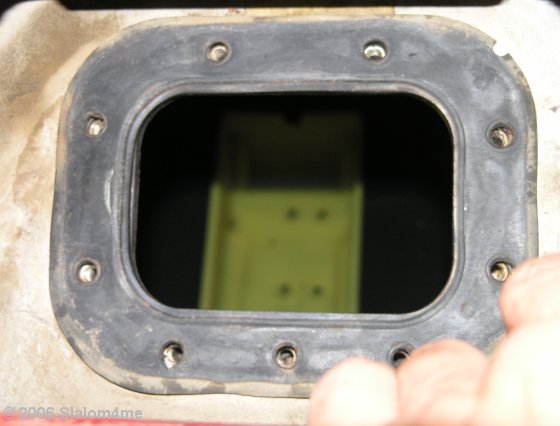
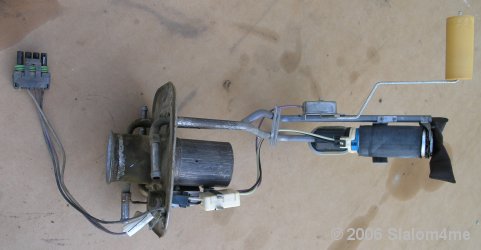
The outbound fuel supply tube extends down from the same stamped
plate that the filler neck is mounted in. The fuel level sending unit and
its float arm are attached midway down and the fuel pump is attached
at the bottom end of this tube. There is a sock-style filter on the
bottom of the pump that sits in the rectangular tray.
Originally Posted by white89ooo
I have water in the tank (clogged drain) and I don't think I am getting
all the way down to the bottom of the tank when I try to pump the gas
out. How long of a tube do I need to use to get to the bottom of the
tank?
all the way down to the bottom of the tank when I try to pump the gas
out. How long of a tube do I need to use to get to the bottom of the
tank?
from the mounting plate flange. The siphon tube needs to pass down
and to the passenger side to miss the pump and tray, the float arm
is on the driver's side of the filler neck. A semi-rigid plastic tubing might
be a better choice than conventional rubber hose - the hose may tend
to coil around on itself, lifting the hose end out above the fuel remaining
at the tank bottom.
Have you considered adding methyl hydrate, isopropyl alcohol or one of
the commercial 'dry-gas' products to the tank and letting this mix with
whatever moisture remains in the tank? The water combines with the
fuel and passes through.
Regarding water contamination and two-stroke engines, be aware of
the following comment from an old post:
Describe Experiences w/ Water-Contaminated Fuel
However, methyl-based additives can cause issues in two-strokes,
particularly if too much is added. Gold Eagle, bottlers of 'Heet'
specifically warn NOT to use 'HEET', a methyl-based product, in
two-cycle or diesel engines.
Isopropyl-based products such as 'ISO HEET' ARE suitable for two
strokes. Same with 99.9% isopropyl alcohol from the drug counter.
OTOH, rubbing alcohol is diluted. It has from 68 - 99% isopropyl
alcohol (as posted on the bottle) and the rest is water. Thus RA is
generally less capable of absorbing moisture from fuel than IA.
.
particularly if too much is added. Gold Eagle, bottlers of 'Heet'
specifically warn NOT to use 'HEET', a methyl-based product, in
two-cycle or diesel engines.
Isopropyl-based products such as 'ISO HEET' ARE suitable for two
strokes. Same with 99.9% isopropyl alcohol from the drug counter.
OTOH, rubbing alcohol is diluted. It has from 68 - 99% isopropyl
alcohol (as posted on the bottle) and the rest is water. Thus RA is
generally less capable of absorbing moisture from fuel than IA.

Instructor

Joined: Mar 1999
Posts: 219
Likes: 2
From: Gainesville Florida
Also.....Is the neck removeable from the gas door on the top or does the tank have to be dropped to remove the mechanism. Can you reack the electical connection without removing the tank. I am having the sending unit problems that are so common. I will try to clean the reostat before replacing it. I have nothing to lose by trying to disassemble it and clean the contact surface. I have heard others have had success doing that. Any help from someone that has done it would be appreciated.Thanks

Le Mans Master
Joined: Sep 2006
Posts: 6,050
Likes: 147
From: Phoenix AZ
2021 C4 of the Year - Modified Finalist
gasket
1. If you have changed it recently, go ahead and try reusing it. If it leaks, you will have to do the job all over again.
2. If it is the original, change it. the real problem is the area under the gasket will rust a little and adhere itself to the gasket. when you pull it loose, it tears.
3. If it doesn't tear, it is probably compressed to it's limit, and should be replaced anyway.
4. anytime you open something up, change the gasket, it's only good practice.
The real reason we use gaskets is to make up for manufacturing deficiencies, and if you reuse the gasket, now that you moved it a few thousandths of and inch, it may not seal as some areas were probably compressed more than other deficient areas.
2. If it is the original, change it. the real problem is the area under the gasket will rust a little and adhere itself to the gasket. when you pull it loose, it tears.
3. If it doesn't tear, it is probably compressed to it's limit, and should be replaced anyway.
4. anytime you open something up, change the gasket, it's only good practice.
The real reason we use gaskets is to make up for manufacturing deficiencies, and if you reuse the gasket, now that you moved it a few thousandths of and inch, it may not seal as some areas were probably compressed more than other deficient areas.
Corvette Stories
The Best of Corvette for Corvette Enthusiasts

5 Best & 5 Worst Corvette Daily Drivers
Joe Kucinski
The Headlights of Every Corvette Generation Explained
Joe Kucinski
5 Best & 5 Most Overrated Corvette Track Packages of All Time!
Joe Kucinski
Every 2027 Corvette Engine Explained
Joe Kucinski
Designer Imagines A Corvette That Looks More Like a Corvette Than the Corvette
Verdad Gallardo
10 Ugly Corvettes That We Still Kinda Love
Joe Kucinski
Top 10 Most Expensive Corvettes Ever Sold on Bring A Trailer
Brett Foote
10 Things Every Corvette Owner Needs (2026 Edition)
Michael S. Palmer
