



cam article 765hp blown 355
Thread Starter
Team Owner


Joined: Mar 2001
Posts: 30,856
Likes: 293
From: Boston, Dallas, Detroit, SoCal, back to Boston MA
 cam article 765hp blown 355
Engine Master's article posted on AFR's site
http://airflowresearch.com/articles/article122/A-P1.htm

following the link for the rest of the pages.
http://airflowresearch.com/articles/article122/A-P1.htm
following the link for the rest of the pages.
Thread Starter
Team Owner
Joined: Mar 2001
Posts: 30,856
Likes: 293
From: Boston, Dallas, Detroit, SoCal, back to Boston MA
also an 810hp 383 with smaller 195 heads
http://airflowresearch.com/articles/article119/A-P1.htm
http://airflowresearch.com/articles/article119/A-P1.htm
Last edited by BrianCunningham; Jul 12, 2008 at 03:50 PM. Reason: Fixed link
Melting Slicks

Joined: Aug 2003
Posts: 3,401
Likes: 397
From: Lakeville MI
Interesting article. Thanks for sharing.
Its difficult to make heads or tails of their results considering the pulley swaps, jetting and rocker changes.
To cut through it all, I plotted HP vs impeller rpm (4.10 D1SC step-up) for Test B and Test F which in my opinion are the most relevent tests. I'm too lazy to post the plot tonight, but I may update it later on.
Here's the plot using a 4.75" pulley as indicated in the table:
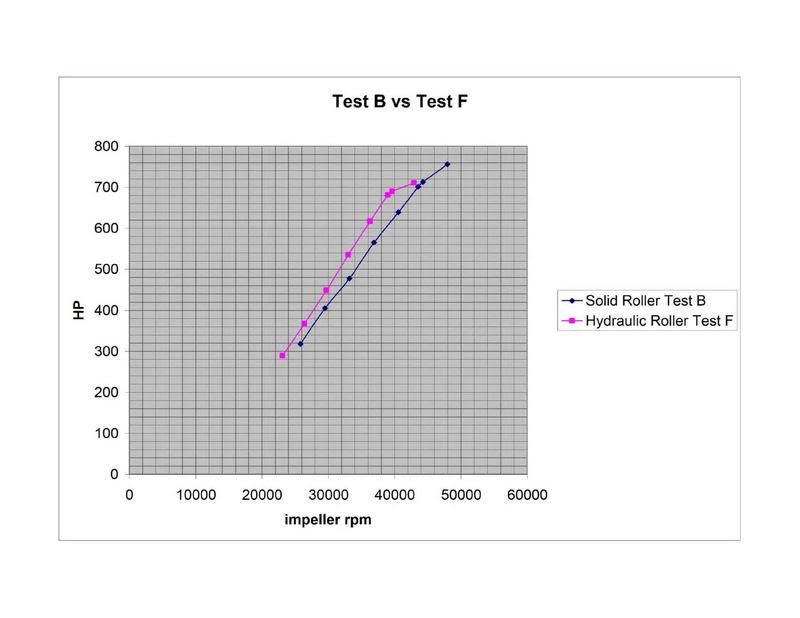
Test F has an edge all the way up to 43,000 rpm compared with Test B. As much as 60-80 HP is gained between 35,000 and 40,000 rpm in test F.
As expected, the reduced overlap of the hydraulic roller is making better use of the blower's airflow output for a given impeller rpm.
Reduced fuel consumption would also be an expected benefit with the reduced overlap hydraulic roller camshaft.
Looking into the data, Test F has a strange kink at the top resulting in a big loss of peak HP. This kink goes away in Test G resulting in much more power up top. I'd be surprised if this gain was actually due to the rocker change and not some sort of test issue.
Here's the plot again using a 4.75" pulley as shown in the table:
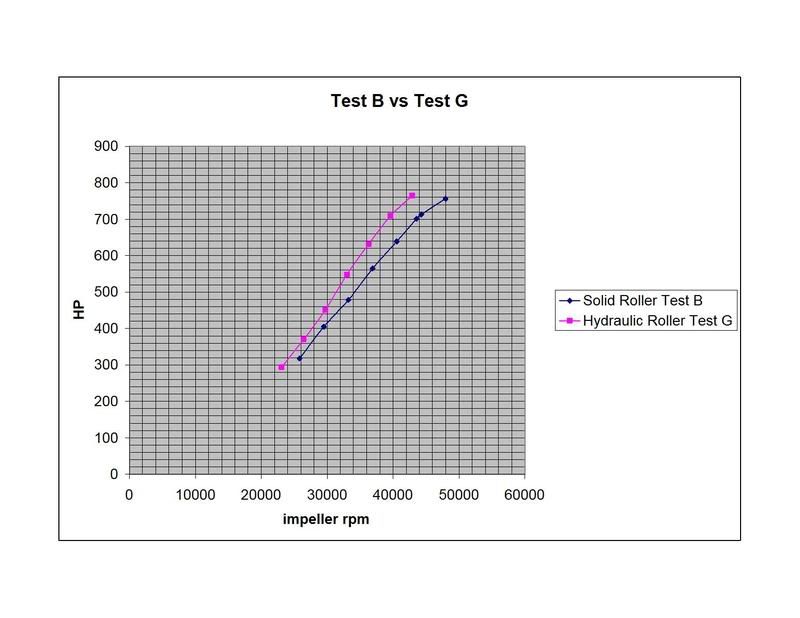
Note: There are quite a few inconsistencies in the article. Did they use a 4.5" pulley for tests F and G as indicated in the text and photo caption, or a 4.75" pulley as shown in the table. The data I have plotted above is for the 4.75" pulley. After re-reading, I think they really ran the 4.5" which changes the results considerably.
Here is Test F replotted for a 4.5" pulley:
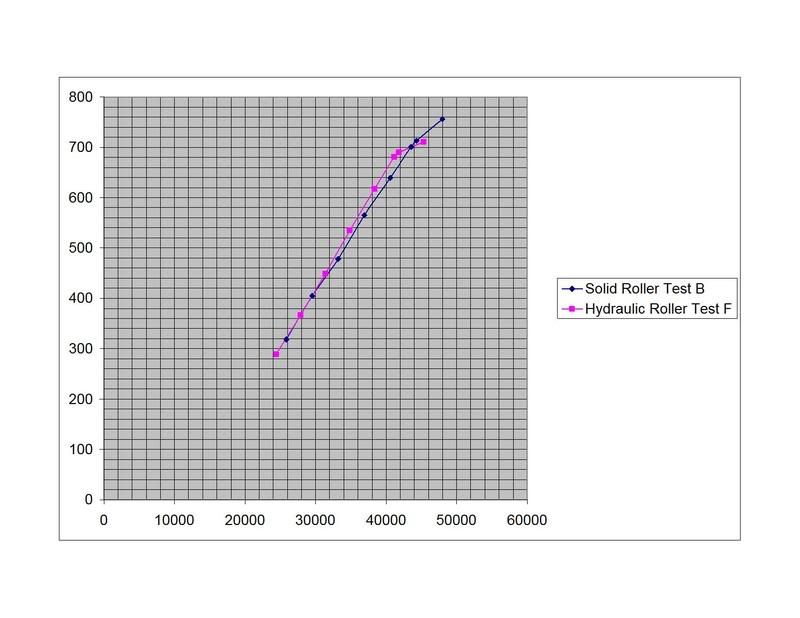
This is a little more believable with maybe a 20 HP gain for the hydraulic roller at the mid-upper impeller rpms.
Here is Test G also replotted for a 4.5" pulley:
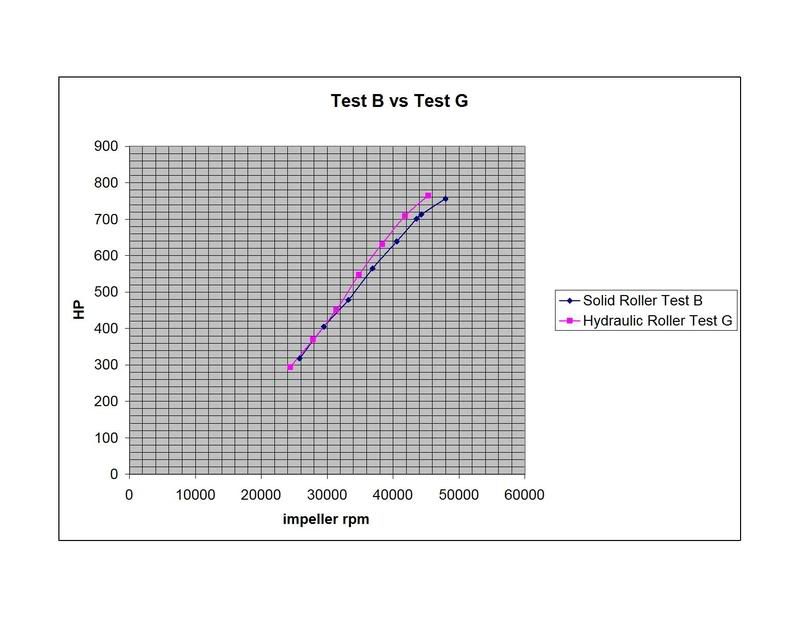
It is up to the reader to draw their own conclusions. The power that the D1SC can support at modest impeller rpms is impressive.
I also added boost vs impeller rpm to the 4.5" pulley plots. The boost vs impeller rpm curves are very similar between tests:
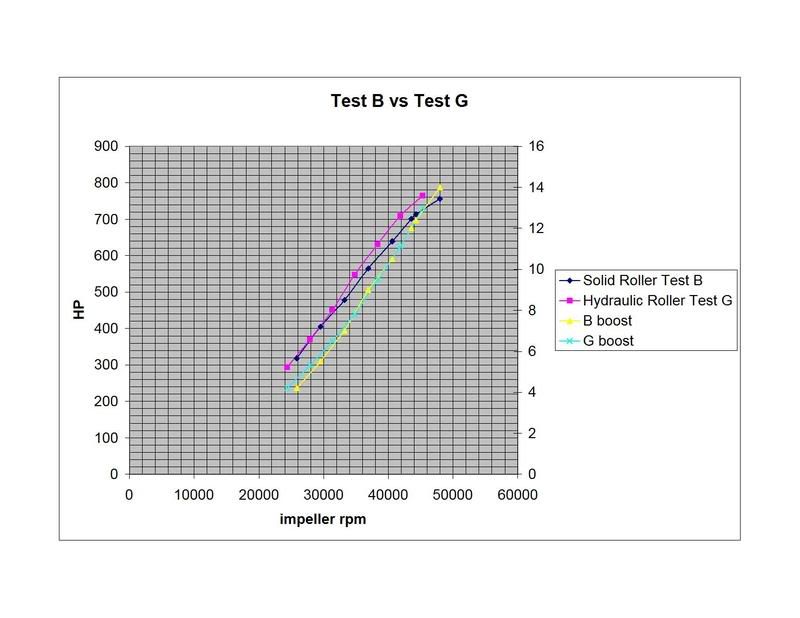
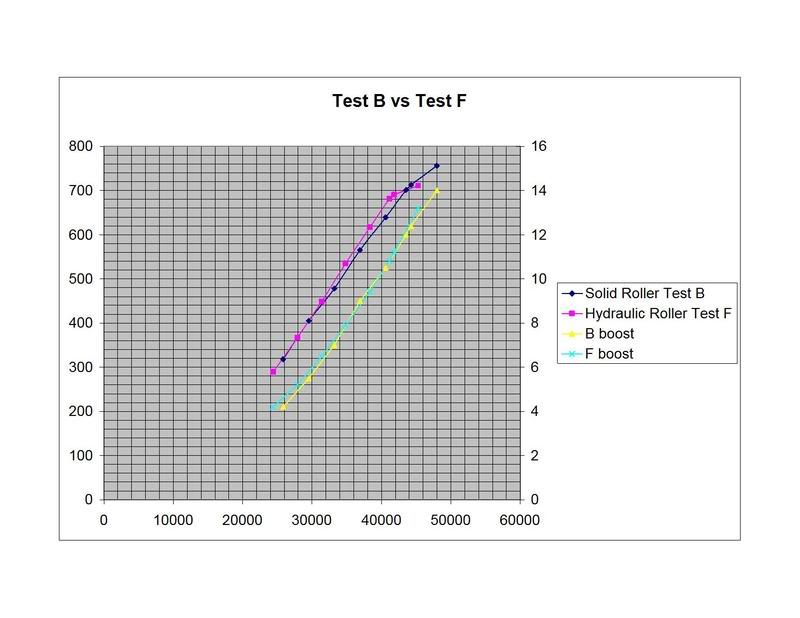
Its difficult to make heads or tails of their results considering the pulley swaps, jetting and rocker changes.
To cut through it all, I plotted HP vs impeller rpm (4.10 D1SC step-up) for Test B and Test F which in my opinion are the most relevent tests. I'm too lazy to post the plot tonight, but I may update it later on.
Here's the plot using a 4.75" pulley as indicated in the table:
Test F has an edge all the way up to 43,000 rpm compared with Test B. As much as 60-80 HP is gained between 35,000 and 40,000 rpm in test F.
As expected, the reduced overlap of the hydraulic roller is making better use of the blower's airflow output for a given impeller rpm.
Reduced fuel consumption would also be an expected benefit with the reduced overlap hydraulic roller camshaft.
Looking into the data, Test F has a strange kink at the top resulting in a big loss of peak HP. This kink goes away in Test G resulting in much more power up top. I'd be surprised if this gain was actually due to the rocker change and not some sort of test issue.
Here's the plot again using a 4.75" pulley as shown in the table:
Note: There are quite a few inconsistencies in the article. Did they use a 4.5" pulley for tests F and G as indicated in the text and photo caption, or a 4.75" pulley as shown in the table. The data I have plotted above is for the 4.75" pulley. After re-reading, I think they really ran the 4.5" which changes the results considerably.
Here is Test F replotted for a 4.5" pulley:
This is a little more believable with maybe a 20 HP gain for the hydraulic roller at the mid-upper impeller rpms.
Here is Test G also replotted for a 4.5" pulley:
It is up to the reader to draw their own conclusions. The power that the D1SC can support at modest impeller rpms is impressive.
I also added boost vs impeller rpm to the 4.5" pulley plots. The boost vs impeller rpm curves are very similar between tests:
Last edited by tequilaboy; Jul 14, 2008 at 09:34 PM.

Melting Slicks

Joined: Jan 2002
Posts: 3,293
Likes: 79
From: Jackson MI
There were alot of inconsitancies in the tests. It would be nice to get a strait apples to apples comparison, but that's hard to do with two different setups.
Here's what I learned:
1.) Less Valve overlap means you can use a larger pulley for the same boost and help avoid belt slip.
2.) 230/242 is considered a "small" hydraulic roller cam. I thought 230 was big for a 355ci with a blower, but I guess not.
Here's what I learned:
1.) Less Valve overlap means you can use a larger pulley for the same boost and help avoid belt slip.
2.) 230/242 is considered a "small" hydraulic roller cam. I thought 230 was big for a 355ci with a blower, but I guess not.
Thread Starter
Team Owner
Joined: Mar 2001
Posts: 30,856
Likes: 293
From: Boston, Dallas, Detroit, SoCal, back to Boston MA
tequilaboy,
can you run those plots for the 383 with 195's and a Vortec S-trim?
It's pretty close to what I'll be running, save the carb and the fact that I have an LT1.
I found it interesting that they left the compression ratio at 10:1 on a non-reverse cooled engine!
Granted they were on 105octane gas.
can you run those plots for the 383 with 195's and a Vortec S-trim?
It's pretty close to what I'll be running, save the carb and the fact that I have an LT1.
I found it interesting that they left the compression ratio at 10:1 on a non-reverse cooled engine!
Granted they were on 105octane gas.
Melting Slicks
Joined: Aug 2003
Posts: 3,401
Likes: 397
From: Lakeville MI
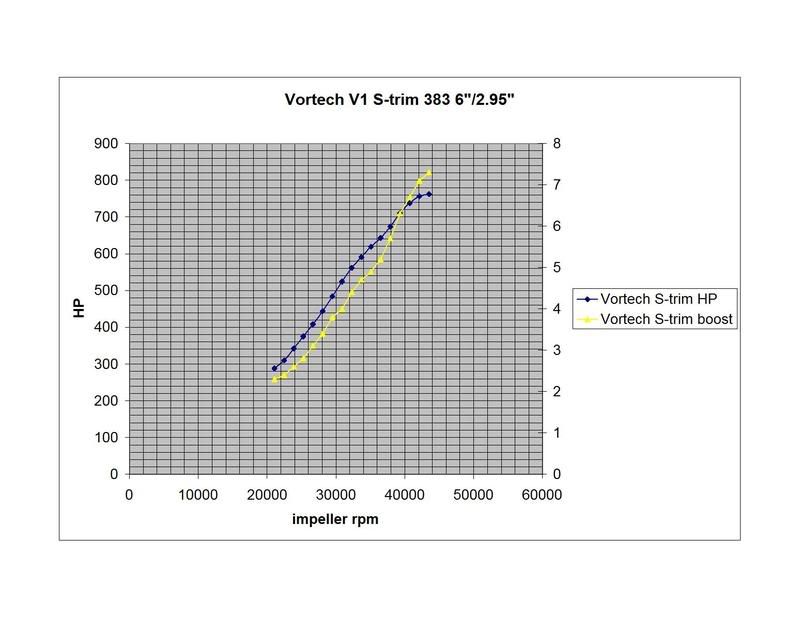
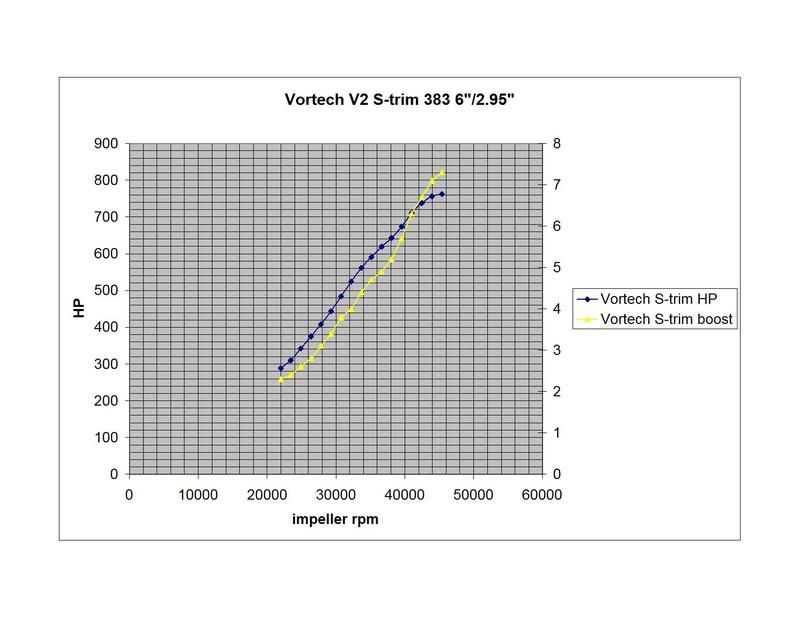
Here are the equivalent plots for the 383 s-trim. I don't know if its a V1 or V2 so I made plots for both. I suspect its really a V1.
V1 with 3.45 step up:
V2 with 3.60 step up:
V1 with 3.45 step up:
V2 with 3.60 step up:
Last edited by tequilaboy; Jul 15, 2008 at 09:10 PM.
Melting Slicks
Joined: Aug 2003
Posts: 3,401
Likes: 397
From: Lakeville MI
I know its not an apples to apples comparison, but how in the heck does a 7 psi hot-boosted S-trim 383 outpower (or equal) an intercooled D1SC'd 355 at 13-14 psi?
I wonder if they were measuring the D1SC boost upsteam of the intercooler or maybe even in the supercharger's volute???
I can imagine a sizeable pressure drop through the intercooler and carb, but is 6 psi or more a realistic drop? I would believe maybe 4 psi. Or does the D1SC suck up so much power in order to deliver 14 psi that it nullifies the gains. I can't imagine that the mechanical efficiency is that bad.
Any D1SC users care to comment on the boost vs impeller rpm or typical pressure drop?
I wonder if they were measuring the D1SC boost upsteam of the intercooler or maybe even in the supercharger's volute???
I can imagine a sizeable pressure drop through the intercooler and carb, but is 6 psi or more a realistic drop? I would believe maybe 4 psi. Or does the D1SC suck up so much power in order to deliver 14 psi that it nullifies the gains. I can't imagine that the mechanical efficiency is that bad.
Any D1SC users care to comment on the boost vs impeller rpm or typical pressure drop?
Last edited by tequilaboy; Jul 15, 2008 at 10:26 PM.
Corvette Stories
The Best of Corvette for Corvette Enthusiasts

Top 10 Most Expensive Corvettes Ever Sold on Bring A Trailer
Brett Foote
10 Things Every Corvette Owner Needs (2026 Edition)
Michael S. Palmer
8 Most "Only Corvette Owners Understand" Quirks and Problems
Pouria Savadkouei
10 Reasons the C6 Z06 is Still A Performance Benchmark After 20 Years
Joe Kucinski
How Much Horsepower Every Corvette Engine "LOST" in 1972
Joe Kucinski
Top 10 DOs and DON'Ts for Protecting Your Convertible Top!
Michael S. Palmer
Top 10 Most Explosive Corvettes Ever Made: Power-to-Weight Ratio Ranked!
Joe Kucinski
150 hp to 1,250 hp: Every Corvette Generation Compared by the Specs That Matter
Joe Kucinski
8 Coolest Corvette Pace Cars (and Replicas) of All Time
Verdad Gallardo
Melting Slicks
Joined: Aug 2003
Posts: 3,401
Likes: 397
From: Lakeville MI
Melting Slicks
Joined: Aug 2003
Posts: 3,401
Likes: 397
From: Lakeville MI
I plotted both hp and boost vs the impeller rpm.
The impeller rpm was obtained by multiplying the engine rpm by the overall impeller drive ratio for each supercharger or pulley combination.
The impeller rpm was obtained by multiplying the engine rpm by the overall impeller drive ratio for each supercharger or pulley combination.
