




Lt4 dyno today

Thread Starter
Burning Brakes


Joined: Jan 2007
Posts: 1,117
Likes: 1
From: Central NJ
 Lt4 dyno today
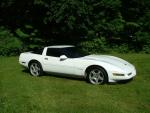
I took the car to sisters bf today, the numbers are less than what I was expecting. Im not sure why the video is so dark.
Dynojet, 78% humidity, 80.31 degrees, 29.65 in-HG.
Run 1 made 308.3hp and 318.4 6tq
run 2 made 309.6hp ans 314.31 tq
Slp intake, EM LT's, random tech cats, and 3" slp cat-back. Tire spin in first run due to antifreeze on the ground (from an import haha)


Dynojet, 78% humidity, 80.31 degrees, 29.65 in-HG.
Run 1 made 308.3hp and 318.4 6tq
run 2 made 309.6hp ans 314.31 tq
Slp intake, EM LT's, random tech cats, and 3" slp cat-back. Tire spin in first run due to antifreeze on the ground (from an import haha)
Burning Brakes

Joined: Sep 2003
Posts: 1,214
Likes: 0
From: Miami FL
Not bad numbers...what were you expecting? You have relatively light mods. The headers and exhaust will give only slight gains on a stock motor, but change your cam and and get a tune...you will see some of results those mods can do.
Last edited by TOO_HOTTVETTE; Sep 6, 2008 at 10:16 PM.
Thread Starter
Burning Brakes
Joined: Jan 2007
Posts: 1,117
Likes: 1
From: Central NJ

Drifting


Joined: May 2005
Posts: 1,370
Likes: 1
From: Raleigh NC
Your number seem a little low, but could be due to 2 things. First, it looks like your numbers are not SAE corrected. At 80 degrees, I would expect your correction factor to be 1.02 (315.7) or 1.03 (318.8). Second, you need a tune to take advantage of your mods. With the exact same set up as yours (EM LTs and RT cats) and a tune and electric water pump my car made 327rwhp on a dynojet. Your numbers are not far off the mark. Get it tuned...!
Last edited by jonecap; Sep 6, 2008 at 10:54 PM.

Safety Car


Joined: Sep 2000
Posts: 3,524
Likes: 4
From: Hinckley Ohio
Your number seem a little low, but could be due to 2 things. First, it looks like your numbers are not SAE corrected. At 80 degrees, I would expect your correction factor to be 1.02 (315.7) or 1.03 (318.8). Second, you need a tune to take advantage of your mods. With the exact same set up as yours (EM LTs and RT cats) and a tune and electric water pump my car made 327rwhp on a dynojet. Your numbers are not far off the mark. Get it tuned...!
Yes you really need a tune to maximize the benefits of your mods....but 309 rwhp on on a near stock car is really sweet!!!


Former Vendor
Joined: Mar 2004
Posts: 1,518
Likes: 7
From: Valencia CA
Actually the SAE correction which is the correction factor most use when comparing chassis dyno results will give you lower numbers....about 4% less I believe. Whoever ran the dyno left the correction factor to standard (STD) to likely show you a better (higher) number.
I stumbled on this thread and quickly opened it curious about the numbers and figured I would better clarify the correction factor situation while I was here.
-Tony
I stumbled on this thread and quickly opened it curious about the numbers and figured I would better clarify the correction factor situation while I was here.
-Tony
Corvette Stories
The Best of Corvette for Corvette Enthusiasts

8 Coolest Corvette Pace Cars (and Replicas) of All Time
Verdad Gallardo
Top 10 Corvette Engines RANKED by Peak Torque (70+ Years of Muscle!)
Joe Kucinski
Corvette ZR1X Will Be Pacing the Indy 500, And Could Probably Race, Too!
Verdad Gallardo
Top 10 Corvettes Coming to Mecum Indy 2026!
Brett Foote
Top 10 C9 Corvette MUST-HAVES to Fix These C8 Generation Flaws!
Michael S. Palmer
10 Revolutionary 'Corvette Firsts' Most People Don't Know
Joe Kucinski
5 Reasons to Upgrade to an LS6-Powered Corvette; 5 Reasons to Stay LT2
Michael S. Palmer
2027 Corvette vs The World: Every C8 vs Its Closest Competitor
Joe Kucinski
10 Most Common Corvette Problems of the Last 20 Years!
Joe Kucinski
Burning Brakes
Joined: Nov 2004
Posts: 781
Likes: 0
Depending on your local emissions testing, I would seriously consider a cam change for your next mod.
Hotcam will work with your LT4 valvesprings, probably get you another 30 HP (with a tune). The engine will make good power to 6,500 RPM.
Go a step or two beyond the Hotcam (with new valvesprings), add a 52mm TB (and a tune), and you could gain up to 60 HP.
Once you get a cam that matches your heads and headers better, the next limiting factor will be the ignition/Opti (due to the additional power at higher RPMs). The simple solution is a MSD box and bigger/hotter coil. This adds some stress to the Opti, so just be prepared.
Hotcam will work with your LT4 valvesprings, probably get you another 30 HP (with a tune). The engine will make good power to 6,500 RPM.
Go a step or two beyond the Hotcam (with new valvesprings), add a 52mm TB (and a tune), and you could gain up to 60 HP.
Once you get a cam that matches your heads and headers better, the next limiting factor will be the ignition/Opti (due to the additional power at higher RPMs). The simple solution is a MSD box and bigger/hotter coil. This adds some stress to the Opti, so just be prepared.

Pro

Joined: Jan 2003
Posts: 515
Likes: 3
From: newark DE
why do people always say the stock opti isnt good at increased power levels or higher rpms? theres a guy around my way named joe overton that has a built LTx trans am and regularly spins the motor over 7500rpms. car runs 9s as well... all on the stock GM opti. it was featured in GMHTP a few years back
Burning Brakes
Joined: Nov 2004
Posts: 781
Likes: 0
I regularly spun mine past 7,000 RPM, in my daily driver. Didn't have the money for a LTCC.
It can be done with all combos, NA or FI.
The Opti does not partcularly like this treatment, though. The Opti rides on a very small axis, with a very short shaft, compared to the relatively large diameter of the rotor, and just a single bearing/support point. While a long shaft conventional distributor has much better support for high speed centrifigal forces. Also the compact design of the Opti makes it suseptable to electrical/firing issues because of the high energy levels that pass through it.
Also, not so much at higher power levels, but at higher RPMs, the small GM 'half' coil is firing quickly, with very little time to recharge/power soak between firings.
In stock form, the Opti system is a little more powerful than a HEI. However, like many things, was not designed to see much more than 6,000 RPM (3,000 cam RPM). Some will last over 100k miles, others will die for no good reason.
I'm not saying that every LTx should go out and get a Dynaspark or convert to LTCC/LS1 coils. Just saying when looking for more power/more RPM...
Be prepared.
Sorry to get off subject. I am not looking to start an Opti thread.
It can be done with all combos, NA or FI.
The Opti does not partcularly like this treatment, though. The Opti rides on a very small axis, with a very short shaft, compared to the relatively large diameter of the rotor, and just a single bearing/support point. While a long shaft conventional distributor has much better support for high speed centrifigal forces. Also the compact design of the Opti makes it suseptable to electrical/firing issues because of the high energy levels that pass through it.
Also, not so much at higher power levels, but at higher RPMs, the small GM 'half' coil is firing quickly, with very little time to recharge/power soak between firings.
In stock form, the Opti system is a little more powerful than a HEI. However, like many things, was not designed to see much more than 6,000 RPM (3,000 cam RPM). Some will last over 100k miles, others will die for no good reason.
I'm not saying that every LTx should go out and get a Dynaspark or convert to LTCC/LS1 coils. Just saying when looking for more power/more RPM...
Be prepared.
Sorry to get off subject. I am not looking to start an Opti thread.

Drifting
Joined: Jan 2006
Posts: 1,740
Likes: 2
From: Winchester Virginia
 It looks like you have a very nice motor there. The mods are not huge power adders and your HP and TQ curves look good! 385 at crank for the stock motor is decent. A cam, more fuel and a good tune will more than likely get you the numbers that your expecting.
Noland
Race Director

Joined: Jan 2005
Posts: 10,641
Likes: 13
From: Slidell Louisiana
As for the opti it the 2nd gen (vented style) optis are pretty robust and mine has survived stints above 6800 without problems.
Mike
Thread Starter
Burning Brakes
Joined: Jan 2007
Posts: 1,117
Likes: 1
From: Central NJ
Actually the SAE correction which is the correction factor most use when comparing chassis dyno results will give you lower numbers....about 4% less I believe. Whoever ran the dyno left the correction factor to standard (STD) to likely show you a better (higher) number.
I stumbled on this thread and quickly opened it curious about the numbers and figured I would better clarify the correction factor situation while I was here.
-Tony
I stumbled on this thread and quickly opened it curious about the numbers and figured I would better clarify the correction factor situation while I was here.
-Tony
