


Oh man I messed up BAAAD

Safety Car


Joined: Jan 2004
Posts: 3,759
Likes: 8

Sand as much as you can with 120 grit without sanding down into the SMC (you will see white when you are getting too far), especially near the body lines. Then lay down some Epoxy primer, at least 2-3 good coats. Then you can wet sand that with 220 and you will see where your problems are, then apply your fillers and your high build primers. You must seal up everything since it sounds like you have quite the mess going on. I painted right over the Epoxy on mine.
And on yours, I'm guessing you stripped it? And you just hit the whole car with Epoxy, then straight to base/clear? When I get mine stripped, what do I need to look for to see if I can get by with just the Epoxy?
I don't see any body damage, just a cheap repaint. The rear bumper has sunk a little, and is a little wavy on top. But I think they all are like that, so I'm gonna leave it be.
Safety Car
Joined: Jan 2004
Posts: 3,759
Likes: 8
paint needs to flash meaning the solvents need to settle out, or you'll get bubbles and or won't adhere cure properly. do some research, and go to the paint section here, they can help you, if you don't have a booth, your car is going to need to flash for a lot longer than a couple minutes. If you want a nice looking paint job, I would take it all off down to the primer, or lower if he did not prep it right before spraying.
If you look at a lot of vettes that have been repainted you can see they either lay it on tooo thick to fast and it cracks, or becauuse of the FB it peels right away at the seems of the car or strange spots.
If you look at a lot of vettes that have been repainted you can see they either lay it on tooo thick to fast and it cracks, or becauuse of the FB it peels right away at the seems of the car or strange spots.
Thread Starter
Burning Brakes

Joined: Nov 2007
Posts: 1,213
Likes: 2
From: Cincinnati oh
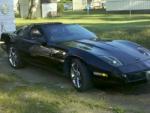
I was looking at getting my 89 painted, it is black and already has a repaint. So, it needs to be stripped. To save some money, I was looking at stripping it myself. What would be better, hand sanding, or a palm sander?
And on yours, I'm guessing you stripped it? And you just hit the whole car with Epoxy, then straight to base/clear? When I get mine stripped, what do I need to look for to see if I can get by with just the Epoxy?
I don't see any body damage, just a cheap repaint. The rear bumper has sunk a little, and is a little wavy on top. But I think they all are like that, so I'm gonna leave it be.
And on yours, I'm guessing you stripped it? And you just hit the whole car with Epoxy, then straight to base/clear? When I get mine stripped, what do I need to look for to see if I can get by with just the Epoxy?
I don't see any body damage, just a cheap repaint. The rear bumper has sunk a little, and is a little wavy on top. But I think they all are like that, so I'm gonna leave it be.
Getting back to doing it my self! Take some time and get some books and Listen to the guys on this forum who have done a few of these. The posting about the Dupont system is gold!
Good Luck, dont be in a rush, and you do get what you pay for....
Thread Starter
Burning Brakes
Joined: Nov 2007
Posts: 1,213
Likes: 2
From: Cincinnati oh
I always paint my Vettes with DuPont Chroma System products. The word "System" is the key.
Everything from primer, surfacer, sealer, base and clear. I always use their additives in the recommended amounts. The products are designed to work with each other and are completely compatible with each other. I don't guess, I measure.
Each can of their products has specific directions that tell about how many coats, flash time between coats, grit of paper to use, etc., etc. So your questions will be answered on the can. If the can label says sand, wet or dry, with 600; sand it, wet or dry, with 600. Don't get creative; leave that to the pros.
The Dupont website has many Tech articles explaining what to do and how to do it. The site also addresses fish-eyes and when a fish-eye eliminator additive is needed, how to correct them by bridging, on and on. You can download and print them too.
Fish-eyes tell me the surface wasn't free of silicone or wax before spraying. Chips are due to the lack of elasticity in the paint or poor adhesion. Mechanical and chemical. Most air-dry, so you don't need a heated booth.
DuPont sells a flex-agent for flexible areas to be used, primarily, on the nose and tail since those areas are the most flexible. The body doesn't need it because the flexibility agent needed is in the paint already.
I chose DuPont because that's what GM uses on our Vettes.
I know a lot of guys have their favorite brand of auto paint, so I'm not trying to start a war. It's just, to me, DuPont addresses all the issues in painting a Vette including durability, chip resistance, color fastness, resistance to chemicals, ease of application, etc., etc.
No matter which brand you choose, be sure to use ALL the recommended additives in the prescribed amounts. Measure, MEASURE, and stir. Choose products based on the temperature.
Start with a CLEAN surface, removing ANY silicone, wax, finger prints, sanding dust, etc. Follow flash times to prevent solvent pop, which occurs when the top coat dries before those coats underneath resulting in the lower solvents "popping" through the upper coats.
As most will tell you, it's the prep that's most important. That's where you will be spending all your energy and time.
Jake
West Point ROCKS!
Everything from primer, surfacer, sealer, base and clear. I always use their additives in the recommended amounts. The products are designed to work with each other and are completely compatible with each other. I don't guess, I measure.
Each can of their products has specific directions that tell about how many coats, flash time between coats, grit of paper to use, etc., etc. So your questions will be answered on the can. If the can label says sand, wet or dry, with 600; sand it, wet or dry, with 600. Don't get creative; leave that to the pros.
The Dupont website has many Tech articles explaining what to do and how to do it. The site also addresses fish-eyes and when a fish-eye eliminator additive is needed, how to correct them by bridging, on and on. You can download and print them too.
Fish-eyes tell me the surface wasn't free of silicone or wax before spraying. Chips are due to the lack of elasticity in the paint or poor adhesion. Mechanical and chemical. Most air-dry, so you don't need a heated booth.
DuPont sells a flex-agent for flexible areas to be used, primarily, on the nose and tail since those areas are the most flexible. The body doesn't need it because the flexibility agent needed is in the paint already.
I chose DuPont because that's what GM uses on our Vettes.
I know a lot of guys have their favorite brand of auto paint, so I'm not trying to start a war. It's just, to me, DuPont addresses all the issues in painting a Vette including durability, chip resistance, color fastness, resistance to chemicals, ease of application, etc., etc.
No matter which brand you choose, be sure to use ALL the recommended additives in the prescribed amounts. Measure, MEASURE, and stir. Choose products based on the temperature.
Start with a CLEAN surface, removing ANY silicone, wax, finger prints, sanding dust, etc. Follow flash times to prevent solvent pop, which occurs when the top coat dries before those coats underneath resulting in the lower solvents "popping" through the upper coats.
As most will tell you, it's the prep that's most important. That's where you will be spending all your energy and time.
Jake
West Point ROCKS!

Drifting


Joined: May 2006
Posts: 1,428
Likes: 7
From: Chewelah Wa
Josh, I hand sanded mine. My clearcoat was peeling really bad on the top half, sun exposed portions due to the previous owner(s) buffing the paint too many times. I hand sanded the clear completely off the top half (above the beltline). Then the car sat under a pine tree for about 6 years after I had sold it to a friend. On parts along the edges where I had carelessly sanded down through the SMC to the yellowish foam substance underneath, these parts had shrunk in the sun. Needless to say it looked like a lost cause. After I got the car back, I lightly resanded everything and laid down 2 heavy coats of Epoxy primer. I then bought some polyurethane filler and filled the chips and shrunken areas, as well as smoothed out the rear deck on top of the rear bumper with a filler that is used for urethane (plastic) bumpers. This took several coats and sanding sessions to get reasonably smooth.Then I hand wet sanded with 220 and a rubber block. Epoxy dries very hard and was difficult to sand, but worth it. Reapply epoxy in areas you sand through. If you are happy with what you see at this point, wet sand with 400 and apply paint. Mine was BC CC Gray Anthracite. If you need to, apply some high build and resand. I bought a gallon of high build and never used it. I bought all my paint and supplies from TPC global online. This is not a project for the faint of heart, I probably had enough hours into it for a pro to paint ten Corvettes, but I did mine for about 800 bucks total. I used a Harbor freight gun and a 3.5 HP compressor with a 20 gallon tank. And boy, did I learn alot. The paint and body portion of this forum was extremely helpful to me.
Drifting
Joined: May 2006
Posts: 1,428
Likes: 7
From: Chewelah Wa
By the way...if you want to sand out an area that is suspect as to how straight it is...wet sand with paper wrapped aroud a paint stick...this is for small problem areas....great on the rear deck.
Safety Car
Joined: Jan 2004
Posts: 3,759
Likes: 8
I'm gonna have someone else paint it though.
Corvette Stories
The Best of Corvette for Corvette Enthusiasts

Every 2027 Corvette Engine Explained
Joe Kucinski
Designer Imagines A Corvette That Looks More Like a Corvette Than the Corvette
Verdad Gallardo
10 Ugly Corvettes That We Still Kinda Love
Joe Kucinski
Top 10 Most Expensive Corvettes Ever Sold on Bring A Trailer
Brett Foote
10 Things Every Corvette Owner Needs (2026 Edition)
Michael S. Palmer
8 Most "Only Corvette Owners Understand" Quirks and Problems
Pouria Savadkouei
10 Reasons the C6 Z06 is Still A Performance Benchmark After 20 Years
Joe Kucinski
How Much Horsepower Every Corvette Engine "LOST" in 1972
Joe Kucinski
Top 10 DOs and DON'Ts for Protecting Your Convertible Top!
Michael S. Palmer
Advanced

Joined: Jul 2007
Posts: 74
Likes: 0
We all know vettes are a little wavy cause there not metal, but I have a feeling that this car is very wavy now. If it was me, i would not leave all the sanding up to a DA. I would da the color coat off, but then I would dry sand with 150 on a block down till I just started to see i was going through the primer. That way your getting rid of the waves out of the old paint job. Then i would spray an etch primer on it, and then a couple coats of build primer. Then wet sand that. Use a guide coat so you can see if you have any real low spots. Reprime if you need to, until the car is fairly straight. I would block sand the hood. That way your sanding it flat, using a DA is easier, but its not sanding it flat like a block will.
Last edited by KoKane; Mar 26, 2009 at 06:45 PM.
Safety Car
Joined: Jan 2004
Posts: 3,759
Likes: 8
We all know vettes are a little wavy cause there not metal, but I have a feeling that this car is very wavy now. If it was me, i would not leave all the sanding up to a DA. I would da the color coat off, but then I would dry sand with 150 on a block down till I just started to see i was going through the primer. That way your getting rid of the waves out of the old paint job. Then i would spray an etch primer on it, and then a couple coats of build primer. Then wet sand that. Use a guide coat so you can see if you have any real low spots. Reprime if you need to, until the car is fairly straight. I would block sand the hood. That way your sanding it flat, using a DA is easier, but its not sanding it flat like a block will.
Advanced
Joined: Jul 2007
Posts: 74
Likes: 0
They make sanding blocks short and long. I would use a long one (one thats about a foot long) for big areas like the top of the hood. Then on the sides of the hood, you could use a shorter block. They sell alot of different blocks in different shapes and sizes. You can buy them in a kit. But for grooves like on the hood where it scoops up. You can use a round block in the grooves. You want to use the flat, stiff block on flat surfaces, top of hood, doors, top of quarters ect.. You want to use flexable blocks on wheel arches and grooves. Its easier to show than to expain. When sanding, say top of door, don't sand back and forth, sand in an x pattern. sand towards bottom left to upper right. Do that a couple of strokes, then go bottom right to upper left. As your doing that, also slowly work your way across to the other side of the door. That way your just not sanding an x in one spot of the door, your kinda blending your x's together, across the whole door. On the long block, use both hands. Grab each side with each hand, short blocks you only use your one hand. http://www.youtube.com/watch?v=_9MhXvC-rE8 check out this video. Hes sanding bodywork, your sanding your old finish. But watch how he sands. The blocks i use are a hard rubber, look more comfortable to use than what hes using.
Last edited by KoKane; Mar 27, 2009 at 05:33 PM.

Race Director


Joined: Sep 2003
Posts: 16,839
Likes: 341
From: Database Error Indiana
There is some good advice here. I think you should get a gun, some paint and give yourself a test. Take a side fender, sand the clear and base off with 320. Leave the primer if you can. Block it with 400. Spray some epoxy primer/sealer. If it looks real good. Spray some base or single stage urethane. If that goes on good clear it. If you end up with a nice panel take what you learned, buy paint and do the car. If its not so good, decide what you feel good about, and do that. Worst case you spent some good $$$ on bad paint. Best case you go on to get the car done on your own. You can always ebay the gun when you are done.




Melting Slicks

Joined: Jan 2004
Posts: 2,659
Likes: 3
From: Oxford CT
Using a d/a is perfectly fine. Using 40 grit is nuts. Here is my link i Have a lot of info maybe it will help you.
My Vette Restore
http://forums.corvetteforum.com/show....php?t=2028913
My Vette Restore
http://forums.corvetteforum.com/show....php?t=2028913