





Patch or plug tires?

Thread Starter
Corvette Enthusiast


Joined: Oct 2007
Posts: 6,797
Likes: 2,721
From: So. Cal.
2025 C7 of the Year Finalist- Unmodified
2024 C7 of the Year Finalist - Unmodified
2023 C7 of the Year Finalist - Unmodified
 Patch or plug tires?
What kind a repair you all doing on your tires? I have always patched tires in the past. But some of my recent patch jobs done for me either leak worse or the same.
I run BFG's KDWS's. Anyone plugging their leaky tires?
Corvette Mike
I run BFG's KDWS's. Anyone plugging their leaky tires?
Corvette Mike

Race Director


Joined: Sep 2003
Posts: 16,839
Likes: 341
From: Database Error Indiana
I've had better luck with plugs. I do it myself. Had a patch come off before and it was a pain because they have to break down the tire. I have plugged tires and never took the wheel off the car. I have BFG KDs on the car but no repairs to report on. 

Le Mans Master

Joined: Jul 2007
Posts: 5,356
Likes: 2
From: No HOA, New Hampshire
Cruise-In X Veteran
St. Jude Donor '09
I recently had a Cooper plugged because of a sheet rock screw decided it needed a new home. Since the repair I lose about 3# per day. This winter all four are going back and remounted and checked for any leaks.I have to top them off @ 34# every month.
Thread Starter
Corvette Enthusiast
Joined: Oct 2007
Posts: 6,797
Likes: 2,721
From: So. Cal.
2025 C7 of the Year Finalist- Unmodified
2024 C7 of the Year Finalist - Unmodified
2023 C7 of the Year Finalist - Unmodified
tire repair
At most tire shops in my area, they hire a bunch of bozo's for employees. I only let them touch my wheel. I take it off and give it to them.
Back in the 70's when I was a kid we had a manual tire machine at a place I worked. It worked great. If I could find one of those, I would buy it.
Corvette Mike
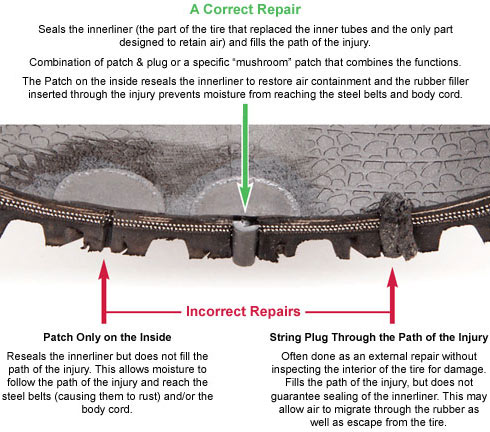
SS396. Thanks for that cool pic of proper plugging.
Back in the 70's when I was a kid we had a manual tire machine at a place I worked. It worked great. If I could find one of those, I would buy it.
Corvette Mike
SS396. Thanks for that cool pic of proper plugging.
Corvette Stories
The Best of Corvette for Corvette Enthusiasts

Every 2027 Corvette Engine Explained
Joe Kucinski
Designer Imagines A Corvette That Looks More Like a Corvette Than the Corvette
Verdad Gallardo
10 Ugly Corvettes That We Still Kinda Love
Joe Kucinski
Top 10 Most Expensive Corvettes Ever Sold on Bring A Trailer
Brett Foote
10 Things Every Corvette Owner Needs (2026 Edition)
Michael S. Palmer
8 Most "Only Corvette Owners Understand" Quirks and Problems
Pouria Savadkouei
10 Reasons the C6 Z06 is Still A Performance Benchmark After 20 Years
Joe Kucinski
How Much Horsepower Every Corvette Engine "LOST" in 1972
Joe Kucinski
Top 10 DOs and DON'Ts for Protecting Your Convertible Top!
Michael S. Palmer

Safety Car

Joined: Jan 2004
Posts: 3,783
Likes: 15
From: Northern California
I always had good luck with the plugs.
My 6 month old Kumho had a screw in it so, I plugged it and it hasn't had a leak or problem in 2 years. Plugging a tire leak is acceptible on a street driven vehicle but, if you were going to do any kind of racing, I would replace the tire instead of using either a plug or patch.
My 6 month old Kumho had a screw in it so, I plugged it and it hasn't had a leak or problem in 2 years. Plugging a tire leak is acceptible on a street driven vehicle but, if you were going to do any kind of racing, I would replace the tire instead of using either a plug or patch.

Team Owner


Joined: Sep 2003
Posts: 20,179
Likes: 673
From: Freedom is never more than one generation away from extinction.
St. Jude '03 thru '24

Melting Slicks


Joined: Oct 2006
Posts: 2,238
Likes: 10
From: College Station TX
Plugging a speed rated tire with a string type plugged pushed in from the outside of the tire ruins the speed rating. The proper repair was posted above: a plug-patch glued to the inside of the tire. The plug part fills the hole and the patch seals it. I would think twice of going fast (120 +) for extended times on any tire that has been plugged or patched.
Thread Starter
Corvette Enthusiast
Joined: Oct 2007
Posts: 6,797
Likes: 2,721
From: So. Cal.
2025 C7 of the Year Finalist- Unmodified
2024 C7 of the Year Finalist - Unmodified
2023 C7 of the Year Finalist - Unmodified
tire
Anyone know where to buy an in expensive manaul tire machine?
Thanks,
Corvette Mike
Thanks,
Corvette Mike

Pro


Joined: Apr 2008
Posts: 542
Likes: 0
From: middle of Illinois

It gets old having to explain to the tire shop "I want these tires put on those wheels, and the tires you take off those wheels put on these wheels, and these tires I will take home with me. And each tire can only go in one spot because they're unidirectional and different sizes front and back." And then to have to pay the stupid "tire disposal fee" every time a tire is taken off of a rim regardless of what you do with the tire, even if you have it put on another rim. Not sure if they're all a bunch of lying cheats or if the Illinois government is (HAHAHAHAHA) but every shop except one which shall remain nameless says they are required by law to charge a disposal fee for every tire they remove from a wheel even if they don't dispose of the tire.
Back on topic, I have plugged a Nitto drag radial that got a nail after only a couple hundred miles. I had no warranty on the tire and was frustrated, so I got some plugs that are a sticky gooey fiberous plug where you use a very course round file to rough up the hole and then push the plug through folded over a tool that resembles a flat screwdriver with a slot in it, then turn 90*, then pull out. The idea is as you turn it 90*, the glue spreads over the inside of the hole, then when you pull the tool out it pulls the fibers back through the hole and squeezes the glue against the hole from the inside. I imagined that it would look a lot like the one on the right in that example, but when those tires were replaced I looked at the repair from the inside and it actually did a very good job. The part of the patch inside the tire was about the diameter of a penny and as flat as one too (the hole was less than 1/8"). And it was bonded very well, I couldn't loosen the patch even with my pocket knife. The first few times, I felt pretty nervous driving over 100 mph on that patch. But after a few months it went to the back of my mind. I never completely forgot about it, but I never had a problem or even a leak with it either. After the tires were worn out and I had them pulled off, I took a good look at the patch and was impressed with how well it formed to the tire and sealed the hole.
No tire manufacturer would recommend driving very far or very fast on that kind of patch, and I wouldn't tell anyone to do it either, but I did it for over a year and got away with it.
Race Director
Joined: Sep 2003
Posts: 16,839
Likes: 341
From: Database Error Indiana
http://search.harborfreight.com/cpis...nger&Submit=Go

Burning Brakes

Joined: Oct 2009
Posts: 773
Likes: 2
From: Minneapolis MN
Patch or plug?
I work as a technician & first off would never tell someone to use fix-a-falt sealer because 1)is messy & no technician likes dealing with tires with fix-a-flat in them 2)the patch will not stick to inside of tire after using fix-a-flat,no matter how much you clean it out 3)fix-a-flat is not a perminate solution & seldoms seals hole 4)fix-a-flat is a liquid & will throw off balance of tire & will freeze in winter 5)never use fix-a-flat or any other sealer!
As far as patch or plug-it depends.If a customers tire is old & fairly worn,I recommend a plug to save them money.If tire is on a nice car(corvette) or if tire is in good shape I recommend patch.When patching tire I always balance tire afterwards.Keep in mind that adding a plug or patch may throw off the wheel balance.The best thing to do is a patch that has a plug(patch plug),although I believe speed rating is average tire after it has been punchured(112 mph tire).
As far as patch or plug-it depends.If a customers tire is old & fairly worn,I recommend a plug to save them money.If tire is on a nice car(corvette) or if tire is in good shape I recommend patch.When patching tire I always balance tire afterwards.Keep in mind that adding a plug or patch may throw off the wheel balance.The best thing to do is a patch that has a plug(patch plug),although I believe speed rating is average tire after it has been punchured(112 mph tire).

Instructor

Joined: Aug 2006
Posts: 143
Likes: 0
From: MD
From US Department of Transportation
"The proper repair of a punctured tire requires a plug for the hole and a patch for the area inside the tire that surrounds the puncture hole. Punctures through the tread can be repaired if they are not too large, but punctures to the sidewall should not be repaired. Tires must be removed from the rim to be properly inspected before being plugged and patched."
There have been people seriously injured or killed by plugging radial tires. If the tire has had any kind of sealant put it in it is dangerous because most of those are highly flamable. Pushing a metal tool through the steel belts can cause a spark turning the tire with sealant into a bomb.
I believe it is actually illegal to plug radial tires because of this, but im not sure if that is a federal or local regulation.
Either way, plugging a steel belted radial is useless because 99 times out of 100 the steel belts (which shift around in the tire) act like a saw damaging the plug causing it to leak.
Plugs = junk
Patch = good
If patched properly it will outlast the tire. Its a chemical reaction that actually bonds the patch to the tire. I have used the patch/plug combo that you pull through from the inside of the tire before with success on a tire with a large puncture but for the average nail/screw hole a patch is plenty.
"The proper repair of a punctured tire requires a plug for the hole and a patch for the area inside the tire that surrounds the puncture hole. Punctures through the tread can be repaired if they are not too large, but punctures to the sidewall should not be repaired. Tires must be removed from the rim to be properly inspected before being plugged and patched."
There have been people seriously injured or killed by plugging radial tires. If the tire has had any kind of sealant put it in it is dangerous because most of those are highly flamable. Pushing a metal tool through the steel belts can cause a spark turning the tire with sealant into a bomb.
I believe it is actually illegal to plug radial tires because of this, but im not sure if that is a federal or local regulation.
Either way, plugging a steel belted radial is useless because 99 times out of 100 the steel belts (which shift around in the tire) act like a saw damaging the plug causing it to leak.
Plugs = junk
Patch = good
If patched properly it will outlast the tire. Its a chemical reaction that actually bonds the patch to the tire. I have used the patch/plug combo that you pull through from the inside of the tire before with success on a tire with a large puncture but for the average nail/screw hole a patch is plenty.

Le Mans Master
Joined: May 2006
Posts: 9,226
Likes: 9
From: Irvine Ca
^^Well, I for one have carried Plugs in my cars for over 20 years. The Steel belts have "never" moved around and acted like a saw and cut the plugs I installed.
I have three cars...they all have a Camel Plug kit in the back somewhere.
I run my tires for much longer than I probably should, if there was an issue with any of the plugs I installed, I surely would have run into it.
I'm sorry, sometime around 1985, while working at a gas station, I learned to plug tires. I've been doing it like that since then.....20+ years of success...I guess I "just got lucky" so far.....
I'm a Road Rep, I put 20K-30K miles on a car per year. Many of my tires have traveled many miles with a plug in them.
I have three cars...they all have a Camel Plug kit in the back somewhere.
I run my tires for much longer than I probably should, if there was an issue with any of the plugs I installed, I surely would have run into it.
I'm sorry, sometime around 1985, while working at a gas station, I learned to plug tires. I've been doing it like that since then.....20+ years of success...I guess I "just got lucky" so far.....
I'm a Road Rep, I put 20K-30K miles on a car per year. Many of my tires have traveled many miles with a plug in them.