


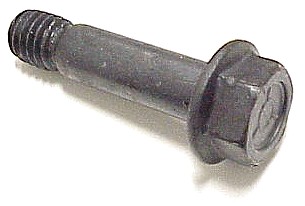




Head Bolts --Reusable or not

Pro

Joined: Oct 2005
Posts: 721
Likes: 1
From: Charlotte NC, behind someone going 10 under the speed limit

 If the final pass isn't in degrees of rotation, , but in ft lbs, that SHOULD indicate they are not TTY.

Thread Starter
Melting Slicks

Joined: Feb 2008
Posts: 3,286
Likes: 6
From: Palm Beach
See what I mean. Another one emphatically on the non TTY side. The Gold Std is measuring the stretch of a bolt. When that is not possible, you are left with straight torque or initial torque and final angle rotation.
I should have started a poll.

Drifting


Joined: Oct 2008
Posts: 1,936
Likes: 92
From: Rochester Hills Michigan
I'm guessing that the angle method is an attempt to attain a certain stretch in the bolt. The pitch of the fastener is known; calculate stretch based on that, you get an angular displacement. Since most of the torque you apply goes into friction at the head of the bolt, this is an attempt to reduce friction as a variable?
Thread Starter
Melting Slicks
Joined: Feb 2008
Posts: 3,286
Likes: 6
From: Palm Beach
I'm guessing that the angle method is an attempt to attain a certain stretch in the bolt. The pitch of the fastener is known; calculate stretch based on that, you get an angular displacement. Since most of the torque you apply goes into friction at the head of the bolt, this is an attempt to reduce friction as a variable?
Now- what other bolts are TTY?
Corvette Stories
The Best of Corvette for Corvette Enthusiasts

Top 10 Most Expensive Corvettes Ever Sold on Bring A Trailer
Brett Foote
10 Things Every Corvette Owner Needs (2026 Edition)
Michael S. Palmer
8 Most "Only Corvette Owners Understand" Quirks and Problems
Pouria Savadkouei
10 Reasons the C6 Z06 is Still A Performance Benchmark After 20 Years
Joe Kucinski
How Much Horsepower Every Corvette Engine "LOST" in 1972
Joe Kucinski
Top 10 DOs and DON'Ts for Protecting Your Convertible Top!
Michael S. Palmer
Top 10 Most Explosive Corvettes Ever Made: Power-to-Weight Ratio Ranked!
Joe Kucinski
150 hp to 1,250 hp: Every Corvette Generation Compared by the Specs That Matter
Joe Kucinski
8 Coolest Corvette Pace Cars (and Replicas) of All Time
Verdad Gallardo
Safety Car


Joined: Aug 2008
Posts: 4,344
Likes: 48
From: San Marcos CA
Here are the bolts in question. They do neck down a bit about and inch below the head.
I think the only definitive way to know if they are TTY is to compare the length to a new one. TTY bolts are designed to stretch beyond the elastic range into the plastic range. That means they don't return to their original lengths when loosened.

I think the only definitive way to know if they are TTY is to compare the length to a new one. TTY bolts are designed to stretch beyond the elastic range into the plastic range. That means they don't return to their original lengths when loosened.
you could probably torque those to 65 lb/ft and they would pronbably be fine...but anyways..I usually bought ARB ones for anything that was higher than stock hp.

Race Director

Joined: Apr 2000
Posts: 15,344
Likes: 4,009
From: Texas
From the book..."How to Rebuild Small-Block Chevy LT1/LT4 Engines" "Step-by-Step Rebuild to Factory Specifications. Covers 1992-1997 GM Cars and Trucks" by Mike Mavrigian on page 21....
"Since the SB2 engines [ie Small Block 2nd Generation, which the LT1/4 are] use TTY (torque-to-yield/torque-angle) cylinder head bolts, these original bolts will not be reused during final assembly."
Hope this ends the debate. It's in the FSM as well, I just haven't had a chance to go digging thru it again.
"Since the SB2 engines [ie Small Block 2nd Generation, which the LT1/4 are] use TTY (torque-to-yield/torque-angle) cylinder head bolts, these original bolts will not be reused during final assembly."
Hope this ends the debate. It's in the FSM as well, I just haven't had a chance to go digging thru it again.
Thread Starter
Melting Slicks
Joined: Feb 2008
Posts: 3,286
Likes: 6
From: Palm Beach
From the book..."How to Rebuild Small-Block Chevy LT1/LT4 Engines" "Step-by-Step Rebuild to Factory Specifications. Covers 1992-1997 GM Cars and Trucks" by Mike Mavrigian on page 21....
"Since the SB2 engines [ie Small Block 2nd Generation, which the LT1/4 are] use TTY (torque-to-yield/torque-angle) cylinder head bolts, these original bolts will not be reused during final assembly."
Hope this ends the debate. It's in the FSM as well, I just haven't had a chance to go digging thru it again.
"Since the SB2 engines [ie Small Block 2nd Generation, which the LT1/4 are] use TTY (torque-to-yield/torque-angle) cylinder head bolts, these original bolts will not be reused during final assembly."
Hope this ends the debate. It's in the FSM as well, I just haven't had a chance to go digging thru it again.
I still can't find it in the FSM.
Race Director
Joined: Apr 2000
Posts: 15,344
Likes: 4,009
From: Texas

Drifting
Joined: Oct 2008
Posts: 1,936
Likes: 92
From: Rochester Hills Michigan
It's not in the FSM for my '92 LT1. If the bolts are TTY, there should be warnings that the fasteners are to be discarded.
If you look at the '92 LT5 section, page 6A2B-31, you'll find a warning to use NEW main bearing bolts whenever they are removed for service. Same for con rod bolts.
If you look at the '92 LT5 section, page 6A2B-31, you'll find a warning to use NEW main bearing bolts whenever they are removed for service. Same for con rod bolts.
Thread Starter
Melting Slicks
Joined: Feb 2008
Posts: 3,286
Likes: 6
From: Palm Beach

Le Mans Master

Joined: Feb 2000
Posts: 9,715
Likes: 27
From: Kempner Texas
It boils down to what source you believe and have your confidence in.
When I compare one source with another I seem to regularly find disgreements.
Take for the example the specs shown in the HAYNES "CHEVROLET CAMARO PONTIAC FIREBIRD Automotive Repair Manual" #24017 where it lists on page 2D-4, LT1 CRANKSHAFT AND CONNECTING RODS as:
Connecting Rod Journal Diameter ; 2.0978 to 2.0998 inches
Bearing oil clearance .0008 to .0022 inch
Crankshaft Main Bearing Journal Diameter: 2.4988 to 2.4998 inches
Oil Bearing Clearance: .001 to .003 inches
Now when you check the 1996 Corvette Factor Service Manual and page 6-15:
Crankshaft (Main) Journal Diameter #1 thru #5 2.4485 to 2.4491 inches
Main Bearing Oil Clearance:
#1, #2, ## and #4: .0009 to .0020 inches
#5 .0010 to .0021 inches DIFFERING FROM HAYNES
Connecting Rod Journal Diameter 2.0978 to 2.0998 inches (which are the same in HAYNES BUT bearing clearance in the FSM is listed as .0013 to .0035 inches WHICH DIFFERS FROM HAYNES which listed .0008 to .0022 inches
I hang my belief on GM's specs. On which do you believe?
Jake
When I compare one source with another I seem to regularly find disgreements.
Take for the example the specs shown in the HAYNES "CHEVROLET CAMARO PONTIAC FIREBIRD Automotive Repair Manual" #24017 where it lists on page 2D-4, LT1 CRANKSHAFT AND CONNECTING RODS as:
Connecting Rod Journal Diameter ; 2.0978 to 2.0998 inches
Bearing oil clearance .0008 to .0022 inch
Crankshaft Main Bearing Journal Diameter: 2.4988 to 2.4998 inches
Oil Bearing Clearance: .001 to .003 inches
Now when you check the 1996 Corvette Factor Service Manual and page 6-15:
Crankshaft (Main) Journal Diameter #1 thru #5 2.4485 to 2.4491 inches
Main Bearing Oil Clearance:
#1, #2, ## and #4: .0009 to .0020 inches
#5 .0010 to .0021 inches DIFFERING FROM HAYNES
Connecting Rod Journal Diameter 2.0978 to 2.0998 inches (which are the same in HAYNES BUT bearing clearance in the FSM is listed as .0013 to .0035 inches WHICH DIFFERS FROM HAYNES which listed .0008 to .0022 inches
I hang my belief on GM's specs. On which do you believe?
Jake

Le Mans Master


Joined: Apr 2000
Posts: 5,713
Likes: 105
From: Manassas VA
I have a haynes manual (24041) It states that on 92-95 torque to 65ft lbs. On a 96 it says 22 ft lbs, then an additional 67 degrees on short bolts and 80 degrees on med, and long bolts.
I do not know for sure if the 96 is a TTY or not, but knowing it is the same motor, I would suspect it. I cant imagine using a different torque sequence on the 96 unless it was TTY bolts.
FWIW I reused the bolts on mine when I switched heads several years back. Never had any problems with the head bolts, gaskets etc.
I do not know for sure if the 96 is a TTY or not, but knowing it is the same motor, I would suspect it. I cant imagine using a different torque sequence on the 96 unless it was TTY bolts.
FWIW I reused the bolts on mine when I switched heads several years back. Never had any problems with the head bolts, gaskets etc.
Pro
Joined: Jun 2001
Posts: 520
Likes: 6
From: Elverson PA
I've done many Volvo and a couple Porsche turbo heads with torque to angle specs. Those manuals state to measure the bolts to ensure they are still within spec. They do stretch, and that is ok within spec. I have always been able to reuse the bolts or find other used bolts within spec. I'm very surprised that GM doesn't publish such a spec.
Thread Starter
Melting Slicks
Joined: Feb 2008
Posts: 3,286
Likes: 6
From: Palm Beach
I've done many Volvo and a couple Porsche turbo heads with torque to angle specs. Those manuals state to measure the bolts to ensure they are still within spec. They do stretch, and that is ok within spec. I have always been able to reuse the bolts or find other used bolts within spec. I'm very surprised that GM doesn't publish such a spec.
I started this thread as a search for info. You will find this debate all over the net. It is a debate but folks let their emotions get away from them. Nowhere have I found concrete proof that the head bolts are TTY. I plan to put new bolts in mine to be safe.
I suggest that anyone interested in this issue spend some time on ARP's site learning what is involved in trying to properly tighten a bolt. I learned a lot.
Here is the catalog. Start on page 27.
Eddie
