





85 corvette died, code 44

Safety Car


Joined: Jan 2008
Posts: 3,939
Likes: 1
From: Vero Beach Florida

Not sure a code 44 will stop it from running. What made you change the pump & filter did you do a fuel pressure check? are your injectors working? are you getting spark?
What else have you checked ?
1985-1991: ECM Codes
Code #12: Normal No Codes.
Code #13: Open Oxygen Sensor Circuit.
Code #14: Coolant Sensor Circuit Low.
Code #15: Coolant Sensor Circuit High.
Code #21: Throttle Position Sensor High.
Code #22: Throttle Position Sensor Low.
Code #23: Manifold Air Temperature Circuit High.
Code #24: Vehicle Speed Sensor.
Code #25: Manifold Air Temperature Circuit Low.
Code #32: EGR System Failure.
Code #33: Mass Air Flow Sensor High.
Code #34: Mass Air Flow Sensor Low.
Code #36: Mass Air Flow Sensor Burn-Off Function Fault.
Code #41: Cylinder Select Error.
Code #42: Electronic Spark Timing.
Code #43: Electronic Spark Control.
Code #44: Lean Exhaust indication.
Code #45: Rich Exhaust Indication.
Code #46: Vehicle Anti Theft Fault.
Code #51: Faulty Mem-Cal.
Code #52: Fuel Calpak Missing.
Code #52: (1990-91 Corvette Only): Engine Oil Temperature Sensor Low.
Code #53: System Over Voltage.
Code #54: Fuel Pump Circuit Low Voltage.
Code #55: Defective ECM.
Code #62: Engine Oil Temperature Sensor Circuit High.
What else have you checked ?
1985-1991: ECM Codes
Code #12: Normal No Codes.
Code #13: Open Oxygen Sensor Circuit.
Code #14: Coolant Sensor Circuit Low.
Code #15: Coolant Sensor Circuit High.
Code #21: Throttle Position Sensor High.
Code #22: Throttle Position Sensor Low.
Code #23: Manifold Air Temperature Circuit High.
Code #24: Vehicle Speed Sensor.
Code #25: Manifold Air Temperature Circuit Low.
Code #32: EGR System Failure.
Code #33: Mass Air Flow Sensor High.
Code #34: Mass Air Flow Sensor Low.
Code #36: Mass Air Flow Sensor Burn-Off Function Fault.
Code #41: Cylinder Select Error.
Code #42: Electronic Spark Timing.
Code #43: Electronic Spark Control.
Code #44: Lean Exhaust indication.
Code #45: Rich Exhaust Indication.
Code #46: Vehicle Anti Theft Fault.
Code #51: Faulty Mem-Cal.
Code #52: Fuel Calpak Missing.
Code #52: (1990-91 Corvette Only): Engine Oil Temperature Sensor Low.
Code #53: System Over Voltage.
Code #54: Fuel Pump Circuit Low Voltage.
Code #55: Defective ECM.
Code #62: Engine Oil Temperature Sensor Circuit High.

Le Mans Master


Joined: Mar 2004
Posts: 5,107
Likes: 171
From: Dublin CA
 #44 lean exhaust.
Possable solutions: Check wiring and connectors from oxygen sensor to the ECM. Check the ECM fround terminal. Check the fuel pressure. Replace the oxygen sensor.
Note that the 85 has a seperate ground for the oxygen sensor. This ground I believe is a orange wire. Ground does NOT go to sensor, but is grounded to the block.

Thread Starter
Instructor

Joined: Jul 2002
Posts: 161
Likes: 0
From: Urbana IL
Checked fuel pressure first, but I think the guage wasn't working, so replaced filter, still wouldn't run, replaced pump, still doesn't run. Now has fuel pressure, but will only run for a second. Shouldn't it still start with a bad O2 sensor?
Safety Car
Joined: Jan 2008
Posts: 3,939
Likes: 1
From: Vero Beach Florida
I would think it would have you checked for spark

Instructor
Joined: Mar 2009
Posts: 126
Likes: 1
From: Newington CT
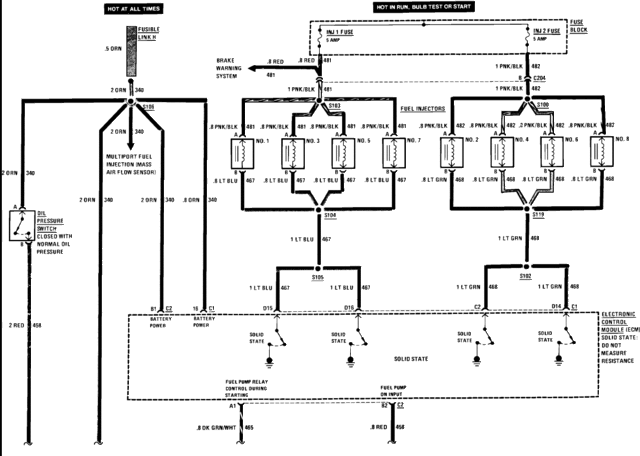
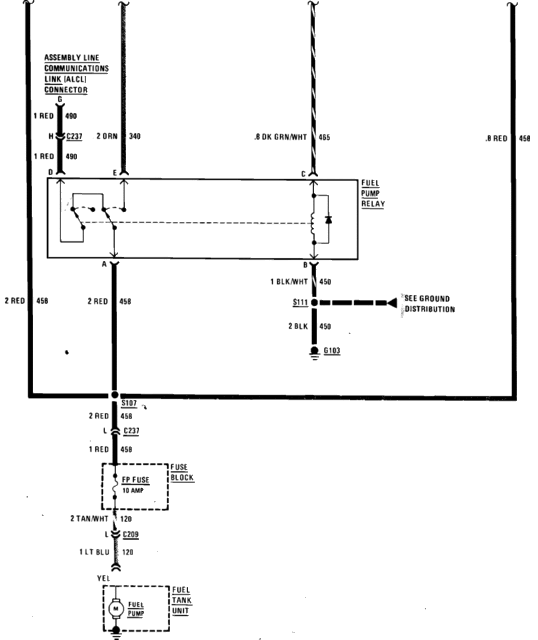
Most EFI cars will only run the pump for a few seconds and shut off if the ECM see's that you turned the key on but didn't try to start the engine.
Power should go back to the pump when in the start postion of the key and the ECM see's that you're trying to start the car. And should stay on when running.
The ECM send's the turn on signal to the fuel pump relay which in turn act's like a switch and keep's the load current away from the ECM.
Also worth noting is the fuel pump relay is tied into the oil psi. switch, it will not turn on unless there is enough oil psi.
Sound's confusing, but it's the best way I can explain it right now.
These diagrams may be of some help.
Check all of your fuse's with a test light yet?
Just because a fuse doesn't look blown doesn't mean it isn't.
The test light will also tell you if you even have power going to that fuse circuit or not, which helps a lot.
Power should go back to the pump when in the start postion of the key and the ECM see's that you're trying to start the car. And should stay on when running.
The ECM send's the turn on signal to the fuel pump relay which in turn act's like a switch and keep's the load current away from the ECM.
Also worth noting is the fuel pump relay is tied into the oil psi. switch, it will not turn on unless there is enough oil psi.
Sound's confusing, but it's the best way I can explain it right now.
These diagrams may be of some help.
Check all of your fuse's with a test light yet?
Just because a fuse doesn't look blown doesn't mean it isn't.
The test light will also tell you if you even have power going to that fuse circuit or not, which helps a lot.
Last edited by Crzyfrlss1; May 8, 2010 at 10:16 PM. Reason: adding to post
Corvette Stories
The Best of Corvette for Corvette Enthusiasts

Every 2027 Corvette Engine Explained
Joe Kucinski
Designer Imagines A Corvette That Looks More Like a Corvette Than the Corvette
Verdad Gallardo
10 Ugly Corvettes That We Still Kinda Love
Joe Kucinski
Top 10 Most Expensive Corvettes Ever Sold on Bring A Trailer
Brett Foote
10 Things Every Corvette Owner Needs (2026 Edition)
Michael S. Palmer
8 Most "Only Corvette Owners Understand" Quirks and Problems
Pouria Savadkouei
10 Reasons the C6 Z06 is Still A Performance Benchmark After 20 Years
Joe Kucinski
How Much Horsepower Every Corvette Engine "LOST" in 1972
Joe Kucinski
Top 10 DOs and DON'Ts for Protecting Your Convertible Top!
Michael S. Palmer
Pro


Joined: Oct 1999
Posts: 515
Likes: 0
From: Nashua NH
This is not accurate. The fuel pump gets energized through the oil pressure switch IF the fuel pump relay fails. It is not a failsafe in case of lack of oil pressure, but rather it is a failsafe in case of relay failure.
Instructor
Joined: Mar 2009
Posts: 126
Likes: 1
From: Newington CT
Well...I DID say it was confusing

Does this mean the pump wont stay energized if there is not enough oil psi. ?
I had a no-start condition like this once on a caddy with the same setup and traced it to a bad oil psi. switch., unplugged and jumpered the switch pigtail and it fired right up.
Last edited by Crzyfrlss1; May 8, 2010 at 11:37 PM.
Pro
Joined: Oct 1999
Posts: 515
Likes: 0
From: Nashua NH
Well...I DID say it was confusing
Does this mean the pump wont stay energized if there is not enough oil psi. ?
I had a no-start condition like this once on a caddy with the same setup and traced it to a bad oil psi. switch., unplugged and jumpered the switch pigtail and it fired right up.
Does this mean the pump wont stay energized if there is not enough oil psi. ?
I had a no-start condition like this once on a caddy with the same setup and traced it to a bad oil psi. switch., unplugged and jumpered the switch pigtail and it fired right up.

Safety Car


Joined: Sep 2005
Posts: 4,229
Likes: 643
From: Orange County Ca
How long have you had the car? Has the idle gotten worse or do you just think it's rougher than it should be?
Regardless of the trouble codes, you say it runs fine. Some members have complained of rough idles in LS3's, thinking that something is wrong, when it is quite normal. My idle roughness varies a bit, but the car runs fine, no codes.
Trouble codes are a totally different animal.
How is your battery?
I've learned from personal experience, and from reading many threads on the forum, that many electrical problems can be traced back to a bad or marginal battery. Just because the car cranks over ok and seems to charge ok, doesn't mean that the battery is good. Needs to be checked with a load testing tool. A vom won't always catch a bad battery.
Check for bad connections, grounds, and high circuit resistance.
Regardless of the trouble codes, you say it runs fine. Some members have complained of rough idles in LS3's, thinking that something is wrong, when it is quite normal. My idle roughness varies a bit, but the car runs fine, no codes.
Trouble codes are a totally different animal.
How is your battery?
I've learned from personal experience, and from reading many threads on the forum, that many electrical problems can be traced back to a bad or marginal battery. Just because the car cranks over ok and seems to charge ok, doesn't mean that the battery is good. Needs to be checked with a load testing tool. A vom won't always catch a bad battery.
Check for bad connections, grounds, and high circuit resistance.


Moderator


Joined: Jul 2005
Posts: 28,858
Likes: 819
From: Parrish FL
St. Jude Donor '06 thru '26
