


 Jack Didley knows Jack Didley!




Could the timing marker move..?
Thread Starter
Instructor

Joined: Jul 2009
Posts: 223
Likes: 0
 Could the timing marker move..?
Ok so I used to have major idle problems with my 89. Replaced a lot of parts and reset the idle many many times...
What fixed it was when I adjusted the idle. Weird thing was everyone said I was supposed to use the timing light to set it at 8 degrees on the timing marker. I unplugged the computer wire and it was already set to 8 degrees. So I moved it around and found my car runs perfect at 0 degrees. I don't understand how the car could of run so bad at factory spec of 8 degrees.
So I was wondering if it was possible the marker itself could of been moved or something accounting for the difference in degrees....
Been running the car now for months like this and it works great... could I be hurting anything?
What fixed it was when I adjusted the idle. Weird thing was everyone said I was supposed to use the timing light to set it at 8 degrees on the timing marker. I unplugged the computer wire and it was already set to 8 degrees. So I moved it around and found my car runs perfect at 0 degrees. I don't understand how the car could of run so bad at factory spec of 8 degrees.
So I was wondering if it was possible the marker itself could of been moved or something accounting for the difference in degrees....
Been running the car now for months like this and it works great... could I be hurting anything?

Race Director


Joined: Sep 2003
Posts: 16,839
Likes: 341
From: Database Error Indiana
Corvette Stories
The Best of Corvette for Corvette Enthusiasts

5 Best & 5 Worst Corvette Daily Drivers
Joe Kucinski
The Headlights of Every Corvette Generation Explained
Joe Kucinski
5 Best & 5 Most Overrated Corvette Track Packages of All Time!
Joe Kucinski
Every 2027 Corvette Engine Explained
Joe Kucinski
Designer Imagines A Corvette That Looks More Like a Corvette Than the Corvette
Verdad Gallardo
10 Ugly Corvettes That We Still Kinda Love
Joe Kucinski
Top 10 Most Expensive Corvettes Ever Sold on Bring A Trailer
Brett Foote
10 Things Every Corvette Owner Needs (2026 Edition)
Michael S. Palmer
8 Most "Only Corvette Owners Understand" Quirks and Problems
Pouria Savadkouei
Team Owner


Joined: Sep 2003
Posts: 20,179
Likes: 673
From: Freedom is never more than one generation away from extinction.
St. Jude '03 thru '24
Mustang_Eater, you can fabricate a simple TDC finder from an old spark plug and a bolt. If your interested I'll post the steps or look for one in Summit or Jegs

Thread Starter
Instructor
Joined: Jul 2009
Posts: 223
Likes: 0
Yes if you wouldn't mind. I decided I would like to make sure my timing is correct and if the bearing wore I don't know how to check....

Melting Slicks


Joined: Dec 2008
Posts: 2,772
Likes: 64
From: Mystic CT
To check to see if the damper has spun and thrown your timing off, is there a way to check what your timing is set at when you run scans? I know on my scans I have readings for "Spark Adv Rel. to TDC degrees" and "Spark Adv Rel. to Ref Pulse degrees".
At idle the "Spark Adv Rel. to TDC degrees" was at 27.07° and the "Spark Adv Rel. to Ref Pulse" was 21.09°.
At idle the "Spark Adv Rel. to TDC degrees" was at 27.07° and the "Spark Adv Rel. to Ref Pulse" was 21.09°.
Dave
Thread Starter
Instructor
Joined: Jul 2009
Posts: 223
Likes: 0
So is there a definitive way to check the timing without a timing light.... besides listening to the engine while you rotate the dist cap? (As the outer ring has most likely slipped on the balancer)

Le Mans Master

Joined: Jan 2003
Posts: 5,858
Likes: 7
From: Santa Maria CA
Indentifying Balancer Slippage:
There is a hole in the metal timing tab of the timing cover. I don't know what it's for but one way to identify a slipped balancer still on the car is if you can see any part of the balancer through that hole from above. If you can then the balancer outer ring has slipped and has walked back closer to the timing cover and your timing mark is now out of place. There should be about a good inch of space between the back of the balancer and timing cover and you should not be able to see any part of the balancer though that hole from above.
Another way is also by using the metal timing tab on the timing cover. On a good balancer the pointed tips of the tab will hover about halfway over the width of the balancer ring. This is shown in the first picture below with the Blue line. Red line shows outer ring flush with center metal hub. This is a good balancer.
Second pic down shows slippage with Green arrows. Outer ring and hub are also no longer flush as a direct result (Red line). Balancer has backed up all the way against the timing cover and is rubbing. The pointed tips of the timing tab are no longer hovering above the halfway point of the balancer ring's width (Blue arrow). Another tell tale sign and hint of balancer slippage.
Good Balancer:

Slipped Balancer:

I've seen balancers that are already rubbing up against the timing cover that go unheard and unnoticed by the owner's inexperienced eye. Also because the engine running drowns out the grinding noise it's making against the timing cover.
Use a balancer puller and installer tool (two separate tools). You can rent both tools with a refundable deposit at Autozone. Don't be an idiot and try to press your new balancer on the crank using only your crank bolt. Don't try to beat the new one on either or pry the old one off cause it ain't going to happen. Use the dedicated puller and installer from Autozone to remove the old and install the new the right way.
Crank Bolt:
To keep the engine from spinning while you break the crank bolt loose put the car in high gear if you have a manual trans. Also set the parking brake and chock the wheels.
On an automatic like mine what I did was remove the flywheel cover. Then I put a long (I think 15mm) Snap-On wrench on one of the torque converter bolts and let it wedge itself against the exhaust pipe. Craftsman wrench was too short to reach. This kept the engine from turning while I broke the crank bolt loose. When re-tightening the crank bolt I placed the wrench on the bottom of the pipe instead of over it to hold the engine from turning the other way. It worked great and never felt unsteady or like it was going to slip. It held rock solid.

Here's my old vs new with the woodruff key slots lined up. Notice how far off my timing mark had moved.


Balancer Removal and Installation:
You need the balancer puller part#27019

And the balancer installer part #27144

Here is how to remove and install the balancer step by step with these two tools.
Removal:
Installation:
NOTE: The removal and install process is exactly the same only you're going to be doing it inside the TPI engine bay with less clerance. Because of this use a deep socket over the end of the puller to turn it and not a shallow socket when pulling the old balancer off. This is because the tool will be right up against the top steering rack line. The deep socket act as a protective cup and shields the puller's threaded shaft as it turns preventing galling and damage to the threads. This way the puller doesn't rub directly on the steering line. Instead the socket will rub but not the tool.
If you have to just go ahead and loosen the top steering rack line and move it to the side for more room. There is no o-ring on this connection so don't worry about loosing it.
Last edited by 86PACER; May 10, 2011 at 01:56 AM.

Burning Brakes

Joined: Aug 2006
Posts: 878
Likes: 2
From: BC



Thread Starter
Instructor
Joined: Jul 2009
Posts: 223
Likes: 0
Wow thanks for the info 86pacer.
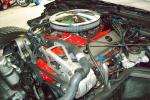
Below is a picture of my balancer... it does not look like there is any slippage....
Can someone please confirm what degree the timing should be at on a 89 Corvette? Maybe it's not supposed to be 8 and I just need to set it to the correct degree.
My idle issue went away as soon as I put the timing to 0 degrees so I know that 8 degrees doens't work on my car when set with the timing light.

Uploaded with ImageShack.us
Below is a picture of my balancer... it does not look like there is any slippage....
Can someone please confirm what degree the timing should be at on a 89 Corvette? Maybe it's not supposed to be 8 and I just need to set it to the correct degree.
My idle issue went away as soon as I put the timing to 0 degrees so I know that 8 degrees doens't work on my car when set with the timing light.

Uploaded with ImageShack.us