


Oil cooler lines; HELP PLEASE

Thread Starter
Drifting


Joined: Dec 2005
Posts: 1,313
Likes: 2
From: High Ridge Missouri
 Oil cooler lines; HELP PLEASE
Anyone out there added an oil cooler? I need pics if you have them of the hose routing. I have a Dewitts radiator with the internal oil cooler. With my headeds I just can't see a safe way to route lines from the filter location to the radiator (or for that matter anywhere).
Anyone with input would be greatly appreciated.
Anyone with input would be greatly appreciated.
Safety Car


Joined: Jul 2001
Posts: 4,871
Likes: 15
From: Detroit's West Side MI
I routed from the sandwich adapter at the stock filter location, forward along the driver's side of the oil pan, over the PS rack (far to drivers side, zip tied to hard line). Then I tied them along the big front cross bar and over to the DeWitt's cooler. I don't have AC and I have LT headers.
I have lots of pics, PM me your email address and I'll send some if you want.
I have lots of pics, PM me your email address and I'll send some if you want.

Instructor

Joined: Jun 2002
Posts: 154
Likes: 3
From: San Diego CA
I need to know this as well, thanks for asking. (I also have a DeWitts with internal oil cooler) I don't even know where to start with the oil line fittings.
A friend mentioned an adapter plate that has a thermal switch to allow the oil to come up to operating temp before the cooler engages.
A friend mentioned an adapter plate that has a thermal switch to allow the oil to come up to operating temp before the cooler engages.

Race Director

Joined: Apr 2000
Posts: 15,344
Likes: 4,009
From: Texas
Mine run from the sandwich adapter along the driver's side of the block, to the front cross-member. I then ran them along the bottom of the cross-member to the passenger side and into the cooler located in the radiator. I did the install with the engine in the car, but I just happen to have a shot of the lines in the empty engine bay from when I built my 383. I have full-length headers and a Canton road racing oil pan. You'll notice that I still wrapped the lines with thermotec and they're zip-tied in a couple strategic locations to help with clearance. Hopefully it helps a little 

Last edited by 96GS#007; Jun 13, 2011 at 03:43 PM.
Instructor
Joined: Jun 2002
Posts: 154
Likes: 3
From: San Diego CA
I drive it year-round in Denver. Do you think that would be an issue in the winter? (taking too long to warm up?)
Yeah, autocross and occasional track day in the summer, nice driver in the winter. Though, I have not mounted the snow tires in years.
Thread Starter
Drifting
Joined: Dec 2005
Posts: 1,313
Likes: 2
From: High Ridge Missouri
Guys thanks for the quick replies.
96GS the pic does help, thank you. I'm pretty sure from your pic you are running braided stainless lines, do you think the thermotec is necessary, or just an extra precaution.
Scaryfast
e-mail is
belmont2537@charter.net
Thanks
96GS the pic does help, thank you. I'm pretty sure from your pic you are running braided stainless lines, do you think the thermotec is necessary, or just an extra precaution.
I routed from the sandwich adapter at the stock filter location, forward along the driver's side of the oil pan, over the PS rack (far to drivers side, zip tied to hard line). Then I tied them along the big front cross bar and over to the DeWitt's cooler. I don't have AC and I have LT headers.
I have lots of pics, PM me your email address and I'll send some if you want.
I have lots of pics, PM me your email address and I'll send some if you want.
e-mail is
belmont2537@charter.net
Thanks
Race Director


Joined: Apr 2003
Posts: 17,701
Likes: 1,667
From: moraga ca
For some reason, I was always under the impression the oil cooler associated with the radiator is usually used for the transmission and a "real" oil cooler is placed in front of the radiator. I imagine the reason is oil temperatures can run a lot hotter than the coolant temperature and will tax a marginal cooling system. Correct me if I'm wrong. Willie
Corvette Stories
The Best of Corvette for Corvette Enthusiasts

Corvette & Porsche 911: How Two Icons Conquered the Last 25 Years
Joe Kucinski
2027 Chevrolet Silverado 1500 First Look: Everything You NEED to Know!
Michael S. Palmer
5 Best & 5 Worst Corvette Daily Drivers
Joe Kucinski
The Headlights of Every Corvette Generation Explained
Joe Kucinski
5 Best & 5 Most Overrated Corvette Track Packages of All Time!
Joe Kucinski
Every 2027 Corvette Engine Explained
Joe Kucinski
Designer Imagines A Corvette That Looks More Like a Corvette Than the Corvette
Verdad Gallardo
10 Ugly Corvettes That We Still Kinda Love
Joe Kucinski
Top 10 Most Expensive Corvettes Ever Sold on Bring A Trailer
Brett Foote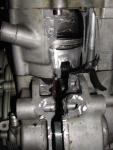
Burning Brakes

Joined: Feb 2010
Posts: 1,013
Likes: 2
From: California City Ca
I end up removing my Oil cooler I didn't like it held a extra 3 Qts of oil that did't drain out during oil changes.
So even you changed the oil you still had 3 Qt's of old oil in the oil system.
If you do use a oil cooler I found a NAPA Gold 7099 oil filter works great it the bottom of the oil filter level with the stock 7 inch deep oil pan.
So even you changed the oil you still had 3 Qt's of old oil in the oil system.
If you do use a oil cooler I found a NAPA Gold 7099 oil filter works great it the bottom of the oil filter level with the stock 7 inch deep oil pan.
Pro


Joined: Jun 2006
Posts: 508
Likes: 1
From: Miami Florida
I installed an oil cooler and placed it in front of the radiator on the driver's side. We made a couple of brackets and screwed the cooler to the bracket. I used a oil filter adapter between the engine and the filter and ran the lines along the driver's wheel well and through the radiator shroud to the oil cooler. My car runs much cooler all around and actually cools down quicker as well. I live in Miami and have 90 degree heat almost daily 6 or 7 months of the year.
I am now planning to install a trans cooler and locate it in the rear where the spare used to be. I drag race a lot, and as you well know, heat is not our friend!
Steve
I am now planning to install a trans cooler and locate it in the rear where the spare used to be. I drag race a lot, and as you well know, heat is not our friend!
Steve
Race Director
Joined: Apr 2000
Posts: 15,344
Likes: 4,009
From: Texas
For some reason, I was always under the impression the oil cooler associated with the radiator is usually used for the transmission and a "real" oil cooler is placed in front of the radiator. I imagine the reason is oil temperatures can run a lot hotter than the coolant temperature and will tax a marginal cooling system. Correct me if I'm wrong. Willie
With no oil cooler and a Fluidyne radiator, my coolant temps after 25 minutes of hard lapping were 230*+ and my oil temps were 310*+ (yes, 310, not 210)
With a traditional oil cooler mounted in front of the radiator and a DeWitt radiator, my coolant temps were 230* and my oil temps were 250*
With this setup, my coolant temps are typically 220* and my oil temps are 240*. I just ran a track day with the Porsche guys Saturday, so this is current data.
Regarding some of the other posts...
To run track days, an oil cooler is a must. For the street...waste of time and money in my opinion. If you want to get nearly all the oil out, remove the fitting that holds the sandwich adapter in place after you remove the oil filter and angle the adapter down slightly. 90% of the remaining oil will drain out of the lines. Just remember to prime the system before starting the engine
Thermotec...The lines are braided Aeroquip lines, but I wrapped them for added protection and to prevent accidental chaffing. This is an area I'd rather overkill than go with what seems to be good enough.
Last edited by 96GS#007; Jun 14, 2011 at 02:22 AM.
Instructor
Joined: Jun 2002
Posts: 154
Likes: 3
From: San Diego CA
Safety Car
Joined: Jul 2001
Posts: 4,871
Likes: 15
From: Detroit's West Side MI
Wow, this thread got active quickly!
Welcome. Winter...hmmm...thinking about it logically, let's say oil and water temp both sit at 30°. You will definately heat both up more quickly if you're only running them through the block. The thermostat will open at 180 and bring the radiator into the system, which would then bring oil temps up. Maybe. Quite frankly I can't see it mattering at all. There is so little oil in the radiator integrated cooler that it's irrelevant.
I think the advice I'd give is the same for summer or winter, don't drive hard until you're seeing oil temps in the 180 range. It will just take a little longer to get there in winter.
I just saw this, I'll post some photos here today since there are others interested now. But my routing isn't that different from GS's.
A real oil cooler is placed wherever you can get high air flow to it, a common place is in front of the radiator. The issue here is that you are doing two things: blocking some air flow to the radiator, and heating up the air that goes to the radiator as it goes through the oil cooler first. Still, this tends to be the best solution for most cars.
Meh. It's really not a big deal. leaving a quart or two in the system and changing the other 7 is good enough, there's no need to get every last drop out. It's not like the oil goes "bad" and ruins the new oil. 3qts is pretty high, most coolers hold about 1. Then probably another qt between the cooler in the radiator and the lines.
I use AN8 lines, no thermotec. I do sleeve them with some hose where they come into contact with anything else, to both protect the SS lines and whatever they are rubbing. That braiding will chew through steel given a little time. It's nuts!
I think the advice I'd give is the same for summer or winter, don't drive hard until you're seeing oil temps in the 180 range. It will just take a little longer to get there in winter.
For some reason, I was always under the impression the oil cooler associated with the radiator is usually used for the transmission and a "real" oil cooler is placed in front of the radiator. I imagine the reason is oil temperatures can run a lot hotter than the coolant temperature and will tax a marginal cooling system. Correct me if I'm wrong. Willie
I use AN8 lines, no thermotec. I do sleeve them with some hose where they come into contact with anything else, to both protect the SS lines and whatever they are rubbing. That braiding will chew through steel given a little time. It's nuts!
Last edited by ScaryFast; Jun 14, 2011 at 10:26 AM.
Le Mans Master


Joined: Oct 2007
Posts: 9,729
Likes: 3,517
From: Akron Ohio
2025 Corvette of the Year Finalist - Modified
2024 C5 of the Year Winner - Modified
2023 C5 of the Year Finalist - Modified
2022 C5 of the Year Finalist - Modified
St. Jude Donor '09-'10-'11
Had not considered that. Thank you.
I drive it year-round in Denver. Do you think that would be an issue in the winter? (taking too long to warm up?)
Yeah, autocross and occasional track day in the summer, nice driver in the winter. Though, I have not mounted the snow tires in years.
I drive it year-round in Denver. Do you think that would be an issue in the winter? (taking too long to warm up?)
Yeah, autocross and occasional track day in the summer, nice driver in the winter. Though, I have not mounted the snow tires in years.
Here is a picture of my setup:
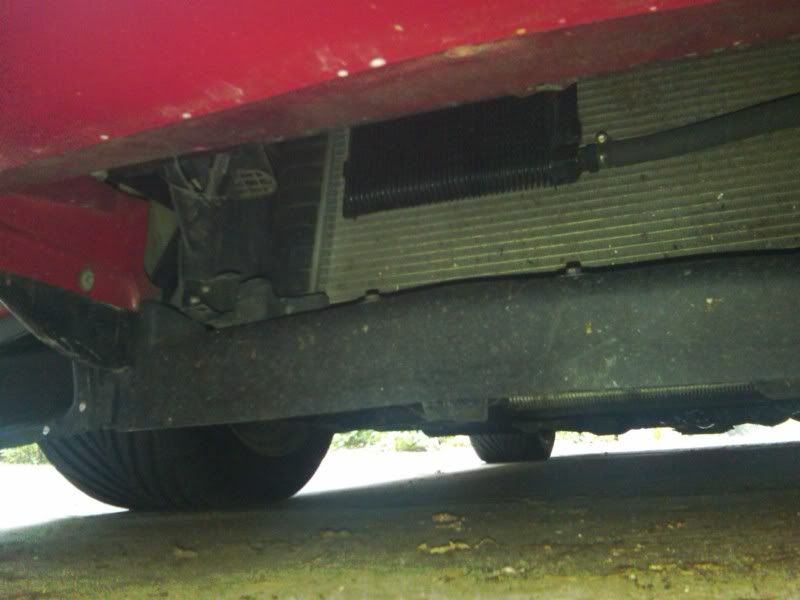
I also routed my line from the sandwhich adapter to the driver side of the radiator. I dont have an oil cooler in the radiator like the Dewitts unit because I am still using the stock radiator.

Instructor
Joined: Jun 2002
Posts: 154
Likes: 3
From: San Diego CA
Thanks Kubs. I will do some more research on a temperature actuated sandwich adapter. Dual use and weather give me a little more of a challenge when upgrading/modifying. Then again, I have been told I like doing things that hard way.
Race Director
Joined: Apr 2000
Posts: 15,344
Likes: 4,009
From: Texas
Thread Starter
Drifting
Joined: Dec 2005
Posts: 1,313
Likes: 2
From: High Ridge Missouri
Thanks for the replies everyone. I guess I need to get the Vette higher off the ground and see if I can get a better idea of the routing. I just can't mentally picture it and last I looked it seemed so tight with the routing being described I guess I just need to buy the lines, fittings, ect. and give it a shot.
Scaryfast your pic didn't come up. Feel free to e-mail the pics to me if you don't mind.
Thanks
Scaryfast your pic didn't come up. Feel free to e-mail the pics to me if you don't mind.
Thanks
