



Optispark question

Thread Starter
Safety Car

Joined: Jul 2006
Posts: 3,696
Likes: 1
From: MA
 Optispark question...UPDATED w\PICS
What fails in the optispark .?
Is it the module,cap rotor,or bearing that cause this thing to really fail?
Im getting ready to do one of these dreaded units.
How is Chandler motors Sports Opti units for 93 LT1 ?
Are the life time warranty ones vented?
Also who would you reccomend that I could get the water pump from?
Any tips would be helpful, Thank you in advance
Is it the module,cap rotor,or bearing that cause this thing to really fail?
Im getting ready to do one of these dreaded units.
How is Chandler motors Sports Opti units for 93 LT1 ?
Are the life time warranty ones vented?
Also who would you reccomend that I could get the water pump from?
Any tips would be helpful, Thank you in advance
Last edited by Repzard; Jun 18, 2011 at 11:55 PM. Reason: Updated

Instructor


Joined: Feb 2011
Posts: 244
Likes: 6
From: harrison twp mi
Have had mostly rotor and module failures,ive had good luck with the lifetime chandler unit.Pretty sure the 93 unit is not vented.Also have had good luck with the new lifetime warranty water pumps from autozone,$110 here in Mi.

Le Mans Master


Joined: Mar 2001
Posts: 7,999
Likes: 14
From: Life is just one big track event. Everything before and after is prep and warm-up and cool-down laps
Cruise-In III Veteran
Cruise-In IV Veteran
St. Jude Donor '12
Bearing, cap, rotor are the componnents that fail most often.
Seems with the problems with a few of the other manuf (Dynaspark, MSD) its a whole lot easier to go with the less expensive Chandler unit.
I needed a genII opti at the time they were only doing eBay (I don't do eBay/PayPal) and went with a Summit Racing white box opti. Its been fine for 6months. Not enough time to say yeah or neah
Seems with the problems with a few of the other manuf (Dynaspark, MSD) its a whole lot easier to go with the less expensive Chandler unit.
I needed a genII opti at the time they were only doing eBay (I don't do eBay/PayPal) and went with a Summit Racing white box opti. Its been fine for 6months. Not enough time to say yeah or neah
Advanced
Joined: Jun 2011
Posts: 83
Likes: 1
If you can, switch over to a vented opti spark cap, they have a link online where you can do it yourself, but that's a little project and you might just want to buy it. The vented cap is a conversion to any non-vented. I have had a water pump from advance auto parts for the past year without any issues.........knock on a big piece of wood...

Pro


Joined: May 2007
Posts: 544
Likes: 10
From: Olympia WA
Lots of bad press for Chandler Motorsports over at the LS! site.
Personally, I don't like the way they talk at us customers and many folks seem to get DOA Opti's from them. Lots seem to have good luck.
Grain of salt...
Personally, I don't like the way they talk at us customers and many folks seem to get DOA Opti's from them. Lots seem to have good luck.
Grain of salt...
Le Mans Master
Joined: Mar 2001
Posts: 7,999
Likes: 14
From: Life is just one big track event. Everything before and after is prep and warm-up and cool-down laps
Cruise-In III Veteran
Cruise-In IV Veteran
St. Jude Donor '12
Thats disconcerting to hear Chandler is having problems.
I was going to use them as a backup if my Summit Racing Opti goes toes up.
My Summit will get three weeks in a row of track duty, if it lasts that will be better than 1/2 a season with no Opti issues
I was going to use them as a backup if my Summit Racing Opti goes toes up.
My Summit will get three weeks in a row of track duty, if it lasts that will be better than 1/2 a season with no Opti issues

Advanced
Joined: Jan 2011
Posts: 77
Likes: 0
From: Winona Mo.
When I replaced my Opti a couple of weeks ago, I took the old one apart to try and figure out what fails. Inside it looked like any used electrical system should. The rotor and cap had what I would consider normal looking wear. There was no evidence of moisture and only slight surface corrosion on non plated parts. Keep in mind, it only acted up once by dying while my daughter was driving and after 1/2 hour it acted fine. I only changed it because of the code 16 and paranoia.
I suspect that the module was going, the encoder wheel looked OK, until I bent it. I don't know if there's a way to test the module. It looks to me like if the encoder is good and you could buy a module, rotor and cap, it could be rebuilt. Of course it would probably cost more than buying a new one.
I suspect that the module was going, the encoder wheel looked OK, until I bent it. I don't know if there's a way to test the module. It looks to me like if the encoder is good and you could buy a module, rotor and cap, it could be rebuilt. Of course it would probably cost more than buying a new one.
Corvette Stories
The Best of Corvette for Corvette Enthusiasts

Top 10 Most Expensive Corvettes Ever Sold on Bring A Trailer
Brett Foote
10 Things Every Corvette Owner Needs (2026 Edition)
Michael S. Palmer
8 Most "Only Corvette Owners Understand" Quirks and Problems
Pouria Savadkouei
10 Reasons the C6 Z06 is Still A Performance Benchmark After 20 Years
Joe Kucinski
How Much Horsepower Every Corvette Engine "LOST" in 1972
Joe Kucinski
Top 10 DOs and DON'Ts for Protecting Your Convertible Top!
Michael S. Palmer
Top 10 Most Explosive Corvettes Ever Made: Power-to-Weight Ratio Ranked!
Joe Kucinski
150 hp to 1,250 hp: Every Corvette Generation Compared by the Specs That Matter
Joe Kucinski
8 Coolest Corvette Pace Cars (and Replicas) of All Time
Verdad Gallardo
Le Mans Master

Joined: May 2005
Posts: 7,354
Likes: 2,278
From: Central Maryland
What fails in the optispark .?
Is it the module,cap rotor,or bearing that cause this thing to really fail?
Im getting ready to do one of these dreaded units.
How is Chandler motors Sports Opti units for 93 LT1 ?
Are the life time warranty ones vented?
Also who would you reccomend that I could get the water pump from?
Any tips would be helpful, Thank you in advance
Is it the module,cap rotor,or bearing that cause this thing to really fail?
Im getting ready to do one of these dreaded units.
How is Chandler motors Sports Opti units for 93 LT1 ?
Are the life time warranty ones vented?
Also who would you reccomend that I could get the water pump from?
Any tips would be helpful, Thank you in advance
All Optis are vented. The first-gen Opti units that were installed in C4s from '92 through '94 are passively-vented, with three weep holes in the bottom. This proved to be inadequate, as condensation buildup became a problem, especially on cars that are seldom driven. I bought my '94 in 2004, when it had only 19,100 miles on it. The Opti began crossfiring a couple of weeks later. I replaced it with an actively-vented Dynaspark unit (this was back when Dynaspark was still built by DynoTech Engineering, and was a quality piece -- word around here is that the quality has fallen off sharply since the product was sold off).
The second-gen Opti units are actively-vented, with filtered air being drawn from the intake bellows, through the Opti unit, and then into the intake manifold. There were numerous other changes made to the second-gen unit, and it is not a bolt-on interchange for the first-gen unit. These second-gen units were installed on C4s in '95 & '96, and tend to last much longer than the first-gen units, although there are folks who've squeezed out north of 100k miles from both models.
I can't comment on any of the aftermarket Optis other than the early, DynoTech-built Dynaspark units, as I've had no personal experience with them. The Dynaspark that's in my '94 has been performing flawlessly since I installed it seven years ago, but that's mostly useless information to you now, as DynoTech Engineering hasn't been building these units for several years now.
I went with an OEM AC Delco water pump from the Chevy dealer that sponsors my club, and it's been just fine. I don't think I'd risk using a pump from Autozone, etc, given that the Opti is in danger anytime a water pump fails. Some of the guys here have installed a drain tube into the weep hole in their water pumps, in the hope that it will drain any leakage off away from the Opti. This is probably a good idea, and you can find threads in the archives here that illustrate how this was done.
As has been noted in other responses, there are also guys here who have added active venting to first-gen OEM Opti units. Search the archives for details. This is probably also a good idea, if you buy a passively-vented Opti as a replacement. Just make sure that:
1. You connect all of the vacuum hoses correctly, so that you are drawing filtered air into the unit.
2. You aren't pulling a vacuum inside of the unit (which will collapse the cap, causing rotor to collide with the contacts in the cap, leading to instant destruction).
3. You have a one-way valve installed in the vacuum hose between the intake manifold and the Opti, so that you don't have air/fuel vapors bleeding back into the Opti while the car is at rest.
If you fail to do any of these three things, you'll do more harm than good by trying to actively-vent the Opti.
If you have a good set of general mechanic's tools, and decent mechanical skills, you can tackle the Opti swap yourself. No special tools are required. Here are a few tech tips I wrote up some time ago about doing an Opti swap with new plug wires (HIGHLY recommended while you're doing the Opti, as it's a hideous job to replace the wires with everything fully assembled):
--------
Get a Factory Service Manual, and follow the procedure it lays out.
A few tips (I'm going from memory here, so I'll probably forget a few things):
Drain the cooling system.
Disconnect the MAF sensor and IAT sensor and remove the air intake duct with the MAF and IAT as an assembly.
Disconnect the ECT sensor and remove it from the water pump.
Remove the serpentine belt and tensioner.
You may find that you’ll need to unbolt the coil/ICM bracket from the front of the right cylinder head. I can’t recall for sure whether or not I did.
Unbolt (but don't remove) the power steering pump. This will help you to sneak the new plug wires in/out behind the pump, but may also be somewhat helpful when working on the water pump/Opti.
If you want more room to work, you can remove the radiator, but it isn't strictly necessary, and it involves considerably more work to remove it (I left mine in place).
The FSM will tell you that you need a special Kent-Moore puller to remove the crank pulley/damper. You don't. Here's how to get it off:
1. Raise the front of the vehicle enough that you can get under the car (it's also helpful to have it at a more comfortable height while you're working from above).
2. Remove the three bolts that secure the pulley/damper to the hub.
3. Mark the damper and hub so that you can easily see how to realign them to each other later.
4. Slide under the car with a long pry bar or hardwood dowel (I use a jumbo Snap-On screwdriver that's around two feet long) and a mallet.
5. Place the tip of the pry bar against the rear face of the damper, as close to the hub as possible (Ideally rest the tip alongside of the hub).
6 Give the pry bar a few whacks with the mallet, and with any luck the damper will pop off without too much of a fight.
You may find it helpful to apply a few whacks, then rotate the crankshaft in 120* increments, whacking it a few times at each interval (I haven't needed to do this).
It's also helpful to, if possible, shoot a bit of penetrating oil where the damper meets the hub, a day or more in advance of doing the job.
After you get the damper off, clean the damper/hub mating surfaces to remove all corrosion, etc, and apply a very thin coating of anti-seize compound to these surfaces before you reassemble the damper to the hub. This should make it a lot easier to get the damper off next time.
Once the damper is removed, rotate the crankshaft so that one wing of the damper hub is at the six-o'clock position. This will position the other two wings at around the ten- and two-o'clock positions. In this orientation, the Opti will clear the hub as it is being removed/installed.
The Opti basically unbolts and pulls off as you'd expect, once you have the water pump and damper out of the way.
Once the Opti is out of the way, inspect the shaft seals for the Opti, water pump, and crankshaft. If they show any signs of leakage, replace them now.
When you install the new Opti, be sure to align it correctly with the cam gear, and don't force it into place against the timing cover (do NOT use the bolts to draw it into place). At most, give it a gentle bump with the heel of your hand to encourage it to pop into place.
Reassemble everything else.
Follow the cooling system refill procedure in the FSM carefully, and you'll have no problems with this. In particular, be sure to bleed the air out of the system as it's being refilled. I recommend re-bleeding the system after each of the first three temperature cycles. I usually get a bit more air out by doing this. Be sure to pack rags under the bleeder screws before you open them, to catch the small amount of coolant that will leak out. You do NOT want coolant getting onto the brand new Opti!!! A cooling system pressure tester can dramatically speed up the bleeding process, if you own or can borrow one.
Hope this helps. Best of luck with it.
Live well,
SJW
Last edited by SJW; Jun 18, 2011 at 04:39 PM.
Thread Starter
Safety Car
Joined: Jul 2006
Posts: 3,696
Likes: 1
From: MA
Update
Well I pull the corvette apart today and this is what I found.
[IMG]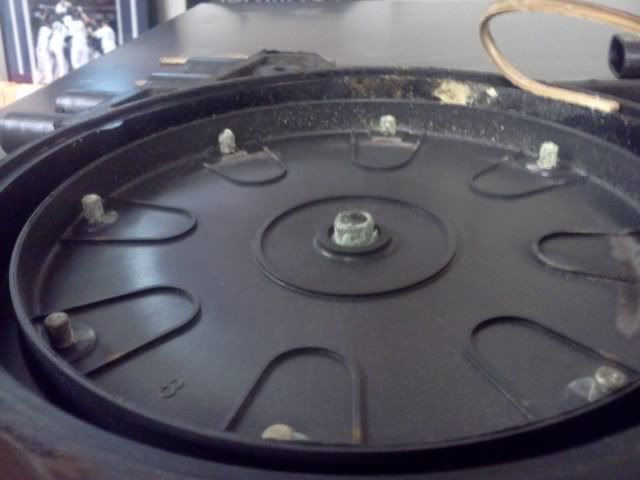 [/IMG]
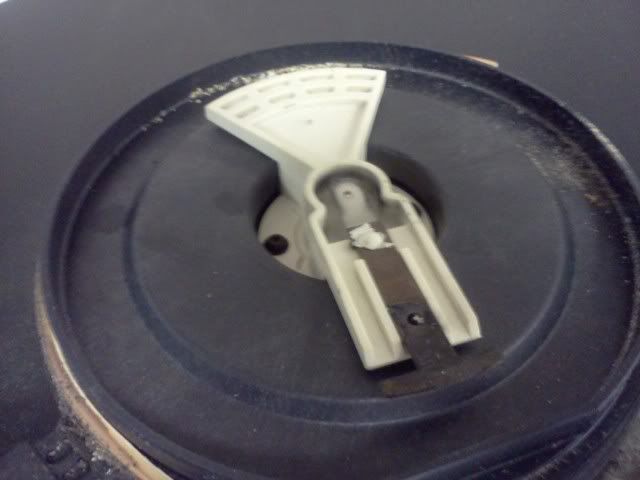
Like SJW said the rotor self destructed as you can see in pictures.
Im really shock this car was still running .Looks of the cap it was running on 2 healthy cylinders for the most part.
As you can see the rotor started to eat at the cap.
Also the water pump had a leak by sensor and front cover which im guessing was leaking when engine got hot and cooling system was under pressure.
Well to end this story on a good note.
This is the original optispark in this Corvette and the millage just hit 128K
Guess this optispark proved one thing.
It lived for 128K miles ,so they cant be that bad as people claim and this is the reason these cars miss fire 80% of the time.
BTW..This is the 2nd Opti ive done on a LT1 so this job wasnt really new to me.
Thanks for all the help and enjoy the pics of my dead opti with a 128K miles
Hope this help some people out as well
Repzard
[IMG]
[/IMG]Like SJW said the rotor self destructed as you can see in pictures.
Im really shock this car was still running .Looks of the cap it was running on 2 healthy cylinders for the most part.
As you can see the rotor started to eat at the cap.
Also the water pump had a leak by sensor and front cover which im guessing was leaking when engine got hot and cooling system was under pressure.
Well to end this story on a good note.
This is the original optispark in this Corvette and the millage just hit 128K
Guess this optispark proved one thing.
It lived for 128K miles ,so they cant be that bad as people claim
and this is the reason these cars miss fire 80% of the time.BTW..This is the 2nd Opti ive done on a LT1 so this job wasnt really new to me.
Thanks for all the help and enjoy the pics of my dead opti with a 128K miles
Hope this help some people out as well
Repzard
Last edited by Repzard; Jun 18, 2011 at 11:37 PM.
