







Thoughts on cross drilled rotors

Thread Starter
6th Gear

Joined: Jul 2011
Posts: 6
Likes: 0
From: State College PA
 Thoughts on cross drilled rotors
I have an 88, and live in "mountainous" Pennsylvania. I notice when going down hill and getting on the brakes, the fade quickly and the heat causes them to warp slightly. They cool down just fine and work ok when just driving around town, but with 70,000 miles and 23 years of driving, I thought about upgrading them when I replace the pads.
I thought about cross drilled on the front, but wanted to get some opinions first. I have heard both good and bad about them. I found a study GM did a little back, and it found that they get about 21% more grip and about 100 degrees cooler when stopping over 120 MPH (not that I plan to do that). But, that doesn't necessarily mean anything. I figured a few people out there may have tried them out and wondered what they thought. I have also considered that standard rotors by today's standard may be much advanced and more than I need. So what do you all think?
I thought about cross drilled on the front, but wanted to get some opinions first. I have heard both good and bad about them. I found a study GM did a little back, and it found that they get about 21% more grip and about 100 degrees cooler when stopping over 120 MPH (not that I plan to do that). But, that doesn't necessarily mean anything. I figured a few people out there may have tried them out and wondered what they thought. I have also considered that standard rotors by today's standard may be much advanced and more than I need. So what do you all think?
Safety Car


Joined: Apr 2011
Posts: 3,660
Likes: 22
Drilled rotors are great BUT, its all about the hole pattern.
The holes must be drilled in such a pattern so there are not any in the same vane that could crack between holes and become a weakened area that could break away. Cracking is bad enough...
Look at the patterns, and see how the holes are chamfered, that means alot. A good bevel or chamfer around the edge does lots to help the grip, disposal of debris and cooling.
The real advances have been in the pads...theres ceramics, newer composites and other late model technology that does make a difference in brake performance. Personally I like the drilled rotors and I currently run good composite pads. These are C5 brakes on a C4, much much bigger, but they work !
Just use caution withn the rotors..lots of plain cheap rotors out there with some generic hole pattern that may look good but has the fatal flaw of multiple holes in the same vane...bad deal.
Slotted are an option but most slotted rotors wear pads faster. More of a track rotor.
The holes must be drilled in such a pattern so there are not any in the same vane that could crack between holes and become a weakened area that could break away. Cracking is bad enough...
Look at the patterns, and see how the holes are chamfered, that means alot. A good bevel or chamfer around the edge does lots to help the grip, disposal of debris and cooling.
The real advances have been in the pads...theres ceramics, newer composites and other late model technology that does make a difference in brake performance. Personally I like the drilled rotors and I currently run good composite pads. These are C5 brakes on a C4, much much bigger, but they work !
Just use caution withn the rotors..lots of plain cheap rotors out there with some generic hole pattern that may look good but has the fatal flaw of multiple holes in the same vane...bad deal.
Slotted are an option but most slotted rotors wear pads faster. More of a track rotor.

Melting Slicks

Joined: Nov 2008
Posts: 2,765
Likes: 5
Install HAWK HPS Ferro - Carbon Brake pads front & rear.
Its best $$ lower dollar brake upgrade you can do to your C4.
They work great with the stock Corvette brake Rotors.
No break fade ever noticed by me with those brake pads on my 87 Vert.
I drive fast most of the time too.
If you have extra $$$, buy quality slotted brake rotors.
BR
Its best $$ lower dollar brake upgrade you can do to your C4.
They work great with the stock Corvette brake Rotors.
No break fade ever noticed by me with those brake pads on my 87 Vert.
I drive fast most of the time too.
If you have extra $$$, buy quality slotted brake rotors.
BR

Team Owner


Joined: Sep 2003
Posts: 20,179
Likes: 673
From: Freedom is never more than one generation away from extinction.
St. Jude '03 thru '24
Stock wheels? Are you getting enough air circulation around the brakes?
Pick a good set of rotors and Hawk pads.
Make sure your cooled off before parking and ensure you properly torque the lug nuts.
Remember to recheck torque after the first 100 miles. It will reduce rotor warp.

Pick a good set of rotors and Hawk pads.
Make sure your cooled off before parking and ensure you properly torque the lug nuts.
Remember to recheck torque after the first 100 miles. It will reduce rotor warp.
Corvette Stories
The Best of Corvette for Corvette Enthusiasts

Top 10 Most Expensive Corvettes Ever Sold on Bring A Trailer
Brett Foote
10 Things Every Corvette Owner Needs (2026 Edition)
Michael S. Palmer
8 Most "Only Corvette Owners Understand" Quirks and Problems
Pouria Savadkouei
10 Reasons the C6 Z06 is Still A Performance Benchmark After 20 Years
Joe Kucinski
How Much Horsepower Every Corvette Engine "LOST" in 1972
Joe Kucinski
Top 10 DOs and DON'Ts for Protecting Your Convertible Top!
Michael S. Palmer
Top 10 Most Explosive Corvettes Ever Made: Power-to-Weight Ratio Ranked!
Joe Kucinski
150 hp to 1,250 hp: Every Corvette Generation Compared by the Specs That Matter
Joe Kucinski
8 Coolest Corvette Pace Cars (and Replicas) of All Time
Verdad Gallardo
Pro


Joined: Aug 2009
Posts: 725
Likes: 4
From: Plano, TX
My opinion is that drilled and slotted rotors are mainly for show. They are prone to warping and cracking in daily driven cars. The small benefits in cooling does not out weigh the longevity problems.
I just threw a pair of C5 drilled and slotted rotors in the trash last month because they were so badly warped. They only had 10,000 miles on them.
As far as pads, I like the oem style ceramic pads. They stop well, last a long time, and are low dust. So you don't have to clean your wheels so often. The hawk pads are very good for performance pads but tend to dust too much and wear out fast.
I just threw a pair of C5 drilled and slotted rotors in the trash last month because they were so badly warped. They only had 10,000 miles on them.
As far as pads, I like the oem style ceramic pads. They stop well, last a long time, and are low dust. So you don't have to clean your wheels so often. The hawk pads are very good for performance pads but tend to dust too much and wear out fast.
Last edited by 93VettePilot; Jul 28, 2011 at 03:16 AM.

Thread Starter
6th Gear
Joined: Jul 2011
Posts: 6
Likes: 0
From: State College PA
Looks like this topic is a bit divided. Thanks for all the insights. I think for the time, I am just going to stick with blank rotors, they are cheaper, not prone to cracking, and I am not convinced drilled rotors are that much better.

Melting Slicks


Joined: Sep 2010
Posts: 2,422
Likes: 202
if they are drilled correct it takes years to crack... and extreme weather like ice... when I drilled my own measuring my pattern to eliminate hitting the vanes... warping never happened....
I would go with slotted... or you could drill divots... but this will give you a popping sound from the pad creating air pockets
I would go with slotted... or you could drill divots... but this will give you a popping sound from the pad creating air pockets

Team Owner
Joined: Aug 2005
Posts: 34,988
Likes: 515
From: Riverside County Southern California
Co-winner 2020 C4 of the Year - Modified
2018 Corvette of Year Finalist
2017 C4 of Year
2016 C7 of Year Finalist
St. Jude Donor '09 thru '20
I installed drilled/slotted rotors with my C5 conversion in 2006 and they still in good shape.
To the OP, have you consider cooling ducts?
To the OP, have you consider cooling ducts?

Race Director

Joined: Jun 2004
Posts: 13,960
Likes: 707
From: WI
For street cars that don't really use their brakes, they are alright. They will have more trouble with rust than blanks too.
In 3/4 of one track day I did this to a C5 set:
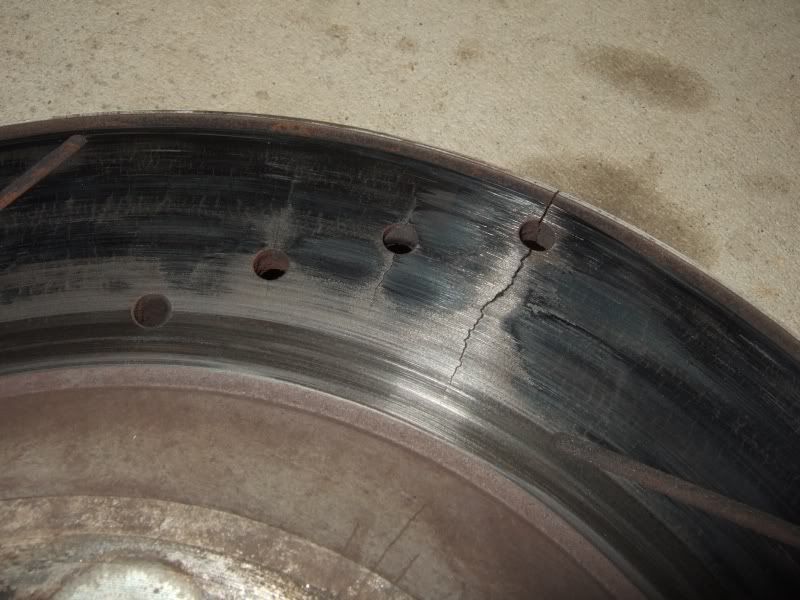
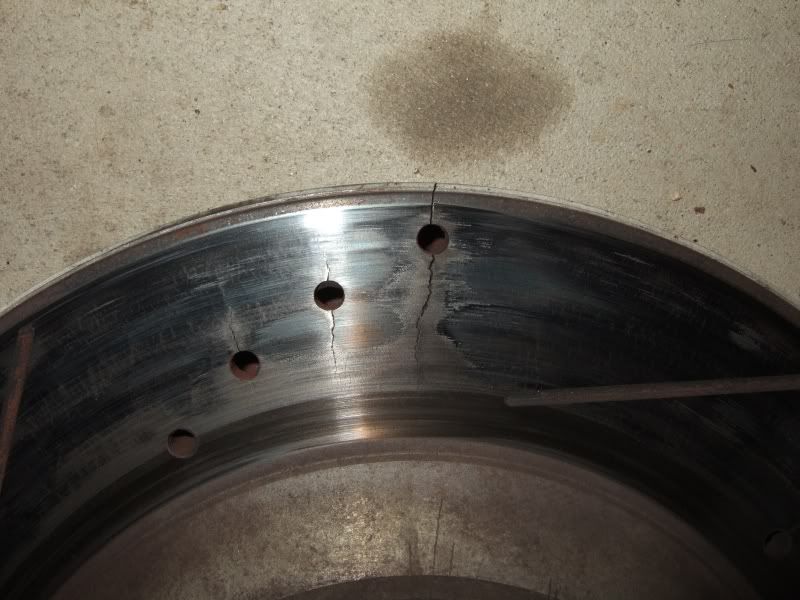
Get slots or whatever you like the looks of, it won't be helping performance.
My '88 FSM lists lug nut torque at 80 ft/lbs. I've used 100 without issues, with and without anti-seize.
In 3/4 of one track day I did this to a C5 set:
Get slots or whatever you like the looks of, it won't be helping performance.
My '88 FSM lists lug nut torque at 80 ft/lbs. I've used 100 without issues, with and without anti-seize.

Racer
Joined: Nov 2005
Posts: 447
Likes: 0
From: Titletown WI
I can't speak for ceramic pads, but I think Performance Friction Carbon Metallic pads might work for you.
http://www.hartsauto.com/faq.html
I've used them in the past with success, but I don't recall how much they dust. They are not quite like a "race" pad but they handle heat quite well. As a matter of fact, they some times take a bit of getting used to as they don't work well until they have a little heat in them.
One down side is they work buy depositing carbon onto your rotors which means that if you ever switch back to another pad(they don't recommend it), it will take a month or so for a regular pad to chew that carbon off the rotor.
The upside is that it turns your rotor a cool gray color.
Speaking of that, I need to order pads for my car soon...
http://www.hartsauto.com/faq.html
I've used them in the past with success, but I don't recall how much they dust. They are not quite like a "race" pad but they handle heat quite well. As a matter of fact, they some times take a bit of getting used to as they don't work well until they have a little heat in them.
One down side is they work buy depositing carbon onto your rotors which means that if you ever switch back to another pad(they don't recommend it), it will take a month or so for a regular pad to chew that carbon off the rotor.
The upside is that it turns your rotor a cool gray color.
Speaking of that, I need to order pads for my car soon...

Intermediate
Joined: Jul 2011
Posts: 30
Likes: 0
No one has mentioned in the replies that there are, I beleive, 2 different manufacturing techniques for cross drilled rotors, cast and drilled. the cast are the most superior because in drilled rotors the metal is weakened due to the drilling. The cast is made as one peice therefore no weakening of the unit cause its made as one peice. Porches and Mercs use cast rotors and they'll wear surface material away before ever cracking.
Race Director
Joined: Jun 2004
Posts: 13,960
Likes: 707
From: WI
Last I knew corner carvers had a $$$ reward for proof cast in holes even existed. Has it been cashed in? There were no cast holes that I knew of for a long time. Haven't checked into it for awhile now.
Team Owner
Joined: Sep 2003
Posts: 20,179
Likes: 673
From: Freedom is never more than one generation away from extinction.
St. Jude '03 thru '24
Race Director
Joined: Jun 2004
Posts: 13,960
Likes: 707
From: WI
Pretty rare to warp a rotor. Check run out on it and see. If there were high spots there will be shiny areas like in my pictures above. Most likely there are uneven pad deposits. They will look as darker areas or whatever colored film your pads are leaving. Mine is blueish in the pix above. I commonly get uneven pad deposits during rain track events. The pedal will shudder badly. Rebedding the pads in dry conditions fixes it up.