


External or Internal Balance ( LT-1 ) ????

Thread Starter
Instructor

Joined: Oct 2010
Posts: 100
Likes: 0
 External or Internal Balance ( LT-1 ) ????
A respected local mechanic said that the 1995 LT-1 was an internally balanced engine and he said that a "neutral balanced" flywheel would be needed when I replace the Clutch assembly on my ZF tranny.
I thought all one piece rear seal engines were externally balanced by the flywheel, but he says the front harmonic damper does that job.
I'd hate to get the wrong flywheel ... What's the real scoop ?
I thought all one piece rear seal engines were externally balanced by the flywheel, but he says the front harmonic damper does that job.
I'd hate to get the wrong flywheel ... What's the real scoop ?

Drifting


Joined: Dec 2007
Posts: 1,647
Likes: 4
From: Argillite KY
The harmonic balancer is neutral balanced and the flywheel is externally balanced. I do believe that the old LT1 engines back in the 70's were neutral balanced flywheels. Maybe that's what he's thinking of. This is just a guess though because I run a slush box. I KNOW they are externally balanced. Call a respected clutch supplier and make sure or wait for one of our own CF gear wringers to step in.
This is just a guess though because I run a slush box. I KNOW they are externally balanced. Call a respected clutch supplier and make sure or wait for one of our own CF gear wringers to step in.
Race Director


Joined: Feb 2003
Posts: 11,672
Likes: 20
From: Lake Wylie SC
The 92 LT1 is definetly external balanced. I have a package from Mr. Kilibrew showing how they balanced the LT1. I believe the rest of the LT1's are also externally balanced. Just look at the outer edge of the fly wheel and if it has holes in it with some of them filled, it is externally balanced.

Race Director
Joined: Apr 2000
Posts: 15,344
Likes: 4,009
From: Texas
A picture is worth a thousand words. Circled in red is the offset weight that is cast into a dual mass flywheel for an L98/LT1/LT4. An auto with a flex plate is externally balanced as well
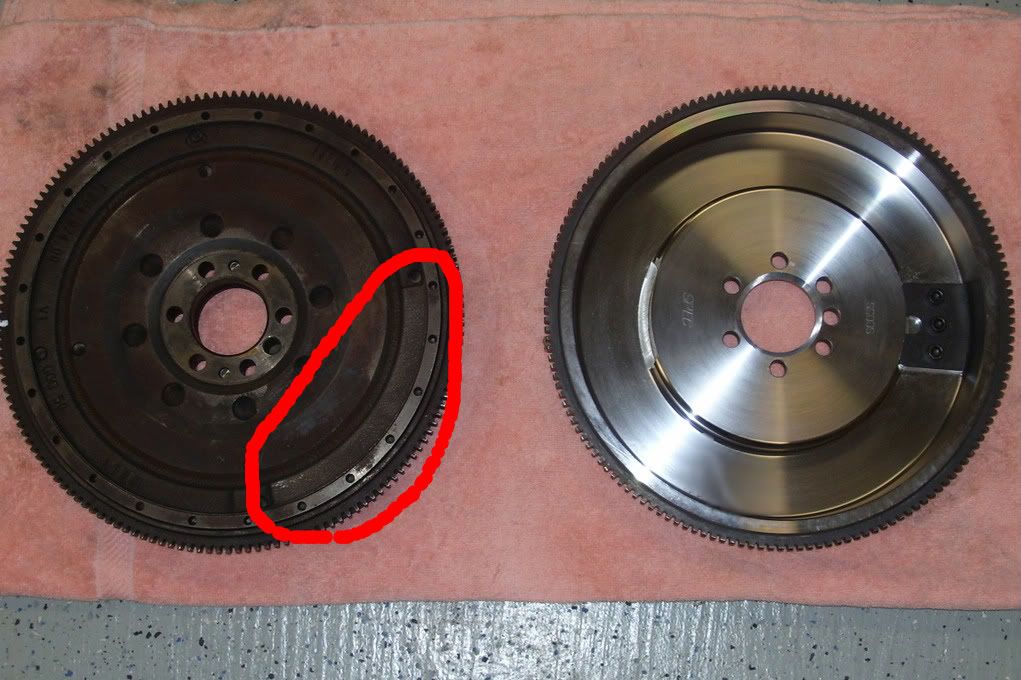
The single mass flywheel on the right has the weight bolted in place (it's the hard to see black rectangle with three bolts on the right side of the flywheel) in order to match the dual mass. This is what you need. If you build an engine and you need a neutral flywheel, you unbolt the weight.
The single mass flywheel on the right has the weight bolted in place (it's the hard to see black rectangle with three bolts on the right side of the flywheel) in order to match the dual mass. This is what you need. If you build an engine and you need a neutral flywheel, you unbolt the weight.

Burning Brakes

Joined: Feb 2009
Posts: 785
Likes: 3
From: Richmond Virginia
This is really gonna start a weeing contest-but so be it  The holes drilled and/or weights added to balancers/dampners/flywheels and flex plates are simply to balance that particular component making it "neutral balanced". If that were not true you wouldn't be able to replace a balancer/fly wheel or flexplate with out removing the crankshaft and rebalancing as a assembly. Once again this is true of STOCK cranked engines only. Some of the "stroker" cranks I've dealt with are external balanced-but that was years ago i can't speak for modern day stroker kits. But once again unless it's a 400SBC it's balanced internally.
The holes drilled and/or weights added to balancers/dampners/flywheels and flex plates are simply to balance that particular component making it "neutral balanced". If that were not true you wouldn't be able to replace a balancer/fly wheel or flexplate with out removing the crankshaft and rebalancing as a assembly. Once again this is true of STOCK cranked engines only. Some of the "stroker" cranks I've dealt with are external balanced-but that was years ago i can't speak for modern day stroker kits. But once again unless it's a 400SBC it's balanced internally.
Race Director
Joined: Apr 2000
Posts: 15,344
Likes: 4,009
From: Texas
This is really gonna start a weeing contest-but so be it The holes drilled and/or weights added to balancers/dampners/flywheels and flex plates are simply to balance that particular component making it "neutral balanced". If that were not true you wouldn't be able to replace a balancer/fly wheel or flexplate with out removing the crankshaft and rebalancing as a assembly. Once again this is true of STOCK cranked engines only. Some of the "stroker" cranks I've dealt with are external balanced-but that was years ago i can't speak for modern day stroker kits. But once again unless it's a 400SBC it's balanced internally.
The holes drilled and/or weights added to balancers/dampners/flywheels and flex plates are simply to balance that particular component making it "neutral balanced". If that were not true you wouldn't be able to replace a balancer/fly wheel or flexplate with out removing the crankshaft and rebalancing as a assembly. Once again this is true of STOCK cranked engines only. Some of the "stroker" cranks I've dealt with are external balanced-but that was years ago i can't speak for modern day stroker kits. But once again unless it's a 400SBC it's balanced internally.The holes in the LT dampers and flywheels are to fine tune the balance. There were some vibration issues that resulted from production problems. There is a service bulletin that discusses the balancing procedure used at the factory as a result. These weights did not neutral balance these components.
If you buy a new LT1/4 damper, the installation directions are very clear...Add pin weights in the same location(s) as the damper being replaced. This is not to neutral balance the damper, it is to match it to the existing one. The new ones are already neutral.
My stroker crank is internally balanced. My ATI damper is neutral, as is my SPEC flywheel and pressure plate.
So, to answer the OP question: Your stock LT1 is absolutely externally balanced in the rear. If you replace the dual mass, it will bolt on just fine since the weight is cast in place. If you install a single mass flywheel like the SPEC unit pictured above, be sure to bolt the weight in place before installing the flywheel.
These are the facts.
Burning Brakes
Joined: Feb 2009
Posts: 785
Likes: 3
From: Richmond Virginia
See the giant weight on the SPEC flywheel in my pic? That's to match balance it to the dual mass flywheel that has the cast in weight. These engines are externally balanced in the rear.
The holes in the LT dampers and flywheels are to fine tune the balance. There were some vibration issues that resulted from production problems. There is a service bulletin that discusses the balancing procedure used at the factory as a result. These weights did not neutral balance these components.
If you buy a new LT1/4 damper, the installation directions are very clear...Add pin weights in the same location(s) as the damper being replaced. This is not to neutral balance the damper, it is to match it to the existing one. The new ones are already neutral.
My stroker crank is internally balanced. My ATI damper is neutral, as is my SPEC flywheel and pressure plate.
So, to answer the OP question: Your stock LT1 is absolutely externally balanced in the rear. If you replace the dual mass, it will bolt on just fine since the weight is cast in place. If you install a single mass flywheel like the SPEC unit pictured above, be sure to bolt the weight in place before installing the flywheel.
These are the facts.
The holes in the LT dampers and flywheels are to fine tune the balance. There were some vibration issues that resulted from production problems. There is a service bulletin that discusses the balancing procedure used at the factory as a result. These weights did not neutral balance these components.
If you buy a new LT1/4 damper, the installation directions are very clear...Add pin weights in the same location(s) as the damper being replaced. This is not to neutral balance the damper, it is to match it to the existing one. The new ones are already neutral.
My stroker crank is internally balanced. My ATI damper is neutral, as is my SPEC flywheel and pressure plate.
So, to answer the OP question: Your stock LT1 is absolutely externally balanced in the rear. If you replace the dual mass, it will bolt on just fine since the weight is cast in place. If you install a single mass flywheel like the SPEC unit pictured above, be sure to bolt the weight in place before installing the flywheel.
These are the facts.
 I stand corrected--just did some research and the LT1 was one of the engines given as a example of a engine which is internally balanced in the front BUT externally balanced in the rear. I'm never to old to learn. I guess as far as my weeing contest goes--it sorta blew back in my face
Corvette Stories
The Best of Corvette for Corvette Enthusiasts

Every 2027 Corvette Engine Explained
Joe Kucinski
Designer Imagines A Corvette That Looks More Like a Corvette Than the Corvette
Verdad Gallardo
10 Ugly Corvettes That We Still Kinda Love
Joe Kucinski
Top 10 Most Expensive Corvettes Ever Sold on Bring A Trailer
Brett Foote
10 Things Every Corvette Owner Needs (2026 Edition)
Michael S. Palmer
8 Most "Only Corvette Owners Understand" Quirks and Problems
Pouria Savadkouei
10 Reasons the C6 Z06 is Still A Performance Benchmark After 20 Years
Joe Kucinski
How Much Horsepower Every Corvette Engine "LOST" in 1972
Joe Kucinski
Top 10 DOs and DON'Ts for Protecting Your Convertible Top!
Michael S. Palmer
Drifting
Joined: Dec 2007
Posts: 1,647
Likes: 4
From: Argillite KY
That's why I said externally balanced as well. Any internally balanced crank comes with instructions to remove the weights on the stock flexplate. (If you intend to use stock). Yep, you're externally balanced.
Make sure you tell your builder. He's never too old to learn either.
Make sure you tell your builder. He's never too old to learn either.
Race Director
Joined: Apr 2000
Posts: 15,344
Likes: 4,009
From: Texas
I stand corrected--just did some research and the LT1 was one of the engines given as a example of a engine which is internally balanced in the front BUT externally balanced in the rear. I'm never to old to learn. I guess as far as my weeing contest goes--it sorta blew back in my face

Le Mans Master


Joined: Aug 2000
Posts: 8,838
Likes: 31
From: Australia
The counterweights on the crank balance the reciprocating mass even though
one of the counterweights on the 2 pce RMS internal balance crankshaft
is external to the engine itself.
Because of the reason I mentioned above ,on the 1 pce RMS engines,
that counterweight could not be cast on the crank flange so the weight
was moved to the flywheel.
The internal balance arrangement has not changed ;only the position of the weight moved.
The aftermarket just confuses everyone by calling them Int or Ext balance to
differentiate between the two crank styles , not a different balance arrangement
The 400 SBC crank didn't have enough room inside the block for the extra mass
of the longer stroke so GM made it externally balanced.
They did this by adding a counterweight to the vibration dampener and to the flywheel;
hence true external balance
Burning Brakes
Joined: Feb 2009
Posts: 785
Likes: 3
From: Richmond Virginia
Technically you are right
The counterweights on the crank balance the reciprocating mass even though
one of the counterweights on the 2 pce RMS internal balance crankshaft
is external to the engine itself.
Because of the reason I mentioned above ,on the 1 pce RMS engines,
that counterweight could not be cast on the crank flange so the weight
was moved to the flywheel.
The internal balance arrangement has not changed ;only the position of the weight moved.
The aftermarket just confuses everyone by calling them Int or Ext balance to
differentiate between the two crank styles , not a different balance arrangement
The 400 SBC crank didn't have enough room inside the block for the extra mass
of the longer stroke so GM made it externally balanced.
They did this by adding a counterweight to the vibration dampener and to the flywheel;
hence true external balance
The counterweights on the crank balance the reciprocating mass even though
one of the counterweights on the 2 pce RMS internal balance crankshaft
is external to the engine itself.
Because of the reason I mentioned above ,on the 1 pce RMS engines,
that counterweight could not be cast on the crank flange so the weight
was moved to the flywheel.
The internal balance arrangement has not changed ;only the position of the weight moved.
The aftermarket just confuses everyone by calling them Int or Ext balance to
differentiate between the two crank styles , not a different balance arrangement
The 400 SBC crank didn't have enough room inside the block for the extra mass
of the longer stroke so GM made it externally balanced.
They did this by adding a counterweight to the vibration dampener and to the flywheel;
hence true external balance
I based my idea on the fact that back in the day when I built a 383-- I had one choice--using a stock 400 crank I HAD to use the balancer and flex plate from the donor crank. Not true any more with the aftermarket cranks. Lots of info online nowadays--but you have to weed through it, so to speak to arrive at what is true.


