


boost

Thread Starter
Race Director


Joined: Sep 2003
Posts: 16,839
Likes: 341
From: Database Error Indiana
 boost
boost
At what point does boost get complicated ? Im talking belt slippage, fuel pump volume, detonation, tuning issues and reliability.
Can I blow 4psi through the MAF and just tune for it ? I know the gains would be minimal but so would the problems. Just sort of kicking around ideas, daydreaming a little, looking for a couple tenths.
Can I blow 4psi through the MAF and just tune for it ? I know the gains would be minimal but so would the problems. Just sort of kicking around ideas, daydreaming a little, looking for a couple tenths.

Racer


Joined: Aug 2009
Posts: 337
Likes: 6
From: Kanata ON
I have never installed FI but I have looked into it and it seems like < 6 PSI requires minimal work. After that the work seems to go up exponentially until at some point you are left with no stock parts anywhere!
However, even 4 PSI should buy you seconds rather than tenths so it may still be worth doing.
However, even 4 PSI should buy you seconds rather than tenths so it may still be worth doing.
Thread Starter
Race Director
Joined: Sep 2003
Posts: 16,839
Likes: 341
From: Database Error Indiana
I'd be happy with a couple tenths. At least for a while. I also think, I can do less than 6 PSI for cheap. I already burning E85 so octane is not an issue and with low boost I may be able to do it without intercooling.

Race Director

Joined: Sep 2001
Posts: 14,686
Likes: 753
From: NEwhere Ohio
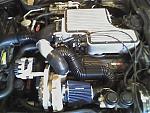
Thats with hotcam kit , LT headers, and crappily ported heads btw.
Ive heard that if you run efficient (AFR comp. ported heads) heads and stuff that you may make less boost but more HP even with less boost.
If you do blower, its a whole package. Blower cam (keep LSA as high as possible so boost has biggest effect), heads, tune.
Id go big or not do it. You will invest $4000 minimum regardless.
My goal was to make my mistakes / learn on the stock motor then build it up 383 forged / AFR heads.
Amazingly, the stock motor is still running fine with unchanged compression numbers since before the blower. About 3k miles on it.
Melting Slicks

Joined: Aug 2003
Posts: 3,421
Likes: 408
From: Lakeville MI
Depends upon your definition of complicated. On an 86-89 MAF L98, I would say that it becomes a little complicated over 600 RWHP (assuming gas for fuel) and maybe 14 psi.
Up to ~600 RWHP can be handled by a single in-tank 255 lph pump, 63 lb injectors, 165 ecm with Blowerworks MAF and corresponding tune. Simple setup and easy to tune.
Above this power level puts you into multiple fuel pumps along with 80 lb. injectors which adds a little complexity due to the increased fuel demand.
On E85, a single 255 lph pump is done by about 2 psi and 2500 rpm. If E85 is planned, more fuel pump is required from the get go. I'd also step up to 80 lb. injectors to start with if planning to run E85.
The stock MAF will be pegged at about 3 psi and 4,000 rpm but with some special tuning can be stretched to support maybe 7 psi.
One note: Stock MAFs are not expected to live long in a blow-through application due to the elevated air temps. Those internal heat sinks don't really work as intended with 250 degree charge air temps. Draw-through chokes the blower inlet and leads to more complicated plumbing. This also creates a need to deal with or recirculate the bypass air. A Blowerworks MAF set up in blow-through is the way to go here.
Belt slip is going to be installation/blower/pulley/belt/step-up ratio specific. Too many variables.
Detonation is always a concern, I'd say 10-11psi is about the limit for pump gas and hot boost. Above this level, some form of charge cooling should be considered. E85 should provide plenty of detonation resistance for even more boost without need for charge cooling.
Minimum things required for an un-complicated set-up:
Adequate injectors
Adequate in-tank fuel pump
Adequate MAF
Adequate tuning
Up to ~600 RWHP can be handled by a single in-tank 255 lph pump, 63 lb injectors, 165 ecm with Blowerworks MAF and corresponding tune. Simple setup and easy to tune.
Above this power level puts you into multiple fuel pumps along with 80 lb. injectors which adds a little complexity due to the increased fuel demand.
On E85, a single 255 lph pump is done by about 2 psi and 2500 rpm. If E85 is planned, more fuel pump is required from the get go. I'd also step up to 80 lb. injectors to start with if planning to run E85.
The stock MAF will be pegged at about 3 psi and 4,000 rpm but with some special tuning can be stretched to support maybe 7 psi.
One note: Stock MAFs are not expected to live long in a blow-through application due to the elevated air temps. Those internal heat sinks don't really work as intended with 250 degree charge air temps. Draw-through chokes the blower inlet and leads to more complicated plumbing. This also creates a need to deal with or recirculate the bypass air. A Blowerworks MAF set up in blow-through is the way to go here.
Belt slip is going to be installation/blower/pulley/belt/step-up ratio specific. Too many variables.
Detonation is always a concern, I'd say 10-11psi is about the limit for pump gas and hot boost. Above this level, some form of charge cooling should be considered. E85 should provide plenty of detonation resistance for even more boost without need for charge cooling.
Minimum things required for an un-complicated set-up:
Adequate injectors
Adequate in-tank fuel pump
Adequate MAF
Adequate tuning
Thread Starter
Race Director
Joined: Sep 2003
Posts: 16,839
Likes: 341
From: Database Error Indiana
Thanks for the info guys. I'm around 350 hp at the crank now. I'm just looking for maybe 75 more without taking the motor apart. Think of it more as an experiment to see what I can do with just a little boost. Sort of like spraying a 50 or 100 shot but never having to fill the bottle.

Burning Brakes

Joined: Jul 2006
Posts: 1,080
Likes: 2
From: Pittsburgh PA
Up to ~600 RWHP can be handled by a single in-tank 255 lph pump, 63 lb injectors, 165 ecm with Blowerworks MAF and corresponding tune. Simple setup and easy to tune.
If he can swap to a big MAF on 165 ecm I'll be MUCH more happy to not mess with FMU's. I do not like fuel control like that.

Drifting


Joined: Feb 2008
Posts: 1,267
Likes: 27
From: Texas
I'd be VERY interested in learning abit more about this. I'm helping a buddy with a L98 with a P600B blower and looking to make 350-400whp, but he's trying to do it with a FMU and MAF sensor. I'm not excited to try tuning this setup.
If he can swap to a big MAF on 165 ecm I'll be MUCH more happy to not mess with FMU's. I do not like fuel control like that.
If he can swap to a big MAF on 165 ecm I'll be MUCH more happy to not mess with FMU's. I do not like fuel control like that.
Greg
http://www.blowerworks.net/
can help with everything you need. Base tune to nice maf setup.
Corvette Stories
The Best of Corvette for Corvette Enthusiasts

5 Best & 5 Worst Corvette Daily Drivers
Joe Kucinski
The Headlights of Every Corvette Generation Explained
Joe Kucinski
5 Best & 5 Most Overrated Corvette Track Packages of All Time!
Joe Kucinski
Every 2027 Corvette Engine Explained
Joe Kucinski
Designer Imagines A Corvette That Looks More Like a Corvette Than the Corvette
Verdad Gallardo
10 Ugly Corvettes That We Still Kinda Love
Joe Kucinski
Top 10 Most Expensive Corvettes Ever Sold on Bring A Trailer
Brett Foote
10 Things Every Corvette Owner Needs (2026 Edition)
Michael S. Palmer
8 Most "Only Corvette Owners Understand" Quirks and Problems
Pouria Savadkouei
Melting Slicks
Joined: Aug 2003
Posts: 3,421
Likes: 408
From: Lakeville MI
I'd be VERY interested in learning abit more about this. I'm helping a buddy with a L98 with a P600B blower and looking to make 350-400whp, but he's trying to do it with a FMU and MAF sensor. I'm not excited to try tuning this setup.
If he can swap to a big MAF on 165 ecm I'll be MUCH more happy to not mess with FMU's. I do not like fuel control like that.
If he can swap to a big MAF on 165 ecm I'll be MUCH more happy to not mess with FMU's. I do not like fuel control like that.
Housing diameter, sensor element and bin are configured based upon injector size and flow and power demands.
One wire repin at ecm. No harness cutting/splicing required with plug and play adaptor.
Most blower cars are running a 3" housing with 63 lb injectors in a triple range configuration (0-765 gm/sec). This allows for plenty of room to grow.
Next step up would be a quad-range tune with 80 lb injectors. Fuel pump upgrades required, but still a simple to tune set-up. This is likey the practical limit, but could be pushed to 1,000 hp or so.
Lower boost cars can get away with 42 lb injectors and a 0-510 gm/sec range tune.
One note: An 85 would not be out of the question, but would require some minor ecm modifications to defeat the pull up resistor on the MAF signal circuit. This is required since the 85 hardware/software is not as flexible as 86-89.
If anybody is willing to experiment with an 870 ecm in a 85, let me know.
Burning Brakes
Joined: Jul 2006
Posts: 1,080
Likes: 2
From: Pittsburgh PA
Its an 89 and is a stock ZZ4 longblock crate motor with stock TPI on top. 42lb injectors. I dont see the blower making more than 8psi boost, so I dont see it making more than 350whp so 42lbs is more than enough.
I'll be tuning the car, so can the bin file be used in tunerpro rt to edit and burn to chip?
Is it a code mod or just half the injector constant and scale the MAF table to get double the range but also lose resolution?
I'll be tuning the car, so can the bin file be used in tunerpro rt to edit and burn to chip?
Is it a code mod or just half the injector constant and scale the MAF table to get double the range but also lose resolution?
Melting Slicks
Joined: Aug 2003
Posts: 3,421
Likes: 408
From: Lakeville MI
Tuning via TunerPro or TunerCat is supported. Custom xdf or tdf files are available.
Loss of resolution is not really an issue.
The MAF flow signal is a 16 bit value which normally resolves to 0.0039 gm/sec. With range doubling this effectively becomes 0.0078 gm/sec, with range tripling 0.0117 gm/sec. Plenty of flow signal resolution for our purposes, which is to calculate the correct injector pulse width for a given airflow, AFR target and injector size.
The system is however limited by the 165 ecm's 8 bit A/D converter. The 5.12 volt range is covered by 255 discrete steps of 0.02 volts.
Since the MAF transfer function is parabolic, the actual working resolution is dependent upon the flow and varies over the flow range of the sensor. The stock system is no different in this regard.
In extreme cases, (over 800 gm/sec or so), a 0.02 volt step will represent a flow change of approx. 8 gm/sec depending upon the actual sensor and housing diameter. Due to the A/D limitations, this can result in a potential measurement error of approx. 1% at this flow rate (800 gm/sec).
1% error due to hardware resolution limitations should be acceptable for the application.
To provide additional tuning resolution for high flow sensors, the MAF tables have been redesigned and resized to provide additional tuning points with linear steps of 0.08 volts. This gives the tuner more points to work with especially in the sensitive low flow idle airflow region.
Loss of resolution is not really an issue.
The MAF flow signal is a 16 bit value which normally resolves to 0.0039 gm/sec. With range doubling this effectively becomes 0.0078 gm/sec, with range tripling 0.0117 gm/sec. Plenty of flow signal resolution for our purposes, which is to calculate the correct injector pulse width for a given airflow, AFR target and injector size.
The system is however limited by the 165 ecm's 8 bit A/D converter. The 5.12 volt range is covered by 255 discrete steps of 0.02 volts.
Since the MAF transfer function is parabolic, the actual working resolution is dependent upon the flow and varies over the flow range of the sensor. The stock system is no different in this regard.
In extreme cases, (over 800 gm/sec or so), a 0.02 volt step will represent a flow change of approx. 8 gm/sec depending upon the actual sensor and housing diameter. Due to the A/D limitations, this can result in a potential measurement error of approx. 1% at this flow rate (800 gm/sec).
1% error due to hardware resolution limitations should be acceptable for the application.
To provide additional tuning resolution for high flow sensors, the MAF tables have been redesigned and resized to provide additional tuning points with linear steps of 0.08 volts. This gives the tuner more points to work with especially in the sensitive low flow idle airflow region.

Melting Slicks
Joined: Aug 2003
Posts: 3,421
Likes: 408
From: Lakeville MI
Yes.
Special tuning above means exaggerated PE tuning including corrections to avoid overflow in the pulse width calculation.
Special tuning above means exaggerated PE tuning including corrections to avoid overflow in the pulse width calculation.
Thread Starter
Race Director
Joined: Sep 2003
Posts: 16,839
Likes: 341
From: Database Error Indiana
Thanks. I will keep looking into this. I have a really good tune as is for the E85. Current injectors may be too small for the fuel I'm running, if I boost it. May have to start with premium gas and see how that works out. Still have to do lots of reading and decide on exactly what I will do.
I will keep looking into this. I have a really good tune as is for the E85. Current injectors may be too small for the fuel I'm running, if I boost it. May have to start with premium gas and see how that works out. Still have to do lots of reading and decide on exactly what I will do.

Instructor
Joined: Sep 2011
Posts: 131
Likes: 0
From: Illinois
I have been looking into this as well and so far the cheapest way to make horse power through boost is to do most of the work yourself. Duh!  Also going with a remote mounted large turbo, usually rear best choice. I estimate it will cost about 4K to get the short block machined and a complete set forged rotating assembly put in and balanced. After that you just need a bit thicker gasket.
The P4 flash system for the older vet cost only 550 dollars and usually is plug and play and reuses your stock MAF wires to put in a MAP sensor.
I have not yet looked into fuel control but that is as simple as calculating how much fuel you need get the right injectors and get a FPR that compensates with boost.
24# injectors will be good up to around 350 RWHP.
A 60mm .62 A/R @ about 5-6 PSI will get you around 100 extra horse power and should be safe on a full stock block. If you build it for boost, lowering the compression to around 8.5 : 1 I don't see a problem running 10-15 psi which would get you a considerable amount more, but extra steps will have to be taken to not float the head or blow the head gasket, such as upgrading the head bolts and grooving the short block to accept a thicker possibly metal head gasket.
I pretty much made up my mind I'm going to work a remote mounted turbo into a machined and rotating forged assembly build and go from there.
Beginning estimate 4000.00 for short block, work 2500 for turbo, pipes, lines, and pumps, 550.00 for ECM change, and about 200.00 for a FPR with a 1:1 pressure increase. I'm already running FORD 24# injectors rate @ 39.15 PSI.
Keep in mind I chose this route because it's never gonna be a track car it's a daily driver with some weekend fun.
Also going with a remote mounted large turbo, usually rear best choice. I estimate it will cost about 4K to get the short block machined and a complete set forged rotating assembly put in and balanced. After that you just need a bit thicker gasket.The P4 flash system for the older vet cost only 550 dollars and usually is plug and play and reuses your stock MAF wires to put in a MAP sensor.
I have not yet looked into fuel control but that is as simple as calculating how much fuel you need get the right injectors and get a FPR that compensates with boost.
24# injectors will be good up to around 350 RWHP.
A 60mm .62 A/R @ about 5-6 PSI will get you around 100 extra horse power and should be safe on a full stock block. If you build it for boost, lowering the compression to around 8.5 : 1 I don't see a problem running 10-15 psi which would get you a considerable amount more, but extra steps will have to be taken to not float the head or blow the head gasket, such as upgrading the head bolts and grooving the short block to accept a thicker possibly metal head gasket.
I pretty much made up my mind I'm going to work a remote mounted turbo into a machined and rotating forged assembly build and go from there.
Beginning estimate 4000.00 for short block, work 2500 for turbo, pipes, lines, and pumps, 550.00 for ECM change, and about 200.00 for a FPR with a 1:1 pressure increase. I'm already running FORD 24# injectors rate @ 39.15 PSI.
Keep in mind I chose this route because it's never gonna be a track car it's a daily driver with some weekend fun.
Drifting
Joined: Feb 2008
Posts: 1,267
Likes: 27
From: Texas
Its basically a conversion to a slot-style MAF with more flow range.
Housing diameter, sensor element and bin are configured based upon injector size and flow and power demands.
One wire repin at ecm. No harness cutting/splicing required with plug and play adaptor.
Most blower cars are running a 3" housing with 63 lb injectors in a triple range configuration (0-765 gm/sec). This allows for plenty of room to grow.
Next step up would be a quad-range tune with 80 lb injectors. Fuel pump upgrades required, but still a simple to tune set-up. This is likey the practical limit, but could be pushed to 1,000 hp or so.
Lower boost cars can get away with 42 lb injectors and a 0-510 gm/sec range tune.
One note: An 85 would not be out of the question, but would require some minor ecm modifications to defeat the pull up resistor on the MAF signal circuit. This is required since the 85 hardware/software is not as flexible as 86-89.
If anybody is willing to experiment with an 870 ecm in a 85, let me know.
Housing diameter, sensor element and bin are configured based upon injector size and flow and power demands.
One wire repin at ecm. No harness cutting/splicing required with plug and play adaptor.
Most blower cars are running a 3" housing with 63 lb injectors in a triple range configuration (0-765 gm/sec). This allows for plenty of room to grow.
Next step up would be a quad-range tune with 80 lb injectors. Fuel pump upgrades required, but still a simple to tune set-up. This is likey the practical limit, but could be pushed to 1,000 hp or so.
Lower boost cars can get away with 42 lb injectors and a 0-510 gm/sec range tune.
One note: An 85 would not be out of the question, but would require some minor ecm modifications to defeat the pull up resistor on the MAF signal circuit. This is required since the 85 hardware/software is not as flexible as 86-89.
If anybody is willing to experiment with an 870 ecm in a 85, let me know.

Melting Slicks
Joined: Jun 1999
Posts: 2,872
Likes: 3
From: Wilmington NC
I have been looking into this as well and so far the cheapest way to make horse power through boost is to do most of the work yourself. Duh! Also going with a remote mounted large turbo, usually rear best choice. I estimate it will cost about 4K to get the short block machined and a complete set forged rotating assembly put in and balanced. After that you just need a bit thicker gasket.
The P4 flash system for the older vet cost only 550 dollars and usually is plug and play and reuses your stock MAF wires to put in a MAP sensor.
I have not yet looked into fuel control but that is as simple as calculating how much fuel you need get the right injectors and get a FPR that compensates with boost.
24# injectors will be good up to around 350 RWHP.
A 60mm .62 A/R @ about 5-6 PSI will get you around 100 extra horse power and should be safe on a full stock block. If you build it for boost, lowering the compression to around 8.5 : 1 I don't see a problem running 10-15 psi which would get you a considerable amount more, but extra steps will have to be taken to not float the head or blow the head gasket, such as upgrading the head bolts and grooving the short block to accept a thicker possibly metal head gasket.
I pretty much made up my mind I'm going to work a remote mounted turbo into a machined and rotating forged assembly build and go from there.
Beginning estimate 4000.00 for short block, work 2500 for turbo, pipes, lines, and pumps, 550.00 for ECM change, and about 200.00 for a FPR with a 1:1 pressure increase. I'm already running FORD 24# injectors rate @ 39.15 PSI.
Keep in mind I chose this route because it's never gonna be a track car it's a daily driver with some weekend fun.
Also going with a remote mounted large turbo, usually rear best choice. I estimate it will cost about 4K to get the short block machined and a complete set forged rotating assembly put in and balanced. After that you just need a bit thicker gasket.The P4 flash system for the older vet cost only 550 dollars and usually is plug and play and reuses your stock MAF wires to put in a MAP sensor.
I have not yet looked into fuel control but that is as simple as calculating how much fuel you need get the right injectors and get a FPR that compensates with boost.
24# injectors will be good up to around 350 RWHP.
A 60mm .62 A/R @ about 5-6 PSI will get you around 100 extra horse power and should be safe on a full stock block. If you build it for boost, lowering the compression to around 8.5 : 1 I don't see a problem running 10-15 psi which would get you a considerable amount more, but extra steps will have to be taken to not float the head or blow the head gasket, such as upgrading the head bolts and grooving the short block to accept a thicker possibly metal head gasket.
I pretty much made up my mind I'm going to work a remote mounted turbo into a machined and rotating forged assembly build and go from there.
Beginning estimate 4000.00 for short block, work 2500 for turbo, pipes, lines, and pumps, 550.00 for ECM change, and about 200.00 for a FPR with a 1:1 pressure increase. I'm already running FORD 24# injectors rate @ 39.15 PSI.
Keep in mind I chose this route because it's never gonna be a track car it's a daily driver with some weekend fun.
here is a brief list:
1- Factory fuel pressure regulator is already vacuum boost compensating. this does not mean it does anything more than balance the fuel pressure and intake manifold pressure to give the ECU a flow rate that isn't a moving target. this allows a 24lb injector to flow 24lb/hr all the time rather then more ad manifold vacuum and less under boost.
2- Thicker head gaskets will create a more detonation friendly environment rather then help. compression should never be adjust by removing the quench area between the outer ledge of the piston and the combustion chamber. quench assists turbulate the mixture during which reduces the chance of detonation.
3- large rear mount is not the right size choice, turbine inlet pressure is greatly reduced farther away from the engine so a smaller turbo will be plenty efficient and not hinder spool.
4- Compression, 8.5:1 SCR is too low especially for a rear mounted turbo and especially if the car will be run primarily on E85. Ethanol likes higher compression ratios. a stock motor on E85 should comfortably be able to run 2-3 times the boost as a car running 91 octane pump gas at the same compression ratio.
5- E85 requires significant fuel delivery upgrades for boost due to the greater volume required as opposed to straight gasoline. roughly 25% more volume is require vs. gas. up to 450rwhp a single walbro will work, after that an inline walbro kicker pump should be used at the very least and that is to get you to around 600-650rwhp. this is on gasoline only NOT E85. i would use a minimum of 60lb/hr injectors and would consider going significatly larger (83lb/hr) if E85 would be the only fuel used, no one ever decided to run LESS boost down the road.
6- your monetary allocation is about right for the shortblock but you need to double or even triple the costs you have used for the forced induction setup. No one ever takes into consideration the smaller required items that you learn about during the build. catching the handful of big ticket items like turbo, wastegate, BOV, etc.. is easy the rest is what will drain your bank account.
I just wanted to offer some help here because i have been down this road more than once and I still underestimate my jobs in most cases unless i take what i can remember to add in and then use a multiplier of about 25%. and that calculation comes from veteran builds.
I hope this helps, I just don't want to see anyone throw good money away doing things the wrong way or get in over their heads when the total tally begins eclipsing their build budget by double or more.
I am happy to help in anyway that I can for forum members in these matters, easiest way to contact me is via email. chris@boostconcepts.net
Chris
