



Hyperyouwhatsit? pistons verses on boost

Thread Starter
Racer


Joined: Sep 2011
Posts: 451
Likes: 16
From: Kalamazoo/delton MI
 Hyperyouwhatsit? pistons verses on boost
Im told on another thread that a turbo with my speed pro hyperwhatever pistons would be a bad idea, that they are brittle and highly susceptible to pre ignition.
so, my question is, do superchargers run at a lower temp then turbos, (seems like they would) and would that lower temp mean that a preignition problem would be less likely?
and if i toned down the boost to say 5 psi, would that give me a worthwhile power boost for the money?
and would it lower the chance of preignition?
OR should i just give it as much boost as it can take, wait for them to blow up, and then get forged pistons?
as I understand it, spark knock jsut blows a hole int he top of the piston and would be unlikely to damage other components?
so, my question is, do superchargers run at a lower temp then turbos, (seems like they would) and would that lower temp mean that a preignition problem would be less likely?
and if i toned down the boost to say 5 psi, would that give me a worthwhile power boost for the money?
and would it lower the chance of preignition?
OR should i just give it as much boost as it can take, wait for them to blow up, and then get forged pistons?
as I understand it, spark knock jsut blows a hole int he top of the piston and would be unlikely to damage other components?
Burning Brakes


Joined: Jun 2005
Posts: 1,191
Likes: 15
From: Wallingford Vermont
Hypereutectic. A high strength cast piston having 12% or more silicon content. I would feel safe running up to 10lbs of boost on cast pistons (hypereutectic or normal eutectic). Depending on the set up. Intercooling or water-injection, close control of fuel and spark: all part of the package.
It's detonation that Hypers have an issue with. When you start cranking up the boost the chance of detonation increases. If you play safe (see above), don't worry about it , BUT boost is addictive and forged piston become part of the "fix"
It's detonation that Hypers have an issue with. When you start cranking up the boost the chance of detonation increases. If you play safe (see above), don't worry about it
, BUT boost is addictive and forged piston become part of the "fix"
Last edited by DanZ51; Nov 27, 2011 at 09:42 PM.
Thread Starter
Racer
Joined: Sep 2011
Posts: 451
Likes: 16
From: Kalamazoo/delton MI
soo, 6-8 pounds of boost, inter cooled, with tight fuel control, and have fun till i blow them up.
the term "when they pop they pop hard" bothers me.
WHEN i break them, not if, will it likely take out other parts on their way?
the term "when they pop they pop hard" bothers me.
WHEN i break them, not if, will it likely take out other parts on their way?

Race Director

Joined: Sep 2001
Posts: 14,682
Likes: 753
From: NEwhere Ohio
If you dont run lean, who knows. Maybe it will take 20 punds of boost.
When they pop in the rpm, you will loose everything, except maybe a valve cover or 2.
If it breaks hard enough, and you push oil out (of the engine) at speed, you may lose paint and body panels too.
See it often at the track.
Fingers crossed you find the right tune up quick enough.
Report back the results. Inquiring minds want to know.
When they pop in the rpm, you will loose everything, except maybe a valve cover or 2.
If it breaks hard enough, and you push oil out (of the engine) at speed, you may lose paint and body panels too.
See it often at the track.
Fingers crossed you find the right tune up quick enough.
Report back the results. Inquiring minds want to know.
Race Director
Joined: Sep 2001
Posts: 14,682
Likes: 753
From: NEwhere Ohio
I'm really worried about this w/ my build (11 psi boost on stock bottom end). Its running fine now, but id hate to have bad gas blow it up.
I got mild detonation this summer when my meth/water injection system malfunctioned and I got a pop, sensation of lack of power, and black smoke out the exhaust.
This when I was 'opening it up' as I left a toll booth in western PA.
The meth system had an alarm buzzer going off, but I couldn't hear it over engine roar. I've since wired a failsafe relay to cutout fuel injectors.
When this incident (the toll-booth incident) occurred, I had a datalog hooked up and it indicated my suspiscion. At 5100 rpm, 10 psi boost (and rising as rpm increased) there was a severe knock retard event resulting in 10 degrees (max I had allowed) of retard. If the knock retard didnt occur and I stayed on the gas, Im guessing the engine would have blown up?
In fact, heres the frame from my scantool when this event occurred!

It shows 20 degrees spark advance (at 5100 rpm) was commanded and you see only what 10 degrees advance occurring. This is because 10 degrees of knock retard knocked off that timing.
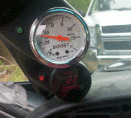
Now, Ive hooked up a device called a 'Casper knock gauge' so I have a direct real-time view of what my knock sensors of doing.
This is a second event (not full-fledge detonation like the toll-booth incident, but pre-detonation) w/ some knock retard
Look at this dyno pull:
http://www.youtube.com/watch?v=J-KIP...&feature=feedu
When the second light on the casper knock gauge (the 2nd gauge in the middle of the dash) lights up, my datascan indicated 83 knock counts and 5 degrees of knock retard - so I immediately let up on the gas and aborted the dyno pull.
In case you are curious, I was running 21 degrees of spark advance (commanded) w/ meth injection when this occurred. This event also occurred around 5100 to 5200 rpm.
In this incident the meth/water injection system was working properly (if it wasnt then the car wouldnt have rev'd that high due to fuel relay cutout).
Now, there are some flaws to the casper knock retard gauge. Mainly, the LED's light up based on input from my a Buick Grand National ESC module spliced into my knock sensor circuit. So those LED's are telling me what knock sensor input would command knock retard on a buick grand national and not the actual retard that my ECM is pulling.
I wish I could splice it into my ECM to know exactly what my knock sensors are doing, but this gauge relies upon a buick grand national ESC. The LT-1 v-8 has knock control integrated directly into the ECM and not a separate module (required for casper gauge to function). Perhaps, I could wire in an L98 ESC module and have a better indication about what would command knock based on a v-8 platform...
but for the moment... I know that the 3rd green light indicates 5 degrees of retard ! which is too much and I should back off.
I got mild detonation this summer when my meth/water injection system malfunctioned and I got a pop, sensation of lack of power, and black smoke out the exhaust.
This when I was 'opening it up' as I left a toll booth in western PA.
The meth system had an alarm buzzer going off, but I couldn't hear it over engine roar. I've since wired a failsafe relay to cutout fuel injectors.
When this incident (the toll-booth incident) occurred, I had a datalog hooked up and it indicated my suspiscion. At 5100 rpm, 10 psi boost (and rising as rpm increased) there was a severe knock retard event resulting in 10 degrees (max I had allowed) of retard. If the knock retard didnt occur and I stayed on the gas, Im guessing the engine would have blown up?
In fact, heres the frame from my scantool when this event occurred!
It shows 20 degrees spark advance (at 5100 rpm) was commanded and you see only what 10 degrees advance occurring. This is because 10 degrees of knock retard knocked off that timing.
Now, Ive hooked up a device called a 'Casper knock gauge' so I have a direct real-time view of what my knock sensors of doing.
This is a second event (not full-fledge detonation like the toll-booth incident, but pre-detonation) w/ some knock retard
Look at this dyno pull:
http://www.youtube.com/watch?v=J-KIP...&feature=feedu
When the second light on the casper knock gauge (the 2nd gauge in the middle of the dash) lights up, my datascan indicated 83 knock counts and 5 degrees of knock retard - so I immediately let up on the gas and aborted the dyno pull.
In case you are curious, I was running 21 degrees of spark advance (commanded) w/ meth injection when this occurred. This event also occurred around 5100 to 5200 rpm.
In this incident the meth/water injection system was working properly (if it wasnt then the car wouldnt have rev'd that high due to fuel relay cutout).
Now, there are some flaws to the casper knock retard gauge. Mainly, the LED's light up based on input from my a Buick Grand National ESC module spliced into my knock sensor circuit. So those LED's are telling me what knock sensor input would command knock retard on a buick grand national and not the actual retard that my ECM is pulling.
I wish I could splice it into my ECM to know exactly what my knock sensors are doing, but this gauge relies upon a buick grand national ESC. The LT-1 v-8 has knock control integrated directly into the ECM and not a separate module (required for casper gauge to function). Perhaps, I could wire in an L98 ESC module and have a better indication about what would command knock based on a v-8 platform...
but for the moment... I know that the 3rd green light indicates 5 degrees of retard ! which is too much and I should back off.
Last edited by dizwiz24; Dec 1, 2011 at 10:02 AM.

Supporting Vendor

Joined: Oct 2004
Posts: 761
Likes: 68
[U]DETONATION[/U
In the interest of helping all new comers to the land of forced induction (or extreme high compression ratios on a N/A engine like 12:1) lets first describe detonation or engine ping. It's not really pre-igniton although both end up with same effect.
If an engine detonates you can hear it as a pinging sound (assuming you are not too old with dead ears or you are running a floMaster exhaust - ! LOL). Maybe you've been at a traffic light and the guy/gal next to you sounded like a broken marble machine and you wondered what the hell was that? Not a diesel (lower sound) but kinda of like a diesel at a higher note !!!!!!
So what is detonation or engine ping ??? OMG it's the worst thing you can possibly think of. It will destroy any engine no matter how well built or with whatever components !!!!
Engine ping or detonation [or pre-ignition with a further definition] is the piston banging around in the cylinder (and it should never do that !). What you hear is the actual piston 'slapping' the cylinder wall as the "rings" collapse and allow metal to metal contact. Not only do we have metal to metal contact but we have an enormous amount of cylinder gas pass by the piston rings (as they collapse) and become BLOW-BY !!!
All of the above is a result of detonation: the flame front expands so quickly as to become an explosion as opposed to a controlled burn. Any high performance engine can demonstrate detonation if fed a bad load of gas (like 87 vs 93 octane).
The end result is an explosion - where the rising psiton meets an expanding gas. Who or what gives ? In the case of cast pistons (hyperutectic) the piston. In the case of forged pistons well the rod bearings first then other components of the rotaing assembly.
Bottom line is detonation will KILL all engines !!!!!!!!! But if your engine has cast pistons the pistons fail first. If forged pistons you'll blow an actual hole in the piston or break a rod or break a crank !!! In any case detonation is the enemy !!!!!!
More later if you want - I've got to run just now ........
VTY - greg
In the interest of helping all new comers to the land of forced induction (or extreme high compression ratios on a N/A engine like 12:1) lets first describe detonation or engine ping. It's not really pre-igniton although both end up with same effect.
If an engine detonates you can hear it as a pinging sound (assuming you are not too old with dead ears or you are running a floMaster exhaust - ! LOL). Maybe you've been at a traffic light and the guy/gal next to you sounded like a broken marble machine and you wondered what the hell was that? Not a diesel (lower sound) but kinda of like a diesel at a higher note !!!!!!
So what is detonation or engine ping ??? OMG it's the worst thing you can possibly think of. It will destroy any engine no matter how well built or with whatever components !!!!
Engine ping or detonation [or pre-ignition with a further definition] is the piston banging around in the cylinder (and it should never do that !). What you hear is the actual piston 'slapping' the cylinder wall as the "rings" collapse and allow metal to metal contact. Not only do we have metal to metal contact but we have an enormous amount of cylinder gas pass by the piston rings (as they collapse) and become BLOW-BY !!!
All of the above is a result of detonation: the flame front expands so quickly as to become an explosion as opposed to a controlled burn. Any high performance engine can demonstrate detonation if fed a bad load of gas (like 87 vs 93 octane).
The end result is an explosion - where the rising psiton meets an expanding gas. Who or what gives ? In the case of cast pistons (hyperutectic) the piston. In the case of forged pistons well the rod bearings first then other components of the rotaing assembly.
Bottom line is detonation will KILL all engines !!!!!!!!! But if your engine has cast pistons the pistons fail first. If forged pistons you'll blow an actual hole in the piston or break a rod or break a crank !!! In any case detonation is the enemy !!!!!!
More later if you want - I've got to run just now ........
VTY - greg
Last edited by BlowerWorks; Nov 29, 2011 at 03:03 PM.
Corvette Stories
The Best of Corvette for Corvette Enthusiasts

Top 10 Most Expensive Corvettes Ever Sold on Bring A Trailer
Brett Foote
10 Things Every Corvette Owner Needs (2026 Edition)
Michael S. Palmer
8 Most "Only Corvette Owners Understand" Quirks and Problems
Pouria Savadkouei
10 Reasons the C6 Z06 is Still A Performance Benchmark After 20 Years
Joe Kucinski
How Much Horsepower Every Corvette Engine "LOST" in 1972
Joe Kucinski
Top 10 DOs and DON'Ts for Protecting Your Convertible Top!
Michael S. Palmer
Top 10 Most Explosive Corvettes Ever Made: Power-to-Weight Ratio Ranked!
Joe Kucinski
150 hp to 1,250 hp: Every Corvette Generation Compared by the Specs That Matter
Joe Kucinski
8 Coolest Corvette Pace Cars (and Replicas) of All Time
Verdad Gallardo
Race Director
Joined: Sep 2001
Posts: 14,682
Likes: 753
From: NEwhere Ohio
Hypereutectic. A high strength cast piston having 12% or more silicon content. I would feel safe running up to 10lbs of boost on cast pistons (hypereutectic or normal eutectic). Depending on the set up. Intercooling or water-injection, close control of fuel and spark: all part of the package.
It's detonation that Hypers have an issue with. When you start cranking up the boost the chance of detonation increases. If you play safe (see above), don't worry about it, BUT boost is addictive and forged piston become part of the "fix"
It's detonation that Hypers have an issue with. When you start cranking up the boost the chance of detonation increases. If you play safe (see above), don't worry about it
, BUT boost is addictive and forged piston become part of the "fix" A little bit harder to break than a regular dish, but when it does break.... It shatters and explodes!



Instructor

Joined: Apr 2004
Posts: 157
Likes: 1
From: Woodstock on
Obviously forged will handle more power. That being said, the supercharged pontiac gtp uses cast pistons (probably not as good as speed pro) and runs 6 psi.
Thread Starter
Racer
Joined: Sep 2011
Posts: 451
Likes: 16
From: Kalamazoo/delton MI
this thread has been interesting, some solid information.
My budget may make the choice for me long before i have to make it for myself (dang kids and braces and all the rest)
Still the question remains, can i go ahead with the planned 6 pounds of boost for a few years untill I am ready to rebuild the bottom end again?
I cant afford to rebuild the bottom end i just rebuilt!
My budget may make the choice for me long before i have to make it for myself (dang kids and braces and all the rest)
Still the question remains, can i go ahead with the planned 6 pounds of boost for a few years untill I am ready to rebuild the bottom end again?
I cant afford to rebuild the bottom end i just rebuilt!

Race Director


Joined: Feb 2004
Posts: 12,518
Likes: 19
this thread has been interesting, some solid information.
My budget may make the choice for me long before i have to make it for myself (dang kids and braces and all the rest)
Still the question remains, can i go ahead with the planned 6 pounds of boost for a few years untill I am ready to rebuild the bottom end again?
I cant afford to rebuild the bottom end i just rebuilt!
My budget may make the choice for me long before i have to make it for myself (dang kids and braces and all the rest)
Still the question remains, can i go ahead with the planned 6 pounds of boost for a few years untill I am ready to rebuild the bottom end again?
I cant afford to rebuild the bottom end i just rebuilt!
Race Director
Joined: Sep 2001
Posts: 14,682
Likes: 753
From: NEwhere Ohio
What do these all have in common?
They are OEM forced induction and do not used forged pistons. They are hyperteutic!
In reality though I think they should have forged components, but likely some exec made the corporate decision to save costs and 'pocket' the difference as a bonus.
