



Front mount intercooler!!??!!

Thread Starter
Drifting

Joined: Feb 2013
Posts: 1,465
Likes: 12
 Front mount intercooler!!??!!
Ok so I want to say that I made a similar post in forced induction but since guys only frequent that every so often and I am looking for a fast solution, I posted here too!
I am upgrading from my P600 to a D1sc and I want to ditch the small procharger intercooler and upgrade to a big front mount. I am looking for pictures and pointers on how some of you other F.I guys have done it!
I am upgrading from my P600 to a D1sc and I want to ditch the small procharger intercooler and upgrade to a big front mount. I am looking for pictures and pointers on how some of you other F.I guys have done it!

Melting Slicks


Joined: Oct 2000
Posts: 2,158
Likes: 9
From: N.E. WA
Most of the guys who accomplished the big FI systems are gone. Baldturbofreak, Lmvette, Possibly Zelement, Mnvette(???) There are still a couple guys around. That Australian guy. Impala Bilko, Jay, maybe Brian. There are others but the FI forum is basically dead. Searching might yield some results coz it has all been done before.
Melting Slicks

Joined: Jul 2004
Posts: 3,277
Likes: 32
From: Mission Viejo California
Coincidentally I might have one for sale that might work for you. I want to say that the core is 18" x 10" by 3.75 and is designed to go between the hood rails. It'll flow enough for your app and is much bigger than the pro jaeger one. Shipping may be costly though...

Advanced

Joined: Jun 2013
Posts: 53
Likes: 0
From: Sacramento CA
Safety Car


Joined: Aug 2009
Posts: 3,751
Likes: 275
From: Melbourne, Victoria, Australia
Ok so I want to say that I made a similar post in forced induction but since guys only frequent that every so often and I am looking for a fast solution, I posted here too!
I am upgrading from my P600 to a D1sc and I want to ditch the small procharger intercooler and upgrade to a big front mount. I am looking for pictures and pointers on how some of you other F.I guys have done it!
I am upgrading from my P600 to a D1sc and I want to ditch the small procharger intercooler and upgrade to a big front mount. I am looking for pictures and pointers on how some of you other F.I guys have done it!
The other problem is HEAT you will not be able to drive hard or run the a/c in summer it will overheat, if going up a mountain you will overheat except in winter. The large intercooler will not allow any cool air to the condenser or radiator.
Go the way of methonal/water injection, (as suggested by Brian Cunningham) I have to bypass the blower in summer so i can use the a/c without overheating.
That will be my next step meth/water injection to cool the charge and control combustion temps, i hate having to watch the coolant temperature.
Another thing is the thick intercooler air passages restrict airflow...


Last edited by gerardvg; Jul 22, 2014 at 07:41 PM.
Thread Starter
Drifting
Joined: Feb 2013
Posts: 1,465
Likes: 12
I have a alchohol injection specialist progressive kit with a 3 gal trunk mount in the car already. Im just not sure about no fail safe! I dont want to destroy all my hard work because I have a pump failure! I might go over to E85 tho
I fitted a large intercooler that is about as thick as my hand is wide in front of the a/c condenser, you have to fabricate new air ducting to fit around the intercooler.
The other problem is HEAT you will not be able to drive hard or run the a/c in summer it will overheat, if going up a mountain you will overheat except in winter. The large intercooler will not allow any cool air to the condenser or radiator.
Go the way of methonal/water injection, (as suggested by Brian Cunningham) I have to bypass the blower in summer so i can use the a/c without overheating.
That will be my next step meth/water injection to cool the charge and control combustion temps, i hate having to watch the coolant temperature.
Another thing is the thick intercooler air passages restrict airflow...
The other problem is HEAT you will not be able to drive hard or run the a/c in summer it will overheat, if going up a mountain you will overheat except in winter. The large intercooler will not allow any cool air to the condenser or radiator.
Go the way of methonal/water injection, (as suggested by Brian Cunningham) I have to bypass the blower in summer so i can use the a/c without overheating.
That will be my next step meth/water injection to cool the charge and control combustion temps, i hate having to watch the coolant temperature.
Another thing is the thick intercooler air passages restrict airflow...
Corvette Stories
The Best of Corvette for Corvette Enthusiasts

How Much Horsepower Every Corvette Engine "LOST" in 1972
Joe Kucinski
Top 10 DOs and DON'Ts for Protecting Your Convertible Top!
Michael S. Palmer
Top 10 Most Explosive Corvettes Ever Made: Power-to-Weight Ratio Ranked!
Joe Kucinski
150 hp to 1,250 hp: Every Corvette Generation Compared by the Specs That Matter
Joe Kucinski
8 Coolest Corvette Pace Cars (and Replicas) of All Time
Verdad Gallardo
Top 10 Corvette Engines RANKED by Peak Torque (70+ Years of Muscle!)
Joe Kucinski
Corvette ZR1X Will Be Pacing the Indy 500, And Could Probably Race, Too!
Verdad Gallardo
Top 10 Corvettes Coming to Mecum Indy 2026!
Brett Foote
Top 10 C9 Corvette MUST-HAVES to Fix These C8 Generation Flaws!
Michael S. Palmer
Thread Starter
Drifting
Joined: Feb 2013
Posts: 1,465
Likes: 12
Mine also has lights. One for a system check that flashes codes for the progressive controller and one for a low level sensor. But having the lights are not going to save my engine if I have just meth/water and no intercooler and i have a pump failure under boost. Running aggressive timing and 20 psi with no intercooler and meth is living on the edge in my opinion. But I am new to this so maybe I just worry to much lol.
Melting Slicks
Joined: Jul 2004
Posts: 3,277
Likes: 32
From: Mission Viejo California
here's some pics. Is yours a passenger side blower setup? That's what this setup is currently setup for. I also have some blower discharge piping. If any of you guys want to pick it up, I'll sell it for
$400. I bought it used for over $700 back in 2006 and never got to installing it. New it cost about $1300 to have made.
$400. I bought it used for over $700 back in 2006 and never got to installing it. New it cost about $1300 to have made.
Safety Car
Joined: Aug 2009
Posts: 3,751
Likes: 275
From: Melbourne, Victoria, Australia
I got a intercooler piping kit, they are cheap and can be found on ebay.
They come in various configurations, some straight lengths some with 90 degree bends and some 45 degree bends enough to do just about any car.

http://www.ebay.com/itm/2-5-Turbo-Intercooler-Pipe-Piping-DIY-Kit-64MM-Blue-HIGH-QUALITY-/111408177302?pt=UK_CarsParts_Vehicles_CarParts_SM&hash=item19f071e096
I ran 2.5 inch diameter from the blower with a 45 degree silicone hose, ran that to a joiner hose and to a 45 degree bend pipe down to the right side of the car under the rail to a 90 degree bend pipe. (had to cut a piece of the plastic trim to fit the pipe beside the coolant overflow tank) there i have a 90 degree 2.5'' to 3'' silicon hose that connects to the intercooler. on the other side of the intercooler its is all 3 inch diameter 90 degree 3'' silicon hose, to a small 3 inch diameter intercooler tube with a 90 degree formed bend that points upward 45 degrees. There is a 3'' 45 degree silicone hose that points straight up, the MAF sensor is fitted there with another silicone hose that has a 90 degree bend. Another small section of 3 inch diameter pipe to 2x 90 degree silicone hoses and the inlet manifold. (you can run the hose right up and get a 3'' to 3.75'' or 4'' hose 45 or 90 degree to the TPI throttle body.
I had to use the original air filter (Australian design rules means if you run an intercooler you cannot use a pod filter, so original air filter needs to be used. A real pain.

I am currently working on fabricating /welding some 3.75'' diameter aluminum tubing, with the right bends to get rid of the 3 inch (restrictive flexible hose) to the air filter housing.
Now some pictures, blower with silicone 45 degree hose to 2.5'' aluminum tubing. A joiner is there for ease of assembly to a 45 degree aluminum pipe that angles under the rail, a 90 degree 2.5 to 3'' silicone hose with a small 3'' aluminum pipe to a 90 degree silicon hose to the intercooler. The other side of the intercooler has a 3'' 90 degree silicone hose, to a 3'' aluminum pipe with a 90 degree bend that points up and is close to the side of the cooling fan. Then there is a 45 deg 3'' silicone hose to the MAF sensor, then a 45 deg silicone hose from the MAF to another 3'' pipe and two more 90 degree silicone hoses to the 45 degree TPI adapter.
You will need to clearance the cooling fan ribs a little to fit the MAF sensor, The air intake shroud (below where the air filter assy sits on) needs to be removed and fabricate a aluminum sheet to clear the intercooler. The booster fan needs to be moved forward to clear the intercooler. Some aluminum piping needs to be flattened a little to clear the sway bar/ radiator area.
Make sure your intercooler is for a 350 cubic inch engine, i have tried a smaller intercooler but it severely limited the h/p and rpm.
I have had my 85 blown for at least 6 to 7 years, she runs great. Adjustable fuel pressure 48-52 psi, inline hi flow fuel pump and a vortech FMU to increase fuel pressure. (restricting return like to raise fuel pressure by around 8 psi fuel pressure per increase per psi boost. Otherwise standard ecm) with a intercooler you can run almost std timing however you need high octane fuel from now on.


Last edited by gerardvg; Jul 29, 2014 at 05:44 AM.
Melting Slicks
Joined: Oct 2000
Posts: 2,158
Likes: 9
From: N.E. WA
Gerardvg, your car was freaking me out. I was looking for the battery on the drivers side and nothing was making sense until I saw that it was a right hand drive. I knew that, but it caught me off guard..

Safety Car
Joined: Aug 2009
Posts: 3,751
Likes: 275
From: Melbourne, Victoria, Australia
Is that better


Burning Brakes

Joined: Mar 2013
Posts: 1,131
Likes: 5
From: Illinois/Wisconsin Line
Thread Starter
Drifting
Joined: Feb 2013
Posts: 1,465
Likes: 12
here's some pics. Is yours a passenger side blower setup? That's what this setup is currently setup for. I also have some blower discharge piping. If any of you guys want to pick it up, I'll sell it for
$400. I bought it used for over $700 back in 2006 and never got to installing it. New it cost about $1300 to have made.
$400. I bought it used for over $700 back in 2006 and never got to installing it. New it cost about $1300 to have made.
I'd be very interested in the piping. Can you post some photos? I can paypal money if it's what I'm looking for!
And yes, it's a passenger side d1sc.

Safety Car

Joined: Apr 2011
Posts: 3,660
Likes: 22
AS previously stated, you CAN stack up intercoolers, tranny coolers, wine coolers, whatever you like, in the area ahead of the condenser inside the nose area of the air box.
There is LOTs of room to work with....
here is the problem.
When you add heat that has only ONE exit thru the condenser then thru the radiator, you are "compounding" heat accumulation. You can ONLY run 2 things out of all the things that are up there....Ie: engine, a/c. OR eng & blower . You CANNOT run engine, a/c, blower all at the same time very hard or you will over heat quickly.
Each heat exchanger adds its own amount of heat. That heat goes directly to the next exchanger which sends its combined collection of heat to the last exchanger, the radiator. By the time all that has reached the radiator the air temp entering the rad is already 200+ degrees. Soooo, there is next to zero temp differential...so no heat exchange. No exchange, no cooling effort.
The ONLY known solutions are:
a fan system that produces hurricane force winds thru the multiple heat exchangers
or
you simply turn off something
or you baby it while you drive with more than 2 things generating heat.
Yes, there is LOTS of room in the nose. Just not lots of wind...
Cooling a 230 degree radiator is hard enough when its 105 outside. Imagine what happens when the outside air is 200 degrees? Stacking heat exchangers is the exact same thing. Give the same result, anyway....
You MUST keep a decent temp differential between ambient and generated heat before any exchange is possible. My guess as to that number....? I'd say it has to be at least 80f to have a chance. Otherwise, the lower THAT number the HIGHER the airspeed MUST be to compensate.
That means if you only have a differential of 75 degrees then you'd have to always have a 100mph wind blowing thru the nose....
hard to do.
There is LOTs of room to work with....
here is the problem.
When you add heat that has only ONE exit thru the condenser then thru the radiator, you are "compounding" heat accumulation. You can ONLY run 2 things out of all the things that are up there....Ie: engine, a/c. OR eng & blower . You CANNOT run engine, a/c, blower all at the same time very hard or you will over heat quickly.
Each heat exchanger adds its own amount of heat. That heat goes directly to the next exchanger which sends its combined collection of heat to the last exchanger, the radiator. By the time all that has reached the radiator the air temp entering the rad is already 200+ degrees. Soooo, there is next to zero temp differential...so no heat exchange. No exchange, no cooling effort.
The ONLY known solutions are:
a fan system that produces hurricane force winds thru the multiple heat exchangers
or
you simply turn off something
or you baby it while you drive with more than 2 things generating heat.
Yes, there is LOTS of room in the nose. Just not lots of wind...
Cooling a 230 degree radiator is hard enough when its 105 outside. Imagine what happens when the outside air is 200 degrees? Stacking heat exchangers is the exact same thing. Give the same result, anyway....
You MUST keep a decent temp differential between ambient and generated heat before any exchange is possible. My guess as to that number....? I'd say it has to be at least 80f to have a chance. Otherwise, the lower THAT number the HIGHER the airspeed MUST be to compensate.
That means if you only have a differential of 75 degrees then you'd have to always have a 100mph wind blowing thru the nose....
hard to do.

Team Owner

Joined: Oct 2004
Posts: 81,241
Likes: 3,063
From: altered state
St. Jude Donor '05
Gotta be a way to do smaller intercoolers somewhere in the compartment
Watching the temp gauge kind of defeats the purpose to building all that power. mod the hood do whatever you gotta do to make it fit
Watching the temp gauge kind of defeats the purpose to building all that power. mod the hood do whatever you gotta do to make it fit
Instructor
Joined: May 2013
Posts: 248
Likes: 3
From: Central Minnesota
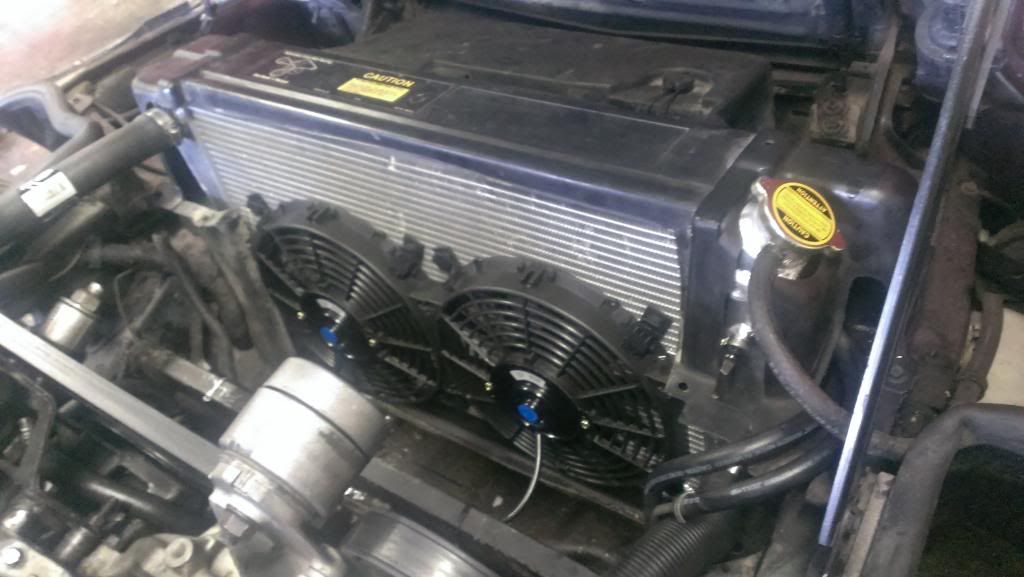
I would just go with a standard front mount that will fit in the radiator area and run the pipes through the side of the air dam underneath the headlights. There is a ton of room up there, however there is the issue of getting all of that heat out of the engine bay. With my engine pushing the power it does N/A I have a 3 core aluminum radiator, huge oil cooler and also a trans cooler half the size of my radiator. There is a lot of heat that needs to exit all from one area. You may want to look into a hood vent similar to what is on a C7 to evacuate the radiator area of hot air quickly. Unless you are one of those people that thinks its blasphemy to cut a hole in your hood anyways...
This was my fan setup when I first installed the aluminum radiator as I found that the stock fan barely pulled air and wasn't efficient at all. Now I've taken off the two small fans and put in one very large high CFM fan. Thing sucks so much air through all three of my coolers that you can feel air coming out of the side vents with the fan on.
This was my fan setup when I first installed the aluminum radiator as I found that the stock fan barely pulled air and wasn't efficient at all. Now I've taken off the two small fans and put in one very large high CFM fan. Thing sucks so much air through all three of my coolers that you can feel air coming out of the side vents with the fan on.

Last edited by Carbd84; Jul 29, 2014 at 12:47 PM.
Safety Car
Joined: Apr 2011
Posts: 3,660
Likes: 22
I would just go with a standard front mount that will fit in the radiator area and run the pipes through the side of the air dam underneath the headlights. There is a ton of room up there, however there is the issue of getting all of that heat out of the engine bay. With my engine pushing the power it does N/A I have a 3 core aluminum radiator, huge oil cooler and also a trans cooler half the size of my radiator. There is a lot of heat that needs to exit all from one area. You may want to look into a hood vent similar to what is on a C7 to evacuate the radiator area of hot air quickly. Unless you are one of those people that thinks its blasphemy to cut a hole in your hood anyways...
This was my fan setup when I first installed the aluminum radiator as I found that the stock fan barely pulled air and wasn't efficient at all. Now I've taken off the two small fans and put in one very large high CFM fan. Thing sucks so much air through all three of my coolers that you can feel air coming out of the side vents with the fan on.
This was my fan setup when I first installed the aluminum radiator as I found that the stock fan barely pulled air and wasn't efficient at all. Now I've taken off the two small fans and put in one very large high CFM fan. Thing sucks so much air through all three of my coolers that you can feel air coming out of the side vents with the fan on.
back in the late 80's there were early blower experiments that encountered these same problems. Placing the heat exchanger was not the issue...placing the heat IS.
The best and slickest solution that was the least offensive was this:
close the lower nose area under the radiator as best as possible and seal off the engine bay as much as possible including the battery side covers left and rt side.
Now, utilizing small 3 or 4" computer cooling fans, mount a row of 2 or 3 in each side of the hood along the fender area and cover with a small but "attractive" grill.
The voltage drain is/was minimal, the effect of pulling the high pressure super hot air, OUT was quite easy for the series of small but efficient fans, since the engine bay was of a higher pressure, these fans worked quite well. They ARE 12v as we would need.
The air that exited via these fans was/is scalding *** hot and the benefits were very obvious. The engine bay has to be sealed to create a higher pressure area to assist the small fans is removing the hot air. The radiator fans and forward motion generates the higher pressure air inside the engine bay compartment.

I saw this, and actually felt the effects of these little fans and I can assure you that you could easily make toast in front of those things !
No other practical method of sucking that super heated air OUT of the engine bay exist.
