




Got the Heads off Today

Thread Starter
Advanced

Joined: Mar 2015
Posts: 80
Likes: 0
From: Winchester Bay Oregon
 Got the Heads off Today
My son and I spent the last two days pulling the top end off his 89 fastback vette. He lost the head gaskets a few weeks ago and we been waiting for him to save enough money to get it fixed. He has enough I think to get the heads rebuilt. I thought this engine was stock since it was supposed to have hydraulic roller lifters. However It has been torn down before as I see odball bolts that were not stock inside. we did finally get the heads off today. Number 7 had antifreeze on top of the piston and #8 had a little too but some came from the water jackets because we had the front raised up so we could get under the engine. #7 was wet inside the other 7 cylinders had dry and brown exhaust valves but #8 was weak as well.
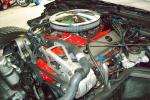
The rockers were blue so I figure they were not stock I will link a photo of them. Also the head bolts on the passenger side had 1/2" hex heads and the drivers side had 5/8 Hex heads on the bolts between the valves in the middle on the bolts between the push rod holders.
Could someone give me a good average cost to have a machine shop go thru the heads I figure if they are off they might as well grind the valves and seats, replace the seats and make sure they are not warped and magnaflux them for cracks. I haven't had that done for a long time I have no idea of the cost. Also give me an idea on cost of a FEL-PRO gasket set.
The rockers were blue so I figure they were not stock I will link a photo of them. Also the head bolts on the passenger side had 1/2" hex heads and the drivers side had 5/8 Hex heads on the bolts between the valves in the middle on the bolts between the push rod holders.
Could someone give me a good average cost to have a machine shop go thru the heads I figure if they are off they might as well grind the valves and seats, replace the seats and make sure they are not warped and magnaflux them for cracks. I haven't had that done for a long time I have no idea of the cost. Also give me an idea on cost of a FEL-PRO gasket set.
Last edited by wolfer; May 30, 2015 at 12:23 AM.

Le Mans Master


Joined: Feb 2005
Posts: 6,485
Likes: 566
From: Clearwater Florida
...... For machine shop costs , it would be best to let your fingers do the walking and call a few shops in your area ... don't be misled into sending your heads out of town because someone quoted you a cheaper price ..... FYI ... you can't magnaflux aluminum , alloy heads aren't prone to cracking anyway but they will warp ... replacing the seats is an expensive and , very likely , an unnecessary operation ... the blue rockers are true roller rockers and definitely not factory on 89 TPI motors .....

Team Owner


Joined: Dec 1999
Posts: 34,873
Likes: 487
From: Lacey WA RVN 68-69
NCM Sinkhole Donor
A competent machine shop can do a pressure test and a cleanup mill to make sure the heads are straight. Certainly have them check the seats and ask about a valve job. All of this can get pricey, but with the heads off now, it could save having to do it again later on.
I would definitely buy a new set of head bolts. ARP makes high quality bolt sets. Check Summit Racing for Fel-Pro gasket sets and ARP bolt sets. Figure around $50-$65 depending on the specific set you need. Most machine shops can provide parts such as the gasket set, valve stem seals so ask about prices and if they allow owner-supplied components.
The 87 and later blocks all use hydraulic roller lifters as OEM. The aftermarket rockers are a roller type and they should be able to be re-used as long as they don't show excessive wear. Can't hurt to check the pushrods too for any excessive wear.
I would definitely buy a new set of head bolts. ARP makes high quality bolt sets. Check Summit Racing for Fel-Pro gasket sets and ARP bolt sets. Figure around $50-$65 depending on the specific set you need. Most machine shops can provide parts such as the gasket set, valve stem seals so ask about prices and if they allow owner-supplied components.
The 87 and later blocks all use hydraulic roller lifters as OEM. The aftermarket rockers are a roller type and they should be able to be re-used as long as they don't show excessive wear. Can't hurt to check the pushrods too for any excessive wear.

Le Mans Master

Joined: Mar 2004
Posts: 5,107
Likes: 171
From: Dublin CA
 with C409. How many miles on the engine? The RR are aftermarket and not stock. I would check the heads to see if they are flat. IF they are flat, and not too may miles on the engine...then you might consider doing the rest yourself if funds are tight. I would change the springs which is easier now that you have the heads off. Change the valve guide seals (have to remove the springs to do this anyway). Replace both the intake and exhaust with Fel-Pro INTAKE seals.
Parts from RockAuto...have to add for freight but costs are usually lower than anywhere else...
Intake gasket set FEL-PRO Part # MS93318 about $20.00
Head gaskets FEL-PRO Part # 501SD $21.00 times 2 $41.00
Head bolts FEL-PRO Part # ES72856 $15.00 times 2 $30.00
or
Head bolts ARP Part Number: ARP-134-3601 $88.00/set
Fel-Pro intake seals FEL-PRO SS72877 $12.26 X 2 $24.52
Intake & Exhaust springs SEALED POWER Part # VS677 $1.82/ea=$29.12
Valve cover seals FEL-PRO Part # VS50088R $13.00
Autozone -
The Right stuff sealant $15.00
Prestone antifreeze 2 gallons $32.00
Anti-seize for bolts into aluminum $4.00 one ounce tube
Tools:
Proform/Stud mount valve spring compressor, Part Number: 66784 Not Vehicle Specific Proform/Stud mount valve spring compressor
Price: $61.99 - from Autozone -----or borrow/rent one for much less.
Then don't forget to change oil and new filter. Oil $26.00(?) filter ($8-$20)
Replacing springs and seals not difficult. Should be able to easily do it within a day.
Last edited by John A. Marker; May 30, 2015 at 12:53 PM.
Thread Starter
Advanced
Joined: Mar 2015
Posts: 80
Likes: 0
From: Winchester Bay Oregon
Other things I am concerned about are Carbon build up on piston tops. Ridge at top of cylinders. #8 hole had antifreeze in it. not mixed with oil. The dipstick shows only little mix on bottom. I have not dumped the oil in the pan yet. There was mixed oil and water muck coated on inside valve covers and under the intake manifold. If when I dump the oil pan and it is mixed should I drop the pan and clean the inside or will it disipate and if I do take the pan off I might as well take the bearings out and re ring it. If I have to take the pistons out should I have them Gi'd and hone the cylinders or do you think I would have to go that far? I am not looking forward to dropping the pan. There is a lot of carbon above the pistons how would I get it out without removing the pistons?

Racer
Joined: Dec 2007
Posts: 416
Likes: 3
What do you mean by lost the head gaskets?
I'd assume you mean blew the head gaskets. Both blew? if so where? AND why. Head gaskets on a small block chevy typically don't just blow out. Did it overheat?
It's money well spent to just have a shop clean, recondition, resurface, and assemble the pair instead of buying special tools to do a half @$$ job.
If the gaskets blew into the water jackets and you have coolant in the pan it's not going to disappear. Coolant raises the boiling point of water so it's not going to evaporate out of the crankcase.
How long did it run with coolant in the oil?
One reason you should have properly drained the coolant is so you'd know how much got there from a blown head gasket vs how much got there from disassembly. If it ran for any amount of time with coolant in the oil it may have ruined the bearings. It may also not have ruined the bearings.
How do you get the carbon off piston tops? With a wire wheel on a drill, then blow it out with compressed air. Some will get stuck between the piston, cylinder, and top ring. But the whole engine is contaminated with crud from coolant in the oil anyway.
Then theres the ridge on the cylinder. That means theres wear on the bores.
You say theres a lot of carbon on the piston tops, and a ridge in the cylinders, PLUS blown head gaskets and coolant in the oil.
It sounds like you need to pull it out and just rebuild the whole thing, skip the hone just have a machine shop bore it to the next size.
I'd assume you mean blew the head gaskets. Both blew? if so where? AND why. Head gaskets on a small block chevy typically don't just blow out. Did it overheat?
It's money well spent to just have a shop clean, recondition, resurface, and assemble the pair instead of buying special tools to do a half @$$ job.
If the gaskets blew into the water jackets and you have coolant in the pan it's not going to disappear. Coolant raises the boiling point of water so it's not going to evaporate out of the crankcase.
How long did it run with coolant in the oil?
One reason you should have properly drained the coolant is so you'd know how much got there from a blown head gasket vs how much got there from disassembly. If it ran for any amount of time with coolant in the oil it may have ruined the bearings. It may also not have ruined the bearings.
How do you get the carbon off piston tops? With a wire wheel on a drill, then blow it out with compressed air. Some will get stuck between the piston, cylinder, and top ring. But the whole engine is contaminated with crud from coolant in the oil anyway.
Then theres the ridge on the cylinder. That means theres wear on the bores.
You say theres a lot of carbon on the piston tops, and a ridge in the cylinders, PLUS blown head gaskets and coolant in the oil.
It sounds like you need to pull it out and just rebuild the whole thing, skip the hone just have a machine shop bore it to the next size.
Thread Starter
Advanced
Joined: Mar 2015
Posts: 80
Likes: 0
From: Winchester Bay Oregon
This is a long story, first of all it is an 89 tuned port injection corvette. Here is what happened it may be a coincidence but we were concerned because it was blowing a small amount of oil out the oil fill hole and the pvc on both sides. Yes I said PVC on both sides. The pvc on the drivers side is like most engines. The pvc on the passenger side comes from a hose coming from the throttle body I assume it was intake air. Instead of having a vent in the valve cover. I was concerned about having two pcv valves so I told my son who owns the car to get a filtered vent and put it in the pvc opening and plug the intake line at the throttle body. Immediately the engine started blowing steam. out both exhausts. Of course there is a crossover pipe so it would. It started to get warm but did not get over 219 degrees. I told him to shut it down and let it cool and I would run a compression test in the morning. I was told 7 and 8 were where a head gasket usually gives away on these engines so I pulled plug #7 and we turned the engine over 5 times and it gave us a 220# reading. I pushed the exhaust button on the compression tester and it blew mixed oil and water all over. I tried it one more time and it came up hard. I immediately took out all the plugs and it turned over ok We never drove it again. I have been told two pvc valves was not a problem. They would not pull enough vacuum to create a problem.
It blew the head gasket on the #7 piston for sure. The plugs were all brown on the tips except #7. When I took off the plenum and tubes and started to take off the intake manifold I noticed the back bolt hole over #7 had broke out and it and it had a hex bolt in place of the torx bolts in the rest of the manifold. When I got the heads off I lifted the front of the car so we could get under it. We only took the bottom radiator hose off so the water was still in the block so when I took the back head bolts on the bottom corner of the heads antifreeze came out. I am not sure if that is how the cylinders filled with antifreeZe or not but the number 7 piston had quite a bit of antifreeze on top and the #8 piston had some but not much. some of the pistons have a little carbon on top the exhaust valves are all brown except #7 there is a ridge of carbon on the top of each cylinder. I have not taken the pan off or drained the oil yet. I am letting my son work on his days off so he can learn. Sorry to make such a long answer. Not sure if it was a coincidence or not. It happened at the parts house when He put the vent on the valve cover and plugged the line from the throttle body. He drove it 3 miles home it was not driven since. It did not get too hot.
It blew the head gasket on the #7 piston for sure. The plugs were all brown on the tips except #7. When I took off the plenum and tubes and started to take off the intake manifold I noticed the back bolt hole over #7 had broke out and it and it had a hex bolt in place of the torx bolts in the rest of the manifold. When I got the heads off I lifted the front of the car so we could get under it. We only took the bottom radiator hose off so the water was still in the block so when I took the back head bolts on the bottom corner of the heads antifreeze came out. I am not sure if that is how the cylinders filled with antifreeZe or not but the number 7 piston had quite a bit of antifreeze on top and the #8 piston had some but not much. some of the pistons have a little carbon on top the exhaust valves are all brown except #7 there is a ridge of carbon on the top of each cylinder. I have not taken the pan off or drained the oil yet. I am letting my son work on his days off so he can learn. Sorry to make such a long answer. Not sure if it was a coincidence or not. It happened at the parts house when He put the vent on the valve cover and plugged the line from the throttle body. He drove it 3 miles home it was not driven since. It did not get too hot.
What do you mean by lost the head gaskets?
I'd assume you mean blew the head gaskets. Both blew? if so where? AND why. Head gaskets on a small block chevy typically don't just blow out. Did it overheat?
It's money well spent to just have a shop clean, recondition, resurface, and assemble the pair instead of buying special tools to do a half @$$ job.
If the gaskets blew into the water jackets and you have coolant in the pan it's not going to disappear. Coolant raises the boiling point of water so it's not going to evaporate out of the crankcase.
How long did it run with coolant in the oil?
One reason you should have properly drained the coolant is so you'd know how much got there from a blown head gasket vs how much got there from disassembly. If it ran for any amount of time with coolant in the oil it may have ruined the bearings. It may also not have ruined the bearings.
How do you get the carbon off piston tops? With a wire wheel on a drill, then blow it out with compressed air. Some will get stuck between the piston, cylinder, and top ring. But the whole engine is contaminated with crud from coolant in the oil anyway.
Then theres the ridge on the cylinder. That means theres wear on the bores.
You say theres a lot of carbon on the piston tops, and a ridge in the cylinders, PLUS blown head gaskets and coolant in the oil.
It sounds like you need to pull it out and just rebuild the whole thing, skip the hone just have a machine shop bore it to the next size.
I'd assume you mean blew the head gaskets. Both blew? if so where? AND why. Head gaskets on a small block chevy typically don't just blow out. Did it overheat?
It's money well spent to just have a shop clean, recondition, resurface, and assemble the pair instead of buying special tools to do a half @$$ job.
If the gaskets blew into the water jackets and you have coolant in the pan it's not going to disappear. Coolant raises the boiling point of water so it's not going to evaporate out of the crankcase.
How long did it run with coolant in the oil?
One reason you should have properly drained the coolant is so you'd know how much got there from a blown head gasket vs how much got there from disassembly. If it ran for any amount of time with coolant in the oil it may have ruined the bearings. It may also not have ruined the bearings.
How do you get the carbon off piston tops? With a wire wheel on a drill, then blow it out with compressed air. Some will get stuck between the piston, cylinder, and top ring. But the whole engine is contaminated with crud from coolant in the oil anyway.
Then theres the ridge on the cylinder. That means theres wear on the bores.
You say theres a lot of carbon on the piston tops, and a ridge in the cylinders, PLUS blown head gaskets and coolant in the oil.
It sounds like you need to pull it out and just rebuild the whole thing, skip the hone just have a machine shop bore it to the next size.
Last edited by wolfer; May 30, 2015 at 08:11 PM.
Corvette Stories
The Best of Corvette for Corvette Enthusiasts

Top 10 Most Expensive Corvettes Ever Sold on Bring A Trailer
Brett Foote
10 Things Every Corvette Owner Needs (2026 Edition)
Michael S. Palmer
8 Most "Only Corvette Owners Understand" Quirks and Problems
Pouria Savadkouei
10 Reasons the C6 Z06 is Still A Performance Benchmark After 20 Years
Joe Kucinski
How Much Horsepower Every Corvette Engine "LOST" in 1972
Joe Kucinski
Top 10 DOs and DON'Ts for Protecting Your Convertible Top!
Michael S. Palmer
Top 10 Most Explosive Corvettes Ever Made: Power-to-Weight Ratio Ranked!
Joe Kucinski
150 hp to 1,250 hp: Every Corvette Generation Compared by the Specs That Matter
Joe Kucinski
8 Coolest Corvette Pace Cars (and Replicas) of All Time
Verdad Gallardo
Racer
Joined: Dec 2007
Posts: 416
Likes: 3
So what did the gasket look like where it was blown?
You've got a mystery engine there, what if a previous owner ported the heads and went way too thin on an intake port. The heads obviously have been off going by the mismatched bolts.
I don't care if I'm fixing a toilet or an over heating car engine I like to see the problem that caused the symptoms instead of just assuming it's a common problem. Thats a big paragraph to not mention how the gasket was actually blown out.
You've got a mystery engine there, what if a previous owner ported the heads and went way too thin on an intake port. The heads obviously have been off going by the mismatched bolts.
I don't care if I'm fixing a toilet or an over heating car engine I like to see the problem that caused the symptoms instead of just assuming it's a common problem. Thats a big paragraph to not mention how the gasket was actually blown out.
This is a long story, first of all it is an 89 tuned port injection corvette. Here is what happened it may be a coincidence but we were concerned because it was blowing a small amount of oil out the oil fill hole and the pvc on both sides. Yes I said PVC on both sides. The pvc on the drivers side is like most engines. The pvc on the passenger side comes from a hose coming from the throttle body I assume it was intake air. Instead of having a vent in the valve cover. I was concerned about having two pcv valves so I told my son who owns the car to get a filtered vent and put it in the pvc opening and plug the intake line at the throttle body. Immediately the engine started blowing steam. out both exhausts. Of course there is a crossover pipe so it would. It started to get warm but did not get over 219 degrees. I told him to shut it down and let it cool and I would run a compression test in the morning. I was told 7 and 8 were where a head gasket usually gives away on these engines so I pulled plug #7 and we turned the engine over 5 times and it gave us a 220# reading. I pushed the exhaust button on the compression tester and it blew mixed oil and water all over. I tried it one more time and it came up hard. I immediately took out all the plugs and it turned over ok We never drove it again. I have been told two pvc valves was not a problem. They would not pull enough vacuum to create a problem.
It blew the head gasket on the #7 piston for sure. The plugs were all brown on the tips except #7. When I took off the plenum and tubes and started to take off the intake manifold I noticed the back bolt hole over #7 had broke out and it and it had a hex bolt in place of the torx bolts in the rest of the manifold. When I got the heads off I lifted the front of the car so we could get under it. We only took the bottom radiator hose off so the water was still in the block so when I took the back head bolts on the bottom corner of the heads antifreeze came out. I am not sure if that is how the cylinders filled with antifreeZe or not but the number 7 piston had quite a bit of antifreeze on top and the #8 piston had some but not much. some of the pistons have a little carbon on top the exhaust valves are all brown except #7 there is a ridge of carbon on the top of each cylinder. I have not taken the pan off or drained the oil yet. I am letting my son work on his days off so he can learn. Sorry to make such a long answer. Not sure if it was a coincidence or not. It happened at the parts house when He put the vent on the valve cover and plugged the line from the throttle body. He drove it 3 miles home it was not driven since. It did not get too hot.
It blew the head gasket on the #7 piston for sure. The plugs were all brown on the tips except #7. When I took off the plenum and tubes and started to take off the intake manifold I noticed the back bolt hole over #7 had broke out and it and it had a hex bolt in place of the torx bolts in the rest of the manifold. When I got the heads off I lifted the front of the car so we could get under it. We only took the bottom radiator hose off so the water was still in the block so when I took the back head bolts on the bottom corner of the heads antifreeze came out. I am not sure if that is how the cylinders filled with antifreeZe or not but the number 7 piston had quite a bit of antifreeze on top and the #8 piston had some but not much. some of the pistons have a little carbon on top the exhaust valves are all brown except #7 there is a ridge of carbon on the top of each cylinder. I have not taken the pan off or drained the oil yet. I am letting my son work on his days off so he can learn. Sorry to make such a long answer. Not sure if it was a coincidence or not. It happened at the parts house when He put the vent on the valve cover and plugged the line from the throttle body. He drove it 3 miles home it was not driven since. It did not get too hot.

Melting Slicks

Joined: Sep 2010
Posts: 2,422
Likes: 202
Those rockers look like proform.. If so. Do yourself the biggest favor. Throw them away!! The hardened steel??? Is very cheap and the fulcrum bearings disintegrate..
Last edited by THE 383 admiral; May 30, 2015 at 10:57 PM.
Le Mans Master
Joined: Mar 2004
Posts: 5,107
Likes: 171
From: Dublin CA
Blowing head gaskets is a common problem with SBC with aluminum heads. And it is typically #7 or #8 where the gaskets give out because of the closeness of the coolant passage to the edge of the cylinder. One of the main reasons is because the heads are aluminum and the block is cast iron. Two different metals that expand and contract at different rates. The head gasket is the matting surface between these and takes the brunt of the expansion and contraction. This is accentuated because of the coolant flow going to the block first. GM solved this problem with the next generation of SBC when they went to the LT1 with it's reverse flow having the coolant go thru the heads first. If you do a search on the Forum, you will find that this is indeed a issue with the L98 with aluminum heads.
Wolfer, I am going to make the assumption that you only drained the radiator before removing the heads. Even draining the radiator will leave enough coolant in the block that when you pull the heads the level is above the head gaskets and coolant will flow into the cylinders. The head bolts do go into the water jacket of the block, which is why you have to use a thread sealant on the head bolts. If you look at the head gaskets, you should find the it is deformed for cylinder #7. It doesn't take much with the coolant is under pressure.
It also sounds like the engine did not overheat so the chances that the heads warped are small.
You can take a wire wheel to the top if the pistons to clean off the carbon build up. Just be sure to tape off all the holes in the block where debris might get into the hole. Then cover the valley with shop rags. You can vacuum the cylinders out with a shop vac.
You have had heads off your other cars in the past, take a good look at these to see if there are any areas of concern. If port work has been performed, you will see it. If you have doubts about the heads, then take them into a shop.
If you do a search you will also find that SBC heads will burn oil after awhile. 90% of the time it is just a mater that the valve stem seals are bad, not a issue with the valve guides themselves. This is usually shown at start up with smoke then it quits once the oil has burned off. The search will indicate how many of us have replaced these seals without removing the heads. As I indicated before, replacing the seals with the heads off is much easier.
Wolfer, I am going to make the assumption that you only drained the radiator before removing the heads. Even draining the radiator will leave enough coolant in the block that when you pull the heads the level is above the head gaskets and coolant will flow into the cylinders. The head bolts do go into the water jacket of the block, which is why you have to use a thread sealant on the head bolts. If you look at the head gaskets, you should find the it is deformed for cylinder #7. It doesn't take much with the coolant is under pressure.
It also sounds like the engine did not overheat so the chances that the heads warped are small.
You can take a wire wheel to the top if the pistons to clean off the carbon build up. Just be sure to tape off all the holes in the block where debris might get into the hole. Then cover the valley with shop rags. You can vacuum the cylinders out with a shop vac.
You have had heads off your other cars in the past, take a good look at these to see if there are any areas of concern. If port work has been performed, you will see it. If you have doubts about the heads, then take them into a shop.
If you do a search you will also find that SBC heads will burn oil after awhile. 90% of the time it is just a mater that the valve stem seals are bad, not a issue with the valve guides themselves. This is usually shown at start up with smoke then it quits once the oil has burned off. The search will indicate how many of us have replaced these seals without removing the heads. As I indicated before, replacing the seals with the heads off is much easier.

Race Director

Joined: Apr 2002
Posts: 10,036
Likes: 346
From: Anaheim CA
This is a long story, first of all it is an 89 tuned port injection corvette. Here is what happened it may be a coincidence but we were concerned because it was blowing a small amount of oil out the oil fill hole and the pvc on both sides. Yes I said PVC on both sides. The pvc on the drivers side is like most engines. The pvc on the passenger side comes from a hose coming from the throttle body I assume it was intake air. Instead of having a vent in the valve cover. I was concerned about having two pcv valves so I told my son who owns the car to get a filtered vent and put it in the pvc opening and plug the intake line at the throttle body.
Thread Starter
Advanced
Joined: Mar 2015
Posts: 80
Likes: 0
From: Winchester Bay Oregon
So Cliff would you put both the pvc valves back in like it was originally or do you think the previous owner put the second one in because the hole in the valve cover was the same size? I have read somewhere in this forum where it was a CCV valve and GM no longer makes them. No one has mentioned this posibility. I have others say that two pcv valves did not create enough vacuum to cause a problem. I have a 2 hour drive to the closest and best machine shop and will be leaving in an hour. I will let them tell me my best option I have used them before and trust their judgement on the heads. Thanks for all your help I will need alot of help putting it back together lots of electrical and vacuum lines I can screw up. Much more than my old 66 chevelle ss.
Last edited by wolfer; Jun 1, 2015 at 09:25 AM.
Race Director
Joined: Apr 2002
Posts: 10,036
Likes: 346
From: Anaheim CA
I recommend putting everything back to stock.
I have heard of the CCV valve. Most Corvettes don't have one. There was an argument some time ago about whether or not this was stock or some Bubba mod. I don't recall how all that came out...
Air flows from the throttle body to the passenger side valve cover (GM calls this CCV for CrankCase Ventilation). The air flows through the crankcase and gets sucked out by the PCV valve, which is connected to the intake manifold. Since this air gets mixed with the fuel it does affect the AFR and how your engine runs. You need the whole system in place for it to work properly.
I have heard of the CCV valve. Most Corvettes don't have one. There was an argument some time ago about whether or not this was stock or some Bubba mod. I don't recall how all that came out...
Air flows from the throttle body to the passenger side valve cover (GM calls this CCV for CrankCase Ventilation). The air flows through the crankcase and gets sucked out by the PCV valve, which is connected to the intake manifold. Since this air gets mixed with the fuel it does affect the AFR and how your engine runs. You need the whole system in place for it to work properly.
Last edited by Cliff Harris; Jun 1, 2015 at 11:46 PM.