


question on the Renegrade intake manifold

Thread Starter
Intermediate

Joined: Jun 2016
Posts: 39
Likes: 0
 question on the Renegrade intake manifold
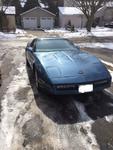
Have a 84 Vette with the crossfire intake, if I switch the intake to the Renegrade intake manifold, is that performance or hp I will feel, or is it not worth the money to do, the intake is around $500 at Summit

Melting Slicks


Joined: Mar 2012
Posts: 2,800
Likes: 456
From: USA
A few years back there was a lot of buzz about the Renegade Manifold.
I do believe that there is some horsepower to gain installing one. $500.00 is a lot of money.
I got some advise here on the forum about porting the stock manifold. I invested in a metal removing bit and a sander. I ported the stock manifold and then ported it some more.
I remove a lot of material and I think the results were well worth the time and expenditure I made.
Would I buy one for my 1984. I would not. I would try and port the stock manifold as the investment was minimal and the results spoke for themselves.
here are a couple of links to look at:
https://www.corvetteforum.com/forums...-critique.html
http://www.technovelocity.com/chevyh...rt_polish.html
I picked up a used manifold for $60.00 and used it and no downtime till my manifold was ready to install.
Good luck with your decision.
I do believe that there is some horsepower to gain installing one. $500.00 is a lot of money.
I got some advise here on the forum about porting the stock manifold. I invested in a metal removing bit and a sander. I ported the stock manifold and then ported it some more.
I remove a lot of material and I think the results were well worth the time and expenditure I made.
Would I buy one for my 1984. I would not. I would try and port the stock manifold as the investment was minimal and the results spoke for themselves.
here are a couple of links to look at:
https://www.corvetteforum.com/forums...-critique.html
http://www.technovelocity.com/chevyh...rt_polish.html
I picked up a used manifold for $60.00 and used it and no downtime till my manifold was ready to install.
Good luck with your decision.
Instructor
Joined: Mar 2016
Posts: 171
Likes: 6
From: SW Ontario
I'm going to have my stock manifold ported this winter. I'm going to pay for a machine shop to do it. Roughly $125-$200.
I've read you can gain up to 30 hp by putting in the renegade or getting a good port done to a stock manifold.
I've read you can gain up to 30 hp by putting in the renegade or getting a good port done to a stock manifold.

Safety Car


Joined: Nov 2005
Posts: 3,532
Likes: 1,185
From: Arizona - If you don’t know CFI, STOP proliferating the myths around it...
I can remember and have his claim somewhere that when the XRam came out, they were claiming 100HP with their manifold which I think is a false statement, but I saw a 22HP gain over the XRam with our manifold to the rear wheels. So what does the say about the Renegade...122HP? LOL, I don't think so.
Safety Car
Joined: Nov 2005
Posts: 3,532
Likes: 1,185
From: Arizona - If you don’t know CFI, STOP proliferating the myths around it...
It is actually considering on how much we spent to develop the manifold. I know many other car/racing guys that spend much more for much less. Jus sayin'. It is a very good addition when you have a bigger cube motor for sure.
Last edited by Buccaneer; Aug 27, 2016 at 12:25 AM.
Melting Slicks


Joined: Dec 2009
Posts: 2,241
Likes: 290
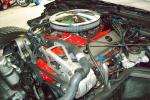
Here's a picture of what they'll be tackling.
Corvette Stories
The Best of Corvette for Corvette Enthusiasts

Every 2027 Corvette Engine Explained
Joe Kucinski
Designer Imagines A Corvette That Looks More Like a Corvette Than the Corvette
Verdad Gallardo
10 Ugly Corvettes That We Still Kinda Love
Joe Kucinski
Top 10 Most Expensive Corvettes Ever Sold on Bring A Trailer
Brett Foote
10 Things Every Corvette Owner Needs (2026 Edition)
Michael S. Palmer
8 Most "Only Corvette Owners Understand" Quirks and Problems
Pouria Savadkouei
10 Reasons the C6 Z06 is Still A Performance Benchmark After 20 Years
Joe Kucinski
How Much Horsepower Every Corvette Engine "LOST" in 1972
Joe Kucinski
Top 10 DOs and DON'Ts for Protecting Your Convertible Top!
Michael S. Palmer
Safety Car
Joined: Sep 2004
Posts: 3,953
Likes: 550
From: Mission Viejo CA
In my photo, I was trying to show there is both an X-plane angle as well as a Y-plane angle when you're porting with an end mill. (More hand contouring is needed after the preliminary mill work is done.)
That sawn section of manifold is interesting! Those casting walls are pretty thin!


Team Owner


Joined: Aug 2004
Posts: 21,543
Likes: 3,216
From: Park City Utah
Improving the "angle" would be better addressed by raising the roof, rather than lowering the floor.
First, it's a straighter shot if you raise the roof.
Second, I tried chopping the coolant passage and sealing it off (strictly in an effort to lower the runners' temps) and it was a **** show. Thing leaked like crazy and it took me a while to get it decently sealed up. Trying to weld the runner bottoms and that passage and have no leaks would really test ones patience. The runners would he leaking to oil/atmosphere. A leak in a runner roof is leaking to plenum which is about the same pressure as in the runner...not a meaningful leak.
First, it's a straighter shot if you raise the roof.
Second, I tried chopping the coolant passage and sealing it off (strictly in an effort to lower the runners' temps) and it was a **** show. Thing leaked like crazy and it took me a while to get it decently sealed up. Trying to weld the runner bottoms and that passage and have no leaks would really test ones patience. The runners would he leaking to oil/atmosphere. A leak in a runner roof is leaking to plenum which is about the same pressure as in the runner...not a meaningful leak.
Team Owner
Joined: Aug 2004
Posts: 21,543
Likes: 3,216
From: Park City Utah
Another weird thing about this picture;
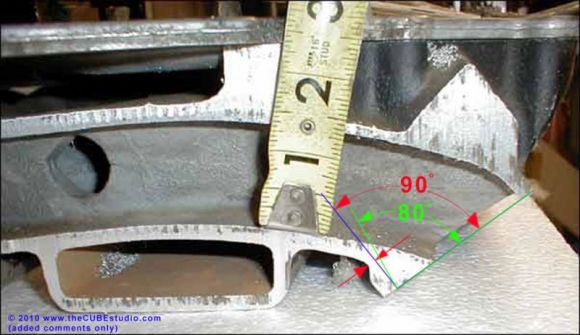
What's with the 90* illustration? The manifold flange on a SBC is not perpendicular to the port. The port floor and ceiling should have an angle to the flange of something like 105* and 75*, respectively.

What's with the 90* illustration? The manifold flange on a SBC is not perpendicular to the port. The port floor and ceiling should have an angle to the flange of something like 105* and 75*, respectively.
Last edited by Tom400CFI; Aug 28, 2016 at 11:14 PM.
Safety Car
Joined: Nov 2005
Posts: 3,532
Likes: 1,185
From: Arizona - If you don’t know CFI, STOP proliferating the myths around it...
Improving the "angle" would be better addressed by raising the roof, rather than lowering the floor.
First, it's a straighter shot if you raise the roof.
Second, I tried chopping the coolant passage and sealing it off (strictly in an effort to lower the runners' temps) and it was a **** show. Thing leaked like crazy and it took me a while to get it decently sealed up. Trying to weld the runner bottoms and that passage and have no leaks would really test ones patience. The runners would he leaking to oil/atmosphere. A leak in a runner roof is leaking to plenum which is about the same pressure as in the runner...not a meaningful leak.
First, it's a straighter shot if you raise the roof.
Second, I tried chopping the coolant passage and sealing it off (strictly in an effort to lower the runners' temps) and it was a **** show. Thing leaked like crazy and it took me a while to get it decently sealed up. Trying to weld the runner bottoms and that passage and have no leaks would really test ones patience. The runners would he leaking to oil/atmosphere. A leak in a runner roof is leaking to plenum which is about the same pressure as in the runner...not a meaningful leak.
Last edited by Buccaneer; Aug 29, 2016 at 02:19 AM.
Safety Car
Joined: Sep 2004
Posts: 3,953
Likes: 550
From: Mission Viejo CA
Ex-x, I think we hijacked this thread. The OP's question was about the Renegade. 
But I can't help thinking there's something wrong with your section photo showing the 80* and 90* lines. My photo shows a MUCH deeper cut from my end mill, and I didn't break thru. I think my cut was more like 100*, but I didn't measure it. The limit of my cut was matched to the head port. Is it possible your sketch is from the gasket, rather than a match to the head port? That would be wrong.
But I can't help thinking there's something wrong with your section photo showing the 80* and 90* lines. My photo shows a MUCH deeper cut from my end mill, and I didn't break thru. I think my cut was more like 100*, but I didn't measure it. The limit of my cut was matched to the head port. Is it possible your sketch is from the gasket, rather than a match to the head port? That would be wrong.
Team Owner
Joined: Aug 2004
Posts: 21,543
Likes: 3,216
From: Park City Utah
Hey Tom, I bet that process was a PITA kind of thing, but a worthy one non the less to make improvements. We knew going into the project that heat was an issue and that the water jacket is fairly close and if someone gets too aggressive with a die grinder they will go through or on top. When we developed the manifold knowing this, we eliminated the lower jacket and now has a standard water flow crossover on the end and to reduce the manifold heat issue on the bottom as much as possible. We also knew that people would more than likely at some point with the larger cube motors want to port the manifold so we left plenty of runner material there just for that purpose if they felt so inclined.
Melting Slicks
Joined: Dec 2009
Posts: 2,241
Likes: 290
Ex-x, I think we hijacked this thread. The OP's question was about the Renegade.
But I can't help thinking there's something wrong with your section photo showing the 80* and 90* lines. My photo shows a MUCH deeper cut from my end mill, and I didn't break thru. I think my cut was more like 100*, but I didn't measure it. The limit of my cut was matched to the head port. Is it possible your sketch is from the gasket, rather than a match to the head port? That would be wrong.
But I can't help thinking there's something wrong with your section photo showing the 80* and 90* lines. My photo shows a MUCH deeper cut from my end mill, and I didn't break thru. I think my cut was more like 100*, but I didn't measure it. The limit of my cut was matched to the head port. Is it possible your sketch is from the gasket, rather than a match to the head port? That would be wrong.

Drifting

Joined: Mar 2015
Posts: 1,275
Likes: 165
From: Utah
Boy looking at the images i'm glad i just forked out the money for the intake. 
That said my renegade intake needed a bit of love over the egr crossover.
I had a little wall at the bottom of the intake runner on egr side.
And on that side the intake runner was a little smaller in that area as well.
I also did a little port matching to the edlebrock heads i used, in the end it turned out great with a little extra work involved.
For my setup it was one part of an entire package, i now have power all the way past 5500rpm where before it would fall flat on it's face well before.
Intake alone i imagine will help out with the power in the upper rpm range, those runners in the stock manifold are tiny!
That said my renegade intake needed a bit of love over the egr crossover.
I had a little wall at the bottom of the intake runner on egr side.
And on that side the intake runner was a little smaller in that area as well.
I also did a little port matching to the edlebrock heads i used, in the end it turned out great with a little extra work involved.
For my setup it was one part of an entire package, i now have power all the way past 5500rpm where before it would fall flat on it's face well before.
Intake alone i imagine will help out with the power in the upper rpm range, those runners in the stock manifold are tiny!

Team Owner
Joined: Oct 2004
Posts: 81,241
Likes: 3,063
From: altered state
St. Jude Donor '05
the fact it could be further ported makes it a no brainer imo
that intake was the rage back then, lots of mag articles on the "crossram" coming back. Beats a stripe pkg which was about it back then. Those were some dismal days of performance or lack of
that intake was the rage back then, lots of mag articles on the "crossram" coming back. Beats a stripe pkg which was about it back then. Those were some dismal days of performance or lack of