When you click on links to various merchants on this site and make a purchase, this can result in this site earning a commission. Affiliate programs and affiliations include, but are not limited to, the eBay Partner Network.
I am thinking about converting my 88' to run a splined 3-piece front anti-roll bar. I currently have a 30mm Z51 bar in the front.
My suspension is pretty custom, however I'm thinking the anti-roll bar design could be improved with a 3-piece splined sway bar and good rod-end endlinks. (I will be making the endlinks myself).
Has anyone done this?
Can anyone suggest what diameter of bar to use with a splined 3-piece setup?
Your current bar is 1.181 inch suggest a 1.250 bar. Length of the splined arms effects bar rate as well as where they connect to the A-arms. Closer to the ball joints = more bar control. A bracket for the bar arm off of the upper ball joint stud = a 1 to 1 wheel/bar rate. Grind the slots of the castle nut deeper or machine it to make it thinner or get a self locking nut for the upper ball joint.
Soft springs & big bar = fast corners.
Don't connect the bar arm bracket to that style upper A-arm. After front wheel alignment suggest welding the tube nuts to the tubes. Set alignment with shims.
The biggest load on the upper A-arms is not cornering it is hard braking the spindle is attempting to rip the A-arm mounts from the frame.
Had that style upper A-arm fail on a 1/2 mile track entering a corner @ 120 (guess) mph.
LF spindle rolled locking the tie rod on the sway bar = no steering, parked it in the fence.
Have a few splined bars, put a 7/8 on the rear of my 57 Chevy build the arms will extend to the rear, arms & brackets will get installed when the car is at ride height. Bar has blue tape on it in the pic. The bar arms can be bent as necessary.
Is your rotor on backwards? Thought the vanes went the other way.
Your very observant! I'm just using an aftermarket slotted C6 J55 rotors (13.4in) , So like the C6 Z51/J55 Corvette rotors they don't have a true left and right rotor. The vanes are the same in both rotors so the passenger's side has the vanes running backwards.
Its not idea, but it still works better than the C4 J55 setup I used to have. These rotors were not expensive so at some point when I have a budget for it I'll probably upgrade to some nice 2-piece 13.4in rotors.
Your current bar is 1.181 inch suggest a 1.250 bar. Length of the splined arms effects bar rate as well as where they connect to the A-arms. Closer to the ball joints = more bar control. A bracket for the bar arm off of the upper ball joint stud = a 1 to 1 wheel/bar rate. Grind the slots of the castle nut deeper or machine it to make it thinner or get a self locking nut for the upper ball joint.
Soft springs & big bar = fast corners.
Don't connect the bar arm bracket to that style upper A-arm. After front wheel alignment suggest welding the tube nuts to the tubes. Set alignment with shims.
The biggest load on the upper A-arms is not cornering it is hard braking the spindle is attempting to rip the A-arm mounts from the frame.
Had that style upper A-arm fail on a 1/2 mile track entering a corner @ 120 (guess) mph.
LF spindle rolled locking the tie rod on the sway bar = no steering, parked it in the fence.
Have a few splined bars, put a 7/8 on the rear of my 57 Chevy build the arms will extend to the rear, arms & brackets will get installed when the car is at ride height. Bar has blue tape on it in the pic. The bar arms can be bent as necessary.
Thank you for all of the advise. My current setup has 550lbs spring per side and the 30mm factory bar. This works ok but I does not seem to move enough over rough surfaces, My rear suspension works perfect, so I want to try getting the front suspension moving more freely.
May plan was to change the front springs to 425 or 450lbs per side (from 550lbs now) and use a splined bar with better endlinks to eliminate the binding in the stock endlink design. Hoping that will allow the suspension to move more while still keeping the car flat around corners.
I had never thought about having the anti-roll bar tied to the top A-arm before....
I'm still just in the planning stage but I was thinking about putting a bracket where the leaf spring used to rest on the lower control arm and running an endlink from there to the bar. Although I realize this would require a larger bar since it would be in-board of the ball-joint by 2-3inches. do you see any issues with this design?
Good call on spring rates 400 - 425 should function better than 500+ units.
If the shocks are adjustable try less comp & a bit more damping.
Nothing is set in stone as far as sway bar link placement, work within the chassis design parameters.
Good luck.
Thank you for the advise. The shocks are just single adjustable (all I could afford at the time)but for sure i'll play with the single adjustment setting once I get the new springs. Hoping to start on this project soon.
DMITTZ, I think you're going to find that damper rates have a lot more to do with ride quality over bumps than do spring rates and swaybar end links. I would shelve all those changes and focus on dampers. If yours are single-adjustable, does it adjust compression and rebound together, or just rebound? Try setting them softer. Depending on what kind they are, perhaps they can be revalved? Or give Konis a try if a better ride is your goal.
DMITTZ, I think you're going to find that damper rates have a lot more to do with ride quality over bumps than do spring rates and swaybar end links. I would shelve all those changes and focus on dampers. If yours are single-adjustable, does it adjust compression and rebound together, or just rebound? Try setting them softer. Depending on what kind they are, perhaps they can be revalved? Or give Konis a try if a better ride is your goal.
They adjust compression and dampening together I believe.
It's not so much about ride quality, but where I do Auto-X the tar mat is paved in 15ft-20ft wide strips. and at the edge of each strip is about a 3/4in- 1inch drop or raise to the adjacent strip of pavement. Going around the sweeper turns on this I could sometimes feel just a hint that the front suspension was slightly 'skipping', The rear suspension stayed planted.
Also when I jack the car up and then set it back down the suspension only compresses on the front maybe an inch. The rear compresses several inches when I do the same to the back of the car.
This lead me to believe the front suspension is to stiff. (to heavy of springs). I also wonder if the design of the sway bar endlinks is causing binding that slows the movement of the suspension.
So the idea was to run softer springs to let the suspension move more and control the roll more with anti-roll bar than with the springs. Figured if I am going to swap the bar then I should fix the endlink design while I'm at it.
Not sure if my thinking is correct, let me know If I missed something...
On the rear I am just using my Z51 shocks and leaf spring with the full banski kit and DRM brackets + heim endlinks and it feels awesome, the front is ok but feels like it doesn't move as well as the rear suspension.
The car does handle well, awesome for street use and Is not far off the pace of heavily modded C6-C7 vettes at the auto-x but still think It could be better.
Thank you for the advise earnest discussions help me figure this stuff out.
They adjust compression and dampening together I believe.
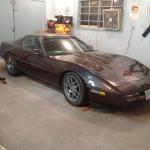
Oops, I didn't think to go back and look at your picture. Now I see that they are Van Steel dampers. I don't really know anything about those.
It's not so much about ride quality, but where I do Auto-X the tar mat is paved in 15ft-20ft wide strips. and at the edge of each strip is about a 3/4in- 1inch drop or raise to the adjacent strip of pavement. Going around the sweeper turns on this I could sometimes feel just a hint that the front suspension was slightly 'skipping', The rear suspension stayed planted.
Ah, okay, I see what you're concerned about now. Interesting topic! I am gathering that, as far as you can tell, your front end grips well on smooth surfaces? My short answer is that I still think damper characteristics will determine your compliance over those sharp bumps much more so than spring rates.
A bump like those you are describing is a transient event, and suspension transients are mostly controlled by dampers and "anti" geometry (in roll, we could call it "anti-roll" but most people just refer to roll center heights). Your car has the updated C4 suspension geometry, right (zero scrub, more anti-dive, lower rear camber rod inner pivot)? Chevy lowered the rear roll center height (reduced "anti-roll"), which will help the rear end stay settled better over bumps when loaded in cornering. I don't think they did that in front, so part of this may be the nature of the roll axis. There's not an easy solution for this, but offset front LCA bushings set to lower the inner LCA pivot point might help a bit (if you don't already have those - I can't tell in the pic).
Dampers usually generate many times more force during those very brief, high-speed suspension events (speed referring to the speed of suspension movement, not the mph of the car). The ideal damper has separate high-speed and low-speed rate adjustments for each direction (4-way adjustables), and you would reduce the high-speed adjustments to address this issue you are experiencing. But if you're like me, you don't have $3k or more to spend on those! So I would still recommend trying to reduce the rates on your current dampers to see how much of this front grip you can claw back. If you can find damping curves for those front shocks, it would be interesting know where the "knee" in the curve is and how flat the high-speed damping curve is. It may be that it isn't that flat, which means your high-speed damping rate could be a little high for the surface you race on.
The damping curve is not easy to address, since you can't just swap shocks and keep your coilover setup. If those shocks can be revalved, it's worth asking if a lower rate for the high-speed damping (relative to the high-speed damping) could be achieved. But failing that, I'd just try to adjust them to a lower rate and see if that helps.
Also when I jack the car up and then set it back down the suspension only compresses on the front maybe an inch. The rear compresses several inches when I do the same to the back of the car.
This is really not a good indicator of spring compliance. What you're seeing is that the rear suspension has a lot more travel in droop than the front, just due to the stops on the dampers. When the rears are off the ground, the spring is totally unloaded on the bolts and you can easily move the suspension an inch or two with your arms. The front doesn't unload as much, and is still preloaded against the spring by the travel limits of the shock. So in the rear, you're just seeing it take up all the slack to get to the same amount of the preload as the front starts with.
This lead me to believe the front suspension is to stiff. (to heavy of springs). I also wonder if the design of the sway bar endlinks is causing binding that slows the movement of the suspension.
So the idea was to run softer springs to let the suspension move more and control the roll more with anti-roll bar than with the springs. Figured if I am going to swap the bar then I should fix the endlink design while I'm at it.
I am skeptical that the stock endlinks could bind that much, but I haven't tested that. Keep in mind that heavier bars will also add wheel rate just like the springs any time the wheels don't move the same amount, in the same direction, at the same time. What that means for your situation is that unless you hit those sharp bumps exactly head-on such that both front wheels go over them at the exact same time, then the bars will resist the suspension travel just as the spring would. In general, I haven't found that the soft-spring/stiff-bar approach really helps compliance over bumps.
On the rear I am just using my Z51 shocks and leaf spring with the full banski kit and DRM brackets + heim endlinks and it feels awesome, the front is ok but feels like it doesn't move as well as the rear suspension.
I am thinking (but I'm not sure) that your rear shocks are probably a good bit softer than the fronts if the fronts are set higher in their rate range. So that's one more nod toward lowering the front damping rates.
About the spring rates, your front and rear motion ratios are now both around 1:1. What's the rate on your rear leaf? FWIW, I run a front leaf that is a touch more than twice as stiff as the rear (1125f/550r). with the front .75 motion ratio, that translates to wheel rates of 633f/550r from just the springs on my car, or a front wheel rate that 15% higher than the rear wheel rate. I'm guessing you're somewhere in that neighborhood. Your front wheel rate is 550, so if your rear spring rate is 478lb then you're in the same general neighborhood of front and rear wheel rates.
I wouldn't necessarily lower the front spring rates. That said, the big advantage of your coilovers is cheap and easy spring rate changes. So it wouldn't be hard to try that. But I'd be suspect of going to a much bigger front swaybar to make up for it, since you'll end up adding back all the wheel rate you removed with the softer springs under most conditions. I'd say try adjusting the front shocks first, then try just softer front springs if the shocks don't get you want you want. The swaybar is a lot bigger project and I would make a last resort (but it would sure look neat!).
Last edited by MatthewMiller; Jan 28, 2017 at 12:20 AM.
Oops, I didn't think to go back and look at your picture. Now I see that they are Van Steel dampers. I don't really know anything about those.
Ah, okay, I see what you're concerned about now. Interesting topic! I am gathering that, as far as you can tell, your front end grips well on smooth surfaces? My short answer is that I still think damper characteristics will determine your compliance over those sharp bumps much more so than spring rates.
A bump like those you are describing is a transient event, and suspension transients are mostly controlled by dampers and "anti" geometry (in roll, we could call it "anti-roll" but most people just refer to roll center heights). Your car has the updated C4 suspension geometry, right (zero scrub, more anti-dive, lower rear camber rod inner pivot)? Chevy lowered the rear roll center height (reduced "anti-roll"), which will help the rear end stay settled better over bumps when loaded in cornering. I don't think they did that in front, so part of this may be the nature of the roll axis. There's not an easy solution for this, but offset front LCA bushings set to lower the inner LCA pivot point might help a bit (if you don't already have those - I can't tell in the pic).
Dampers usually generate many times more force during those very brief, high-speed suspension events (speed referring to the speed of suspension movement, not the mph of the car). The ideal damper has separate high-speed and low-speed rate adjustments for each direction (4-way adjustables), and you would reduce the high-speed adjustments to address this issue you are experiencing. But if you're like me, you don't have $3k or more to spend on those! So I would still recommend trying to reduce the rates on your current dampers to see how much of this front grip you can claw back. If you can find damping curves for those front shocks, it would be interesting know where the "knee" in the curve is and how flat the high-speed damping curve is. It may be that it isn't that flat, which means your high-speed damping rate could be a little high for the surface you race on.
The damping curve is not easy to address, since you can't just swap shocks and keep your coilover setup. If those shocks can be revalved, it's worth asking if a lower rate for the high-speed damping (relative to the high-speed damping) could be achieved. But failing that, I'd just try to adjust them to a lower rate and see if that helps.
This is really not a good indicator of spring compliance. What you're seeing is that the rear suspension has a lot more travel in droop than the front, just due to the stops on the dampers. When the rears are off the ground, the spring is totally unloaded on the bolts and you can easily move the suspension an inch or two with your arms. The front doesn't unload as much, and is still preloaded against the spring by the travel limits of the shock. So in the rear, you're just seeing it take up all the slack to get to the same amount of the preload as the front starts with.
I am skeptical that the stock endlinks could bind that much, but I haven't tested that. Keep in mind that heavier bars will also add wheel rate just like the springs any time the wheels don't move the same amount, in the same direction, at the same time. What that means for your situation is that unless you hit those sharp bumps exactly head-on such that both front wheels go over them at the exact same time, then the bars will resist the suspension travel just as the spring would. In general, I haven't found that the soft-spring/stiff-bar approach really helps compliance over bumps.
I am thinking (but I'm not sure) that your rear shocks are probably a good bit softer than the fronts if the fronts are set higher in their rate range. So that's one more nod toward lowering the front damping rates.
About the spring rates, your front and rear motion ratios are now both around 1:1. What's the rate on your rear leaf? FWIW, I run a front leaf that is a touch more than twice as stiff as the rear (1125f/550r). with the front .75 motion ratio, that translates to wheel rates of 633f/550r from just the springs on my car, or a front wheel rate that 15% higher than the rear wheel rate. I'm guessing you're somewhere in that neighborhood. Your front wheel rate is 550, so if your rear spring rate is 478lb then you're in the same general neighborhood of front and rear wheel rates.
I wouldn't necessarily lower the front spring rates. That said, the big advantage of your coilovers is cheap and easy spring rate changes. So it wouldn't be hard to try that. But I'd be suspect of going to a much bigger front swaybar to make up for it, since you'll end up adding back all the wheel rate you removed with the softer springs under most conditions. I'd say try adjusting the front shocks first, then try just softer front springs if the shocks don't get you want you want. The swaybar is a lot bigger project and I would make a last resort (but it would sure look neat!).
First off, I would like to thank you for taking the time to give me such a informative and well thought out response, I appreciate it.
I'll have to double check this but I think my shocks have 18 setting and I think I was about in the middle, so there should be some room to go softer for sure, I do know that the hardest setting didn't perform well, I don't think I have yet tested the softest setting so I'll give it a try. Some quad adjustable shocks etc... would be nice but unfortunately the single adjustable were a budget decision when I got them and I don't want to spend $3K US for new shocks (4.5K for me since I would be paying in Canadian dollars).
You made a good point about the front at full droop vs the rear. I guess my concern had been that I went over a small drop in the road surface (say 1.5in) and the suspension only was compressed under the weight of the car at most 1in then the tires wouldn't touch the ground for a split second causing the car to skip since full droop is only 1in from ride height, vs the rear where the spring would push the tire down to the road more quickly because of the added travel from ride height to full droop. Which is why I thought of a softer spring to increase the travel between ride height and full droop. But maybe that is not as as important as shock dampening since I know the dampening determines how quickly the suspension reacts.
I suspect you are right and the shocks may be the biggest limiting factor for me vs using a high dollar shock. On the other hand though for not much money I do think I can improve the sway bar design. Part of that improvement would be adding some adjustment holes to the sway bar 'blade' If I do a 3-piece bar. So that I can adjust the stiffness of the bar. I will definitely keep in mind about not going with to large of a sway bar though.
I should mention that my upper control arms have delrin bushings, the lower control arms have Global West Del-aluminum bushings. without the sway bar and spring hooked up I can easily move the suspension up and down, if fact it droops down on its own. I noticed with my sway bar that even though I have greeseable poly anchor bushings it still takes some force to move it when its not hooked up. Also with the endlink bushings being in double sheer and facing perpendicular to each other it seems to me the endlink will bind as the sway bar and lower control arm move through thier axis of motion. So it was my hope with this project to be able to fix this issue and allow the sway bar to move more freely plus add some adjustability to the sway bar rate.
Spring rates & shock rates have little to do with F/R ride height when returning a vehicle to terra firma after the suspension has been in full droop. Camber curve & tire scrub are the dominant factors. A vehicle must be rolled fore/aft to eliminate tire scrub & settle the suspension before height assessments can be made.
Lowering the LCA inner pivot will lower the front roll center at the expense of increasing the roll couple difference = the vehicle may become tail happy. A front roll center that is below ground will cause the vehicle plow the nose in a corner (dependent on corner speed) + the vehicle will tend to "dart" at speed. A stock Vette has a decent roll couple number.
Workshop camber curve graphs, height measurements etc are nothing more than a base line they will enable a crew to return the vehicle to its starting point should the chassis get adjusted to far out of spec or if it is crashed then repaired.
Front camber curve, shock control & sway bars are key to quick corners. Tire discussion intentionally omitted @ this point..
To determine if the camber curves are correct for a given track the tire temperatures must be monitored with a digital pyrometer. Ideally the tire outside & middle temp should be the same the inside 10* warmer. Check outside/inside tire temps 1" inboard of the edges.
If running auto X there will not be enough track time to check tire temps. Suggest checking camber by chalking the outside edge of the tire I" in & 1" down the sidewall. Adjust camber to wear the sidewall chalk line off 1/4" down.
If running threaded tires each thread will roll under during side loading = maybe 1/2 of the tire is working. You want tires that durometer in the low 50's, shave the thread down to the wear bars, use them for track days only.
I'll have to double check this but I think my shocks have 18 setting and I think I was about in the middle, so there should be some room to go softer for sure, I do know that the hardest setting didn't perform well, I don't think I have yet tested the softest setting so I'll give it a try. Some quad adjustable shocks etc... would be nice but unfortunately the single adjustable were a budget decision when I got them and I don't want to spend $3K US for new shocks (4.5K for me since I would be paying in Canadian dollars).
Yep, me neither. I really think you have a lot of settings to experiment with here, before spending any money or replacing any parts.
You made a good point about the front at full droop vs the rear. I guess my concern had been that I went over a small drop in the road surface (say 1.5in) and the suspension only was compressed under the weight of the car at most 1in then the tires wouldn't touch the ground for a split second causing the car to skip since full droop is only 1in from ride height, vs the rear where the spring would push the tire down to the road more quickly because of the added travel from ride height to full droop. Which is why I thought of a softer spring to increase the travel between ride height and full droop.
I really think your suspension won't reach full droop before the sprung mass "catches up," because the dampers hopefully have enough rebound damping to slow the suspension's movement down a bit. But even if it does reach full droop, that's a function of the limits of travel, not spring rate. You can't increase the range of travel with a spring rate change.
Edit to add:[/quote=Churchkey]Spring rates & shock rates have little to do with F/R ride height when returning a vehicle to terra firma after the suspension has been in full droop. Camber curve & tire scrub are the dominant factors. A vehicle must be rolled fore/aft to eliminate tire scrub & settle the suspension before height assessments can be made.[/quote]
Churchkey also makes a very good point here. The suspension won't fully settle until you roll the car, because of scrub and camber. IOW, the tire's contact patch must move laterally across the ground as the suspension moves. If the car is stationary, it can't do that. It would be much better to measure the difference after you roll the car a significant amount back and forth. You probably have more than 1" of rebound travel.
I should mention that my upper control arms have delrin bushings, the lower control arms have Global West Del-aluminum bushings. without the sway bar and spring hooked up I can easily move the suspension up and down, if fact it droops down on its own. I noticed with my sway bar that even though I have greeseable poly anchor bushings it still takes some force to move it when its not hooked up. Also with the endlink bushings being in double sheer and facing perpendicular to each other it seems to me the endlink will bind as the sway bar and lower control arm move through thier axis of motion. So it was my hope with this project to be able to fix this issue and allow the sway bar to move more freely plus add some adjustability to the sway bar rate.
You certainly aren't going to cause harm by doing this. I just don't think you're going to significantly improve compliance over those sharp bumps you mentioned.
I think you're going to have to work with the dampers to improve that. And you've got the adjustment in those QA1s, so give it a try. The beauty of that is that if you race on other, smoother, surfaces too, you can use the harder front damper settings for that. If you have a "test-n-tune" even in the spring, that's the perfect time to mess around with the settings. Whatever you do, please let us know the outcome.
Last edited by MatthewMiller; Jan 28, 2017 at 11:29 AM.






 Splined anti-roll bar question