


Rear camber strut bracket design change

Thread Starter
Racer

Joined: Jul 2015
Posts: 313
Likes: 15
From: Modesto Ca
 Rear camber strut bracket design change
What year was the design changed?Can the newer version be used on the early c4?I noticed the design was changed to eliminate the camber change during suspension travel.

Team Owner


Joined: Sep 2003
Posts: 25,397
Likes: 2,741
I've seen your "reason why" debated I believe.

Safety Car


Joined: Aug 2013
Posts: 4,430
Likes: 609
From: Minneapolis Mn
Have you compared it to the Banski kit? If you use the newer ones you might be able to sleeve the bolts down to 10 mm and not have to drill and tap anything assuming this other one doesn't do what you need.
Just a thought.
Just a thought.

Team Owner

Joined: Aug 2004
Posts: 21,543
Likes: 3,216
From: Park City Utah
Do you mean that the newer design doesn't eliminate camber change? I agree that it doesn't eliminate it. Newer car still exhibits pretty radical camber change throughout it's travel. Only way to eliminate it is to lower the lower arm mounting point until it's the same distance from the u-joint center line (pivot point of the "upper arm") as the outer u-joint centerline is from the outer lower arm/knuckle pivot.
Thread Starter
Racer
Joined: Jul 2015
Posts: 313
Likes: 15
From: Modesto Ca
I have a 57 Chevy I am working on with 85 vette rear suspension.The camber change when cycling the rear suspension is quite severe .I got a set of 1990 brackets and I am going to check the fit on those.I have a buddy that has a 4x4/ fab shop and I just might try making a single piece the bolts across the bottom of the diff for both sides.I have a 87 I want to fix this on too.Tom400cfi spotted the cure for the design.I can't believe GM would design something like that but low profile tires were just coming on the market .
Last edited by odxr; Aug 27, 2017 at 07:24 PM.
Team Owner
Joined: Aug 2004
Posts: 21,543
Likes: 3,216
From: Park City Utah
If we eliminate body roll though, with big bars, suspension geometry and low COG, then we want to minimize camber change, since we won't create any with body roll, but we'd be hurting traction through suspension jounce and rebound over bumps as the tire won't stay vertical on the road.
Le Mans Master


Joined: Aug 2015
Posts: 6,119
Likes: 1,996
From: St. Charles MO
I hear that...but keep in mind that there are benefits to that feature in a typical street car. A street car has some body roll in turns. Adding negative camber during jounce (compression) will compensate for the angularity of the body and consequently suspension points and tire angle (actual camber)....keeping the tire straight up and down during cornering and body roll. In theory.
If we eliminate body roll though, with big bars, suspension geometry and low COG, then we want to minimize camber change, since we won't create any with body roll, but we'd be hurting traction through suspension jounce and rebound over bumps as the tire won't stay vertical on the road.
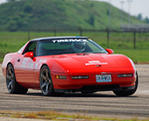
Radial tires are interesting creatures. They actually want to corner with negative camber (tires leaning into the corners). So the idea of keeping a tire perfectly vertical in cornering is not really the goal for radial tires. That said, if you look at good action shots of any production car cornering hard, you won't find any with negative camber on the outside tires. It's a whole lot harder to make that happen than people think. If you don't believe that, here's a pic of my car with 1125lb front spring, 550lb rear spring, -3.5* static front camber, and -2.5* static rear camber:

At best, you see that the front is only just vertical and the rear still has a little positive camber. At some point you have to account for longitudinal traction in braking and acceleration, though. So there are limits to static camber settings.
To the OP's question, I think the basic answer depends on whether the two camber arms (older and newer) at the same length. The newer C4 rear geometry changed more than just the camber arm length. I believe the mounting height for the camber arm was lowered to reduce the roll center height. I don't know what introducing the newer camber arm into an old suspension actually will do. One thing about all these OE arms is that they seem to have a bad habit of moving their static camber setting (the eccentric) when a car is cornered hard. The Banski arms (or any spherical bearing setup) will eliminate that.
Last edited by MatthewMiller; Aug 28, 2017 at 11:44 AM.
Corvette Stories
The Best of Corvette for Corvette Enthusiasts

Top 10 Most Expensive Corvettes Ever Sold on Bring A Trailer
Brett Foote
10 Things Every Corvette Owner Needs (2026 Edition)
Michael S. Palmer
8 Most "Only Corvette Owners Understand" Quirks and Problems
Pouria Savadkouei
10 Reasons the C6 Z06 is Still A Performance Benchmark After 20 Years
Joe Kucinski
How Much Horsepower Every Corvette Engine "LOST" in 1972
Joe Kucinski
Top 10 DOs and DON'Ts for Protecting Your Convertible Top!
Michael S. Palmer
Top 10 Most Explosive Corvettes Ever Made: Power-to-Weight Ratio Ranked!
Joe Kucinski
150 hp to 1,250 hp: Every Corvette Generation Compared by the Specs That Matter
Joe Kucinski
8 Coolest Corvette Pace Cars (and Replicas) of All Time
Verdad Gallardo
Team Owner
Joined: Aug 2004
Posts: 21,543
Likes: 3,216
From: Park City Utah
 with all of that. I was just trying to KISS an answer to "I can't believe GM would design something like that".
The pic is great, and pics like that can be great diagnostic/tuning tools. At least, for a poor guy like me.

.
Last edited by Tom400CFI; Aug 28, 2017 at 03:10 PM.
Thread Starter
Racer
Joined: Jul 2015
Posts: 313
Likes: 15
From: Modesto Ca
Matt-very cool pick of your car working very hard-left front wheel is off the ground.Probably a little frame twisting going on there.I got a set of the 88 up style brackets from ebay cheap.The mounting point is lower to the ground and I am going to install them on the project car to see if it will work.I had an old 77 Datsun 280z that I ran hpde track days with and it was set up with negative camber front and rear.Its amazing when you get a good set of tires up to operating temp how good they will stick.
Le Mans Master
Joined: Aug 2015
Posts: 6,119
Likes: 1,996
From: St. Charles MO
Matt-very cool pick of your car working very hard-left front wheel is off the ground.Probably a little frame twisting going on there.I got a set of the 88 up style brackets from ebay cheap.The mounting point is lower to the ground and I am going to install them on the project car to see if it will work.I had an old 77 Datsun 280z that I ran hpde track days with and it was set up with negative camber front and rear.Its amazing when you get a good set of tires up to operating temp how good they will stick.
What the tire coming up means is that the car is relatively stiff in the front roll rate (spring plus swaybar), and therefore transferring a lot of grip to the outside rear tire. That makes it launch out of corners hard, possibly at the expense of steady-state grip compared to if it had more rear roll stiffness. I will probably experiment with a bigger rear swaybar to see if moving some grip to the front will be an overall improvement. I may find that helps with the Hoosiers but not with the Rivals.
I'm curious what you'll find with the updated camber rod and mount. If the length is correct, it will probably help keep the rear grip more linear, with less jacking effect (due to lower roll center). Let us know.
Team Owner
Joined: Aug 2004
Posts: 21,543
Likes: 3,216
From: Park City Utah
Le Mans Master
Joined: Aug 2015
Posts: 6,119
Likes: 1,996
From: St. Charles MO
That was presumably with 1980s street tires at 255mm width, though. In that pic I'm running 315 Hoosier A7 tires. Consider that I'm probably pulling 1.4-1.5G in corners. We can probably add 500lb to that number for my situation.
Team Owner
Joined: Aug 2004
Posts: 21,543
Likes: 3,216
From: Park City Utah
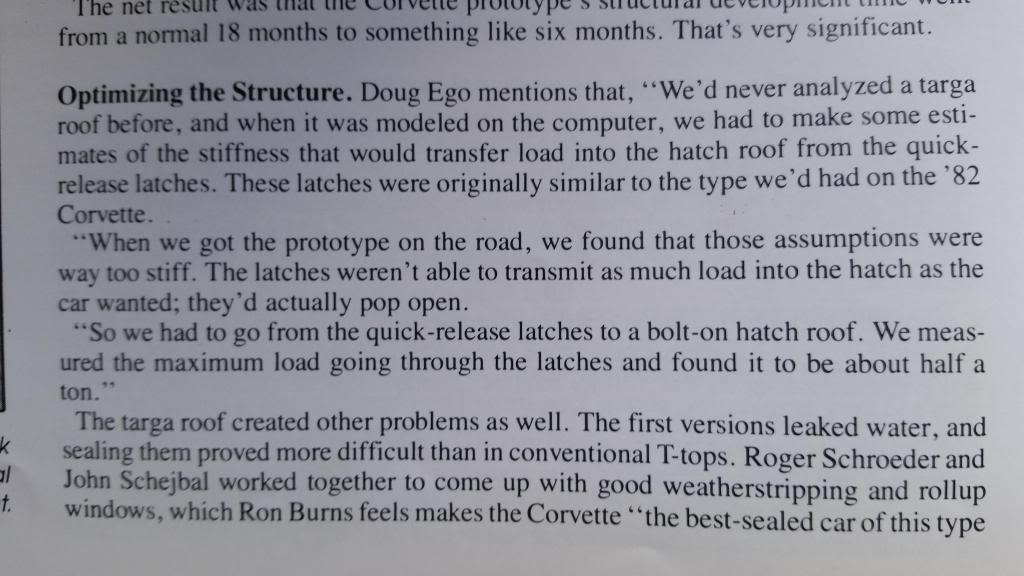
Yeah, that is quite possible. I've always thought that the most force applied to the frame in torsion would be driving through a gutter diagonally, like when entering or leaving a gas station. When doing that, I can get my car on two opposing wheels for a second, before it teeters over onto a third wheel (or I roll back onto flatish ground). Anyway, at that point, 50% of ~3400 lbs is twisting the frame. What is going on when you're cornering like in your pic? Hard to say but if you're pulling over 1g (and I have no doubt that you are), with one wheel in the air, it stands to reason that you could be applying 1.xg * .5 * ~3400 lbs in torsion to the frame of the car. She's under some stress, for sure. 
Whatever the actual numbers are, the measured figure in the text above was pretty mind blowing when I first read it. The roof has a hell of a job to do!
.
Whatever the actual numbers are, the measured figure in the text above was pretty mind blowing when I first read it. The roof has a hell of a job to do!
.
Last edited by Tom400CFI; Aug 29, 2017 at 10:27 AM.
Thread Starter
Racer
Joined: Jul 2015
Posts: 313
Likes: 15
From: Modesto Ca
I bought a set of 88-up brackets on ebay.I am building a 57 Chevy with c4 rear suspension I noticed the extreme camber change while cycling the suspension with a floor jack.The 88-up brackets are a direct bolt in.I am sure GM didn't have the software and computer power we have today with programs like Solidworks.