


Rear trailing arms frame bracket question.

Team Owner


Joined: Sep 2003
Posts: 25,388
Likes: 2,741

Mine not being bolted to car but having arms bolted to them I should be able to measure the clearance in some fashion. I might try to do that but not today. Appointments.
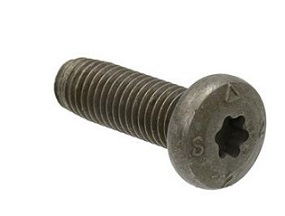
A typical M12X1.75 Torx seat belt bolt
Last edited by WVZR-1; Mar 7, 2018 at 06:02 AM.
Le Mans Master


Joined: Aug 2015
Posts: 6,091
Likes: 1,972
From: St. Charles MO
I would think you could swap the bolts to the rail with M12X175 Torx seat belt bolts, that would substantially reduce 'head height' and don't require a washer because of head diameter. Sufficient for larger Heim? I've no idea but I'd think ideal for most. Bolts would be an easy JY find.
Last edited by MatthewMiller; Mar 7, 2018 at 07:55 AM.
Team Owner
Joined: Sep 2003
Posts: 25,388
Likes: 2,741
I was wondering about something like this, too. I guess the big question if if those seatbelt bolts have any strength limitations, and/or whether one can safely torque them to the proper spec with their Torx head design. FWIW, the "head" of the rod ends that Banski uses (Aurora VCM-10 and VCB-10) are only 1.5" in diamter. I think that is actually a smaller diameter than the stock arm "heads." I can measure those later today.
An issue seems to be that the rods are actually located at 'depressions' in the bracket and there would certainly be limitations as to where they could be located. See SuperL98's snapshots in post#16
I checked mine this AM quickly, at first glance visually it seems to be an issue. Insurmountable? Likely not. That 'local' fella did!!
**Using 'centers' you'd want to locate which direction how much? That would determine the feasibility and the M12 bolt I suggested would certainly make it more feasible.
Last edited by WVZR-1; Mar 7, 2018 at 08:32 AM.
Le Mans Master
Joined: Aug 2015
Posts: 6,091
Likes: 1,972
From: St. Charles MO
An issue seems to be that the rods are actually located at 'depressions' in the bracket and there would certainly be limitations as to where they could be located. See SuperL98's snapshots in post#16
I checked mine this AM quickly, at first glance visually it seems to be an issue. Insurmountable? Likely not. That 'local' fella did!!
Race Director


Joined: Dec 2002
Posts: 13,348
Likes: 233
From: SCMR Rat Pack'r Charter Member..Great Bend KS
Team Owner
Joined: Sep 2003
Posts: 25,388
Likes: 2,741
I was measuring with flange head bolts, flange head nuts with brackets and arms assembled. Using 'east to east' side of exposed threaded ends of bolts gets interesting.
**I get the 'east to east' reference - I've a friend who might explain dimensions like that!
Last edited by WVZR-1; Mar 8, 2018 at 04:31 PM.
Race Director
Joined: Dec 2002
Posts: 13,348
Likes: 233
From: SCMR Rat Pack'r Charter Member..Great Bend KS

Team Owner

Joined: Aug 2004
Posts: 21,543
Likes: 3,216
From: Park City Utah

Corvette Stories
The Best of Corvette for Corvette Enthusiasts

How Much Horsepower Every Corvette Engine "LOST" in 1972
Joe Kucinski
Top 10 DOs and DON'Ts for Protecting Your Convertible Top!
Michael S. Palmer
Top 10 Most Explosive Corvettes Ever Made: Power-to-Weight Ratio Ranked!
Joe Kucinski
150 hp to 1,250 hp: Every Corvette Generation Compared by the Specs That Matter
Joe Kucinski
8 Coolest Corvette Pace Cars (and Replicas) of All Time
Verdad Gallardo
Top 10 Corvette Engines RANKED by Peak Torque (70+ Years of Muscle!)
Joe Kucinski
Corvette ZR1X Will Be Pacing the Indy 500, And Could Probably Race, Too!
Verdad Gallardo
Top 10 Corvettes Coming to Mecum Indy 2026!
Brett Foote
Top 10 C9 Corvette MUST-HAVES to Fix These C8 Generation Flaws!
Michael S. Palmer
Le Mans Master
Joined: Aug 2015
Posts: 6,091
Likes: 1,972
From: St. Charles MO
ok, I will re-phrase that - if you take the rear leaf off and replace it with coilovers it changes a few things, the leaf reacts slightly differently to the coil springs during cornering, but mainly mounting coils in front of the axle and slightly inboard as opposed to a leaf mounted to the rear of the axle and out further on the hub changes wheel rates etc,
so if you replace the rear leaf with coilovers and your racing or driving hard - then you will most likely need more rear sway bar.
so if you replace the rear leaf with coilovers and your racing or driving hard - then you will most likely need more rear sway bar.