When you click on links to various merchants on this site and make a purchase, this can result in this site earning a commission. Affiliate programs and affiliations include, but are not limited to, the eBay Partner Network.
Reher Morrison did extensive testing years ago on rod length and found, rod length didn't really affect power output. But rod length does have a big effect on piston wear and longevity. I always choose the longest connecting rod that is practical. Big stroke engine builds will usually have a less than ideal rod ratio, but will have the potential for alot of power. I built a 450 sbc 4.165X4.125 with a standard deck height block. It had a horrible 1.42 rod ratio...Rod length is a compromise on alot of big stroke builds.
Agreed. To add detail, here is a quote from Reher and Morrison on the topic:
Originally Posted by Reher-Morrison
Most people tend to overgeneralize this issue. It would be more accurate to compare different rod-to-stroke ratios, and from a mathematical stand-point, a couple thousandths of an inch of rod doesn't really change things a lot in an engine. We've conducted tests for GM on NASCAR engines where we varied rod ratio from 1.48- to 1.85:1. In the test, mean piston speeds were in the 4,500-4,800 feet-per-second range, and we took painstaking measures to minimize variables. The result was zero difference in average power and a zero difference in the shape of the horsepower curves. However, I'm not going to say there's absolutely nothing to rod ratio, and there are some pitfalls going above and below a certain point. At anything below a 1.55:1 ratio, rod angularity is such that it will increase the side loading of the piston, increase piston rock, and increase skirt load. So while you can cave in skirts on a high-end engine and shorten its life, it won't change the actual power it makes. Above 1.80- or 1.85:1, you can run into an induction lag situation where there's so little piston movement at TDC that you have to advance the cam or decrease the cross-sectional area of your induction package to increase velocity. Where people get into trouble is when they get a magical rod ratio in their head and screw up the entire engine design trying to achieve it. The rod ratio is pretty simple. Take whatever stroke you have, then put the wrist pin as high as you can on the piston without getting into the oil ring. Whatever connects the two is your rod length.
And also:
Originally Posted by Reher-Morrison
If I had to make a list of the ten most important specifications in a racing engine, connecting rod length would rank about fiftieth. Back in the days when Buddy Morrison and I built dozens of small-block Modified motors, we earnestly believed that an engine needed a 1.9:1 rod/stroke ratio. Today every Pro Stock team uses blocks with super-short deck heights, and we couldn’t care less about the rod ratio. A short deck height improves the alignment between the intake manifold runners and the cylinder head intake ports, and helps to stabilize the valvetrain. These are much more important considerations than the rod-to-stroke ratio. There’s no magic – a rod’s function is to connect the piston to the crankshaft. Period.
I have little doubt that at the extreme end of small rod:stroke ratios the piston wear becomes an issue. Even then, rpm and power levels play a huge factor. A short ratio that might be fine in a 450hp stroker redlined at 6000rpm could make ovals out of pistons pretty fast at 800hp and 7500rpm. I would definitely consider 1.42 to be an extremely short ratio, and would limit it to a low-rpm engine for that reason. But at 1.52, GM gave a production car warranty to its 7000rpm LS7. So that appears to be well inside the safe zone for anything typical of SBC rpms.
By comparison, it appears that fairly recent Sprint Cup motors are running 1.91 ratios. Those are designed to output 750-900hp at 10,000rpm(!) for up to 600mi at a time, and they are very reliable doing that. That is more evidence that the intended use makes all the difference in what a safe rod:stroke ratio is. If we remember that forces vary with the square of the velocity, then that makes sense: the pistons running at 10krpm are seeing over twice the forces as those running at 7krpm. For the 99% of us that aren't even going to see 7k with our SBCs, typical 1.5 ratios are safe.
But going back to the original topic of this thread, the OP was asking "How much [do 6" rods] help torque production." The answer is very clear, as stated by Reher-Morrison: not one bit. They don't do anything for torque production or power (which is what really matters).
With all this talk about rod lengths and piston side loads, I'm surprised no one has mentioned piston pin offsets! That throws another twist into the piston wear consideration.
With all this talk about rod lengths and piston side loads, I'm surprised no one has mentioned piston pin offsets! That throws another twist into the piston wear consideration.
Why not take it one step further and offset the cylinders
..... Rod length is used in calculating the dynamic compression ratio … its important because the rod length determines the position of the piston in the bore at valve open/close events during the cycles … and the DCR will affect the torque/power output of an engine … perhaps by an insignificant amount … BUT …..
….. I'm getting a blank page from your link … but it seems they just transferred the thrust loading from one side to the other … and possibly multiplied it by a factor of the offset itself … the piston moves and works in both directions … this perhaps relieves some of the side loading during the power stroke but increases it during compression …..
Yamaha was really 'Cutting edge tech" with that idea. The 1910 Hupmobile that our family has, has that same technology. Unfortunately that tech (in the Hupmobile) only yeilded 20 hp from 1.8 liters. Maybe the Hupp needed longer rods?
If you're not giving away the store in terms of short piston skirts and (too) tight ring packs, I just think long rods make for a more efficient engine.
This is my own admittedly unscientific analogy, but here goes.
If you were jacking up your car you want your shoulders (aka wristpin) as nearly vertical over the end of the jack handle (aka crankshaft rod journal) as possible. The Hupmobile / Yamaha approaches this near perfectly, but look at the long rod versus the short rod, not only does the short rod give up efficiency in the way of sidewall friction, it also gives away a geometrical advantage because the wrist pin (your shoulders) is moved farther away from the crank rod journal (end of the jack handle). Plus long rods, at least in theory have longer dwell at TDC, for whatever that's worth in a street engine.
Now please excuse me while I retire to my bunker
Last edited by mtwoolford; Aug 5, 2018 at 05:02 PM.
If you're not giving away the store in terms of short piston skirts and (too) tight ring packs, I just think long rods make for a more efficient engine.
I think this is a completely reasonable statement. From the standpoint of wear, it's reasonable to use the longest rods you can that don't compromise any other part of the engine. That is, you set things like stroke, bore, deck height, piston design, ring package and placement, etc first, because they are all way more important. Within the constraints they pose, then you choose the longest rod that fits.
If you were jacking up your car you want your shoulders (aka wristpin) as nearly vertical over the end of the jack handle (aka crankshaft rod journal) as possible. The Hupmobile / Yamaha approaches this near perfectly, but look at the long rod versus the short rod, not only does the short rod give up efficiency in the way of sidewall friction, it also gives away a geometrical advantage because the wrist pin (your shoulders) is moved farther away from the crank rod journal (end of the jack handle). Plus long rods, at least in theory have longer dwell at TDC, for whatever that's worth in a street engine.
All the above makes sense, but in reality it never seems to work out that way. The other variable is piston speed: where and how much acceleration and speed occurs in the piston cycle. That may make up for the leverage you are talking about. I don't know - I just know nobody has ever been able to demonstrate a real performance difference.
If the intake ports are way too big or way too small little is to be found. On a small displacement engine it is very easy to put an intake way too big on it and on a very large displacement engine it is hard to put a large enough intake port on it especially with a push rod engine. Rod length does change the peak air speed and gets it closer to the mean speed. It does work to some degree mostly to extend the RPM range with a fixed size port and no metal to make it larger safely. A lot of times physical limitations from available room control the length along with piston blanks and a host of other things. To me it is one of those things you use as practical length that will fit without screwing everything else up.
Longer rods do work and have run them back to back with only a piston change to suit, same piston at different compression height. While in the early 90's geometry and air speed have not changed. Port limited or intake limited engines gain the most. They make the air speeds at 73 to 78 degrees after tdc lower where the piston is moving the fastest. This extends the torque curve in both degrees of rotation and RPM before reaching the critical pressure ratio.
What is a Sd intake??
A Chevy Performance dealer. scoggie dickens ( So ?). I had one of these intakes and with bigger runners they are awesome. As for the longer rods Smokey was dead on right. The advantage is additional dwell time at TDC and its effects on cylinder filling.
It has zero to do with time at TDC and if piston speed is plotted vs. degrees it becomes very clear. It has everything to do with piston speed at 72 to 78 degrees after TDC on both the intake and power stroke. So if Smokey said it had to do with dwell time at TDC he was dead wrong.
It has zero to do with time at TDC and if piston speed is plotted vs. degrees it becomes very clear. It has everything to do with piston speed at 72 to 78 degrees after TDC on both the intake and power stroke. So if Smokey said it had to do with dwell time at TDC he was dead wrong.
Because of the longer dwell time at TDC the acceleration (piston speed) away from top dead center is the advantage. I stand corrected.
Because of the longer dwell time at TDC the acceleration (piston speed) away from top dead center is the advantage. I stand corrected.
This is the answer eliminate everything else you added before it
"the acceleration (piston speed) away from top dead center is the advantage"
Most racing urban myths are easily explained away with math unfortunately well beyond the ability of those that perpetuate the myths.
You have to go faster somewhere in order to go slower in another place.
There are 10 ms in one rev at 6000 RPM so everything has to fit in that time period..
It has everything to do with piston speed at 72 to 78 degrees after TDC on both the intake and power stroke...This is the answer eliminate everything else you added before it
"the acceleration (piston speed) away from top dead center is the advantage"
I don't think this correct though. The following two charts are copied from FTL Racing. They pertain to a comparison of two engines with identical stroke, but one with a rod:stroke of 1.49 (blue lines) and the other at 2.00 (red lines). At 75* ATDC we see that the long-rod engine does indeed have a bit more acceleration, but both have pretty low acceleration here and it is getting lower. In fact, at this position it's about to hit zero acceleration in the next few degrees, so acceleration here is a non-issue. Overall, the short-rod engine has the highest peak acceleration forces, which is one reason it is detrimental to engine life at high rpms. But for piston speed, we see the opposite: the short-rod engine has the higher velocity at 75* ATDC. In fact, it has higher velocity from 1*-90* and from 270*-360*, and it also has the highest peak velocity overall.
So if we believe that higher piston speed from TDC helps intake performance (which is a reasonable thing to believe), then it's in favor of the short-rod engine. BUT, we should also notice that this info tells us to take it all with a grain of salt. The differences in acceleration in this example are moderate at best, and the differences in piston speeds are small. And this is for a comparison of two very extreme (for the SBC world) rod:stroke ratios: with a 3.5" stroke it compares a 5" rod with a 7" rod! What that tells us is that in the bench racing worlds where SBCs are concerned, the performance (piston speed ) differences between typically available rod length choices are going to be nil, and the durability (acceleration) differences will be small at best, and immeasurable in all likelihood.
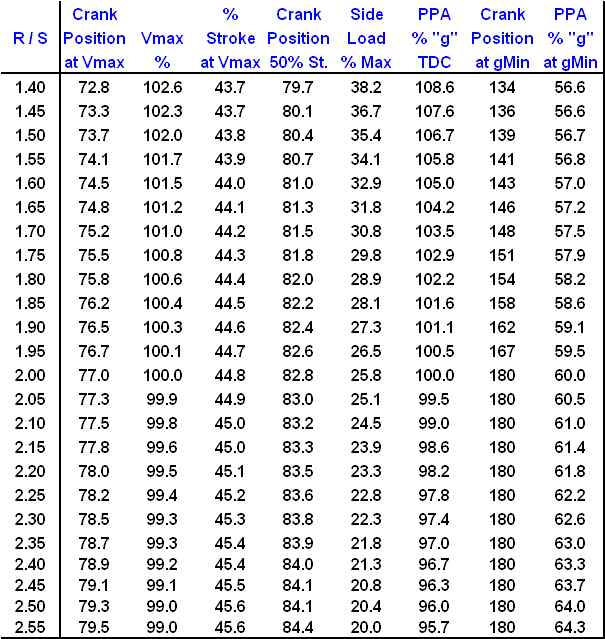
Addendum: This page on piston motion from EPI discusses all of this and much more. Germane to the info above, take a look at Figures 9 and 10. In Figure 9, you see a similar comparison to the charts shown above (two very different engines, so velocities are shown in percentages of peak in this graph). I pasted Figure 10 below because it gives us very useful comparisons of incremental rod:stroke ratios. When comparing 1.50 to 1.60 (which is in the range of what typical SBC build might allow), you can see that the difference in peak piston speed is less than 0.5%. That's nothing, but it's in the favor of the shorter rod length. There is a bigger difference in side loads, which means that the longest practical rod length will be helpful for longevity at high rpms. But again, even here it's not going to mean much at the rpms most of us will ever see with our SBCs.
Last edited by MatthewMiller; Sep 1, 2018 at 09:51 PM.
The importance is more in time to cylinder filling more than side load. A lower acceleration rate gives more time for cylinder filling and peak air speeds that are lower and allow extending the torque curve. .
The importance is more in time to cylinder filling more than side load. A lower acceleration rate gives more time for cylinder filling and peak air speeds that are lower and allow extending the torque curve. .
If that is true (see below), then it also means the short-rod engine has the advantage because it has the lower acceleration rate around 75*.
But I don't see how it matters. For a given rpm, all four-cycle engines take the same amount of time to get from TDC to BDC and vice versa. This is true no matter the displacement, bore: stroke, rod:stroke, etc. For an engine of a given stroke at a given rpm, the average piston speed (in absolute value) is always the same, regardless of rod length. And the piston speed is always zero at TDC and BDC. So in any engine of a given stroke and rpm, the cylinder has the same amount of time to fill (assuming identical cam timing, of course). And again, in any case the differences in piston speeds and acceleration in any given crank position are so small within the range of rod lengths available to a SBC build that it wouldn't result in measurable differences of performance anyway.
Think what you will makes no difference to me. It makes no difference to the math and physics involved too they don't care what you think or Smokey thinks or anyone else.
Think what you will makes no difference to me. It makes no difference to the math and physics involved too they don't care what you think or Smokey thinks or anyone else.
The math involved is included in the links I provided. You have stated that the long-rod engine has better performance because it has greater piston speed and lower acceleration around 75* ATDC. The math says you are wrong about both those things: they are true for the short-rod engine rather than the long-rod engine. The math also tells us that within the range we can actually use in an SBC, rod length just can't provide measurable differences either way. Luckily for it, the math doesn't care what you think either.
Most racing urban myths are easily explained away with math unfortunately well beyond the ability of those that perpetuate the myths.
Indeed!
Last edited by MatthewMiller; Sep 2, 2018 at 06:36 PM.
Yeah I'd say that Rod to Stroke ratio is a waste of time to think about too much. Things have to fit together in an engine real estate wise and they have to be made correctly for the application is what's much more important by a long shot. Longer rods do lighten the piston up and shorter rods do allow a beefier power adder piston for sure so it really just depends on many variables in reality.
F1 engines with a V angle are forced to run a way longer rod than even they'd want due to the large 4 valve heads and the short deck and very short approximately 1.5" stroke. You can only push the heads so far down on the block real estate wise with a shorter deck before they hit each other and it gets worse the narrower the V-angle is like the 72 degree V10s or say a 60 degree engine would be even worse.
Basically you are stuck with a longer aka, weaker, heavier and flexier rod than what the race engineers probably want but it is just the way it ends up. With an inline or wider V angle engine the rods will become shorter and thus stronger, stiffer and lighter. You'd rather have them like that especially in a race engine and that's generally what happens.
Yeah I'd say that Rod to Stroke ratio is a waste of time to think about too much. Things have to fit together in an engine real estate wise and they have to be made correctly for the application is what's much more important by a long shot. Longer rods do lighten the piston up and shorter rods do allow a beefier power adder piston for sure so it really just depends on many variables in reality.
F1 engines with a V angle are forced to run a way longer rod than even they'd want due to the large 4 valve heads and the short deck and very short approximately 1.5" stroke. You can only push the heads so far down on the block real estate wise with a shorter deck before they hit each other and it gets worse the narrower the V-angle is like the 72 degree V10s or say a 60 degree engine would be even worse.
Basically you are stuck with a longer aka, weaker, heavier and flexier rod than what the race engineers probably want but it is just the way it ends up. With an inline or wider V angle engine the rods will become shorter and thus stronger, stiffer and lighter. You'd rather have them like that especially in a race engine and that's generally what happens.
I will ask a pointed question then offer a thought.
Do you personally know any F1 engine designers and they let you read their test logs? If from a magazine good luck with that.
I suspect withing the limits of what might be a reasonable budget using off the shelf parts and an average american v8 rod length is not that big a deal until rpm goes up for extended periods. BTW bank angles have a lot to do with the number of cylinders and an even firing order. I suggest some reading and start with 'Internal Combustion Engine Fundimentals' and sharpen your math skills as there are few pretty pictures of folksy explanations.