When you click on links to various merchants on this site and make a purchase, this can result in this site earning a commission. Affiliate programs and affiliations include, but are not limited to, the eBay Partner Network.
I have a perception about shocks and damping that may be misguided but I'll try to explain it, then ask the questions.
I feel that there is a difference between a suspension that is well dampened....and one that is just STIFF. Cars that I've observed in Auto-x that have what look like good compliance and even a fair amount of body roll...but good damping (and also fantastic performance) are E36 (and other) M3, some Porsche's, E55 AMG, some Audi. These cars appear to have compliance and body roll, but doing maneuvers that are typically "upsetting", don't upset the car; the body reacts to the input ONCE and then stays through the corner or maneuver. No bouncing.
In contrast, I feel that you can have a STIFF/jarring ride, poor compliance and still have a bouncy or easily up-settable body/chassis. Going around a corner, you hit bumps and the rear of the car does the "whoopty-whoop" where you get lateral oscillations with the vertical ones. That spikes G forces and can initiate a slide. Or you cut into a turn and the initial reaction isn't well dampened and that initiates a slide when the car is or should be capable of that degree of cornering.
If this is difference is true, what makes a shock have good damping while still having good compliance? Or is it something outside of the shock? The bushings? If I spend $$ on high end shocks, will I realize sublime damping? Or are these issues/solutions found elsewhere. How do you make a car more "unflappable"? I'm not talking about absolute limits here...I'm talking about making it's reactivity to inputs, more benign and approachable. Thoughts?
There have been a lot of design concepts about how to make a better handling car through various situations, and they don't all agree. Even big name places have different approaches. For example 40 years ago Herb Adams tried to make the car more compliant to handle irregular surfaces (bumps) while Doug Rippie made stiffer suspensions that worked well on the track (smoother surface).
Generally the more compliant suspensions used softer springs with bigger sway bars and high shock damping. The stiffer suspensions used stiff springs with optionally large sway bars and usually high shock damping. The comparisons of the day frequently went to a track and found which one could make better lap times. In this narrow set of conditions usually the stiff suspension won, but in real world driving the more compliant won although it was not able to be tested by the magazines, etc.
My opinion is to make a good handling street car (all types of road conditions) I like to have a moderate spring, big sway bars, and heavy damping shocks. The springs allow movement over bumps and almost any shock will be overpowered by a bump an compress and extend keeping contact. The sway bars generally don't change the reaction to bumps, but only keep the car level.
For a comparison, look at the 84 Z51 cars. The springs were very stiff. The car did well on a track and some reported over 1 G cornering. However, if you have driven or ridden in one you know how stiff it is and how easily it gets "airborne" over bumps in the road and bounces. In a corner it loses traction in the rear when it bounces.
There have been different opinions on how to set up a car for a long time and they don't agree. But as I described, that is how I would approach a versatile suspension that performs well and can handle irregularities.
Whew, Tom! This is one topic that could result in volumes of info. The problem with dampers is that their basic function is simple, but their dynamics in an actual car is complicated and affected by a number of different variables. Race teams spend ridiculous money to model this stuff and to test it on shaker rigs and such.
I'm no expert, but I'll try to take a stab at some of this. Your observations are on target overall, I think.
As background: A damper has a rate of resistance in force units plotted over damper shaft speed. This is the fundamental property of any damper. The rates may be different for compression and rebound. The compression damping is generally perceived as controlling the oscillations of the unsprung weight, and the rebound is thought of as generally controlling oscillations of the sprung weight. We generally consider that a bump in the road causes high shaft speeds, and for that we want a fairly low rate for good compliance, especially in compression. Low-speed (shaft speed) damping is thought to be about controlling the sprung mass in reaction to acceleration forces (accelerating, braking, turning). Ideally we usually want this low-speed rate to be higher than the high-speed rate.
A simple damper has a simple line on that plot. A better damper generally has higher damping rates for rebound than compression. Most advanced dampers have a different damping rate for high and low shaft speeds. This produces a pronounced "knee" in the damping curve, where the rate (the inclination of the plotted line) suddenly flattens out at a certain speed and doesn't build much after that. Where this knee is, and how severe the angle of the plotted line before and after it, determine a lot of how compliant a damper feels, and how well it control body motions in response to acceleration forces.
A single-adjustable damper provides control of only rebound damping. A crappy single-adjustable adjusts both rebound and compression damping. A double-adjustable damper provides independent settings for both rebound and compression damping. And a four-way-adjustable damper gives you independent control of both high- and low-speed rates in both compression and rebound. Other important qualities of dampers include how quickly the aerate the damper fluid, how they deal with aerated fluid, how well the valving reacts to changing forces, and how prone they are to overheating the fluid.
To your questions, it is certainly possible to have damping rates that are too high and don't allow optimum tire contact. It's also possible to have a damper that is too harsh over bumps yet doesn't control body motions well enough, if it has too much high-speed rate and too little low-speed rate. In fact, this is probably the case for most cheap dampers. The problem, of course, is that four-way-adjustable dampers are super expensive, so most of us don't have them. If we did, we could tune those aspects out. It's also likely that some of the of bouncing you're seeing is a car that is either very stiffly sprung or riding near the bump stops, and so the dampers can't keep up. Probably that's the case on the cars where bouncing is visible.* Car with just way too much damping do tend to be difficult and unpredictable to control near the limits. Another challenge is for a car that relies on large swaybars: it will have a significantly different wheel rate in roll (springs+swaybars) vs heave or pitch (springs only).
The other thing to note at many autocross events is that many of the cars there have modified suspensions and non-original dampers. So it may be less brand dependent. Autocrossing is a fairly unique situation for cars, since the surfaces are (usually) fairly smooth and the control inputs are often more abrupt and more transitional (quickly changing inputs from left to right and brakes to throttle) than road courses. And you see a lot of cars in "Street" classes where they can change dampers but not spring or swaybar rates. That means you see a lot of softly-sprung stock cars trying to crutch things with stiffer-than-ideal dampers - it works to improve times, even if it isn't the best way to go about it. Finally, you may see a car set up to be neutral in steady-state cornering (springs and swaybars) but tight (understeer) in transitions like slaloms (dampers).
In general, yes, better/fancier dampers can allow you to set the car up with more compliance over bumps while retaining good control of the body motions with control inputs. Of course, they can also be set up to ruin the car's handling! There are of course tons of other things that affect how benign a car is to inputs: alignment, suspension geometry, bushing compliance, tire qualities, etc.
*Unless a car is so stiff and overdamped that the tires or rubber bushings have become the most compliant parts, and the bouncing is a result of that undamped compliance rather than the springs.
Last edited by MatthewMiller; Oct 30, 2018 at 09:43 AM.
By lightening the car, I've effectively raised the spring rate with regard to body control, but wheel rate is unchanged. I wonder what this means for shock damping? I'd guess ~the same compression damping as stock, but more rebound damping? Which would make for "tight" feeling suspension. ...?
I guess I've effectively raised the roll bar rate too? When I connect and disconnect the rear bar, I can't feel any difference in body roll. There is basically none either way.
Last edited by Tom400CFI; Oct 31, 2018 at 08:45 PM.
By lightening the car, I've effectively raised the spring rate with regard to body control, but wheel rate is unchanged. I wonder what this means for shock damping? I'd guess ~the same compression damping as stock, but more rebound damping? Which would make for "tight" feeling suspension. ...?
Yes, you've effectively increased the rebound damping, in theory. And/or you've also increase low-speed damping. You might be able to do with less. Also, this may be more pronounced in the rear if more of the mass reduction came from the back half of the car (do you have any idea where the weight bias is now?). If so, that could account for the nervous rear traction you're experiencing, I suppose. Not sure what shocks you have on the car right now, but it would be interesting to try a set with single-adjustable rebound damping, like Konis or Ridetechs.
I guess I've effectively raised the roll bar rate too? When I connect and disconnect the rear bar, I can't feel any difference in body roll. There is basically none either way.
Yes, you have. However, the proportion of roll bar and spring contributions to the total wheel rate should remain the same. When you disconnect the rear bar, can you tell any difference in understeer/oversteer? I find my full-weight C4 to be pretty sensitive to rear bar size. When you say you can't feel a difference with or without the rear bar, the impression I get (again) is that more of the mass came off the rear than the front.
I'm sure you've thought about it, but also make sure your alignment, and especially rear toe, is in a good range.
Copy all that too. The shocks that are on the car right now are (I believe) the original Bilsteins. Two (at least) are shot, two are marginal (at best).
IDK where most of the weight came off the car. My GUT would say the rear;
Rear=hatch, tub, gas tank/subframe/tire and rear bumper and inner and outer fenders.
"Middle" =The doors, roof/windshield, interior, IMO.
Front = hood, bumper, AC/heat/dash, front of frame, battery, headlights...
The cage probably added more weight to the rear than the front. I need to weigh the car and find out. When I jack it, I put my jack pad about in the middle of the rocker rail in order to get the car to raise evenly, front/rear -which surprises me. I guess that I could "poor man test" it by jacking it, then putting jack stands in the middle of the frame rail until the car balances, and measure the distance front to rear axle centerline.
I haven't been able to notice any diff in understeer/oversteer w/the rear bar connected or not. I should have disconnected it at the event to see in a more controlled environment.
The alignment was done by me, in my garage using a tape measure, straight sq tube and a level. I'm sure it could be better. I set the rear toe to 0.
Okay, one more thing to contemplate: not only did you reduce the mass a lot, but you also lowered the CG quite a bit. Again, that reduces weight transfer with acceleration forces, and again it effectively increases your spring, swaybar, and damping rates. So you get kind of a double-whammy effect with all the reduced mass. Re alignment, the biggest thing is to make sure the rear toe is 0, as you have done. Front toe is also very important. Luckily it's the easiest to measure and change.
Warning, the following information is entirely useless...
If you could estimate weight on the front wheels and then weight on the rear wheels you could calculate the approximate center of mass of the car. This would also work with the shift left to right to so you could figure it out. It seems relatively useless for your goals but if you're bored... I'd say drive the nose so the tires are 1 foot onto a scale and record and then do the same for the rear, leaving the other set of tires off the scale. Then you could add in your seating position and weight based on the true center and see how you alter its position... see the crude sketch and equation below for details.
All this makes me wonder if the GM suspension guys took the known chassis flex into account when specifying damper and spring rates, for overall effect. My 89 seems to be sensitive to the little things like tire pressure. And setting the FX3 to the softest setting makes the car more comfortable but too floaty.
Tom's orginal comments about BMWs is spot on. Ive owned two 5 series and they were quiet and comfortable without being floaty but also handled well. Not Corvette good, but good for a sedan. What are they doing differently?
All this makes me wonder if the GM suspension guys took the known chassis flex into account when specifying damper and spring rates, for overall effect.
Probably not in the way you're thinking of. The range of spring rates for C4s was more than 2:1 for front springs and roughly 3.5:1 for front. They were all over the place in swaybar and damping rates, too.
Tom's orginal comments about BMWs is spot on. Ive owned two 5 series and they were quiet and comfortable without being floaty but also handled well. Not Corvette good, but good for a sedan. What are they doing differently?
Probably it's partly a result of more "planned" compliance in the suspension. That is, they had geometry and soft bushings in certain places that caused the car to become more stable at the limit - such as bushings that caused more rear toe-in with roll, or lots of camber gain in the rear. I also recall the E36 being a pretty stiff chassis, and it actually had a rearward weight bias which help it in autocross and road course work. It was a great handling car, and the Backdraft Cobra kit is based on it.
Last edited by MatthewMiller; Nov 3, 2018 at 08:37 AM.
Probably not in the way you're thinking of. The range of spring rates for C4s was more than 2:1 for front springs and roughly 3.5:1 for front. They were all over the place in swaybar and damping rates, too.
Probably it's partly a result of more "planned" compliance in the suspension. That is, they had geometry and soft bushings in certain places that caused the car to become more stable at the limit - such as bushings that caused more rear toe-in with roll, or lots of camber gain in the rear. I also recall the E36 being a pretty stiff chassis, and it actually had a rearward weight bias which help it in autocross and road course work. It was a great handling car, and the Backdraft Cobra kit is based on it.
Ah, I do recall that with both fives (E34, E39) their chassis would take a nice set quickly and just hang in there rock solid. The old 535 was quite nimble for such a heavy car
So, for me, how do I get the Vette to be more comfortable and handle well? They just can't be mutually exclusive on our cars.
One other thing I forgot to mention is that most German sedans seem to have a crap ton of caster built in. That provides an advantage in sharper turns, since both tires gain camber in the desired direction for the turn; and also because it jacks the inside tire a bit and raises the outside tire, which helps keep a little more load on the inside front tire and outside rear.
As for how to make a C4 "more comfortable and handle well," I always tend to think that ride comfort (or harshness) comes mostly from dampers. So we're back to Tom's questions. In theory, a digressive damper with a big difference between low-speed and high-speed damping is going to be more comfortable and compliant. That's the biggest thing.
If this is difference is true, what makes a shock have good damping while still having good compliance? Or is it something outside of the shock? The bushings? If I spend $$ on high end shocks, will I realize sublime damping? Or are these issues/solutions found elsewhere. How do you make a car more "unflappable"? I'm not talking about absolute limits here...I'm talking about making it's reactivity to inputs, more benign and approachable. Thoughts?
The relationship between the spring rates, the dampening curves (compression and rebound), and the weight of that which is suspended, is what matters. So, the question about whether big money, high end shocks will give you the suspension qualities you want, the answer Is yes, only if you are lucky enough that the dampening curves happen to be well matched to your particular spring rates and vehicle weight.
I think the very best you can hope for, even with an unlimited budget, is to be able to buy shocks that have adjustable high and low speed compression, and adjustable rebound, then you have to go out and start testing. I don't even know if a shock like that is available for a c4 car, but if they are, I wouldn't be surprised if they cost a thousand bucks per unit.
I think the very best you can hope for, even with an unlimited budget, is to be able to buy shocks that have adjustable high and low speed compression, and adjustable rebound, then you have to go out and start testing. I don't even know if a shock like that is available for a c4 car, but if they are, I wouldn't be surprised if they cost a thousand bucks per unit.
I believe Ridetech can make those for a C4, but I bet you're price prediction is accurate. An alternative might be to get the corner weights figured out and ask them to make a set of their HQ single-adjustables with custom valving to get the compression rates in the right range. I've thought about going that route myself.
However, I think there is likely to be some other stuff going on with Tom's car that should be sorted first. Tom, one thing you might want to try is literally just removing all the shocks to see what the basic handling is like without them. Only do this on a closed-course test, like an autocross! But it would be interesting to see what changes with this. For example, if the car is still a twitchy mess then you know you have more problems than just dampers. If the car gets much easier to drive to the limit, then the dampers really are the culprit.
Good idea about removing the dampers....I think it will be a springy, bouncing jalopy. A friend of mine had a good idea that I should have thought of; Take the Wheels/tires off the '92 and put them on the Kart. That would give me a decent tire for an event. I took that idea and went one further; I should have taken wheels, tires and the Koni's that are on the '92 and put them on the Kart, for the event. Duh.
The reason I ask about "more expensive" shocks is this: I've never felt that the damping on any 'Vette is "great". My C6 had the rear end "whoopty-whoop" over elevation changes and could get upset in transitions easier than I thought it should. I thought more rebound damping would have helped that car. The '92 exhibits similar traits with Koni's (set tight in front, middle in rear). Not bad...but it's there. With the Kart feeling relatively "insane", I wondered if more $$$ would or could equal better damping to make the car more benign or if that was barking up the wrong tree.
There are no more Auto-x events here this year (until March), so I'm SOL on swapping wheels and shocks from the '92 as a test....for a while at least.
I don't know about the springs being too stiff. Maybe. race cars often run incredibly high spring rates to achieve their goals, but IDK what the negative effects of that are...other than poor ride quality.
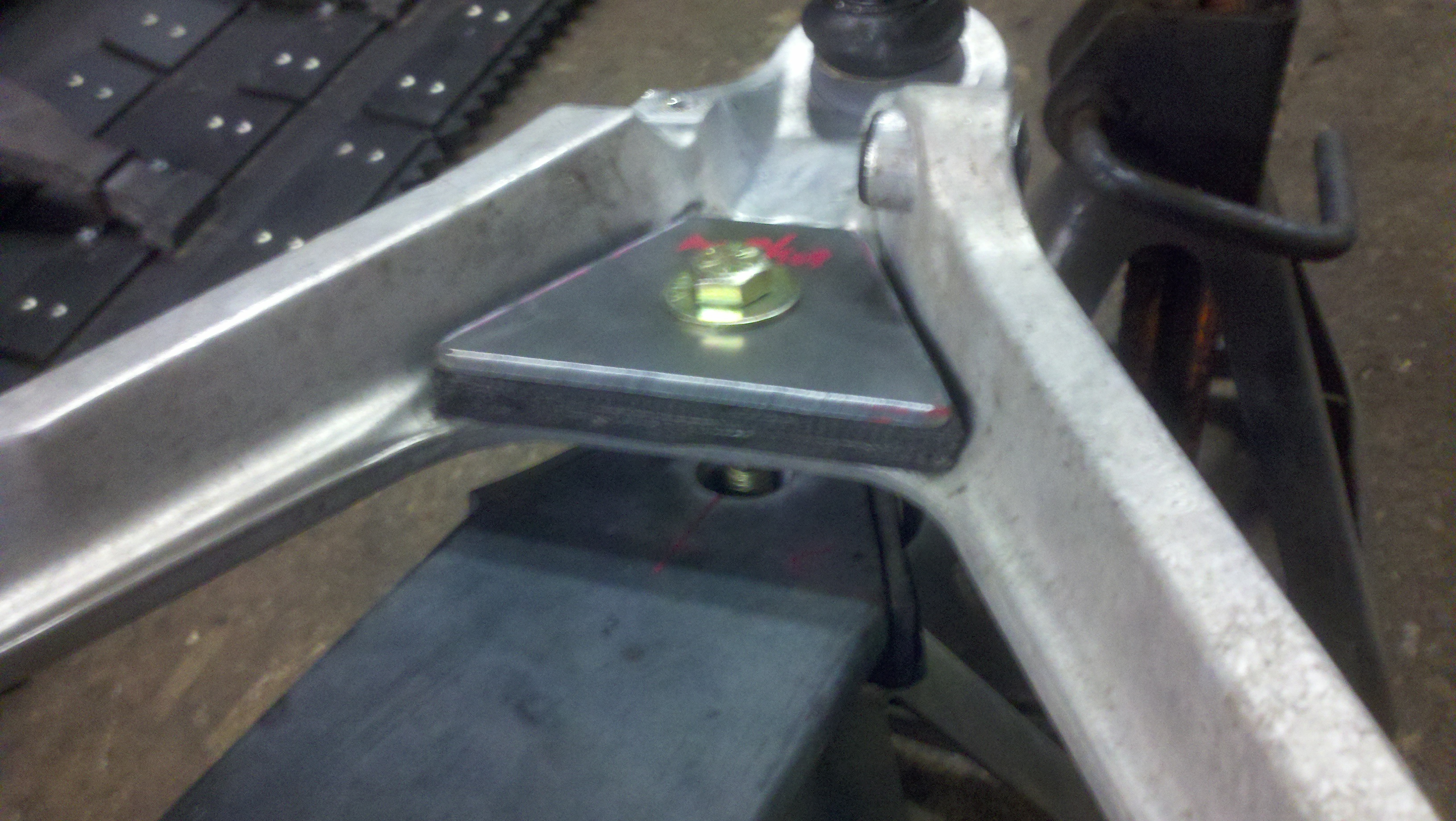
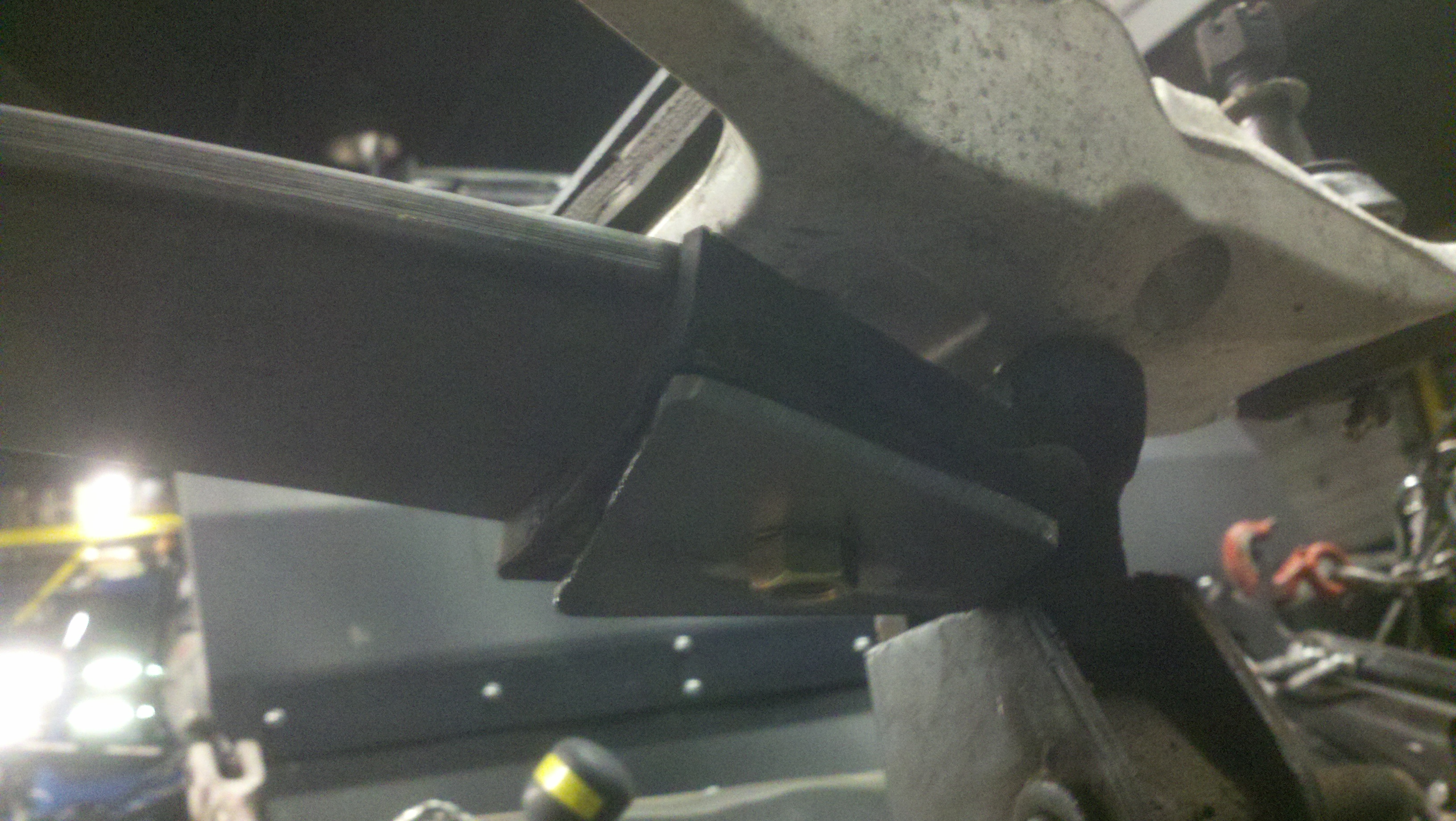
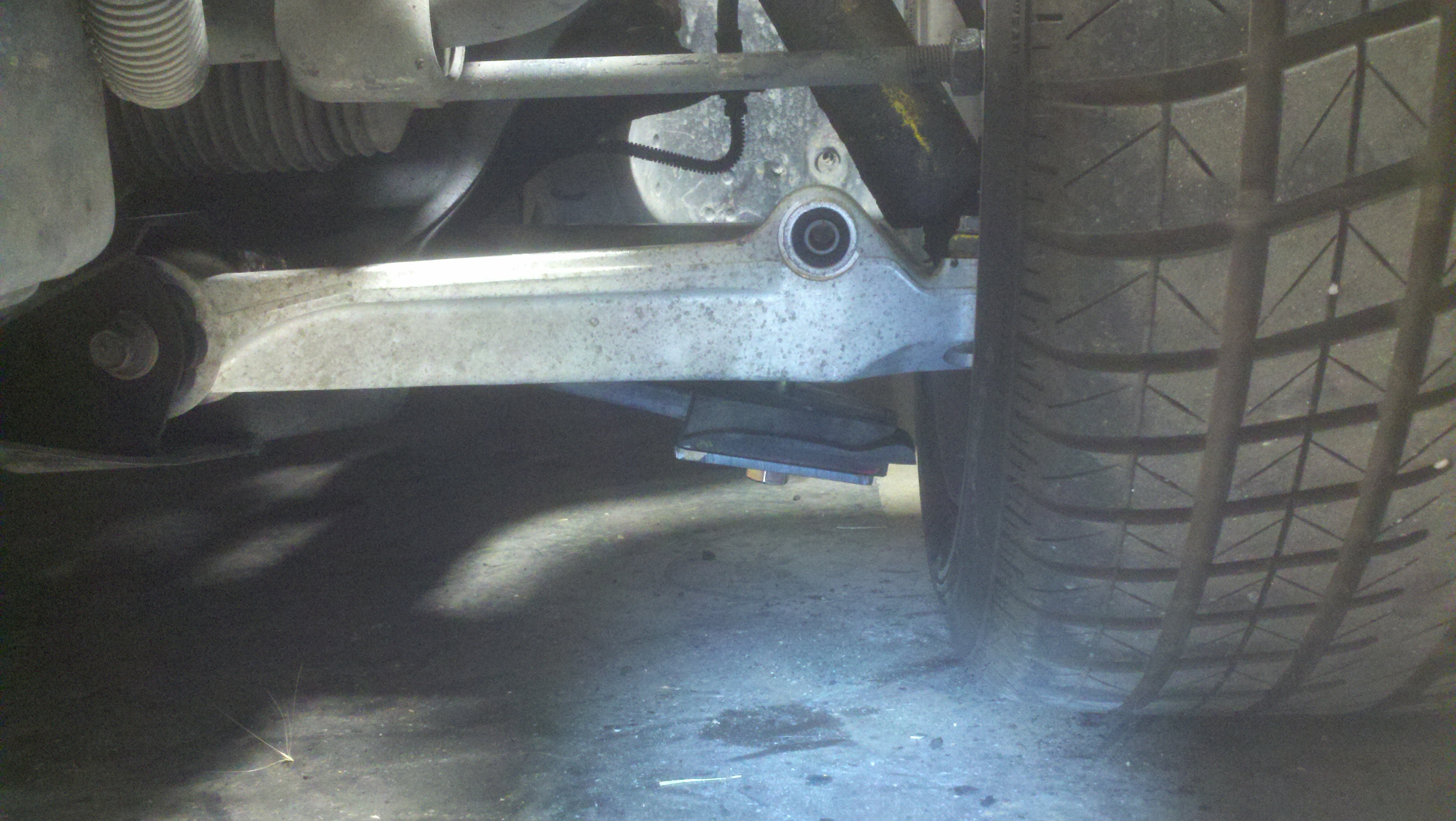
I FIXED THE RIDE HEIGHT, by installing much longer bolts in the rear and relocating the front spring under the control arm with bolts. The Kart's frame now rides exactly the same distance from the ground as my stock, '92. It could and probably should go lower, but I wanted to start by keeping everything as close to stock as possible.
Yes, there is some at full rebound both front and rear. Good question. Running out of spring before full rebound could make for some weirdness, I'd think.






 Handling/Shocks/Damping....