When you click on links to various merchants on this site and make a purchase, this can result in this site earning a commission. Affiliate programs and affiliations include, but are not limited to, the eBay Partner Network.
When I pulled the engine a few months back I foolishly kinked the steam pipe. It has enough prior ding and dents that make it too risky to reuse.
I’ve collected NPT fittings for DIY a steam pipe but this custom setup will do away with the banjo bolts. And use 1/4 NPT fittings in the head.
In the stock steam pipe the banjo bolt passages are a significant restriction. Great for pushing steam out and keeping coolant in the head and then down into the block.
Question here is, with the obvious and significant increase in flow potential through 1/4 NPT fittings over the stock banjo bolts, is too much coolant going to flow out of the head vs down into the block? And to what detriment?
Instincts say no, but asking the question is free. I run the high volume Meziere electric pump should that have any bearing on the answer. I don’t recall its gpm rating but I imagine less than a cam driven water pump at high rpm and more so than the cam driven pump at low rpm.
Thank you for the reply and the mention of Marc Hibecks LT5 site. I visited it, tons of info. Among which was information on the LT5 bleed restrictors and interesting he mentions the LT1 utilizes similar restrictors.
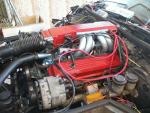
I didn’t want to steal his image, so I took my own on my car. Pictured is what I believe just might be one of restrictors on the LT1. This is the hose that connects into the steam pipe. The left red circle, I always thought to be nothing more than a crimp, but it looks same/similar to the restrictors images on Marc’s site for the LT5. The right circle is where the steam pipe hose feeds into a tee, one end goes to the surge tank and the other to the top of the radiator.
It makes sense that this would be a restrictor. Just hard to know for certain. If it were, then the NPT fittings regardless of what they can flow, don’t matter. The restriction point would be up stream from that point.
Final product. I went simple, a few brass fittings and a 3/8 heater hose. It looks a little more boiler room than automotive but it’s out of sight, functional, and inexpensive. There are all kinds of silicone heater hoses on Amazon that make big claims on flexibility and durability, but in the end I didn’t trust them and went with a standard Gates hose that I know will last a decade or more. I was a little worried about how far off the drivers side head the fitting stands and that it would hit the wiper motor. But, engine went back in the car last night and it cleared just fine. I did end up clocking the oil pressure senders a bit more clockwise to better clear the horizontal senders connector.
Thanks for the comments. I certainly took my time with it! Spun the rod bearing all the way back on Memorial Day and here in Nov still don’t have it together. Lots of that was waiting on a machine shop and also just no time on my part.
As far as restrictors, I do believe that fitting pictured above circled in red is a restrictor piece (one of the left). But I’m still considering the suggestion above, which is center drilling a 3/8 piece of round stock and inserting it inline.
Read this article this evening and honed in a bit on the “pin hole” sized vents. I don’t know if the story is true or not, but the pin hole size vents generally is - the banjo bolts.
I did order some 1/4” brass round stock and I was going to drill it 1/8” and put it after both heads in the fitting that goes to the rest of the system. BUT, wondering if I’ll be better served putting them in the fittings right at the heads. Wish I made that decision before putting the motor back in the car as this is all much much harder to do now.
Did my redo on this to size the holes the same as the stock banjo bolts. Without, the fittings are prob about 2x the size, maybe more. I assumed 1/4” brass rods would fit i to the ID of the 1/4” fittings. Not so. The ID turned out to be 9mm.
Instead, I chucked a 1/4” brass pipe plug into a drill press and squeezed 2 files around it to reduce it to a slightly loose press fit. Just under 9mm. I didn’t trust a press fit alone to never move, so these got soldered in. Then I fit a drill bit into a stock banjo bolts to find the right size used it to drill my new steam holes. Result, right size holes. I’ll never know if it was worth the trouble.
Thankfully, the engine was installed but nothing else, I unbolted 2 motor mounts studs and then lifted the engine about 6” for easy access.








 DIY steam pipe, too much flow?








