When you click on links to various merchants on this site and make a purchase, this can result in this site earning a commission. Affiliate programs and affiliations include, but are not limited to, the eBay Partner Network.
Good day gents! Has anyone logged or seen their stock LT1 VE (volumetric efficiency)? I logged mine, wot @5kRpm came out to 72.74Kpa... seems pretty low to me. Could the 1.6 rockers play a role on lowering the VE? Thanks!
The manifold pressure is not a measurement of the engine VE
Your intake manifold pressure is barometric influenced so depending on altitude not some exact number for all car examples
First youll need to verify the accuracy of the measurement. Do not trust sensors or computers. You need multiple measurements taken. Get another map sensor or pressure gauge and get second perhaps third opinions.
Next the target manifold pressure at WOT is about 90KPA for a 100KPA barometric pressure, for stock engines with factory PCV this is roughly ideal. Give up 10% to drive the PCV system at wot which will keep the oil inside the engine when the factory tube connecting the intake air filter tract to the crankcase is intact and not leaking.
The low reading if accurate points to a restriction upstream of the intake manifold such as dirty air filter.
Target air filter pressure drop is 1.5" to 2.5"Hg at wide open throttle
Filters are rated CFM @ pressure drop for example 500CFM @ 1.5"Hg is the filter you want for an engine that produces 500 to 600CFM by say roughly 1 to 2k rpm before redline
Logging, as in getting all the computer information from the engine while idle, cruising, and wot. I use ECMPro Scan, seems the only thing that will log a '96. And since it's a '96, I have to use JetDST for tuning.
Last edited by TheKodiak; Sep 15, 2024 at 08:04 PM.
The manifold pressure is not a measurement of the engine VE
Your intake manifold pressure is barometric influenced so depending on altitude not some exact number for all car examples
First youll need to verify the accuracy of the measurement. Do not trust sensors or computers. You need multiple measurements taken. Get another map sensor or pressure gauge and get second perhaps third opinions.
Next the target manifold pressure at WOT is about 90KPA for a 100KPA barometric pressure, for stock engines with factory PCV this is roughly ideal. Give up 10% to drive the PCV system at wot which will keep the oil inside the engine when the factory tube connecting the intake air filter tract to the crankcase is intact and not leaking.
The low reading if accurate points to a restriction upstream of the intake manifold such as dirty air filter.
Target air filter pressure drop is 1.5" to 2.5"Hg at wide open throttle
Filters are rated CFM @ pressure drop for example 500CFM @ 1.5"Hg is the filter you want for an engine that produces 500 to 600CFM by say roughly 1 to 2k rpm before redline
My MAP is at 97, I may be using the wrong units of measurement for. The baro was 99.6 that day. I understand the different variables that come into play, but a "stock" corvette should have an average VE. Calculated, mines cam out to 74.72.
VE table is not a VE table, it is a FUEL table. There are too many real world variables for a VE table to accurately pin point actual VE such as fuel going out during overlap or fuel being reversed by long intake valve duration at low rpm back into the plenum or fuel that boiled from an intake valve early or changes in engine efficiency due to temperature variation and heat exchanging, or injector on-time standard deviation and differences between cylinder sealing and compression... ALL of these and more influence perceived fuel usage and therefore impact the VE table without actually telling you the difference between losses due to brake specific fuel consumption and losses due to cylinder fill VE.
VE units are generally expressed as theoretical VE % of cylinder fill, which is usually represented as a 1.00 (100%) being completely full ambient pressure cylinders at a static perceived temperature, temperature information helps turn volume into mass of air and it is only a rough estimate fine tuned in performance apps using a wideband(s) and plug inspections and EGT measurements etc...
I would not be concerned with the literal VE% on any VE table as an indication of anything. The information or data of interest is in the trendlines of VE, not the VE itself. For example the rising cylinder fill with cylinder pressure and torque is an expected trend for combustion gasoline engines that tends to produce an arch shape
You are looking for a peak VE whatever the number is doesn't matter. It could be 50 or 150% or 300% the computer doesn't care because all a computer does is output signals to the injectors and coils and those signals are either right or wrong depending on the how it is tuned, not based on what the numbers are. For example if you put the value 20lb/hr for injectors when they are actually 50lb/hr the VE table will be completely wrong but you can still tune it perfectly using wideband feedback and plug reading and EGT etc... you can tune anything based on observed phenomena no matter what the computer thinks.
The correct way to evaluate engine output such as torque and power is based on measurable and if possible, replicable data recordings, such as power output, temperature rise rates, fuel economy/efficiency (brake specific fuel consumption), compression & crankcase pressure data, variables which tie the input of fuel rate to some energy exchange with some efficiency rate whereby heat and stress is being transferred to fluids and engine parts are acceptable rates with expected power reaching the tires
I guess what I'm trying to say is, I'm looking for a theoretical base line for VE, on those given conditions. I wonder if the rocker arms changed the VE, or is that simply the same "stock" base line VE? The VE I got was calculated using the variables from the data log. Here's a screen shot of part of that data log, at WOT.
Good day gents! Has anyone logged or seen their stock LT1 VE (volumetric efficiency)? I logged mine, wot @5kRpm came out to 72.74Kpa... seems pretty low to me. Could the 1.6 rockers play a role on lowering the VE? Thanks!
Get me at WOT your RPM, MAF in grams/second, temperature, humidity, and your BARO in inches of Mercury and I’ll plug them into my VE calculator….at sea level you should see 101 kPa on your scan tool Baro PID key on engine off.
You can't really tell if it gained a tiny percentage of VE just by fuel or airflow rate comparisons and I'll show why
First, If an engine picks up torque we often say this is akin to gaining VE, however adjustments to timing also change torque without changing VE because timing influences cylinder pressure integral which is what VE does.
Small changes to temperature in fuel or air or oil or engine parts change the energy extraction efficiency of the engine as well as cylinder pressure because temperature influences chemical reaction rate. For example it is possible for cold fuel to reduce engine torque as the delay due to low temp creates a reduced pressure integral of torque for an engine designed to operate at some ideal efficiency with warmer temperature cylinder mixture.
A large hurdle for calculation is air temp. Your calculated air temp is unrealistic and the VE calculations working backwards from mass flow of air or fuel are influenced strongly by an incorrect air temp reporting, giving inaccurate VE calculation.
For example in the picture you post the air temp says like 50*C or something. Hot air assumed to be what is inside the cylinder now.
In this example we changed the air temp to show its impact on VE. Lets say the actual air temp is 25*C but your calculation and IAT sensors are using 55*C instead. The VE will be back calculated from air mass and skewed by 10% - far more than any gain or loss associated with a rocker arm. The rocker arm mod is lost in the variables in terms of its impact. This is called on the order of error term in mathematical methods, we can show mathematically that the magnitude of the error term when calculating VE a number of ways makes the impact of small adjustments to VE (around a few percentage, on old equipment from the 90's for sure) negligible.
What I would be looking at instead is engine torque (dynojet) and timing headroom response (how much timing can be removed while maintaining torque and reasonable EGT) as these are more established means of determining the state and volatility of an engine output and the quality of its inputs
Funny you mention that, I actually got 101.325kPa. Also using a VE Calculator. Not sure if I add "%" to that Est_VE of 71.24% on my opening question.
Originally Posted by C5 Diag
Get me at WOT your RPM, MAF in grams/second, temperature, humidity, and your BARO in inches of Mercury and I’ll plug them into my VE calculator….at sea level you should see 101 kPa on your scan tool Baro PID key on engine off.
You're probably right, but at the moment I'm at level 1 on tuning... and I know I'm going to have to read your reply a few times to really let it sink in . The first parameter I'm learning is Fuel, should ignition timing be first?
Originally Posted by Kingtal0n
You can't really tell if it gained a tiny percentage of VE just by fuel or airflow rate comparisons and I'll show why
First, If an engine picks up torque we often say this is akin to gaining VE, however adjustments to timing also change torque without changing VE because timing influences cylinder pressure integral which is what VE does.
Small changes to temperature in fuel or air or oil or engine parts change the energy extraction efficiency of the engine as well as cylinder pressure because temperature influences chemical reaction rate. For example it is possible for cold fuel to reduce engine torque as the delay due to low temp creates a reduced pressure integral of torque for an engine designed to operate at some ideal efficiency with warmer temperature cylinder mixture.
A large hurdle for calculation is air temp. Your calculated air temp is unrealistic and the VE calculations working backwards from mass flow of air or fuel are influenced strongly by an incorrect air temp reporting, giving inaccurate VE calculation.
For example in the picture you post the air temp says like 50*C or something. Hot air assumed to be what is inside the cylinder now.
In this example we changed the air temp to show its impact on VE. Lets say the actual air temp is 25*C but your calculation and IAT sensors are using 55*C instead. The VE will be back calculated from air mass and skewed by 10% - far more than any gain or loss associated with a rocker arm. The rocker arm mod is lost in the variables in terms of its impact. This is called on the order of error term in mathematical methods, we can show mathematically that the magnitude of the error term when calculating VE a number of ways makes the impact of small adjustments to VE (around a few percentage, on old equipment from the 90's for sure) negligible.
What I would be looking at instead is engine torque (dynojet) and timing headroom response (how much timing can be removed while maintaining torque and reasonable EGT) as these are more established means of determining the state and volatility of an engine output and the quality of its inputs
The way I started learning is by adjusting carb and points distributors on a wide variety of engines, and years of running & racing reading plugs until the invention of EFI became feasible.
With EFI there is superior control but we lost the connection between man and machine, instead of physically routinely inspecting hardware and tuning based on what you hold in your hand from an engine, you are tuning based on some computer's arbitrary number system and many people will neglect physical inspection and verification steps such as timing sync and cylinder distribution, and engine cleanliness which comes along with physical inspections as a practice akin to surgery.
Tuning starts with cleanliness, quality sealing and distribution, clean air, clean fuel, clean cylinders, clean plugs. Good cylinder seals. Pressure tested crankcase and intake systems. Proper OEM PCV system is essential and needs to be measured by driving the vehicle with crankcase pressure monitoring. Clean quality uniform engine oil. Prep work for racing such as accumulators and oil sump mods and fuel system prep. The type of lines and filters and heat exchangers, I follow specific rules for safety, only machine crimp PTFE oil lines for example. The filtering of air fuel oil is primary concern and the integrity of oil system and crankcase is part of that, leaking is contamination and PCV keeps the oil inside the engine and prevents leaking.
Once the quality of the drivetrain has been maintained properly, tuning becomes easy by taking care of the engine's mechanical needs and cleanliness the engine will run smooth and consistently which is necessary to tune one easily quickly properly. If you start with a dirty engine the problems will develop while you tune or have just finished tuning causing a never ending cycle of re-tuning and diagnostics as if something is wrong with the tune when its actually a clogged injector or a filthy cylinder or poor distribution somewhere etc...
With enough experience you can write timing table without touching the engine. I generally arrive to customers with a timing table already setup based on what I expect from the combination and application. Timing table finesse slight changing while driving but mostly empirical testing on the dyno to find the minimum timing points with reasonable EGT to establish headroom for some fuel quality. Timing rough adjustments AND fine adjustments are with fuel quality, temperature, application, time under load, etc... many variables to consider but the fuel only has so much headroom to work with, i.e. there are situations with too much boost, temp, compression, that the timing becomes so low or impossibly low the engine will not run properly or producing too much heat products with the given fuel, usually this happens on gasoline because gasoline is extremely temp sensitive and pressure sensitive and tends to expand gas rapidly 'detonation' is rapidly expanding gas that happens to fast it rings the engine parts with specific frequencys that bandpass knocksensor are tuned specifically for the onset of that noise. Knock sensors are extremely unreliable and should never be used for tuning an engine because they can fail a wide number of ways to detect some frequency and furthermore there are fuels such as alcohol which can 'detonate' slowly enough to keep from ringing parts and setting off knock sensors while still damaging the engine, gasoline will do that also at very low temperature. Not to mention if parts change or age inside the engine knock sensors also get old and the frequency of knock onset can drift right out of the range of the sensors.
Fuel in Seq-MPFI has two components, injector on-time and injector phase (also known as end or start of injection angle). I don't remember if your computer is true sequential, sometime in the 90's I think it went batch fire first, which means injection phase or end angle cannot be adjusted the same or at all, it something to keep in mind how the injection strategies are different.
Injection On-time (pulse in milliseconds) generally leads to an air fuel ratio but air leaking, cylinder burn-ability efficiency and air input energy (momentum, velocity, temperature and sound) play a role in what the oxygen sensor reports. highly modified engines may report strange unrealistic air fuel values at low speeds where poor input velocity and cold temps yield poor distribution and poor cylinder burn-efficiency, they produce more carbon products (faster dilute the oil) rough running and poor drivability, these require more mechanical tuning (physical inspections and empirical tuning) rather than what you see on the computer screen. You 'give it what it wants' not what the computer says it wants. I mention this because it is important to keep in mind the computer is a lying sack of $#!T when you least expect it and always consult or consider that it might be wrong as you move forwards, computer cannot tell a good engine from a bad engine it just takes signals and runs some code then tries to output signals based on that code and memory input various calcs. All computers work the same way and you can tune computers you've never seen before just by knowing how it gets from signals in to signals out. You can even modify those signals to make things run that shouldn't run, for example if I take a maf sensor and double its flow then double the injectors and use a device in between them to smooth the differences in the signal - that is called air flow converter and you can buy a commercial product to do exactly that (SAFC) which allows you to tune an engine without actually changing what is inside the ECU or tuning the ECU because all you really need to tune an engine is to tune it's signals, which are simply voltage or frequency traveling down a wire that anybody can intercept and change. Therefore knowledge of electrical is important perhaps essential to understanding modern microcontrollers used in vehicles. I recommend start with arduino and RC circuits it will give your foundation for how a computer works and get an oscilloscope to watch adjust those signals.
Here are general combustion starting air fuel ratio for gasoline that works with almost all engines you can start by target
cruise/idle 15.2 to 15.8:1 air fuel ratio
Part throttle transitions (up a slight hill) at between say 55 to 65KPA 14.2 to 14.4:1 air fuel
get richer as manifold pressure goes up now,
70KPA 13.5 to 13.9:1
80KPA 12.9 to 13.3:1
90KPA 12.3 to 12.8:1
100KPA 11.9 to 12.5:1
110KPA 11.7 to 12.2:1
150KPA 11.4 to 11.7:1
200KPA 10.8 to 11.4:1
Here is one of my starting V8 target tables
It may be difficult to tune a very old computer like this, if there is no real time tuning. You might be forced to use the narrowband feedback. there is a way to turn a wideband signal into a narrowband signal but I do not think it practical for this app. Just keep in mind for all combustion engines using gasoline especially, that running it lean at cruise and idle will help keep cylinder clean, reduce carbon deposits, preserve oil quality (especially for loose engines and forged engines with loose cold pistons). May also improve economy slightly but that is not why we do it.
Usually when you get the air fuel values close enough you play with timing and injection END-Angle, the timing removed or added on a dyno gives an idea of fuel quality headroom, the injection end-angle you can adjust while watching a wideband initially (for end angle cruise and idle) but for wide open you need the dyno to tell you when to go from spraying post exhaust valve to pre-intake valve open (depending on the size of injector) e.g. larger injectors requires less time to inject more fuel, so they can be used post EVC(exhaustvalveclosed) for more mid-range power than a small injector usually, depends on the fuel and app. But end-angle only applies to seq-mpfi.
Summary
0. Clean the engine completely, wash the intake system, pressure test the intake system, new spark plugs untouched by human skin, clean air filters, clean injectors (get them cleaned), etc... Start with a clean engine or this whole process is possibly a waste
1. use a general timing map written from experience, if the engine is mostly factory then you can start near factory timing usually if are not sure.
2. If it has injection end-angle set it to end at least ~40* before the intake valves open
3. Tune the air fuel ratios similar to what I listed
4. Adjust end-angle for idle and cruise to try and make the engine go richer (so you can lean it out on the VE or fuel tables). You didn't actually change the VE even though the VE table changed - you just changed the fuel conversion to energy ratio (brake specific fuel consumption) so less fuel is wasted which looks like reduced VE on the VE table but its actually just conserving fuel. https://forums.holley.com/forum/holl...215#post392215 https://forums.holley.com/forum/holl...243#post390243
5. Adjust timing for idle and cruise. Idle is done strictly for the application, e.g. whatever it takes to make it suitable drivability and clean combustion. Cruise is done towards economy, you can setup an experience for economy and generate a series data points like this https://forums.holley.com/forum/holl...301#post390301
With that kind of graph I would choose about 34 to 36* Of timing and leave the rest (about 1/2 a mpg) on the table for future conditions which raise combustion rate vs piston speed for example extra vehicle weight, high temperatures, bad gas, etc... all will push that curve in a 'bad' direction so that if you are standing on the edge (40*~) it will go right over the edge and could damage the engine.
We use this same philosophy when tuning wide open throttle, that is, find the minimum timing suitable to leave headroom for the changing conditions of the future (dyno does not equal road or racing environments)
6. Re-tune the air fuel ratios as needed and repeat (steps 0 through 5) as needed for idle and cruise.
Now that the engine is tuned, economically, cleanly, idles quality and cruise comfortably, everything looks good. Next,
7. Install fresh set of spark plugs, again clean never touched human hands. Use disposable gloves. Do not gap them if possible. Keep as large gap as possible, large wide surface area sparks are best if possible. Look at the old plugs for heat range, look for 3 to 4 golden threads discoloring from the tip. The plugs should be pretty clean that came out, but tuning marks them up which is why we need new ones for 8
8. The new plugs and engine is already tuned, now drive the vehicle 300 to 500miles and re-inspect the plugs. If they are truly clean and all look the same,
9. Dynojet vehicle. For vehicles around 3000lbs dynojet will be pretty close to accurate roller weight load. Use only dynojet for the standard measurement to be valid e.g. any cars dynojet numbers can be compared, which includes your old runs from the other times you've been there, makes it very easy to assess your performance and improvements.
During dynojet, you play with timing and air fuel ratio. Remove timing until the torque drops out, EGT begins to spike, you don't need to actually measure the EGT just be aware it will rise and watch out for that as torque falls out. You want to use the least timing possible to keep the torque within say 3 to 6% of max, and to make this measurement valid you MUST set the dynojet smoothing to zero (smoothing = 0) because you need to look for tiny spikes or wavy behavior in the curve which indicates some issues either in the drivetrain (energy transfer in say, elastic parts that causes a waveform of energy release and absorption that causes a wavy graph) or with the combustion process (too much timing or temperature creates spikes of cylinder pressure which may show up as spikes in the dynojet curve). Thus the torque you are looking for is the curve itself, not the tiny sharp peaks. Don't concern with max torque or max power. Look at the SHAPE of the curve, focus on getting a SMOOTH curve with the LEAST timing.
Smoothing = 0 example of a good curve
Remove timing until the torque drops off noticeably. It may smooth out first. Then, add some timing back to restore that torque, just barely, which maintaining a smooth curve. This leaves headroom depending on the fuel for future load/temp. It is possible to push a fuel so hard that the margin between 'minimum' and 'max' timing is basically the same spot, you only get one exact timing value that works, but that is usually seen in gasoline applications with tiny displacment engines using 20+psi of boost and modern chambers.
The combustion chamber matters. Pre-LS chambers which use 32 to 35*btdc of timing at wide open throttle naturally aspirated have different rules than the modern chambers of LS which require 22 to 23*btdc of timing at natural aspirated wot. The air fuel values are similar though mostly carry over. The 'rules' involve how much timing needs to be added or removed based on temp and pressure, and load rate (rate of piston speed vs evolving combustion pressure).
If you have the 'old' chambers SBC style chambers I wrote a timing map here for a heavy vehicle that would work as a starting point https://forums.holley.com/forum/holl...625#post397625
The dynojet session hones those timing and air fuel values to the safest setting possible for daily drivers. The minimum timing for sure. Fuel on the other hand sort of in the middle, not the richest, not the leanest, you want to move the air fuel around a bit to see that nothing really changes which indicates that it is a valley of safety. For example when I go from 11.8 to 12.5:1 on E85 fuel and see that it picks up only 2 or 3whp, I know the 11.8 is safe and suitable. On gasoline I'd try richer values to make sure not much happens as well. You are looking for a suitably rich value which can cool the engine for its racing duration (Not the dyno session, the actual application) which may be richer than some best-power setting you found on a dynojet, which is why dyno tuning isn't about finding max power at all; instead you are establishing safe valleys for your timing and fuel increments to function viably in a wide range of conditions.
Wow! That's a huge bite... . The car seems to be in tip top shape. I've been busy making the whole car new... ignition system, major sensors, intake, cooling w/ 4 row radiator, most of the fuel system, belt, tranny, and soon to be A/C system. And as far as mods, catback open exhaust, egr delete, 52mm throttle body, and 1.6 rockers... all the mods were done by the previous owner. But I'll keep adding as I pick up more of what you were laying down. Thanks








 Stock volumetric efficiency













 . The first parameter I'm learning is Fuel, should ignition timing be first?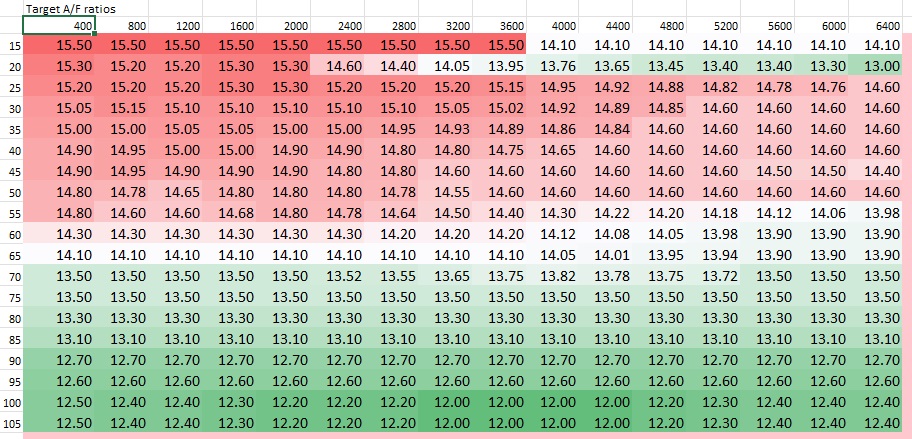


 . The car seems to be in tip top shape. I've been busy making the whole car new... ignition system, major sensors, intake, cooling w/ 4 row radiator, most of the fuel system, belt, tranny, and soon to be A/C system. And as far as mods, catback open exhaust, egr delete, 52mm throttle body, and 1.6 rockers... all the mods were done by the previous owner. But I'll keep adding as I pick up more of what you were laying down. Thanks