


Engine Stalling when not under load 33, 44


Thread Starter
3rd Gear

Joined: Nov 2024
Posts: 3
Likes: 0
From: Virginia Beach
 Engine Stalling when not under load 33, 44
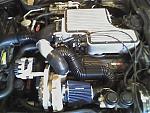
My '87 with a K&N filter on it and an opened up air filter box lid, has started dying when I push in the clutch, with the exception of when I don't push it in until I have almost come to a stop. This does not happen when the car has first started. I checked the codes that came up when this was happening and got 33 and 44. My understanding is that these are a low MAF voltage and a high exhaust O2 voltage. Assuming low voltage is indicative of a lower value, it seems like the car thinks it's getting less air than it is and subsequently starves it of fuel resulting in stalling and high exhaust O2.
Is this an appropriate diag or am I in left field?
Is this an appropriate diag or am I in left field?


Melting Slicks

Joined: Aug 2003
Posts: 3,414
Likes: 404
From: Lakeville MI
First of all Code 33 is MAF high (unlimited airflow > 45 gm/sec with tps < 14.8% (~1.10 volts) and rpm < 2200, or unlimited airflow > 45 gm/sec when engine is first started) and Code 44 is O2 lean (< 0.19 volts for 50 seconds).
These are somewhat contrary indications and are not necessarily related to the stalling issue. I would suggest that you clear the codes and try to address them one at a time. Pay attention to the conditions when the next code (SES lamp) is set and which one is set first.
Now if the actual (unlimited) MAF flow is much greater than the limited airflow and the default airflow, this could cause a lean condition (see log below) resulting in a cascade effect. Without scan data, this will be difficult to diagnose.
Here's an example of a modified car setting a Code 33 due to legitimately high airflow and then going lean: https://datazap.me/u/tequilaboy/code...mark=2094-2103
Note the behavior of the maf unlimited airflow and mass air flow signals. The code is set when the unlimited airflow signal latches high and the mass air flow signal drops as it is being replaced by the default airflow calculation.
Stalling during coast down with the clutch disengaged could be a min air adjustment or IAC valve issue, or even a misfire. Not much to keep it running other than the flywheel inertia. What is the vehicle speed when it stalls? Does it idle normally (700 rpm) when warm?
These are somewhat contrary indications and are not necessarily related to the stalling issue. I would suggest that you clear the codes and try to address them one at a time. Pay attention to the conditions when the next code (SES lamp) is set and which one is set first.
Now if the actual (unlimited) MAF flow is much greater than the limited airflow and the default airflow, this could cause a lean condition (see log below) resulting in a cascade effect. Without scan data, this will be difficult to diagnose.
Here's an example of a modified car setting a Code 33 due to legitimately high airflow and then going lean: https://datazap.me/u/tequilaboy/code...mark=2094-2103
Note the behavior of the maf unlimited airflow and mass air flow signals. The code is set when the unlimited airflow signal latches high and the mass air flow signal drops as it is being replaced by the default airflow calculation.
Stalling during coast down with the clutch disengaged could be a min air adjustment or IAC valve issue, or even a misfire. Not much to keep it running other than the flywheel inertia. What is the vehicle speed when it stalls? Does it idle normally (700 rpm) when warm?
Last edited by tequilaboy; Mar 24, 2025 at 11:21 AM.

Melting Slicks


Joined: Nov 2016
Posts: 2,256
Likes: 3,084
From: So Cal
2023 C4 of the Year Finalist - Unmodified
My 85 did the exact same thing as the OP's 87 when I began to drive it again after 10 years of hibernation. I'd push in the clutch to shift and it would die. I'd let the clutch out after the shift and it would fire up and run again. I don't recall any codes. I replaced the at the time original 20 year old fuel pump. The replacement pump is still in it, I should probably change it again just because.
I had another, more recent, occurrence in my daily driver S10 of occasionally it just wouldn't "go". It ran smoothly, but with my foot on the floor it wouldn't out-accelerate a bicycle. On my Tech-1, when it would "do it", I noticed O2 voltage would go to 0-Volts (way-lean), and the BLM would jump up in huge steps to as high as 170-ish. (Again, super lean.). No codes because the conditions wouldn't last long enough to set the DTCs. I replaced the 15 year old fuel pump, and the issue was resolved.
Fuel pumps are inexpensive enough and easy to change in a C4. If you don't know how old the one in it now is, a new pump is a good place to begin.
I had another, more recent, occurrence in my daily driver S10 of occasionally it just wouldn't "go". It ran smoothly, but with my foot on the floor it wouldn't out-accelerate a bicycle. On my Tech-1, when it would "do it", I noticed O2 voltage would go to 0-Volts (way-lean), and the BLM would jump up in huge steps to as high as 170-ish. (Again, super lean.). No codes because the conditions wouldn't last long enough to set the DTCs. I replaced the 15 year old fuel pump, and the issue was resolved.
Fuel pumps are inexpensive enough and easy to change in a C4. If you don't know how old the one in it now is, a new pump is a good place to begin.
Last edited by IHBD; Mar 24, 2025 at 11:29 AM.
Melting Slicks
Joined: Aug 2003
Posts: 3,414
Likes: 404
From: Lakeville MI
Come to think of it, somebody else had a Code 44 issue recently: https://www.corvetteforum.com/forums...e-in-gear.html
Thread Starter
3rd Gear
Joined: Nov 2024
Posts: 3
Likes: 0
From: Virginia Beach
Come to think of it, somebody else had a Code 44 issue recently: https://www.corvetteforum.com/forums...e-in-gear.html
Additionally I'd like to know what scanner you're using to get that CSV data @tequilaboy
Thread Starter
3rd Gear
Joined: Nov 2024
Posts: 3
Likes: 0
From: Virginia Beach
Final answer was water in the bottom of the fuel tank moving forward during deceleration getting picked up and causing the stalling. Root cause was a rusty filler neck and is now good to go.





