When you click on links to various merchants on this site and make a purchase, this can result in this site earning a commission. Affiliate programs and affiliations include, but are not limited to, the eBay Partner Network.
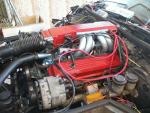
I recently installed a keyless ignition kit (made in China) on my 1986 C4.
The colors of the wires in this section correspond precisely to this kit, for clarity.
The scheme being particular to our C4, it needs to be thought about (or researched). We need to prepare our own diagram, nothing is indicated for our C4 in the provided instructions. But I give you mine, it should come out anyone who would want to tackle it, because for those who have no knowledge in electricity, it’s not a small matter !
Indeed, the box cannot be simply installed in series, nor in parallel, under penalty of directly short-circuiting !
Material to have:
- 3 relays 4 pins, 10A minimum, NO "normally open" (for the turn signals)
- 2 5-pin relays, 10A minimum (for door actuators)
- 1 universal centralization kit
- plastic collars
- flat lugs
- heat-shrink sleeves (several diameters) - soldering iron + tin
- sheath to protect the wires
The relays do not seem theoretically mandatory according to the instructions, but I strongly recommend it because I do not know the consumption of the actuators, and all the turn signals consume a little more than the maximum 10A tolerated by the housing. Indeed, the small case and its small electronics, and its ridiculous wires will not resist for long to the intensities that will pass through it ! Let’s relieve it !
On the instructions, it is noted the function of the wires of the case.
The red part will be wired according to the diagram most suitable for your car, among the 4 proposed. This remains a 'general' diagram.
Just look at the original circuit. It is a well-thought-out system of inverters. The actuators each have their two terminals to ground. With each pulse from one of the two switches, one terminal receives +12 V instead of ground to lock, or the other to unlock.
Original circuit : The actuators not shown (sorry) are connected in parallel on the beige and gray wire under the switch on the driver’s side.
We see the actuators in this diagram, only in black and white here.
Symbolized modification (found on this forum, I forgot the name of the owner, I am really sorry). It will be necessary to cut the blue wire and the black wire to insert two 5-pin relays.
Final general diagram to be done : Note that the brown wire (terminal 30) of each of the two left relays must be connected on the driver (and not passenger) switch side, once your blue and black wires are cut, otherwise it will not work.
Then, prepare all the wiring, the lugs, the sheet metal, the heat-shrink tubing...
I also fixed the whole thing on a support, and glued it all under a crosspiece of the dashboard.
Here is the new circuit to graft.
I decided to cut the black and blue wires, directly into the door, for simplicity.
I inserted the relay wires, gray and brown, into the door
I placed connectors under the dashboard, in case of future disassembly. All wrapped in a wide thermo sheath.
The 3 wires of the left and right turn signals, and STOP lights are here, near the steering column: yellow, sky blue, and dark blue. Given the access, I preferred to connect them with quick couplings.
I transferred the power supply of the new circuit to the 20 A fuse, STOP/HAZ lights (orange wire, after the fuse, and not before !). The wires are a bit short, I had to put a domino. Everything wrapped in a thermo sheath that encloses everything.
Location of the main circuit (sorry for the reflections) :
I forgot one thing !
I added a relay so that the alarm deactivates without having to use the key manually.
Otherwise, the remote control is no longer used for much !
I attach two diagrams of your choice, for the addition of this function.
Either:
Assembly 1: One of the 3 blue wires (which correspond to the power supply for the bulbs) must be connected to drive a relay. The relay contact will be connected in parallel with the key lock switch wiring. The wires are green and black.
Either:
Mounting 2: Couple a relay in parallel with the other 3 already mounted, and connect the contact of the relay in parallel with the wiring of the key locking contactor. The wires are green and black.
In this way, when unlocking the doors, the new relay simulates the action of the key in the door and cuts off the alarm: no more need for a key.
NB: I specify that this case allows this operation. The concern was whether the pulse on the lock contactor power line was longer or shorter than that on the actuators. A bit like if you had locked and turned the key immediately: it would have canceled the activation of the alarm, I believe.
Same for the unlock: the question of whether the action on the lock switch could be synchronized with the actuators. Finally, the anti-theft case seems to take this parameter into account.
To be continued, about ten trials without problem. Everything works!
That's one way to do it. I used a similar aftermarket system on my '90. I put the unit in the driver's door as both doors and the hatch circuit are in there as well as power. I used no external relays just the ones on built into the controller and cut no factory wiring. It's worked for 5 years now (lock/unlock/pop hatch).
Really ? I know 2 others owners who installed this similar wiring. They had to cut.
I would be curious to know how not to cut original wiring, otherwise it could cause a short circuit.
I tapped the wires with 3M taps. There is no need to cut anything. Power, ground, door lock, door unlock, and hatch release. That's all you need unless you want to flash the lights or something.
The 2 wire plugs of each actutators are connected to the ground, at rest.
Normally, you are forced to divert the original wiring, to disconnect a ground from the 2 actuator plugs, while sending 12V on this deactivated groung, by the keyless module.
Ideally, I would have liked to see your scheme because I am surprised.
In a 84 or 85 this is true (you don't need to cut anything) because these years have a lock relay, and the RKE can interface to the relay inputs. In the 86-92, you do have to sever the black and blue wires as outlined by the OP. The black and blue wires rest at ground at the Driver side switch. If you inject 12V onto either wire, there is a short to ground at the driver switch.
In a 90 you have to sever the black and blue. Or it won't work. And who advocates using ScotchLocks?
~~~~~~~~~~~~~~~~~~~~~~~~~~
I have no real criticism of the OP's installation because it works. But there is a bit of complexity. He did not need the external relays for the locks because there are relays onboard the module for the locks. (He mentioned this.) The OP is in Europe where the park lights are divided into left and right. The module has (2) light flash outputs, I would have just connected these to left and right tail lights, not the "blinkers" and brake lights. Additional relays don't 'hurt' anything, but add unnecessary complexity to the install, and additional failure points in service.
Because it works, he did well. And he took the time to document and present his install for others to refer to. Cool.
I didn’t find any information about the consumption of the actuators (maybe around 5A each?). Without a relay, it would surely have worked, but I preferred to relieve the dog that seems weak and his threads a bit ridiculous.
For the bulb relays, the total consumption is about 11A. The case allows 10A. You can take the risk, I prefer not.
My C4 is a US, non-European version.
I connected the 2 independent circuits of the front turn signals, and the circuit of the rear turn signals (same as the STOP circuit). Note that connecting 1 single yellow wire is sufficient at the back, as they are connected in parallel when no turn signal is activated.
RKE installs traditionally utilize the park/tail lights for Light Flash. The light flash may not be easialy seen in bright daylight.
Tof used the bright filaments in the turn signal and brake lights for Light Flash. This requires (3) relays to keep the circuits segregated. (Or one could use 5A diodes on the output of a single relay.)
I used tail lights in my 90's install, but because the Fog Light switch is almost always left on, the fogs flash with Light Flash.This was Ok most of the time.
When I did my 1992 install for Light Flash I used 2 relays. One for tail lights, and another for the Back-up Lights. So I have a white-light flash front and rear. (The back-up lights are a lt green wire in the 15-cavity connector in the RH side underdash to the rear of the car.)
Power, ground, door lock, door unlock, and hatch release. That's all you need unless you want to flash the lights or something.
These connections may be "all you need" for locks, but where's the satisfaction with completing the install without incorporating some "cool factor", especially if the module has it available?
I don't believe I've seen "2nd Unlock" in the "Central Locking" modules used in Europe that Tof used.
DEI RKE and alarm modules we have access to, do. (2nd Unlock is Driver door 1st push, Passenger door 2nd push.) Adds another relay, and now involves the tan wire to the passenger lock motor. I always incorporate 2nd Unlock if the module has it.
DEI have a Ground When Armed output. I use this to energize a relay that interrupts the IGN input to the ECM. If the car was locked with the RKE, and not unlocked with the RKE, the car will crank, but will not run. My VATS is still functional, this just adds another level of security that no thief is going to be familiar with. It is also needed for the Automated Window Module I have in the 92.
DEI have a Factory Alarm Disarm wire. I connect this to the lt green disarm wire to the outside door-key locks. If the RKE is locked with a door open, then closed, the factory alarm is set. When the RKE is used to unlock the car, the factory alarm is disarmed. (In a 90-up, the interior lights are also turned on as a function of the dis-arm wire.) You also need this connection to disarm the factory alarm when you pop the hatch with the RKE, or the alarm goes off if it was set.
DEI have a horn-honk wire. I connect this to the black wire at the base of the steering column. It can be set to honk or not-honk with RKE. I set it to no-honk. But on a DEI, if you push trunk-pop first, then lock or unlock, the opposite of the setting occurs. I use this feature when I can't see the light flash, or I want to annoy the ***-hat parked next to me when his horn went off.
DEI have an Aux Output. (Push Lock and Unlock at the same time). In my 92 I utilized this output for the Automated Window Module.
Yes, a basic install will lock and unlock the doors and pop the hatch, but where's the cool factor in that? I do these next-level installs with additional features for the challenge of figuring them out, and making them work. I derive satisfaction from the accomplishment every time I push the button, and it works the way I intended it to.
I like electricity, I also find that making the system functional in all its capacities is a pleasure, in the end !
Even though I could have also added the hatchback (but for now, I have a small circuit failure that occurs at the switch in the center console).
Thanks again for your your additional information !
I forgot one thing !
I added a relay so that the alarm deactivates without having to use the key manually.
The concern was whether the pulse on the lock contactor power line was longer or shorter than that on the actuators. A bit like if you had locked and turned the key immediately: it would have canceled the activation of the alarm, I believe.
Doesn't the light-flash occur with Lock? If = yes, the light flash may disarm the alarm.
I suggest that for the alarm dis-arm relay control, connect it to the tan wire to either lock motor actuator. (Not the light-flash.).
You really don't need any connection at all because Unlock on the tan lock motor wire is a Disarm input to the alarm.( As long as the alarm is not triggered.) I'd keep the relay because it is there and wired, and therefor if the alarm is accidentally triggered, you can dis-arm it with the RKE unlock.
But I would change the relay input from the light flash to the lock actuators 'unlock' tan wire.
I like electricity, I also find that making the system functional in all its capacities is a pleasure, in the end.
So do I.
If you want a real challenge, obtain and install a Directed Electronics 535T Automated Window Module. It took me several hours with it on my bench to figure out how it works, interfaces, and programs. Then another full day to run the wires into both doors to the switches. And I made a stupid mistake that burned up my first module and had to order-in another. But it's pretty cool. You could use your trunk-pop output for the window module. You'd have to figure out a way to simulate a Ground When Armed to trigger the window module. (I have an idea how to do it, ask if you ever want to try this.)
But I would change the relay input from the light flash to the lock actuators 'unlock' tan wire.
Thank you !
It’s something I had thought about, then started wiring like your suggestion, then something made me change in the course of wiring. I don’t know if it was worth it, even though everything works perfectly today with my diagram. I could also try your wiring that you suggested, to test (if I have time :p )
But there was a particular reason why I changed (or 2?):
- When closing, the flashing of the lamps is unique and short, and seems shorter than the action on the actuator. I deduced that the key simulation (created by the flashing) would therefore end before the end of the actuator command.
- When opening, the blinking seems longer than the actuator control time. This could simulate a key action after the unlock, to really validate the deactivation of the alarm.
Activation and deactivation proceed perfectly as it is
With your suggestion, the key simulation would be synchronized with the unlocking. I don’t know if the anti-theft system would understand? Possibly yes.
If you want a real challenge, obtain and install a Directed Electronics 535T Automated Window Module. It took me several hours with it on my bench to figure out how it works, interfaces, and programs. Then another full day to run the wires into both doors to the switches. And I made a stupid mistake that burned up my first module and had to order-in another. But it's pretty cool. You could use your trunk-pop output for the window module. You'd have to figure out a way to simulate a Ground When Armed to trigger the window module. (I have an idea how to do it, ask if you ever want to try this.)
You need to have time, and I will try to limit the modifications of the original circuit a bit :p
- When closing, the flashing [ ] is unique and short,and seems shorter than the action on the actuator. I deduced that the key simulation (created by the flashing) would therefore end before the end of the actuator command.
- When opening, the blinking seems longer than the actuator control time. This could simulate a key action after the unlock, to really validate the deactivation of the alarm.
There may be something else here to understand.
In the States, generally, LOCK is one flash and/or one chirp on the horn. UNLOCK is 2 flash and/or 2 chirps on the horn. Both aftermarket and OEM systems are usually this way.
Your European "Central Locking" module seems to be opposite. 2 flash for LOCK, 1 flash for UNlock. My Cayenne is this way. My 1997 993's DriveBlock / Central Locking system doesn't have any light flash at all, and the horn only beeps if a door is ajar when the alarm is set.
So European and North American may have opposite chirp patterns. Just a curiosity, not really anything pertinent to making these systems functional.
~~~~~~~~~~~~~~~~~~~~~~~~~~~~~~~~~
In another thread you asked about window operation with a door open. USA cars generally don't. I know Corvettes don't. USA cars, and C4 1991 and later have what we call "Delayed Accessory" which is a system that keeps the entertainment and windows energized for a period of time (about 15 minutes) after key-off or until a door is opened. (I've had my Cayenne for 13 years and never noticed if the windows work with the door open. It isn't here right now, but I'm gonna' try it next time I'm in it and remember.)











 Keyless system on C4 1986 (tutorial / wiring)








