When you click on links to various merchants on this site and make a purchase, this can result in this site earning a commission. Affiliate programs and affiliations include, but are not limited to, the eBay Partner Network.
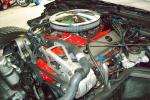
Started porting the 84 intake, noticed something...
I was reading a bunch of threads, not too many where people talked a whole lot about it. Some said that the intake (when port-matched) will flow 190cfm, which is more than the heads can handle anyway... which I thought was interesting.
I also saw a comment that said the small port is the same size all the way through. I'm not sure I necessarily believe that. I don't think it's the full size of the intake port, but it definitely looks larger inside the port (and inside the plenum itself).
Anyway, I had my daughter tap all the holes, I took care of one side...
Not perfect... it's been well over a decade since I ported anything with a hand grinder, but I got better after I did the first one...
I basically used the EGR staining as my guide for what I needed to grind down. I have a bunch of carbide bits. For the heavy grinding, I used a 3,000 RPM power drill (plug in). And for the smoothing and polishing, I used a Dremel-style tool with a remote Dremel handle.
And then you compare that to the other side:
Pretty crazy if you ask me.
The last time I did this, it was on a really piece of crap 1982 TransAm that I owned over 28 years ago. Anyone have any idea of what kind of power increase a person can typically expect from doing this?
We also cut the EGR shroud from within the intake too... just to give a bit better flow inside the plenum... my daughter is going to polish that out and smooth it down where all the ridges are.
I'm going to keep the EGR because, why not... it's not that much of a big deal.
Quick question, I noticed one of the coolant ports had this...
Is there a reason why this is there? Is it trying to prevent (obviously) too much coolant from going through the intake rather than say, part of the engine? I don't recall my new intake manifold gaskets having this in it... should I try to re-install it, and should it really be basically completely blocked off like this?
I was reading a bunch of threads, not too many where people talked a whole lot about it. Some said that the intake (when port-matched) will flow 190cfm, which is more than the heads can handle anyway... which I thought was interesting.
I got 156cfm when only port matching.
I also saw a comment that said the small port is the same size all the way through. I'm not sure I necessarily believe that. I don't think it's the full size of the intake port, but it definitely looks larger inside the port (and inside the plenum itself).
I measured runners with snap gauge; smallest size was 1.31x1.06. does vary. largest was 1.375 x 1.1.
Anyway, I had my daughter tap all the holes, I took care of one side...
Not perfect... it's been well over a decade since I ported anything with a hand grinder, but I got better after I did the first one...
I basically used the EGR staining as my guide for what I needed to grind down. I have a bunch of carbide bits. For the heavy grinding, I used a 3,000 RPM power drill (plug in). And for the smoothing and polishing, I used a Dremel-style tool with a remote Dremel handle.
And then you compare that to the other side:
Pretty crazy if you ask me.
The last time I did this, it was on a really piece of crap 1982 TransAm that I owned over 28 years ago. Anyone have any idea of what kind of power increase a person can typically expect from doing this?
We also cut the EGR shroud from within the intake too... just to give a bit better flow inside the plenum... my daughter is going to polish that out and smooth it down where all the ridges are.
60 grit cartridge roll is what I use for final finish.
I'm going to keep the EGR because, why not... it's not that much of a big deal.
Quick question, I noticed one of the coolant ports had this...
look at stock intake gaskets. they are blocked of at the back part of head with little hole. I trim stock gasket to port size.
Is there a reason why this is there? Is it trying to prevent (obviously) too much coolant from going through the intake rather than say, part of the engine? I don't recall my new intake manifold gaskets having this in it... should I try to re-install it, and should it really be basically completely blocked off like this?
gasket match,1.4 x 1.1 main runner, 1.6 x 1.225 entrance. 204.5 cfm with TBs, without heads. 163cfm+ with stock heads and stock TB's. compared to stock 135cfm. my flow bench is conservative.
Regarding the blocked coolant port. There is actually some thinking behind that.
There is a large coolant chamber under the intake. When it is cold outside the driver probably turns the heat on. That opens a valve allowing coolant thru the heater core. Have you seen where that water returns to the engine? There is a hose connection near the distributor on the other side of the blocked coolant port. So when the heater is on, there is also extra heating under the manifold.
The rear coolant passages are blocked to force coolant under the intake up to the t stat area, they wanted the manifold hot, so fuel doesn't condense on the manifold ports.
The rear coolant passages are blocked to force coolant under the intake up to the t stat area, they wanted the manifold hot, so fuel doesn't condense on the manifold ports.
If you read my post, it is to run return coolant water from the heater core under the intake, and not water from the head. That way the driver automatically adds heat under the intake when heat is needed in the car.
Mines sitting on the bench... I haven't tested it against stock or the Renegade yet but will eventually get around to it. Life just gets in the way.
Based off most time slips people posted back in the day... 20 or so HP if you port it well on a stock engine. Another way to look at it would be in line with how an 85 vette behaves.
Mines sitting on the bench... I haven't tested it against stock or the Renegade yet but will eventually get around to it. Life just gets in the way.
Based off most time slips people posted back in the day... 20 or so HP if you port it well on a stock engine. Another way to look at it would be in line with how an 85 vette behaves.
same hp as1985 is what I was thinking also. same heads, same exhaust, same cam, same intake manifold cfm. better exhaust would also help, headers etc..
Hello. Thinking about porting my 82 crossfire vette. Did you run the car with the ported crossfire manifold yet and what differences have you noticed, if any? Mike 82
Hello. Thinking about porting my 82 crossfire vette. Did you run the car with the ported crossfire manifold yet and what differences have you noticed, if any? Mike 82
Oh man, that Vette is sweet looking.
Unfortunately no, but I hope others can answer. This 84 Corvette barely ran... so it definitely wasn't getting the sub 7 second 0-60 it's advertised with, it was getting more like 9 seconds. I think there was a whole cyl dead, and any wire that touched the engine had been torched. So we're basically replacing and rebuilding everything.
People I've talked to on ThirdGen.org suggest you're supposed to get like 20-25% more horsepower... but I'm not sure how realistic that is. It doesn't seem unreasonable though that you could get 20 horsepower with some good porting, and doing the same with the exhaust manifolds too...
I was reading a bunch of threads, not too many where people talked a whole lot about it. Some said that the intake (when port-matched) will flow 190cfm, which is more than the heads can handle anyway... which I thought was interesting.
I also saw a comment that said the small port is the same size all the way through. I'm not sure I necessarily believe that. I don't think it's the full size of the intake port, but it definitely looks larger inside the port (and inside the plenum itself).
Anyway, I had my daughter tap all the holes, I took care of one side...
Not perfect... it's been well over a decade since I ported anything with a hand grinder, but I got better after I did the first one...
I basically used the EGR staining as my guide for what I needed to grind down. I have a bunch of carbide bits. For the heavy grinding, I used a 3,000 RPM power drill (plug in). And for the smoothing and polishing, I used a Dremel-style tool with a remote Dremel handle.
And then you compare that to the other side:
Pretty crazy if you ask me.
The last time I did this, it was on a really piece of crap 1982 TransAm that I owned over 28 years ago. Anyone have any idea of what kind of power increase a person can typically expect from doing this?
We also cut the EGR shroud from within the intake too... just to give a bit better flow inside the plenum... my daughter is going to polish that out and smooth it down where all the ridges are.
I'm going to keep the EGR because, why not... it's not that much of a big deal.
Quick question, I noticed one of the coolant ports had this...
Is there a reason why this is there? Is it trying to prevent (obviously) too much coolant from going through the intake rather than say, part of the engine? I don't recall my new intake manifold gaskets having this in it... should I try to re-install it, and should it really be basically completely blocked off like this?
I trim stock gasket to match port.
An intake manifold will flow a % of the head flow. in general, as the intake manifold flows more on its own, it will flow a higher percentage of the head flow. tops out around 90-95% of head flow. intake that flows 191cfm will flow somewhere in the 150's with stock head. intake that flows 237cfm will flow 180cfm with stock head. this assumes the head is flowing 196cfm. gain of 30cfm. potential 60hp






 Started porting the 84 intake, noticed something...