


VATS - How do I determine my keycode without the Keys ?

Thread Starter
Heel & Toe


Joined: May 2003
Posts: 20
Likes: 0
From: FL
 Re: VATS - How do I determine my keycode without the Keys ? (Bill's86Coupe)
Bill's response triggered a memory - too bad it wasn't the memory of where I'd left the keys ! !!
I have the build sheet and a lot of other documentation - in the data I have, I see the key-codes, the ones that my local dealer found for me - 2 4-character groups representing the teeth... On the build sheet is a lot, and I mean LOT of info in little groups, and in blocks with no description. Would ANY of these possibly be the VATS resistor value?? :confused:
[Modified by TripleBlack89, 6:18 PM 5/20/2003]
I have the build sheet and a lot of other documentation - in the data I have, I see the key-codes, the ones that my local dealer found for me - 2 4-character groups representing the teeth... On the build sheet is a lot, and I mean LOT of info in little groups, and in blocks with no description. Would ANY of these possibly be the VATS resistor value?? :confused:
[Modified by TripleBlack89, 6:18 PM 5/20/2003]
Thread Starter
Heel & Toe
Joined: May 2003
Posts: 20
Likes: 0
From: FL
Re: VATS - How do I determine my keycode without the Keys ? (TripleBlack89)
I had a non-resistor key made, and it didn't fit the lock. The lock cylinder is a different blank type (A GM "A" key fits it) than the key-code says it is ( They *swear* it's a "C".) I even had the code of the key cut into the "A" blank, just to be sure - it fits in but doesn't turn.
Can I conclude that the lock cylinder has been changed before?? :confused:
Can I conclude that the lock cylinder has been changed before?? :confused:

Melting Slicks


Joined: Aug 2001
Posts: 2,516
Likes: 0
From: Lockport NY
Re: VATS - How do I determine my keycode without the Keys ? (87SAM)
Referring to Forum topic 215035 (I printed it out; may not be in Archives), these values were different -
There seems to be a wide range of variation...My # 7 key measures 2.20 on my volt/ohm meter...But my local locksmith has a GM Interrogator, and he confirmed it's a # 7 (I ordered two keys from the dealer; he cut them, and they work!)...
Pass Key Codes:
Key���.�...Ohms
.1����.�.... 392 ---> 402
11������4.75k --> 4.57
Key���.�...Ohms
.1����.�.... 392 ---> 402
11������4.75k --> 4.57

Burning Brakes

Joined: Feb 2000
Posts: 824
Likes: 2
From: Camden SC
Re: VATS - How do I determine my keycode without the Keys ? (Rich B.)
Your assumption may be correct, someone may have installed a new/different lock set. IF that is the case, you will need to install a new tumbler, thereby assuring you have the correct mechanical key. Have seen locksmiths with about 50 keys just checking each key, but very time consuming. Replacing the tumbler will allow you to proceed to the second problem, the electrical key.
If I were you, I would solve the mechanical key problem first. Get a key that turns the tumbler allowing you to at least move the car out of the garage without power. You will likely have to remove the steering wheel, replace the tumbler, etc. The tools need for this are under $20. Once this is accomplished, you can tackle the second problem, determining the resistance value. The tool Gordon K sells has all 15 values and is around $75. If you can locate a well equipped locksmith, pay him/her and they will run through the values, determine the correct resistance, armed with this knowledge, get another key made complete with pellet, assuming you have the correct mechanical key.
I lost a Corvette key. The couch was hiding the darn thing. Must have set down, key slid out and went into hiding.
Maybe some locksmiths know how to remove Corvette steering wheels.
Let us know if you need more help.
Keep the faith.
dlmeyers 90 coupe zf6 3 speed shocks
If I were you, I would solve the mechanical key problem first. Get a key that turns the tumbler allowing you to at least move the car out of the garage without power. You will likely have to remove the steering wheel, replace the tumbler, etc. The tools need for this are under $20. Once this is accomplished, you can tackle the second problem, determining the resistance value. The tool Gordon K sells has all 15 values and is around $75. If you can locate a well equipped locksmith, pay him/her and they will run through the values, determine the correct resistance, armed with this knowledge, get another key made complete with pellet, assuming you have the correct mechanical key.
I lost a Corvette key. The couch was hiding the darn thing. Must have set down, key slid out and went into hiding.
Maybe some locksmiths know how to remove Corvette steering wheels.
Let us know if you need more help.
Keep the faith.
dlmeyers 90 coupe zf6 3 speed shocks
Drifting

Joined: Jul 2001
Posts: 1,897
Likes: 0
From: La Fontaine Indiana
Re: VATS - How do I determine my keycode without the Keys ? (TripleBlack89)
If GM can tell you what key to cut make one without the pellet then use the vats bypass from mad or you can bypass it yourself. If you don't know how a mechanic should. I carry one of those bypass kits in my car because the vats fail and the car won't start but I could just plug this in and then the key will start it.

Pro

Joined: Sep 2002
Posts: 515
Likes: 0
From: HAMILTON OH
Re: VATS - How do I determine my keycode without the Keys ? (TripleBlack89)
Take the vin# to a GM dealership and they can make you a key....I did it for $14.00. They have the codes in the computer and make the key right there at the dealerships. You will need proof of who you are and ownership.

Pro
Joined: Nov 2002
Posts: 665
Likes: 2
From: Southington CT
Re: VATS - How do I determine my keycode without the Keys ? (toondaddy)
just happened to me and i had a new key made by borrowing the instrument from my local dealer to read the key resistance. dealer also supplied a blank to use during this procedure. process took about an hour and cost about $35 bucks. good luck
Corvette Stories
The Best of Corvette for Corvette Enthusiasts

How Much Horsepower Every Corvette Engine "LOST" in 1972
Joe Kucinski
Top 10 DOs and DON'Ts for Protecting Your Convertible Top!
Michael S. Palmer
Top 10 Most Explosive Corvettes Ever Made: Power-to-Weight Ratio Ranked!
Joe Kucinski
150 hp to 1,250 hp: Every Corvette Generation Compared by the Specs That Matter
Joe Kucinski
8 Coolest Corvette Pace Cars (and Replicas) of All Time
Verdad Gallardo
Top 10 Corvette Engines RANKED by Peak Torque (70+ Years of Muscle!)
Joe Kucinski
Corvette ZR1X Will Be Pacing the Indy 500, And Could Probably Race, Too!
Verdad Gallardo
Top 10 Corvettes Coming to Mecum Indy 2026!
Brett Foote
Top 10 C9 Corvette MUST-HAVES to Fix These C8 Generation Flaws!
Michael S. Palmer
Team Owner


Joined: Sep 2003
Posts: 25,389
Likes: 2,741
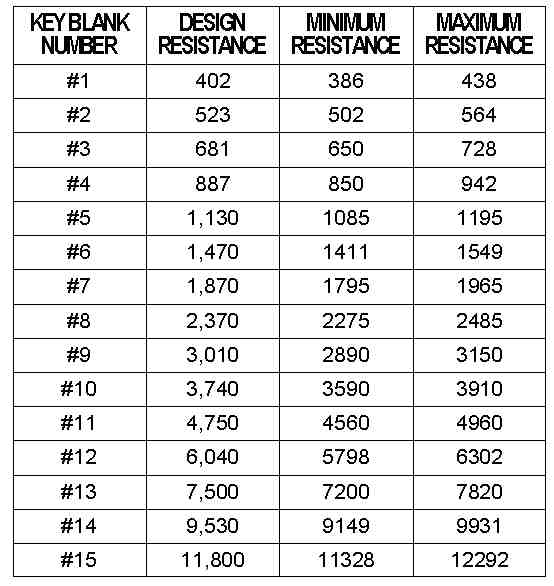
Should not make a difference, either will be fine. You need to be concerned with the "tolerance values". Preferred would be 2% I'd think but 5% might do well. You normally need a combination so the final assembled value is your concern. The final assembled value needs to fall between the min/max reference for each key value.
Last edited by WVZR-1; Mar 6, 2014 at 06:23 AM.



8th Gear
Joined: Feb 2014
Posts: 8
Likes: 0
Team Owner
Joined: Sep 2003
Posts: 25,389
Likes: 2,741
You didn't mention "losing a key" earlier! If you have your key that works presently there's no need for a potentiometer or anything else other than knowing the VATS resistance value of your key. You could take it by a GM dealer and ask that they "drop it" for resistance value and they'll know what to do. They generally wouldn't charge for that service.
If you have a DMM you can check the resistance yourself and then just get your resistors to match the "key value". You could go by any lock service and have it read also if you've no knowledge of what's involved.

Last edited by WVZR-1; Mar 6, 2014 at 06:30 PM.

Team Owner

Joined: Aug 2004
Posts: 21,543
Likes: 3,216
From: Park City Utah
 Bingo. That is what I did. Hit the right value on the second try.
Does anyone realize that this thread is 11 years old??

Team Owner
Joined: Sep 2003
Posts: 25,389
Likes: 2,741
I did and rather than just "bust on" the new poster I answered what seemed like a very "simple" question:
He never mentioned the loss of a key so there was no need in any mention of anything "other than" just the answer I gave him.
He never mentioned the loss of a key so there was no need in any mention of anything "other than" just the answer I gave him.
Last edited by WVZR-1; Mar 7, 2014 at 12:46 AM.

Race Director


Joined: Apr 2002
Posts: 10,036
Likes: 346
From: Anaheim CA
To fill in the blank that was never answered previously: there was a recall on the ignition lock cylinder. The new one uses a longer key than the original. I replaced mine after I had VATS problems. One of the contacts inside was bent over and not making a good connection to the VATS resistor pellet.
My recollection is that the new cylinder had silver-plated contacts for the VATS resistor pellet.
One more thing: the "design resistance" listed in WVZR-1's chart are 1% resistor values. It's not necessary to get the exact value, as long as it's within the tolerance. Also, 1/4 watt resistors are fine. They're a little delicate though, so 1/2 watt resistors might be better.
My recollection is that the new cylinder had silver-plated contacts for the VATS resistor pellet.
One more thing: the "design resistance" listed in WVZR-1's chart are 1% resistor values. It's not necessary to get the exact value, as long as it's within the tolerance. Also, 1/4 watt resistors are fine. They're a little delicate though, so 1/2 watt resistors might be better.
Team Owner
Joined: Sep 2003
Posts: 25,389
Likes: 2,741
To fill in the blank that was never answered previously: there was a recall on the ignition lock cylinder. The new one uses a longer key than the original. I replaced mine after I had VATS problems. One of the contacts inside was bent over and not making a good connection to the VATS resistor pellet.
My recollection is that the new cylinder had silver-plated contacts for the VATS resistor pellet.
One more thing: the "design resistance" listed in WVZR-1's chart are 1% resistor values. It's not necessary to get the exact value, as long as it's within the tolerance. Also, 1/4 watt resistors are fine. They're a little delicate though, so 1/2 watt resistors might be better.
My recollection is that the new cylinder had silver-plated contacts for the VATS resistor pellet.
One more thing: the "design resistance" listed in WVZR-1's chart are 1% resistor values. It's not necessary to get the exact value, as long as it's within the tolerance. Also, 1/4 watt resistors are fine. They're a little delicate though, so 1/2 watt resistors might be better.
Original TSB was released in May '87 - didn't get much publicity at that time and of course it wasn't an issue for most. As the '86 - '87 aged of course the situation became notably more pronounced due to just normal use. The original TSB explained the difference in keys and also the fact that the "newer" blank would work with earlier cylinders but that "earlier" keys would NOT work with the "newer" cylinders. Dealers with older stock sometimes had issues. The "work key" wasn't an original thought either, that was an after thought.
The most current '88 TSB is here on "RayQuayles" page:
http://www.quayle-co.com/tsbs/88-292.htm
Last edited by WVZR-1; Mar 7, 2014 at 02:09 AM.
