


Porting questions LT1
Thread Starter
Race Director


Joined: Feb 2003
Posts: 11,672
Likes: 20
From: Lake Wylie SC
 Porting questions LT1
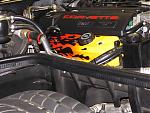
I just took the intake off my OEM LT1 and noticed the intake manifold ports are larger than the head intake ports, and the shape is different. That's got to kill a few ponies. Anyone every take a dremel to the heads to match the gasket opening? Which bit do you use?
Take a look:

Notice how small the top part of the port is.
[Modified by Strick, 7:28 PM 2/18/2004]
Take a look:
Notice how small the top part of the port is.
[Modified by Strick, 7:28 PM 2/18/2004]

Team Owner

Joined: Nov 1999
Posts: 32,782
Likes: 11
From: Former NCM Drag Racing coordinator, National director Corvette Challenge Spring Hill, Tennessee: Whiting, New Jersey
Cruise-In VI Veteran
Cruise-In VII Veteran
Re: Porting questions LT1 (Strick)
Not a job for a rookie :nono:
Thread Starter
Race Director
Joined: Feb 2003
Posts: 11,672
Likes: 20
From: Lake Wylie SC
Re: Porting questions LT1 (JordonMusser)
A dremel will not do it :) and you will find that the intake ports on the intake actually match the intake ports on the head quite well

Burning Brakes

Joined: May 2000
Posts: 1,160
Likes: 10
From: Nashville TN
Re: Porting questions LT1 (Strick)
Sand-paper rolls on a drill. It could take you a year to do it with a dremel. If so, use large grinding stones then switch to sand paper rolls. Don't go past 60 grit. You don't want the intake runners too polished.

Race Director
Joined: Apr 2000
Posts: 15,344
Likes: 4,009
From: Texas
Re: Porting questions LT1 (kman0066)
Sand-paper rolls on a drill. It could take you a year to do it with a dremel. If so, use large grinding stones then switch to sand paper rolls. Don't go past 60 grit. You don't want the intake runners too polished.

Safety Car

Joined: Jun 1999
Posts: 3,570
Likes: 3
From: Austin, Singapore, Kuala Lumpur, Houston, Dallas, Hong Kong, Elgin, etc.. Texas
Re: Porting questions LT1 (Strick)
Do yourself and your LT1 a favor, have a professional do the port work on heads.
You can do the intake yourself with a Dremel and a rotory file type bit from Home Depot. I did it. The aluminum is soft and clogs stone bits. If you tried to gasket match the heads still installed on the block, shavings will get everywhere. Don't do it!
For the heads, if you are not going with a bigger cam, get them pocket ported with a 3 angle valve job. If you do them yourself, you have to take them to a shop anyway to get the valve job done (unless you have a valve grinding equipment). For the valves, put a 20 degree back cut to increase flow when the valves just come off their seats.
You should pick up 20-25 rwhp when done. See my website in my signature for information on head porting.
You can do the intake yourself with a Dremel and a rotory file type bit from Home Depot. I did it. The aluminum is soft and clogs stone bits. If you tried to gasket match the heads still installed on the block, shavings will get everywhere. Don't do it!
For the heads, if you are not going with a bigger cam, get them pocket ported with a 3 angle valve job. If you do them yourself, you have to take them to a shop anyway to get the valve job done (unless you have a valve grinding equipment). For the valves, put a 20 degree back cut to increase flow when the valves just come off their seats.
You should pick up 20-25 rwhp when done. See my website in my signature for information on head porting.
Corvette Stories
The Best of Corvette for Corvette Enthusiasts

5 Best & 5 Worst Corvette Daily Drivers
Joe Kucinski
The Headlights of Every Corvette Generation Explained
Joe Kucinski
5 Best & 5 Most Overrated Corvette Track Packages of All Time!
Joe Kucinski
Every 2027 Corvette Engine Explained
Joe Kucinski
Designer Imagines A Corvette That Looks More Like a Corvette Than the Corvette
Verdad Gallardo
10 Ugly Corvettes That We Still Kinda Love
Joe Kucinski
Top 10 Most Expensive Corvettes Ever Sold on Bring A Trailer
Brett Foote
10 Things Every Corvette Owner Needs (2026 Edition)
Michael S. Palmer
8 Most "Only Corvette Owners Understand" Quirks and Problems
Pouria Savadkouei
Thread Starter
Race Director
Joined: Feb 2003
Posts: 11,672
Likes: 20
From: Lake Wylie SC
Re: Porting questions LT1 (Mez)
Thanks guys for the responces. I'll wait til I do the cam and have the heads worked on. Maybe next winter. I was trying to workout a way with a high powered vacuum right next to the bit as I ported away. Just thought I could do it, not worth the chance, I guess. :rolleyes:
Safety Car
Joined: Jun 1999
Posts: 3,570
Likes: 3
From: Austin, Singapore, Kuala Lumpur, Houston, Dallas, Hong Kong, Elgin, etc.. Texas
Re: Porting questions LT1 (Strick)
In my opinion, gasket matching won't give you that much more power. Perhaps 5 rwhp, but I really don't know for sure.
The biggest gain in flow would be in the bowl and throat area just below the valve. That is what the 3 angle valve job would address. Of course, if you send the heads to a shop, they normally gasket match the intake ports.
If you already have the intake off, it won't be that much more work to remove the heads now.
The biggest gain in flow would be in the bowl and throat area just below the valve. That is what the 3 angle valve job would address. Of course, if you send the heads to a shop, they normally gasket match the intake ports.
If you already have the intake off, it won't be that much more work to remove the heads now.

Melting Slicks


Joined: Sep 2000
Posts: 2,710
Likes: 1
From: Green Bay WI
Re: Porting questions LT1 (Strick)
FWIW, I wanted to do the same thing on the intake. When I got the stage III heads from CNC Heads, Pete told me that I should not port the LT-1 intake as it flows very well in stock form and he actually saw decreases on the dyno from porting it.
He did say however that for an LT-4 intake, it must be done to get proper flow...
He did say however that for an LT-4 intake, it must be done to get proper flow...
Safety Car
Joined: Jun 1999
Posts: 3,570
Likes: 3
From: Austin, Singapore, Kuala Lumpur, Houston, Dallas, Hong Kong, Elgin, etc.. Texas
Re: Porting questions LT1 (cprgmr)
I can testify that the stock LT4 intake and heads don't match up very well. The upper portion of the intake overlapped the head ports by a good .25 to .375 inch. I matched the head and intake ports to the 12367777 gasket.

Team Owner
Joined: Dec 2000
Posts: 90,675
Likes: 304
From: SE NY
Cruise-In II Veteran
Re: Porting questions LT1 (Strick)
Air tends to move in a straight line at high velocities, so air flow should be greatest at the bottom of the port. In such case enlarging the port will mostly increase volume with only a slight increas in actual CFMs flowed. This is the kind of thing that hurts low end torque with only a slight incrase in peak values.
So when considering where to remove metal you need to look at the air path and only remove metal on the outside curve of any bends.
So when considering where to remove metal you need to look at the air path and only remove metal on the outside curve of any bends.
