



Bypassing VATS

Team Owner


Joined: Sep 2003
Posts: 25,398
Likes: 2,742

That VATS module doesn't care that it's a 3 time "trophy winner" ! Buy a key cylinder, rent or borrow a VATS interrogator and move on. If you do a VATS interrogator or build your own resistor packages you can rule out a #1 - not used - saves you 4 minutes!
You could do it this way also. Buy a module here for a requested VATS code and cut a new key with a matching VATS resistance for your new cylinder which BTW will NOT come with a resistance chip. It will only have a mechanical cut. You might want to confirm the number on your module but I'm quite confident in the GM # 1228548
http://www.ebay.com/itm/1986-1988-C4...-/150794713410
Last edited by WVZR-1; Mar 31, 2013 at 01:26 AM.

Race Director


Joined: Apr 2002
Posts: 10,036
Likes: 346
From: Anaheim CA
The VATS module compares the resistance of the chip in the key with a resistor in the module. If you buy a random module you won't know which key is required to match it. I wrote an article on the module in my '86 (don't know how many years that module was used):
http://forums.corvetteforum.com/c4-t...schematic.html
http://forums.corvetteforum.com/c4-t...schematic.html
Team Owner
Joined: Sep 2003
Posts: 25,398
Likes: 2,742
The VATS module compares the resistance of the chip in the key with a resistor in the module. If you buy a random module you won't know which key is required to match it. I wrote an article on the module in my '86 (don't know how many years that module was used):
http://forums.corvetteforum.com/c4-t...schematic.html
http://forums.corvetteforum.com/c4-t...schematic.html
It matters NOT what you wrote it's the CHOICE of the purchase - read again!
If you're attempting to direct the "recent" poster to the internal diagnostics that's fine but your implying that I suggested a "random" purchase. I did NOT.
Last edited by WVZR-1; Mar 31, 2013 at 05:58 AM.
Race Director
Joined: Apr 2002
Posts: 10,036
Likes: 346
From: Anaheim CA
Sorry, my error. I didn't realize that the eBay seller was selling "to order" by resistor code. I didn't read down the page where he makes that clear.

Safety Car

Joined: Jan 2004
Posts: 3,556
Likes: 13

A dealership may be able to get it from the VIN if you are lucky otherwise you have to try all 15 resistance values until you find the one that works.

Drifting

Joined: Nov 2012
Posts: 1,331
Likes: 2
I appreciate what you are saying about the effectiveness of the VATS system, but I don't really leave the car anywhere and being an 86, I think it has lost its real theft appeal. While I am sure it is still possible for someone to steal it, I am more concerned with it stranding me like it is doing now.
Anyway, my plan to bypass the starter enable relay won't work because VATS also disables the fuel pump. So next step for me is to determine whether it is the relay or VATS that is interrupting the power, later today or this weekend, I will see what has power at the relay and go from there. Thanks for the tips on checking the tumbler contacts.
Anyway, my plan to bypass the starter enable relay won't work because VATS also disables the fuel pump. So next step for me is to determine whether it is the relay or VATS that is interrupting the power, later today or this weekend, I will see what has power at the relay and go from there. Thanks for the tips on checking the tumbler contacts.
My first car was an 85 Camaro with the crappy 2.8 V6 and a slush box with no VATS system. I caught a guy trying to break in to steal it (it had the old factory cassette radio so he certainly wasn't trying to get in for that) once. Do you think that same guy wouldn't have tried his hand for a Vette? The car was already 20 years old (same age as it's driver) at the time.
Age does not impact desirability.
My 96 Bird had an intermittent issue with VATS, and it turned out to be a worn key. I had another spare made, and switched to using my spare and never had issues again. It's much better to fix it than to just bypass it in my opinion.
Last edited by Aaron Keating; Apr 18, 2013 at 10:49 AM.
Corvette Stories
The Best of Corvette for Corvette Enthusiasts

Top 10 Most Expensive Corvettes Ever Sold on Bring A Trailer
Brett Foote
10 Things Every Corvette Owner Needs (2026 Edition)
Michael S. Palmer
8 Most "Only Corvette Owners Understand" Quirks and Problems
Pouria Savadkouei
10 Reasons the C6 Z06 is Still A Performance Benchmark After 20 Years
Joe Kucinski
How Much Horsepower Every Corvette Engine "LOST" in 1972
Joe Kucinski
Top 10 DOs and DON'Ts for Protecting Your Convertible Top!
Michael S. Palmer
Top 10 Most Explosive Corvettes Ever Made: Power-to-Weight Ratio Ranked!
Joe Kucinski
150 hp to 1,250 hp: Every Corvette Generation Compared by the Specs That Matter
Joe Kucinski
8 Coolest Corvette Pace Cars (and Replicas) of All Time
Verdad Gallardo
Drifting
Joined: Nov 2012
Posts: 1,331
Likes: 2
Probably because it would kind of defeat the purpose of having the resistors in the first place if every tom dick and harry knew how to bypass it just sticking a resistor in the wire leads 
Someone -does- know the values I've seen them pop up on a Camaro forum once but it's not exactly wide spread.
Someone -does- know the values I've seen them pop up on a Camaro forum once but it's not exactly wide spread.
Team Owner
Joined: Sep 2003
Posts: 25,398
Likes: 2,742
In the thread you started regarding your brothers situation I mentioned the easiest three methods for you to accomplish his key situation. You've apparently done the dealer request and the VATS information wasn't included with the information supplied by GM. It was worth the attempt. You've apparently got the mechanical code now. Have you had the code cut on a "work key" to check the mechanical cuts? If not then you should ask for the code to be cut on a VATS "work key" and confirm the cylinder hasn't been replaced already. The "work key" is inexpensive. You could use the "work key" and resistor combinations to do the checks one code at a time. You can eliminate the code 1 - that was a single year usage and your '96 can't possibly have that.
It might be cruel to make you look any further than you already likely have:
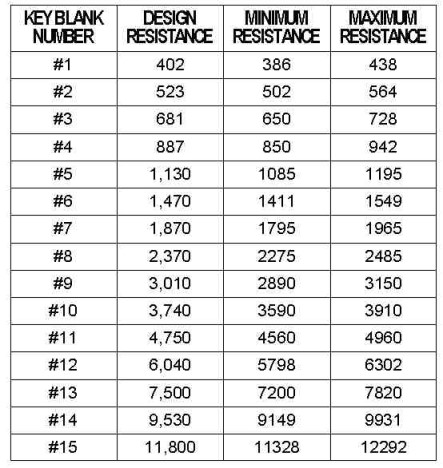
Before you start you need to understand that before each "new attempt" there's a "four minute" rest required before the next resistance check of the system. Try one, 4 minute break, then try the next! Patience!
Use 1/4 Watt 5% resistors.
Last edited by WVZR-1; Apr 19, 2013 at 12:42 AM.
Race Director
Joined: Apr 2002
Posts: 10,036
Likes: 346
From: Anaheim CA
Team Owner
Joined: Sep 2003
Posts: 25,398
Likes: 2,742
You connect the resistors in a "series" and confirm the resistance that you've created with your DMM. Or if using an advertised value you do the same, confirm with your DMM. The resistors I mentioned are the least expensive and more easily sourced locally.
You can buy a package if you like and if you have the time:
http://www.ebay.com/itm/Directed-652T-Resistors-Pack-General-Motors-GM-VATS-Override-Bypass-Kit-/360629338416?pt=US_Car_Keys_Transponders&hash=item53f72f0130&vxp=mtr

Le Mans Master


Joined: Jun 2009
Posts: 6,528
Likes: 752
From: South Dakota
I had problems with VATS on my 96 Impala SS back in the 90's. One key would work sometimes and the other key would always work. I found a slight difference in resistance between the keys. I researched the schematic and found I could unplug a VATS connector under the steering column, leave it disconnected and splice in the "good" resistance value resistors into the harness. It has worked well since.
I also can relate to the VATS working as a theft deterrent. I had a '90 Camaro with VATS. The car was broken into and the column was broken twice, but the car wouldn't start and they abandoned their theft efforts.
I also had a Caprice 9C1 without VATS that was stolen.
In short the resistor or bypass method works, but assess what kind of theft protection you need or want.
Good luck.
I also can relate to the VATS working as a theft deterrent. I had a '90 Camaro with VATS. The car was broken into and the column was broken twice, but the car wouldn't start and they abandoned their theft efforts.
I also had a Caprice 9C1 without VATS that was stolen.
In short the resistor or bypass method works, but assess what kind of theft protection you need or want.
Good luck.
Team Owner
Joined: Sep 2003
Posts: 25,398
Likes: 2,742
I had problems with VATS on my 96 Impala SS back in the 90's. One key would work sometimes and the other key would always work. I found a slight difference in resistance between the keys. I researched the schematic and found I could unplug a VATS connector under the steering column, leave it disconnected and splice in the "good" resistance value resistors into the harness. It has worked well since.
I also can relate to the VATS working as a theft deterrent. I had a '90 Camaro with VATS. The car was broken into and the column was broken twice, but the car wouldn't start and they abandoned their theft efforts.
I also had a Caprice 9C1 without VATS that was stolen.
In short the resistor or bypass method works, but assess what kind of theft protection you need or want.
Good luck.
I also can relate to the VATS working as a theft deterrent. I had a '90 Camaro with VATS. The car was broken into and the column was broken twice, but the car wouldn't start and they abandoned their theft efforts.
I also had a Caprice 9C1 without VATS that was stolen.
In short the resistor or bypass method works, but assess what kind of theft protection you need or want.
Good luck.
