



 Dentonation is the killer here...


School me on compression vs boost psi
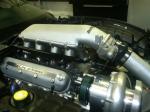
Drifting


Joined: Aug 2006
Posts: 1,629
Likes: 6
From: Little Rock Arkansas

I would say the short answer for that is a lower compression high boost motor is less likely to detonate vs a high comp low boost motor making the same power. Detonation is the killer. JMO

Thread Starter
Drifting

Joined: Oct 2004
Posts: 1,621
Likes: 6
Wy when the over all pressure is the same? My combo for instance is running e85 which burns over 200 deg cooler and seems to be pretty resilient to detonation.

Tech Contributor


Joined: Apr 2007
Posts: 10,924
Likes: 78
From: Forney Texas
Tech Contributor
Joined: Apr 2007
Posts: 10,924
Likes: 78
From: Forney Texas


Melting Slicks

Joined: Jul 2008
Posts: 3,002
Likes: 216
From: Houston Texas
2018 Corvette of Year Finalist
2017 C5 of Year Finalist
There are two compression ratios at work here. Let's take a very simplified approach and ignore any pressure drops between the inlet and the outlet. Both Engines are on 93 octane and using meth injection.
Engine A is 10.5:1 and receiving air with a 2.22:1 pressure ratio (18 psi)
Engine B is 8.8:1 and receiving air with a 2.36:1 pressure ratio (20 psi)
Engine A theoretical compression: 23.3:1
Engine B theoretical compression: 20.7:1
Engine A is done unless higher octane fuel is added. Engine B wants more pressure and will remain on pump gas. It's all about compression and expansion ratios and how they relate to the tendency for detonation.
Both engines will last if the tune is correct, but which one do you think will be more forgiving and easier to tune without detonation?
By the way, Engine B makes more power with less pressure.
Engine A is 10.5:1 and receiving air with a 2.22:1 pressure ratio (18 psi)
Engine B is 8.8:1 and receiving air with a 2.36:1 pressure ratio (20 psi)
Engine A theoretical compression: 23.3:1
Engine B theoretical compression: 20.7:1
Engine A is done unless higher octane fuel is added. Engine B wants more pressure and will remain on pump gas. It's all about compression and expansion ratios and how they relate to the tendency for detonation.
Both engines will last if the tune is correct, but which one do you think will be more forgiving and easier to tune without detonation?
By the way, Engine B makes more power with less pressure.

Team Owner


Joined: Jan 2007
Posts: 29,065
Likes: 1,839
From: cookeville tennessee
Corvette Stories
The Best of Corvette for Corvette Enthusiasts

Every 2027 Corvette Engine Explained
Joe Kucinski
Designer Imagines A Corvette That Looks More Like a Corvette Than the Corvette
Verdad Gallardo
10 Ugly Corvettes That We Still Kinda Love
Joe Kucinski
Top 10 Most Expensive Corvettes Ever Sold on Bring A Trailer
Brett Foote
10 Things Every Corvette Owner Needs (2026 Edition)
Michael S. Palmer
8 Most "Only Corvette Owners Understand" Quirks and Problems
Pouria Savadkouei
10 Reasons the C6 Z06 is Still A Performance Benchmark After 20 Years
Joe Kucinski
How Much Horsepower Every Corvette Engine "LOST" in 1972
Joe Kucinski
Top 10 DOs and DON'Ts for Protecting Your Convertible Top!
Michael S. Palmer
Race Director


Joined: Mar 2007
Posts: 18,308
Likes: 21
From: Marlton. Increasing performance one speeding ticket at a time! NJ
Yep.
Pre-detonation is the killer. Octane rating of fuel is it's resistance to pre-detonation (extreamly oversimplified explanation).
Under normal pressures (NA), there is basically a max of ~11.5:1. That's the limit of compression when the fuel will ignite before the spark. Instead of having a controlled clean wavefront that pushed the piston down, you get several wavefronts that impact the cylinder wall, piston, etc. That pre-detonation is commonly caused knock, and the pressure wave will damage the cylinder wall or other parts.
Higher octane fuel will help control that, which is why leaded cars from the 60's were able to run a higher comp ratio.
Now when assisting the air into the cylinder, you still have to keep the fuel air ratio the same (technically richer for safety). So with more air, you'll have a higher chance to get more pre-detonition.
As mentioned, way too complex to completely describe everything, and of course, the engine operates non-linearly across it's RPM range. But that's the quick explanation.
Pre-detonation is the killer. Octane rating of fuel is it's resistance to pre-detonation (extreamly oversimplified explanation).
Under normal pressures (NA), there is basically a max of ~11.5:1. That's the limit of compression when the fuel will ignite before the spark. Instead of having a controlled clean wavefront that pushed the piston down, you get several wavefronts that impact the cylinder wall, piston, etc. That pre-detonation is commonly caused knock, and the pressure wave will damage the cylinder wall or other parts.
Higher octane fuel will help control that, which is why leaded cars from the 60's were able to run a higher comp ratio.
Now when assisting the air into the cylinder, you still have to keep the fuel air ratio the same (technically richer for safety). So with more air, you'll have a higher chance to get more pre-detonition.
As mentioned, way too complex to completely describe everything, and of course, the engine operates non-linearly across it's RPM range. But that's the quick explanation.



Burning Brakes

Joined: May 2009
Posts: 793
Likes: 3
From: Scotland UK
No one mentioned the efficiencies of the blower/turbo yet so I'll just add that it does take power to turn the impeller(s). More turning = more power. In stating this, I'm not trying to contradict what's been previously mentioned; it offers more to the point that it's a pretty friggin complex answer.
Thread Starter
Drifting
Joined: Oct 2004
Posts: 1,621
Likes: 6
talking to my tuner he isconfident that he can tune with higher compression so Im staying w 11 to 1 for now. I have the 317 heads on standby if needed later
Turbos are def more efficient bu boost being unpredictable when it will come in it def not the right direction for me for road coarse.
Turbos are def more efficient bu boost being unpredictable when it will come in it def not the right direction for me for road coarse.

Advanced

Joined: Jan 2011
Posts: 72
Likes: 1
What Turbo-Geist said.
...
If the higher/lower compression engines aren't detonating, there shouldn't be a significant difference in longevity.
When running pump gas, it's easy to "hit the wall" with power. Power, limited by the fuel's propensity to detonate. The amount of power lost by lowering compression is much less than the amount of power gained by increased boost.
High compression pump gas engines just start detonating at much lower power levels. And, detonation is sometimes intermittent and hard to pick up.
With E85, you have a much higher threshold of greater of boost and compression can be run.
...
If the higher/lower compression engines aren't detonating, there shouldn't be a significant difference in longevity.
When running pump gas, it's easy to "hit the wall" with power. Power, limited by the fuel's propensity to detonate. The amount of power lost by lowering compression is much less than the amount of power gained by increased boost.
High compression pump gas engines just start detonating at much lower power levels. And, detonation is sometimes intermittent and hard to pick up.
With E85, you have a much higher threshold of greater of boost and compression can be run.
Last edited by ZMX; Mar 10, 2012 at 04:59 PM.
