





[Z06] 2001 oil consumption problem

Racer


Joined: Aug 2000
Posts: 460
Likes: 12
From: Gulf Shores AL

Originally Posted by tomiboy
I know that there is a problem with 01 Z06s. My question is, if I buy an 01 used and find I have got a bad one, how much will it cost to fix?
I should be able to tell you in a couple of days. My 01 went in on monday for the ring job. Fortunately, mine will be covered by warranty, but the dealer usually tells me what it would have cost. My recollection is that the intake valley repair would have cost me $1500-2000 w/o the warranty

Le Mans Master


Joined: Sep 1999
Posts: 5,464
Likes: 2
From: Private
My 01 was one of the first delivered in August of 2000 and it had a huge oil consumption problem. I kept an eye on it for a year (8k miles), before I brought it to the dealers attention. While this was happening, I was also taking the car to road race tracks through HPDE's pretty heavily, and by my 5th HPDE or so, the oil consumption problem went away. So, I never had the dealer fix the problem, because the car stopped burning oil on it's own after a lot of constant high RPM driving. I mean constant high RPM, something you could never do on the street.
What I found from several very knowledgeable people was that the rings in the 01's were made out of an extremely hard material that couldn't seat properly from the low friction synthetics during casual street driving (even with infrequent drag racing). The car really needed to be run hard at high RPM for the rings to finally seat properly. Most people will never run their car on a road race track like I have, and therefore GM could not allow cars to burn oil at the pace they were on the street. I was told by an engine builder that this will actually work to my benefit, as the softer rings won't hold up to race track driving as well. Here's the amazing thing...I mean the car now after a few years of HPDE's barely even burns a 1/4 of a quart between oil changes. At the time I bought the car, it would burn over 3 quarts every 1500 miles
What I found from several very knowledgeable people was that the rings in the 01's were made out of an extremely hard material that couldn't seat properly from the low friction synthetics during casual street driving (even with infrequent drag racing). The car really needed to be run hard at high RPM for the rings to finally seat properly. Most people will never run their car on a road race track like I have, and therefore GM could not allow cars to burn oil at the pace they were on the street. I was told by an engine builder that this will actually work to my benefit, as the softer rings won't hold up to race track driving as well. Here's the amazing thing...I mean the car now after a few years of HPDE's barely even burns a 1/4 of a quart between oil changes. At the time I bought the car, it would burn over 3 quarts every 1500 miles
Melting Slicks


Joined: Nov 2003
Posts: 2,155
Likes: 56
From: Escondido CA
read the other recent thread on oil consumption
just make sure the 01 has a good warranty..if not i would'nt be in a rush to get it-and i own an 01..
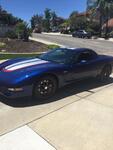
the previous owner should know-like i said in the other thread i get about 1400-1800mi/qt now after the valley cover seal /breather replacement..but per an article in corvette mag..the one with the red ZR1-it covers this issue quite well, from 99-2002 all ls1 and ls6 had the same ring issue with #2 cylinder..and some of those engines will consume a lot of oil-especially if you drive it about 3200rpm with extended times such as tracking /racing the car and deceleration from about 3200..and the problem is more obvious with 6spds..and we drive our Z's ,but its with ls1's too ,my 00'Z28 camaro had the iconsumption issue too..pic of my Z
http://www.z06vette.com/forums/showt...1&page=1&pp=15
good luck on your purchase and be a wise buyer.....
just make sure the 01 has a good warranty..if not i would'nt be in a rush to get it-and i own an 01..
the previous owner should know-like i said in the other thread i get about 1400-1800mi/qt now after the valley cover seal /breather replacement..but per an article in corvette mag..the one with the red ZR1-it covers this issue quite well, from 99-2002 all ls1 and ls6 had the same ring issue with #2 cylinder..and some of those engines will consume a lot of oil-especially if you drive it about 3200rpm with extended times such as tracking /racing the car and deceleration from about 3200..and the problem is more obvious with 6spds..and we drive our Z's ,but its with ls1's too ,my 00'Z28 camaro had the iconsumption issue too..pic of my Z
http://www.z06vette.com/forums/showt...1&page=1&pp=15
good luck on your purchase and be a wise buyer.....

Burning Brakes

Joined: Feb 2004
Posts: 884
Likes: 0
From: Murrieta ca
Originally Posted by 95jersey
My 01 was one of the first delivered in August of 2000 and it had a huge oil consumption problem. I kept an eye on it for a year (8k miles), before I brought it to the dealers attention. While this was happening, I was also taking the car to road race tracks through HPDE's pretty heavily, and by my 5th HPDE or so, the oil consumption problem went away. So, I never had the dealer fix the problem, because the car stopped burning oil on it's own after a lot of constant high RPM driving. I mean constant high RPM, something you could never do on the street.
What I found from several very knowledgeable people was that the rings in the 01's were made out of an extremely hard material that couldn't seat properly from the low friction synthetics during casual street driving (even with infrequent drag racing). The car really needed to be run hard at high RPM for the rings to finally seat properly. Most people will never run their car on a road race track like I have, and therefore GM could not allow cars to burn oil at the pace they were on the street. I was told by an engine builder that this will actually work to my benefit, as the softer rings won't hold up to race track driving as well. Here's the amazing thing...I mean the car now after a few years of HPDE's barely even burns a 1/4 of a quart between oil changes. At the time I bought the car, it would burn over 3 quarts every 1500 miles
What I found from several very knowledgeable people was that the rings in the 01's were made out of an extremely hard material that couldn't seat properly from the low friction synthetics during casual street driving (even with infrequent drag racing). The car really needed to be run hard at high RPM for the rings to finally seat properly. Most people will never run their car on a road race track like I have, and therefore GM could not allow cars to burn oil at the pace they were on the street. I was told by an engine builder that this will actually work to my benefit, as the softer rings won't hold up to race track driving as well. Here's the amazing thing...I mean the car now after a few years of HPDE's barely even burns a 1/4 of a quart between oil changes. At the time I bought the car, it would burn over 3 quarts every 1500 miles
What are the potential problems with not fixing it??
I first purchased my car and after 1000 miles I got low oil level.......well I babied it for a while and had no issues , but that was no fun...So I started driving the old way again....I was getting about 1500 miles before the light and this has been the last couple oil changes. Talked to my dealer and he said no problem....bring it in next time and they will fix it....Well I have been driving the **** out of it and I have gone 1700 miles AND NO LOW OIL !!!! I am sitting on a pair of headers waiting to get my warranty workdone and I am getting impatient
Shawn
Corvette Stories
The Best of Corvette for Corvette Enthusiasts

5 Best & 5 Worst Corvette Daily Drivers
Joe Kucinski
The Headlights of Every Corvette Generation Explained
Joe Kucinski
5 Best & 5 Most Overrated Corvette Track Packages of All Time!
Joe Kucinski
Every 2027 Corvette Engine Explained
Joe Kucinski
Designer Imagines A Corvette That Looks More Like a Corvette Than the Corvette
Verdad Gallardo
10 Ugly Corvettes That We Still Kinda Love
Joe Kucinski
Top 10 Most Expensive Corvettes Ever Sold on Bring A Trailer
Brett Foote
10 Things Every Corvette Owner Needs (2026 Edition)
Michael S. Palmer
8 Most "Only Corvette Owners Understand" Quirks and Problems
Pouria Savadkouei
Racer
Joined: Feb 2000
Posts: 327
Likes: 0
From: Portland
My 01 was using about 1 quart evey 1200 miles depending on how I drove it and I was tempted to not worry about it except I believe that the majority of 01s have the problem and that the resale value would be better if I got if fixed.
I went through 4 oil changes and oil level readings at the dealer and then they put in new rings. It runs stronger then every and uses a quart in 3000 miles now.
Jim
I went through 4 oil changes and oil level readings at the dealer and then they put in new rings. It runs stronger then every and uses a quart in 3000 miles now.
Jim


Instructor
Joined: Aug 2004
Posts: 158
Likes: 0
From: Bucks County PA
Gee, so I guess my 3 quarts in under 1000 miles would be exceptionally high? '01 Z. No warranty left but only 10500 miles. I plan on contacting GM and or the dealer who I bought the car from last year and see if I can get GM to spring for the re ring. I know it's been done before...

Pro

Joined: May 2003
Posts: 611
Likes: 0
From: The great state of Massholia
Originally Posted by NoNeck
Gee, so I guess my 3 quarts in under 1000 miles would be exceptionally high? '01 Z. No warranty left but only 10500 miles. I plan on contacting GM and or the dealer who I bought the car from last year and see if I can get GM to spring for the re ring. I know it's been done before...
SmacZ; plenty of prob.'s can come from burning that much oil and coating your internals from ignition to oil pump to cat and more...


Pro Mechanic


Joined: Oct 1999
Posts: 3,922
Likes: 1,468
From: South-Central Coast California
Originally Posted by 95jersey
(snip)
What I found from several very knowledgeable people was that the rings in the 01's were made out of an extremely hard material that couldn't seat properly from the low friction synthetics during casual street driving (even with infrequent drag racing). The car really needed to be run hard at high RPM for the rings to finally seat properly. Most people will never run their car on a road race track like I have, and therefore GM could not allow cars to burn oil at the pace they were on the street. I was told by an engine builder that this will actually work to my benefit, as the softer rings won't hold up to race track driving as well. Here's the amazing thing...I mean the car now after a few years of HPDE's barely even burns a 1/4 of a quart between oil changes. At the time I bought the car, it would burn over 3 quarts every 1500 miles
What I found from several very knowledgeable people was that the rings in the 01's were made out of an extremely hard material that couldn't seat properly from the low friction synthetics during casual street driving (even with infrequent drag racing). The car really needed to be run hard at high RPM for the rings to finally seat properly. Most people will never run their car on a road race track like I have, and therefore GM could not allow cars to burn oil at the pace they were on the street. I was told by an engine builder that this will actually work to my benefit, as the softer rings won't hold up to race track driving as well. Here's the amazing thing...I mean the car now after a few years of HPDE's barely even burns a 1/4 of a quart between oil changes. At the time I bought the car, it would burn over 3 quarts every 1500 miles
The ring material for all Gen 3 V8s is cast iron and did not change from 1997 to 2004. Cast iron cannot be described as "extremely hard" though it is harder than, say, aluminum, pot metal and the types of iron typically used for rings might be somewhat harder than other cast irons used for, say, skillets or some cast iron engine blocks.
The statements that stock rings have to be run hard for some period of time to "seat" in engines using synthetic oil and that these rings in engines which are driven casually do not seat properly is total

The problem with the 01 LS6, and to some extent 97-01 LS1s, which caused high oil consumption was a combination of 1) a crankcase breather design which is marginal at best for proper oil-air seperation when PCV flow reverses at WOT, 2) the narrow ring faces favored by car companies in the last decade or so 3) a low tension oil ring expander, 4) frequent use at high rpm and 5) a low-viscosity 5W30 oil.
The solutions to oil use which is in the 400-600 miles per quart range that is symptommatic of the high oil consumption problem discussed in GM TSB01-06-01-023A are: 1) a new second compression ring with a "Napier" type scraper face, 2) a new, higher-tension oil ring expander and 3) (on some LS6es only) a new valley cover.
02-04 LS6es had #1 and #2 at start-of-production MY02 They got #3 sometime in MY02. 02-04 LS1s got #1 and #2 about two weeks into MY02 production.
An additional solution, not discussed in the TSB, is a switch to a better quality "premium" synthetic oil (such as Red Line) and a viscosity increase to either 10W30 or even 10W40.
Pro Mechanic
Joined: Oct 1999
Posts: 3,922
Likes: 1,468
From: South-Central Coast California
Originally Posted by jessem
so,what will a switch to 10w30 or 40 do to operating temps all around in say 90 degree heat?thanks.and for that matter,30 degrees or less,too??
Slightly more oil pressure once the oil temp gets past 225. Noticeably better oil pressure when oil temp gets up around 250.
