




Rolled While Parked In Gear

Life Time NCM #2196


Joined: Sep 2004
Posts: 82,586
Likes: 1,698
From: Converse TX


With what little I know about cars, I have taken my back rotors off and have seen the parking brake. There's no way the ebrake can warp your rotors if your brake system is like mine on my 2001 coupe. Like NJ02Vette stated, its more like drum brakes and does not apply any pressure to the part of the rotor that the actual brakes do. Check out this shot from the Helms manual:

As you can see by the picture, the surface area that the ebrake shoes rub up against is totally different from where the regular brake pads rub against.


Night Owl for life


Joined: Nov 2003
Posts: 24,722
Likes: 4,562
From: Bugs Bunny should'a made a left turn here
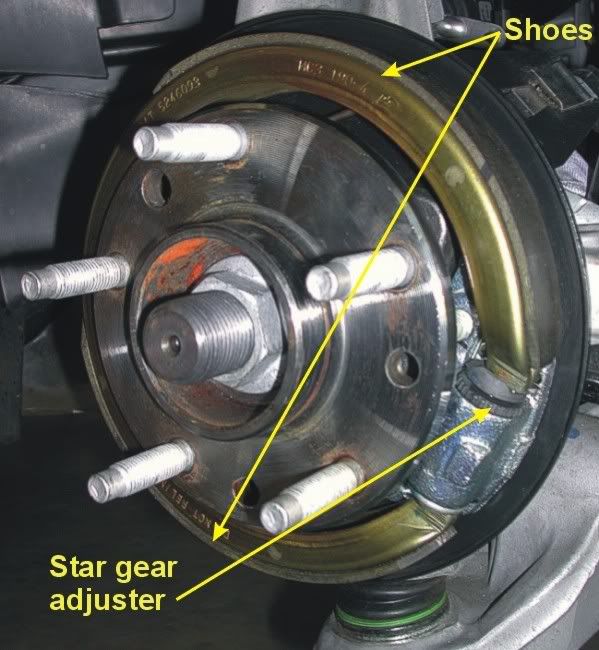
just pull off the rear rotors and adjust the little star nut so the shoes expand.

it's really not hard to do. and since i've done mine myself, i'm very confident that my parking brakes won't fail on me.
Team Owner


Joined: Aug 2002
Posts: 35,617
Likes: 167
Tech Contributor
Cruise-In 11 Veteran
NCM Ambassador
St. Jude Donor '05-'06-'07-'10
When you park your car in gear you are relying on the compression of the engine and the resistance of the transmission to hold it in place. You really should always use a parking brake as an added measure. You will not warp your rotor. The parking brake system uses brake pads pressing against the inside of the "hat" of the rotor as pictured below (photo credit to Patches)

Instructor

Joined: Nov 2007
Posts: 138
Likes: 1
From: N.E. Atlanta Ga.
Here is what you should remember, for a manual transmission car always put it in the lowest gear in the direction it will want to roll. If you park it facing down hill you put it in first. If you park it up hill you put it in reverse. The reason it rolled was because it never built compression because the engine rotated backwards. It is really bad on an engine to rotate backwards. The bearings get used to the crank and cam rotating one way. When it is rotated the other way it can sometimes roll a bur and gouge the bearings. Also the oil pump will suck the oil out of the lifters. Then when you crank it they will float the valves until they pump back up. If you rev it before they pump up the piston can hit a valve. Oh and as it says above you will not warp a rotor if you use the emergency brake so use it whenever you park on any slope.
Last edited by Jeff_in_Atl; Dec 30, 2007 at 09:57 AM.

Drifting

Joined: Oct 2004
Posts: 1,664
Likes: 0
From: Sonoran Desert of Arizona
Maybe I am more **** or stupid than most.
My dad taught me to always engage the parking brake BEFORE putting the auto trans in park when parking on anything other than level.
His thought is that way the brake is holding the load and not the pawl.
I do know that by doing it his way I have never experienced the pull the Shift lever hard and hear a bang when taking it out of park like I have when with friends.
My dad taught me to always engage the parking brake BEFORE putting the auto trans in park when parking on anything other than level.
His thought is that way the brake is holding the load and not the pawl.
I do know that by doing it his way I have never experienced the pull the Shift lever hard and hear a bang when taking it out of park like I have when with friends.
Safety Car


Joined: Jan 2001
Posts: 4,386
Likes: 689
From: Boise ID
Maybe I am more **** or stupid than most.
My dad taught me to always engage the parking brake BEFORE putting the auto trans in park when parking on anything other than level.
His thought is that way the brake is holding the load and not the pawl.
I do know that by doing it his way I have never experienced the pull the Shift lever hard and hear a bang when taking it out of park like I have when with friends.
My dad taught me to always engage the parking brake BEFORE putting the auto trans in park when parking on anything other than level.
His thought is that way the brake is holding the load and not the pawl.
I do know that by doing it his way I have never experienced the pull the Shift lever hard and hear a bang when taking it out of park like I have when with friends.
Torque Lock (Automatic Transmission)
If you are parking on a hill and you don’t shift your
transmission into PARK (P) properly, the weight of the
vehicle may put too much force on the parking pawl in
the transmission. You may find it difficult to pull the
shift lever out of PARK (P). This is called “torque lock.”
To prevent torque lock, set the parking brake and then
shift into PARK (P) properly before you leave the
driver’s seat. To find out how, see “Shifting Into
PARK (P)” in the Index.
When you are ready to drive, move the shift lever out
of PARK (P) before you release the parking brake.
If torque lock does occur, you may need to have another
vehicle push yours a little uphill to take some of the
pressure from the parking pawl in the transmission,
so you can pull the shift lever out of PARK (P).
Parking Your Vehicle
(Manual Transmission)Before you get out of your vehicle, put your manual
transmission in REVERSE (R) and firmly apply the
parking brake.
Corvette Stories
The Best of Corvette for Corvette Enthusiasts

10 Reasons the C6 Z06 is Still A Performance Benchmark After 20 Years
Joe Kucinski
How Much Horsepower Every Corvette Engine "LOST" in 1972
Joe Kucinski
Top 10 DOs and DON'Ts for Protecting Your Convertible Top!
Michael S. Palmer
Top 10 Most Explosive Corvettes Ever Made: Power-to-Weight Ratio Ranked!
Joe Kucinski
150 hp to 1,250 hp: Every Corvette Generation Compared by the Specs That Matter
Joe Kucinski
8 Coolest Corvette Pace Cars (and Replicas) of All Time
Verdad Gallardo
Top 10 Corvette Engines RANKED by Peak Torque (70+ Years of Muscle!)
Joe Kucinski
Corvette ZR1X Will Be Pacing the Indy 500, And Could Probably Race, Too!
Verdad Gallardo
Top 10 Corvettes Coming to Mecum Indy 2026!
Brett Foote
Safety Car

Joined: Jul 2007
Posts: 4,333
Likes: 6
From: Louisville Kentucky
Yep, from the manual:
Torque Lock (Automatic Transmission)
If you are parking on a hill and you don’t shift your
transmission into PARK (P) properly, the weight of the
vehicle may put too much force on the parking pawl in
the transmission. You may find it difficult to pull the
shift lever out of PARK (P). This is called “torque lock.”
To prevent torque lock, set the parking brake and then
shift into PARK (P) properly before you leave the
driver’s seat. To find out how, see “Shifting Into
PARK (P)” in the Index.
When you are ready to drive, move the shift lever out
of PARK (P) before you release the parking brake.
If torque lock does occur, you may need to have another
vehicle push yours a little uphill to take some of the
pressure from the parking pawl in the transmission,
so you can pull the shift lever out of PARK (P).
Parking Your Vehicle
(Manual Transmission)Before you get out of your vehicle, put your manual
transmission in REVERSE (R) and firmly apply the
parking brake.
Torque Lock (Automatic Transmission)
If you are parking on a hill and you don’t shift your
transmission into PARK (P) properly, the weight of the
vehicle may put too much force on the parking pawl in
the transmission. You may find it difficult to pull the
shift lever out of PARK (P). This is called “torque lock.”
To prevent torque lock, set the parking brake and then
shift into PARK (P) properly before you leave the
driver’s seat. To find out how, see “Shifting Into
PARK (P)” in the Index.
When you are ready to drive, move the shift lever out
of PARK (P) before you release the parking brake.
If torque lock does occur, you may need to have another
vehicle push yours a little uphill to take some of the
pressure from the parking pawl in the transmission,
so you can pull the shift lever out of PARK (P).
Parking Your Vehicle
(Manual Transmission)Before you get out of your vehicle, put your manual
transmission in REVERSE (R) and firmly apply the
parking brake.

Instructor
Joined: Nov 2007
Posts: 138
Likes: 1
From: N.E. Atlanta Ga.
While that may work most of the time it will not work all of the time. Been there done that. My car rolled about 100 feet down a steep driveway out in the middle of Houston Mill road near Emory. Luckily it was about 2 am in the morning when it happened. I didn't know it until a car honked their horn and I looked out the window. It took about 5 minutes for the lifters to quit making noise. My post above is the correct way to park a manual car.
Race Director

Joined: Oct 2006
Posts: 13,404
Likes: 55
From: Glastonbury CT.
St. Jude Donor '11-'12-'13-'14-'15-'16-'17,'20, '21,'22, '23
I read someplace you can adjust your parking brake if you roll backwards down a long hill; don't remember if it manual gearshift should be in neutral or in reverse.
777
777
Race Director


Joined: Aug 2003
Posts: 16,270
Likes: 30
From: "It's 106 miles to Chicago, we've got a full tank of gas, half a pack of cigarettes, it's dark, and
St. Jude Donor '03-'04-'05-'06-'07-'08-'09-'10-'11-'12-'13-'14-'15-'16-'17-‘18-'19
NCM Sinkhole Donor
Parking brake doesn't use the caliper on the wheels. There is a small drum brake for this purpose. If it is not effective, and many of them are way out of adjustment....adjust it!http://forums.corvetteforum.com/show...6&postcount=17
Instructor

Joined: Jan 2007
Posts: 116
Likes: 0
From: Howell Michigan
Had always parked mine in 1st.. Parking brake has not worked since I bought the car.
A year or 2 ago I was parked on small incline. Another Vette 4 feet behind me.
We walked around 20 minutes and returned to find my Vette resting against the front bumper of 2nd Vette!
Still strongly in 1st gear.
Thats when I read that you are supposed to park it in Reverse.
Stopped at a relative's house to leave the Vette overnight while we drove on up in the SUV with the familiy for a holiday.
While I was sitting in the Vette, engine off, 1st Gear, VERY STEEP driveway incline, I noticed the Vette inching back. Almost like teeth on a flywheel.. 1 tooth at a time.. click, click, click, click...
Placed it in Reverse and it stopped. (of course being gone overnight, I lowered it to the base of the driveway and parked there - level)
A year or 2 ago I was parked on small incline. Another Vette 4 feet behind me.
We walked around 20 minutes and returned to find my Vette resting against the front bumper of 2nd Vette!
Still strongly in 1st gear.
Thats when I read that you are supposed to park it in Reverse.
Stopped at a relative's house to leave the Vette overnight while we drove on up in the SUV with the familiy for a holiday.
While I was sitting in the Vette, engine off, 1st Gear, VERY STEEP driveway incline, I noticed the Vette inching back. Almost like teeth on a flywheel.. 1 tooth at a time.. click, click, click, click...
Placed it in Reverse and it stopped. (of course being gone overnight, I lowered it to the base of the driveway and parked there - level)
Mine works great now. In reverse with parking brake on.

Safety Car
Joined: Mar 2006
Posts: 4,554
Likes: 35
From: Godfrey IL
While that may work most of the time it will not work all of the time. Been there done that. My car rolled about 100 feet down a steep driveway out in the middle of Houston Mill road near Emory. Luckily it was about 2 am in the morning when it happened. I didn't know it until a car honked their horn and I looked out the window. It took about 5 minutes for the lifters to quit making noise. My post above is the correct way to park a manual car.

Burning Brakes

Joined: May 2004
Posts: 850
Likes: 2
